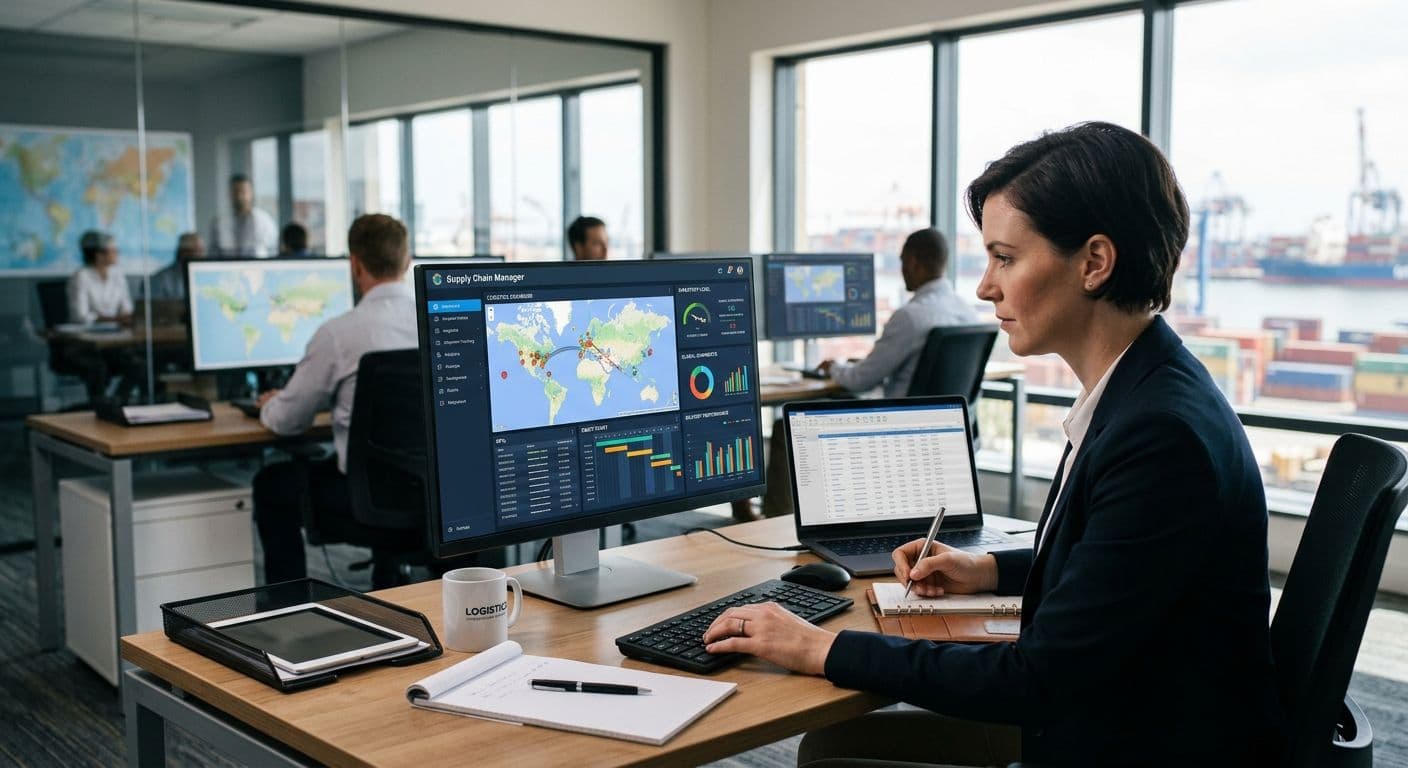
Supply chain manager software wins for most Amazon FBA and Shopify sellers in 2026.
Why?
Because it costs a fraction of a full-time salary, runs invoice and purchase order work automatically, and scales with order volume without adding headcount.
Hire a dedicated supply chain manager only once your supplier count and shipment complexity have outgrown what one operator can track by hand.
TL;DR
Supply chain manager software beats hiring for most Shopify and Amazon FBA sellers running under a few hundred active SKUs in 2026.
SupplyAutomate's supply chain manager software processes invoices and POs with AI, replacing hours of manual data entry.
Median pay for logisticians runs $80,000 to $90,000 a year before benefits, per U.S. Bureau of Labor Statistics data.
Loaded cost of a full-time hire typically runs 1.25 to 1.4 times base salary once payroll tax and benefits are added.
A dedicated hire earns its keep once you're negotiating face-to-face with 10 or more active suppliers.
Every operator running invoices through a spreadsheet eventually hits the same wall: SKU count climbs, supplier count climbs, and landed cost math gets wrong often enough to hurt margin.
The instinct is to hire.
The math usually says otherwise.
SupplyAutomate built its supply chain manager software specifically for that gap: the point where spreadsheets break but an $80,000-plus salary line isn't justified yet.
If you're wondering whether your store has even hit that wall, is ERP software overkill for a small Shopify store walks through the actual thresholds.
The decision isn't hire versus software in the abstract.
It's what your order volume, supplier count, and internal bandwidth can actually support in 2026.
Hire A Supply Chain Manager Or Use Software? Quick Comparison
| Factor | Full-time supply chain manager | Supply chain manager software | Outsourced supply chain manager |
|---|---|---|---|
| Best for | High supplier count, in-house negotiation, complex freight | Sellers automating invoices, POs, and landed cost math | Growing brands that want strategy without a full department |
| Ongoing cost | Salary plus benefits, loaded roughly 1.25-1.4x base | Software subscription, no payroll tax or benefits | Subscription plus an outsourced supply chain manager fee |
| Scales with SKU growth | Needs more hires as volume grows | Scales without adding headcount | Software scales; the outsourced team adjusts hours as needed |
| Verdict | Hire once one operator can't keep up | Buy first. Most sellers stop here | Consider it when ops need direction, not another employee |
Full-Time Supply Chain Manager: Cost And Scope
A supply chain manager is a real operational hire, not a data-entry role.
The job covers supplier negotiation, freight strategy, inventory planning, and cross-team coordination between purchasing and fulfillment.
Median pay for logisticians, the closest published occupational category, sits at $80,000 to $90,000 a year, according to U.S. Bureau of Labor Statistics wage data.
Add the loaded cost of benefits and payroll tax, typically 1.25 to 1.4 times base salary, and a single hire runs well past six figures in total cost before they've processed a single invoice.
That cost only makes sense when the workload justifies a dedicated 40-hour week: double-digit active suppliers, frequent freight renegotiation, and enough shipment volume that landed cost errors move real margin.
Verdict: hire once you're past that point.
Otherwise you're paying a full salary to do work software already automates.
Supply Chain Manager Software: Cost And Scope
Supply chain manager software handles the mechanical part of the job: reading invoices, matching purchase orders, calculating true landed cost per unit, and tracking supplier performance, without a salary attached.
SupplyAutomate's supply chain manager software processes invoices and POs with AI: upload the paperwork, and it extracts line items, freight, duties, and fees to produce a real per-unit landed cost instead of a guess based on unit price alone.
That's the exact function a junior supply chain hire would spend most of their week doing by hand.
For sellers issuing frequent purchase orders across multiple suppliers, best purchase order management software compares how different tools handle PO tracking specifically.
Verdict: buy.
Software covers the repetitive 80% of the job at a fraction of the cost of a hire, and it doesn't take vacation.
Outsourced Supply Chain Manager
Some sellers need more than automation but aren't ready to carry a full-time salary.
That is the gap an outsourced supply chain manager fills: a US-based team handling supplier relationships and the order path on top of the software doing the processing work.
SupplyAutomate offers exactly this pairing: AI supply chain software for invoice and PO processing, plus an outsourced supply chain manager for sellers who want supplier oversight without adding headcount.
The team places the PO, chases production, inspects before the goods ship, moves freight, and lands it at your 3PL.
The fee is a flat $989 a month, with no commission on the goods.
Goods, freight, duty, and inspection are billed at cost.
Takeover takes about two weeks.
You keep your suppliers.
The work runs inside SupplyAutomate, and you get a login so you can see the same account they work in.
It fits between first repeat orders and a first in-house hire.
Verdict: consider it if your team has outgrown spreadsheets but an $80,000-plus hire still doesn't pencil out against your current order volume.
Why The Right Choice Varies
Supplier Count
A handful of suppliers rarely justifies a full-time hire.
A dozen or more active suppliers with frequent renegotiation usually does.
Order Volume
Higher order volume means more invoices and POs to process, which is exactly what software automates first.
Team Bandwidth
If the founder or ops lead is already doing landed cost math manually, software removes that task before a hire would.
Freight And Customs Complexity
Sellers importing from multiple countries with varying duty rates need accurate landed cost calculation more than they need a negotiator.
Growth Stage
Early-stage sellers should buy software.
Sellers scaling past a few hundred SKUs with growing supplier lists should evaluate a hire or an outsourced supply chain manager.
Budget Structure
A software subscription is a predictable line item.
A salary adds payroll tax, benefits, and hiring risk.
Is Supply Chain Manager Software The Same As An ERP?
Supply chain manager software and ERP software overlap but aren't identical.
ERP systems typically span accounting, inventory, and order management in one platform, while supply chain manager software focuses specifically on suppliers, purchase orders, and landed cost.
Some sellers need the narrower tool.
Others eventually grow into a full ERP setup, which the guide on Shopify ERP setup and integration covers in more depth for stores connecting orders to supplier workflows.
Can Software Replace A Supply Chain Manager Entirely?
Software replaces the data processing and calculation work a supply chain manager does: invoice matching, PO tracking, and landed cost math.
It doesn't replace supplier negotiation, relationship management, or judgment calls during a shipment delay.
Sellers with a small supplier base rarely miss the human role.
Sellers negotiating pricing across a dozen factories usually still want a person in the loop.
What Does Supply Chain Manager Software Actually Do?
Supply chain manager software processes invoices and purchase orders, calculates true landed cost per unit including freight and duties, and tracks supplier performance over time.
It removes manual spreadsheet work rather than making strategic sourcing decisions on its own.
Those still need a human, whether that's the founder or a dedicated hire.
FAQ
Is Supply Chain Manager Software Worth It For A Small Shopify Store?
Supply chain manager software is worth it once a store is processing more invoices and POs than one person can track manually in a spreadsheet.
Below that volume, a simple tracker may still work, though landed cost accuracy usually suffers either way.
How Much Does A Supply Chain Manager Cost To Hire?
A supply chain manager costs roughly $80,000 to $90,000 a year in median base salary, per U.S. Bureau of Labor Statistics wage data, before benefits and payroll tax add another 1.25 to 1.4 times that figure.
What Is The Difference Between Supply Chain Software And An Outsourced Supply Chain Manager?
Supply chain software automates invoice, PO, and landed cost processing.
An outsourced supply chain manager adds a human team handling supplier relationships and strategy.
Many sellers use both together rather than choosing one.
Can Amazon FBA Sellers Use Supply Chain Manager Software?
Yes.
Amazon FBA sellers use supply chain manager software to calculate true landed cost per unit, which matters for FBA fee and margin math, and to track purchase orders across multiple suppliers.
Does Supply Chain Manager Software Replace An ERP?
Supply chain manager software covers suppliers, purchase orders, and landed cost specifically, while a full ERP spans accounting, inventory, and order management.
Some sellers use supply chain software instead of a full ERP.
Others use both.
When Should A Growing Brand Hire A Supply Chain Manager Instead Of Using Software?
A growing brand should hire a supply chain manager once supplier negotiation and freight strategy require dedicated attention beyond what software processing covers, typically once a team is managing 10 or more active supplier relationships.
Is Landed Cost Calculation Part Of Supply Chain Manager Software?
Yes.
Landed cost calculation is a core function of most supply chain manager software, since accurate per-unit cost including freight and duties drives pricing and margin decisions for importers.
Most sellers who hire a supply chain manager in 2026 end up buying software for them within the first quarter anyway.
The manual invoice and PO work is exactly what the hire complains about first.
Buying the software before the hire, not after, saves both the onboarding cost and the frustration.