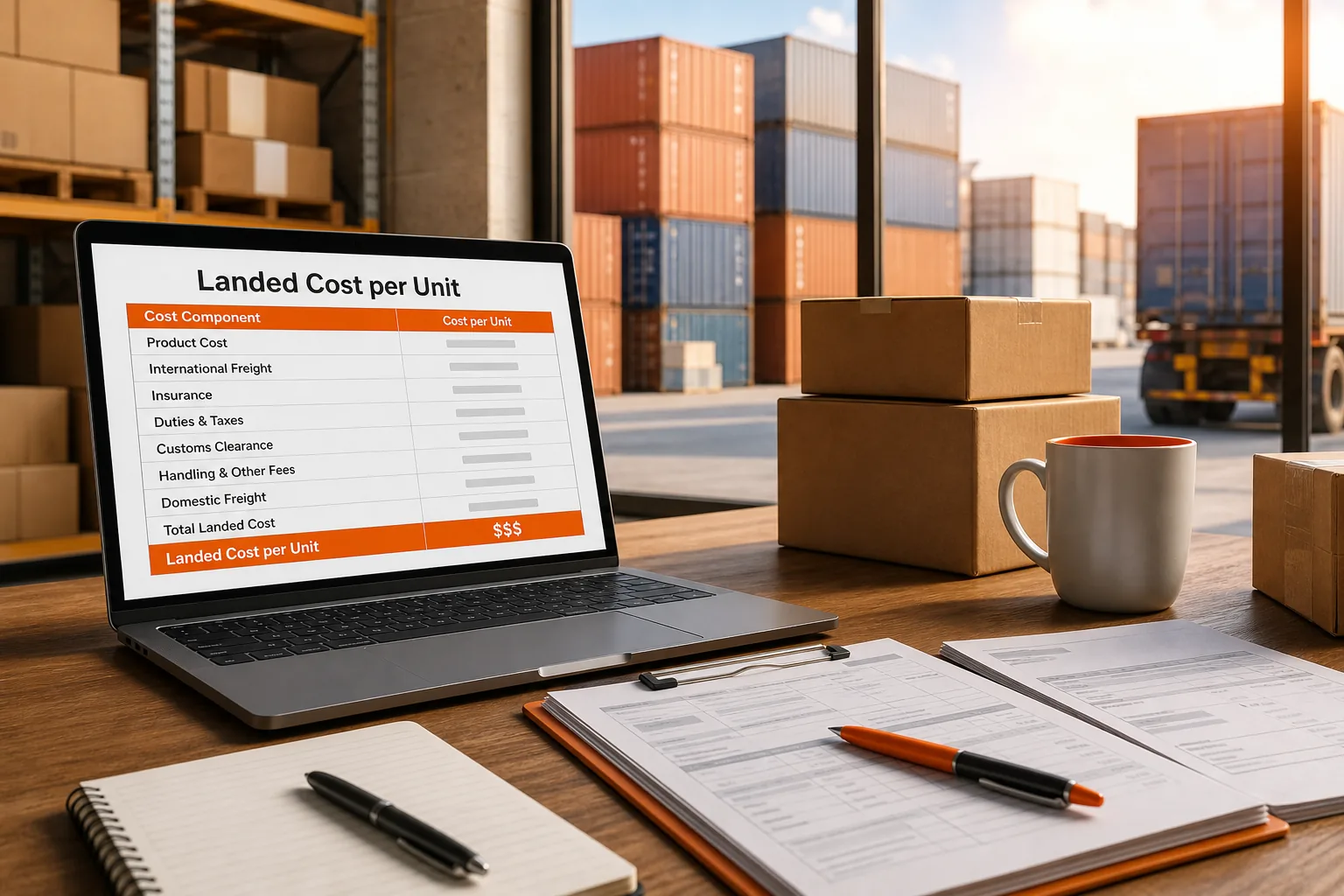
Landed cost per unit is one division.
Total inbound cost, divided by the units you can actually sell.
Not the PO quantity.
Not the factory quote.
The how-to is the method (that page uses a $10 invoice that lands at $14.10).
The formula is the identities (u = L ÷ n).
Stay here for the divisor and what you do with u: price, reorder, compare two factories.
What landed cost is is the definition.
Landed cost vs COGS is the accounting boundary.
Stay here for the unit math.
If The Number You Quote Is Still PO Quantity
You import finished goods for Amazon FBA, Shopify, or a warehouse.
You already add freight somewhere.
The number you still quote in Slack is last PO's unit price times quantity, or that total divided by what you ordered.
The algebra on a card is the formula page.
If the SKU is FBA and you need referral and pick/pack in the same view, that is a second column on Amazon FBA landed cost.
The Divisor Is The Whole Trick
Landed cost per unit = total landed cost ÷ sellable units received
Total landed cost is product + freight + duty and entry fees + insurance + brokerage + port + inland + the inbound overhead you can point at a bill.
What belongs is listed on the how-to.
n is sellable.
Damaged, held for inspection, missing from the packing list: they still ate cost.
Divide by the PO quantity and you hide them.
A shared charge needs a driver before it reaches a SKU.
Units when the SKUs are alike.
Weight or CBM when the carrier bills that way.
Customs value when the fee follows product value.
Allocating freight is the long table.
A flat split is easy.
It makes a bulky cheap item fund a dense expensive one.
Duty uses customs value × rate for that heading.
Customs value is not always the commercial invoice.
Confirm the basis.
U.S. entries also pick up CBP processing and, on ocean, harbor maintenance.
Include the bills.
Do not invent a "typical percent of landed cost."
Insurance: use the premium.
A planning rate is an estimate.
Label it.
Marketplace referral, FBA fulfillment, ads, and returns are selling costs.
Keep them next to u.
Do not pour them into inventory unless your accountant says otherwise.
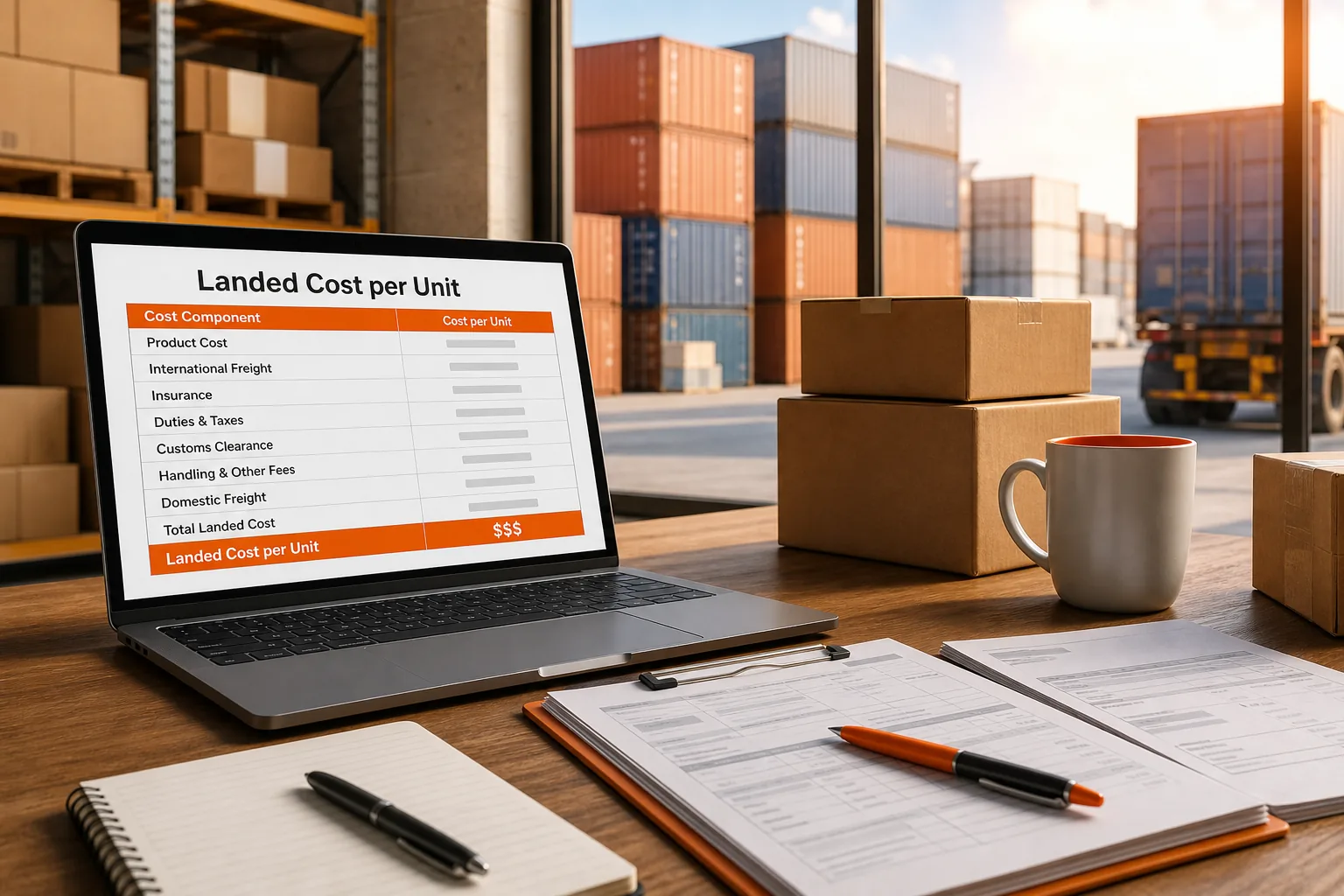
$8.50 On The PO Quantity, $9.06 On What Arrived
A Shopify + FBA seller reorders 2,000 units of a $6.40 factory SKU.
| Line | Amount |
|---|---|
| Factory invoice | $12,800 |
| Ocean freight (revised after booking) | $3,050, not the $2,200 in the sheet |
| Duty and brokerage | $1,140 |
| Trucking + FBA inbound prep | $860 |
| Sellable units received | 1,970 (30 units failed inspection) |
Sheet version, first freight quote, PO quantity:
- ($12,800 + $2,200 + $1,140 + $860) / 2,000 = $8.50
After the documents are in:
- ($12,800 + $3,050 + $1,140 + $860) / 1,970 = $9.06
Same shipment.
The only changes are a freight revision and a honest divisor.
Every unit is $0.56 light if they price or reorder off $8.50.
On a 2,000-unit cadence that is about $1,100 of missing cost.
If they had divided the final total by 2,000 they would have reported $8.93 and still been wrong.
The 30 missing units are why n is 1,970.
Run the same shipment through the landed cost calculator before you approve the next PO.
Keep estimated and actual in two columns.
Replace the estimate when the freight invoice and the entry arrive.
Do not delete the first number.
The gap is the forecast.
Price From $9.06, Not From $6.40
u is the inventory floor.
It is not the selling price.
Markup adds a percent to cost.
Margin is the share of price left after cost.
On $9.06:
- 40% markup: $9.06 × 1.40 = $12.68 before ads, referral, or outbound
- 40% gross margin on landed cost alone: $9.06 ÷ 0.60 = $15.10 before those same fees
Those two prices are not interchangeable.
Teams say "40%" and mean the first, then read a margin report that assumes the second.
Channel fees still sit on top.
A $29 promo on a unit that cost $9.06 inbound can look fat in Shopify until referral, fulfillment, and ads arrive.
The profit margin calculator uses landed cost as the unit cost.
That is the point.
Compare two factories on u at the same destination, same Incoterm boundary, same sellable count.
The cheaper invoice can lose after freight and duty.
Change one factor at a time.
For Shopify bundles built from different POs, each component keeps its own u.
Landed cost for a Shopify catalog is the storefront version.

Estimate, Actual, Variance
Track three numbers per SKU: estimated u, actual u, current selling price.
Flag when actual crosses the price model.
A freight miss points at the quote or a surcharge.
A duty miss points at classification or customs value.
A unit miss often points at shortages.
How to calculate landed cost for imported products is the policy version of that review.
A sheet holds one shipment.
Several POs, currencies, and late bills is spreadsheet vs software.
The templates give you columns.
SupplyAutomate keeps the invoice, freight bill, and PO on one record so $8.50 can become $9.06 without a new tab.
It will not classify a heading for you.
Ways the unit actually moves, without a slogan list: a fuller container spreads fixed fees; a smaller carton can change dimensional weight; air vs ocean is a lead-time trade, not a virtue.
Model the legs in the lead time calculator before you pay for speed you do not need.
FAQ
What Is Landed Cost Per Unit?
The total inbound cost of a shipment divided by sellable units received.
Supplier price plus freight, duty, insurance, brokerage, handling, and other bills that make the unit pickable.
Not later Amazon or Shopify selling fees.
What Is The Formula For Landed Cost Per Unit?
u = L ÷ n.
Add the inbound bills to get L.
Divide by sellable units, not the PO quantity.
If 30 of 2,000 fail, n is 1,970.
Does Landed Cost Per Unit Include Amazon FBA Fees?
Inbound landed cost usually ends when the unit is sellable in the fulfillment network.
Referral, storage, pick/pack, ads, and returns belong in the contribution view.
The FBA how-to keeps those columns apart.
How Should I Allocate Freight Across Multiple SKUs?
Use the driver that causes the bill: volume, weight, value, or units.
Write the driver next to the row.
A flat split is fast and often wrong for mixed cartons.
Should I Use Estimated Or Actual Landed Cost Per Unit?
Estimate to approve the PO and to price if the lot will sell before the last bill arrives.
Replace with actuals when the freight invoice and the entry land.
Keep both.
The variance is the lesson.
The divisor is sellable units, not the PO quantity.
If the last inbound assumed every carton arrived, the number in Shopify, Seller Central, or QuickBooks is already light.
The landed cost calculator will show the gap.
If the files never reach the PO, that is a record problem, not a formula problem.