
Shopify will not combine factory cost, freight, and duty on the variant for you.
A checkout duty widget, a FIFO COGS app, and a platform that wants the purchase order are different jobs.
A cart estimate is not the unit-cost record.
Use this as the tool map: inventory landed cost versus duty at checkout, where to look, and how to trial.
The formula and the $27 shipment live in how to calculate Shopify landed cost.
Stay here when you are choosing software, not learning the arithmetic.
What landed cost is is the definition.
Spreadsheet vs software is when the workbook is finished.
If The Shopify Cost Field Is Still The Factory Price
You sell on Shopify.
You import, or you are about to.
Variants matter.
You already suspect the $20 in the cost field is the factory price.
Skip an app install if you have one SKU, one lane, and a sheet you still trust.
The how-to is enough until freight starts arriving after you have sold through the lot.
If Amazon is the larger channel, read Amazon FBA supply chain software and keep one inbound unit cost.
Two Jobs People Mix Up
Inventory landed cost: what the unit cost to put into available stock.
Product, freight, duty, brokerage, inbound.
Lives on the shipment and the SKU.
That is what you reorder and price from.
Checkout duty and tax: what you show a shopper on an international order.
DDP versus DDU.
A widget.
A surprise bill on delivery.
Same rates, sometimes.
Not a substitute for the cost field.
Do the inventory job first.
Then decide what the customer sees.
What A Shopify Landed-Cost Tool Has To Do
A useful inventory tool estimates the inbound stack before the PO, then replaces the estimate when the bills arrive.
Allocation by a stated driver.
Late freight that does not rewrite orders already sold.
Documents you can open.
Checkout tools need origin, destination, and a heading.
They will not hold your container's freight bill.
Score a trial on your files, not the listing.
| Criterion | Weight | What "5" looks like | What "1" looks like |
|---|---|---|---|
| Inbound cost on the SKU | 30% | Freight and duty land on the variant | Only a checkout estimate |
| Documents on the order | 20% | Invoice and freight bill attach to the PO | Files in Drive |
| Late bills | 15% | Remaining stock adjusts; sold units stay | Rewrites history |
| Channel honesty | 15% | FBA or a second shop sits beside Shopify | Shopify-only, silent about Amazon |
| Books | 10% | A journal you can review | "Sync" with no allocation basis |
| Time to value | 10% | This month, on one shipment | A catalog import first |
I am not quoting app-store prices.
They move.
Check the current listing against order volume.
Where To Look, By The Job
Category judgments.
Not a ten-logo trophy list.
If a vendor will not run your mixed PO, treat the claim as unproven.
SupplyAutomate, If The Questions Are "What Moved?" And "What Did It Cost?"
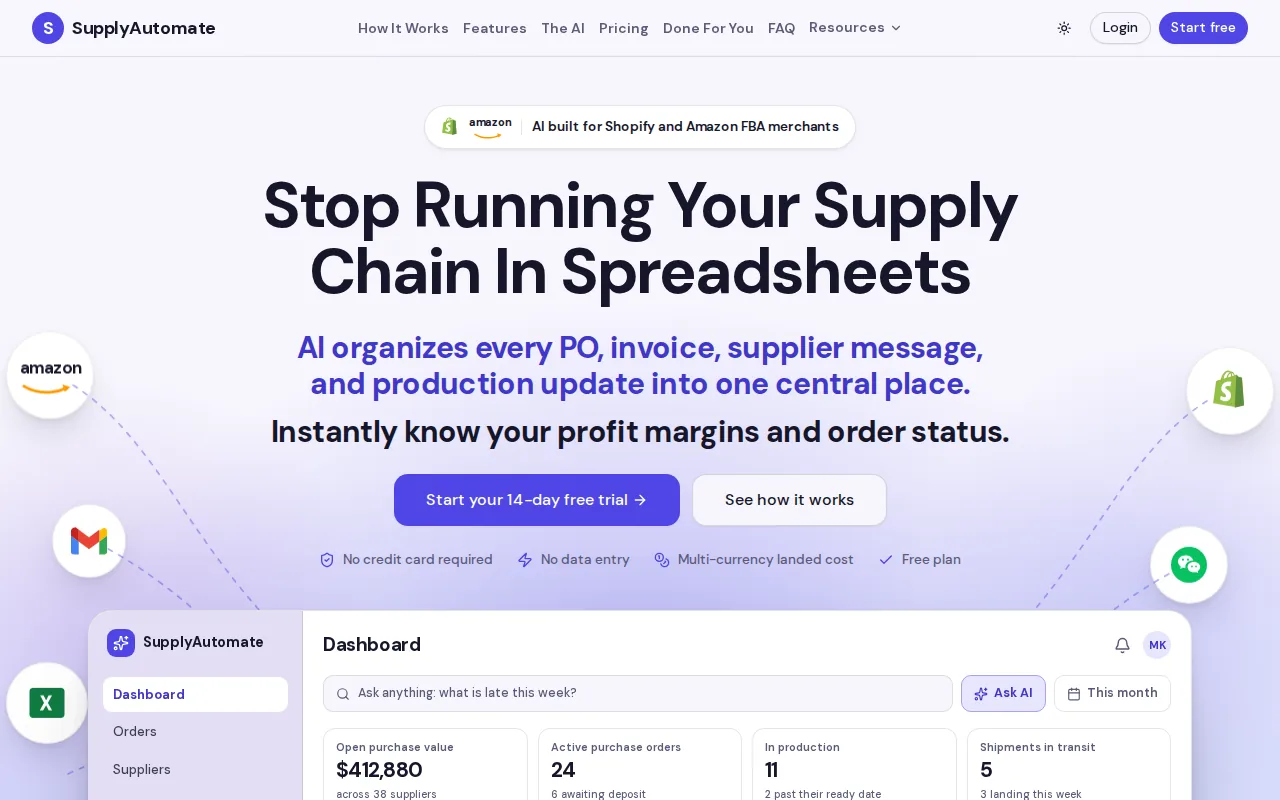
SupplyAutomate is for Shopify and Amazon FBA importers who want the PO, supplier documents, and landed cost in one workspace.
Upload the invoice, packing list, and freight bill.
Match them to the order.
See what the SKU cost after the revision.
It is not a checkout widget and not a stock-count app.
If you only need on-hand quantity, this is more than you need.
Start with one recent shipment.
The landed cost calculator is the planning pass.
Landara, When Shopify COGS And The Books Are The Fire
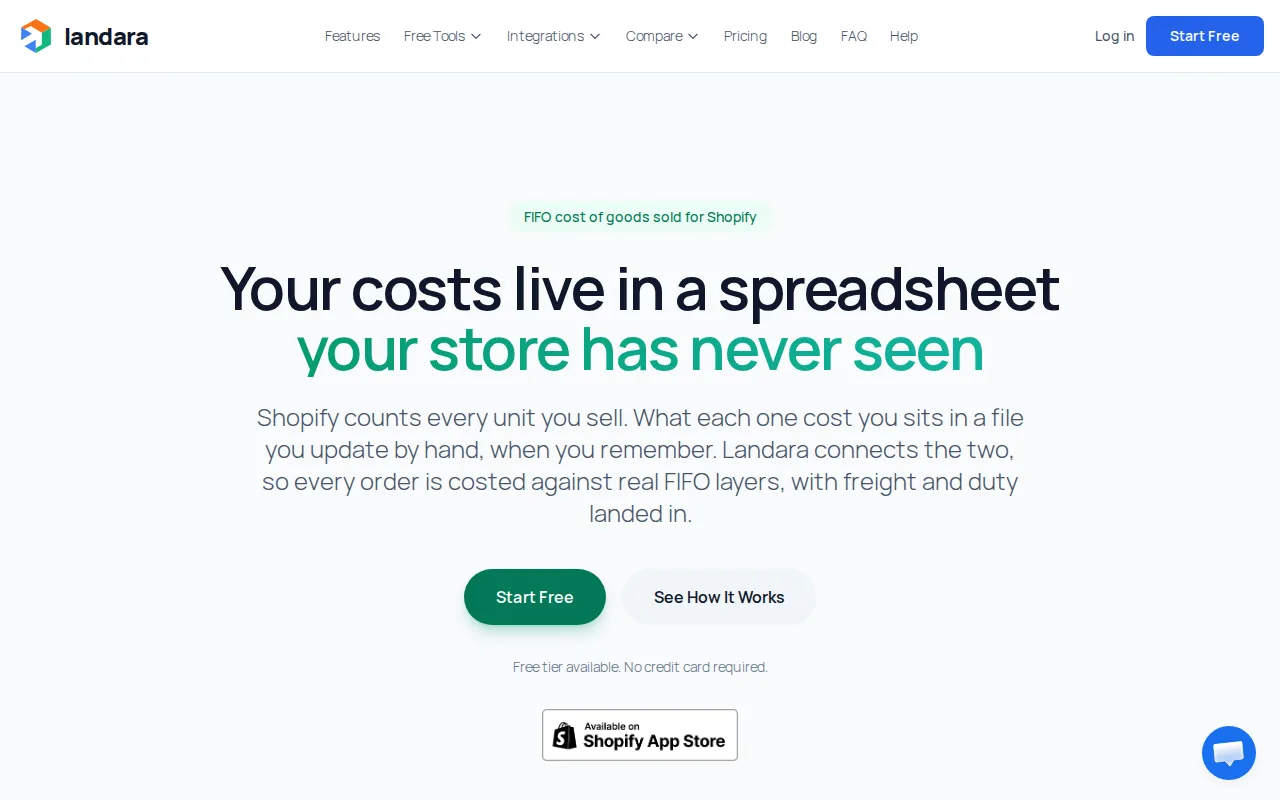
Landara is a Shopify app aimed at FIFO (or average) COGS and inbound landed cost.
Their listing says AI extracts freight, duty, and customs from an uploaded PO or freight invoice and allocates them per SKU, then prepares journals for Xero or QuickBooks Online.
Confirm the current extract and posting model (review-and-post versus auto-post) before you promise "sync."
Shopify-centered.
Xero and QuickBooks Online are the listed ledgers.
If Amazon FBA is a first-class channel, test the handoff.
A free tier appears on the App Store listing; check today's limits.
Landara is the finance-layer pick.
It is not a substitute for a messy factory record across two marketplaces.
Landed cost vs COGS is why that journal matters.
QuickBooks is the books walkthrough if you post yourself.
Inventory Platforms (Sumtracker And Peers) When Channels Disagree
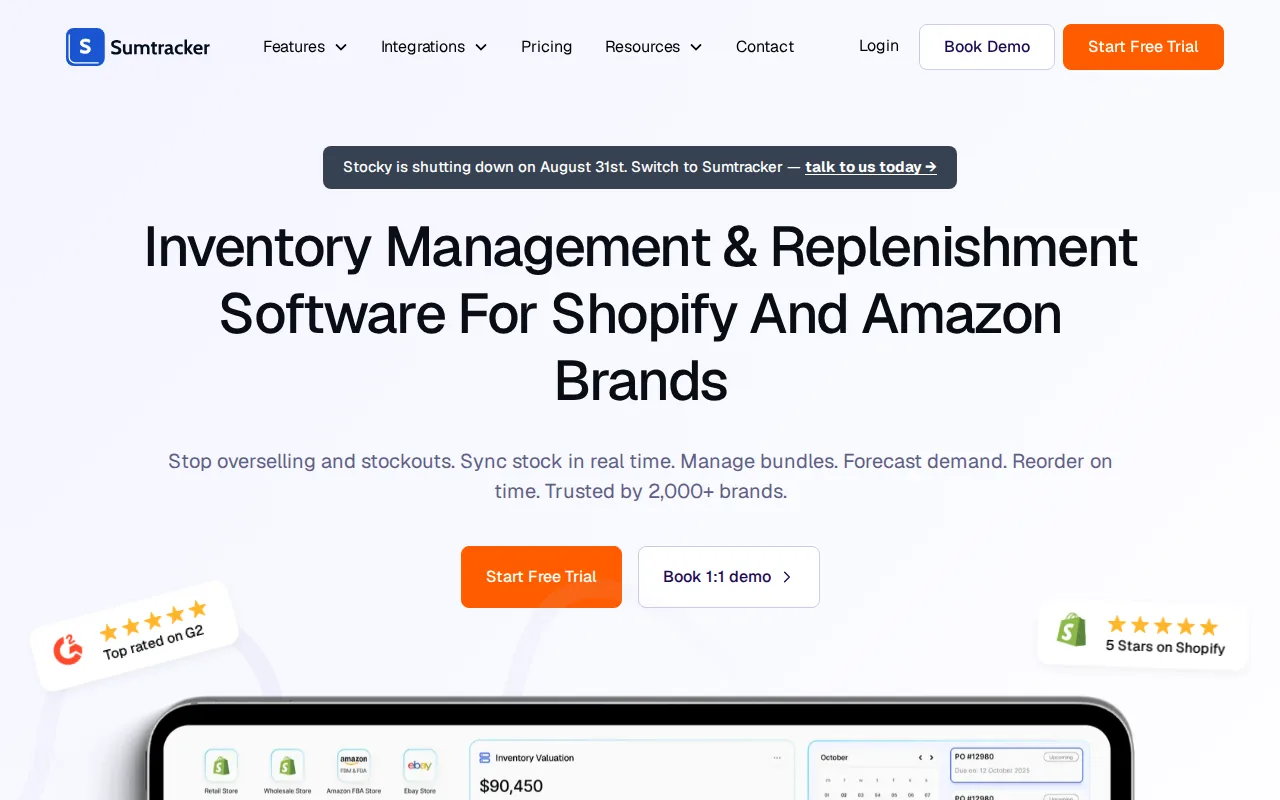
Sumtracker is sold as multi-channel inventory: Shopify, POS, Amazon FBA/FBM, and other marketplaces appear in their marketing.
Bundles, stocktakes, POs.
Useful when a sale on one channel consumes stock promised on another.
Confirm how deep landed cost goes with your freight bill, not the feature list.
If the pain is invoice extraction and a dual-channel unit cost, look at SupplyAutomate.
Sumtracker is the trial when a sale on one channel is consuming stock promised on another and the pain is oversell, not invoice cost.
Native Receiving And Variant Cost
Shopify stores cost on the variant.
The supplier invoice is usually a shipment.
Receiving tools that allocate a transfer or PO onto variants are solving that mismatch.
Freight may fit value; a carton fee may fit units.
A late duty bill should adjust remaining stock, not rewrite sold orders.
Use this category when the cost field inside Shopify is the break.
For documents across factories and FBA, look upstream.
Checkout Duty And Tax Apps (DDP / DDU)
These estimate what the shopper pays.
HS code and origin on the SKU.
DDP collects or pays import charges before delivery.
DDU leaves them for the door.
The Shopify how-to is the customer-experience version.
They will not fix a $20 cost field that should have been $27.
Confirm countries, carriers, and plan limits.
Mixed carts and EU tariff lines behave differently from a single SKU.
Scenario And Freight Estimators
Before you buy a platform, run expected / high-freight / high-duty cases.
The freight cost estimator is enough for an early air-versus-sea split.
Alerts only help if they stop a PO.
Supplier-verification tools are a different job.
They do not allocate a freight bill.
Do not install one expecting landed cost.
A One-Shipment Trial
Do not use the vendor's sample order.
Take one mixed PO: two SKUs, the commercial invoice, the freight bill, the duty or broker bill.
Enter it as it was placed.
Attach the files.
Correct the extract.
Produce a unit cost and compare it to the Shopify cost field and to the $27 in the how-to.
It passes if a second person can rebuild the number, late freight does not smash sold orders, and you know whether you bought inventory cost or a checkout widget.
It fails if you still need the sheet to trust the figure, or the only output is a duty estimate on the cart.
FAQ
What Is Landed Cost In Shopify?
The inbound cost of getting inventory ready to sell: supplier price plus freight, duty, tax that is a true cost, customs, receiving.
Platform and fulfillment fees usually sit in a second margin view.
How Do You Calculate It?
Product + inbound charges, divided by sellable units received.
Document the allocation rule.
The how-to is the method.
Stay here for the tool shortlist.
Does Shopify Calculate Landed Cost Automatically?
No.
Shopify may help collect duty at checkout if you set it up.
Inbound unit cost is still your process: a sheet, an app, or a PO system.
What Is The Difference Between DDP And DDU?
DDP: import charges handled before delivery; the cart is clearer.
DDU: the buyer may pay on arrival.
Neither one sets inventory cost.
Which Tool Is Best For Amazon FBA And Shopify?
For documents and unit cost across both, SupplyAutomate is the trial I would run first.
For Shopify-only FIFO COGS into Xero or QuickBooks, start with Landara.
For stock sync across marketplaces, an inventory platform.
Buy the handoff that fails.
Shopify can hold a cost field, run a COGS app, or collect duty at checkout.
Those are three jobs.
Build the inventory number from the bills first, then decide which of the three you actually need.
The landed cost calculator is the rebuild.
When the files are already hard to find, SupplyAutomate keeps them on the PO.