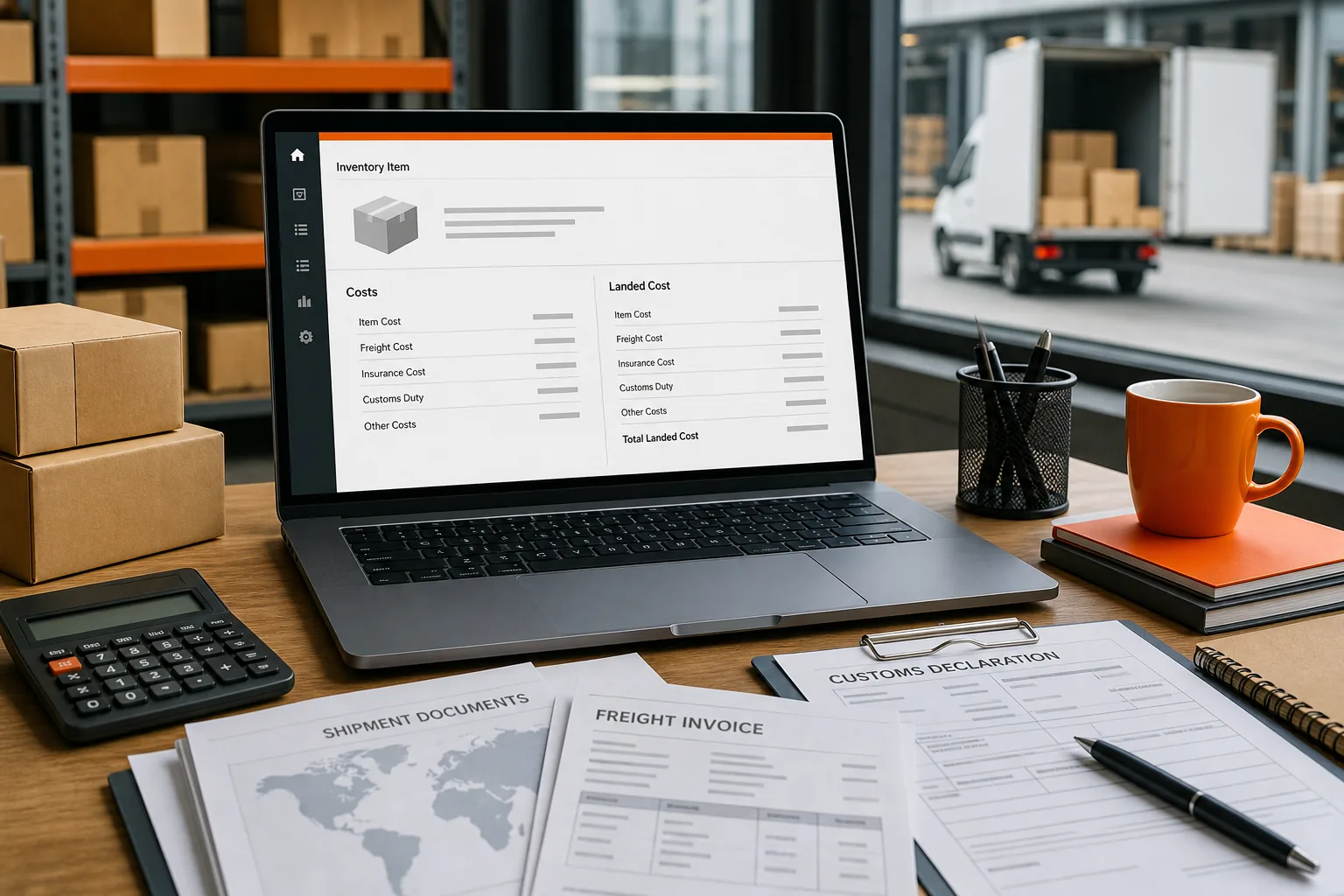
QuickBooks will not invent landed cost from a supplier invoice.
Freight, duty, brokerage, and trucking sit on other bills, often weeks later, from other vendors.
If those charges go to expense, inventory stays cheap and the margin report lies.
Landed cost in QuickBooks is a posting problem: hold the extra charges in a clearing account, allocate them onto the SKUs they moved, then prove the leftover is zero.
The screens differ by edition.
The math does not.
Use this the week you have a mixed shipment, a freight bill, and a duty receipt, and someone is about to expense the freight because that is faster.
The inbound formula is the arithmetic.
Stay here for how it hits the books.
If Inventory Lives In QuickBooks And Freight Does Not
You import finished goods for Amazon FBA, Shopify, or WooCommerce.
Inventory lives in QuickBooks.
The POs repeat.
You already know the factory invoice is not COGS.
Skip a software project if you post two import bills a quarter and one person still has the worksheet.
The clearing-account method below is enough until the allocator starts spreading a wrong number.
If you need the allocation rule itself (weight, volume, value), use how to allocate freight across SKUs.
Stay here when the question is "which QuickBooks account, which bill, which button."
Pick The Edition And The Clearing Account First
Desktop's native allocator lives under Advanced Inventory.
Intuit's setup article ties that to Enterprise Platinum or Diamond with Advanced Inventory enabled (and an internet connection; confirm the current plan page before you buy a tier for this screen).
Open Edit, Preferences, Items and Inventory, Company Preferences.
Open Advanced Inventory Settings, then the Landed Cost tab.
Turn it on and name the clearing account.
QuickBooks Online is not the same screen.
Some Online setups have import or tariff tools.
Many sellers still gather charges in a holding account and allocate by hand or through a connected inventory app.
Check the subscription you actually have before you promise a one-click allocate.
The clearing account is an Other Current Asset.
It holds freight and duty until you assign them to inventory.
After a clean allocation the balance for that shipment is zero.
A leftover means a bill was missed, duplicated, or posted to the wrong PO.
Then create Other Charge items for the costs you actually get:
- Freight / ocean / air
- Duty or tariff
- Cargo insurance
- Brokerage, port, or handling
- Inland trucking or FBA inbound
Map each item to the clearing account.
Desktop may demand a sales account before it saves the item, even if you never sell "freight."
Use a dummy income account and never invoice it.
Online users without the allocator need the same holding account and a naming habit.
Put the PO or shipment ID in every bill memo.
When you open the register later, one shipment should sort together.
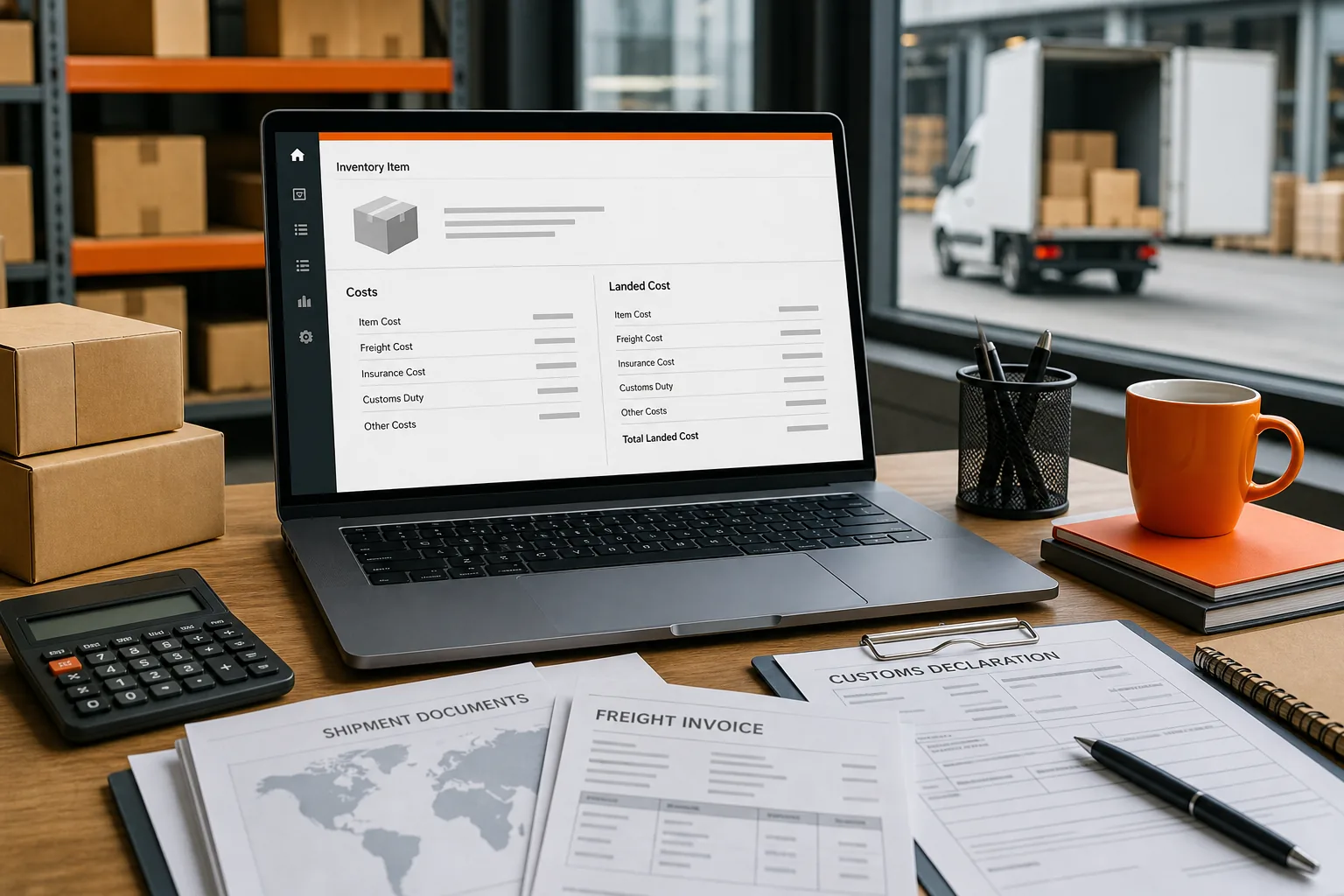
Do not post the first freight bill until the items and the clearing account exist.
Fixing the chart of accounts after six bills is how the leftover never clears.
Post The Inventory Bill, Then The Extra Bills
Record the supplier invoice as inventory at the factory value.
Separate lines for separate SKUs.
Quantity, rate, and date have to match the item you will receive.
A blended "mixed goods" line makes the later allocate guess.
Enter each outside charge as its own bill, against the mapped Other Charge item, not as an expense.
The freight carrier gets freight.
The broker or CBP payment gets duty.
The trucker gets trucking.
Those amounts sit in clearing until you allocate.
The freight invoice often arrives after the goods.
That is fine.
The memo still needs the same PO.
Organizing supplier invoices is the filing version of this.
During a margin review the question is not "did we pay freight?"
It is "which inventory did this $1,860 belong to?"
Run the clearing-account detail before you allocate.
Look for a second copy of the same bill, a credit you ignored, or a charge tagged to last month's container.
An allocator will spread a bad total very efficiently.
Check the per-unit math outside QuickBooks first.
The landed cost per unit formula and the landed cost calculator should agree with the bills in clearing.
If they do not, stop.
Do not let Desktop "Calculate Landed Cost" spread a typo.
Allocate The Pool: Desktop, Online, And A Worked Shipment
Allocation moves the clearing balance onto inventory.
You pick the items and a basis.
Quantity, value, percentage, or a manual amount.
Use the basis that matches how the charge arose.
One rule for every line is how a bulky cheap SKU subsidizes a dense expensive one.
QuickBooks Desktop Enterprise
Intuit's current path is Inventory, Calculate Landed Cost: add the inventory bill, add the shipping and handling bills, then split by quantity, amount, percentage, or shipping-and-handling cost and post.
Some files still expose Calculate Landed Cost on the inventory bill itself.
Use the screen you have.
Find the unallocated freight, duty, and trucking bills for that shipment.
If one freight invoice covers two containers, enter only this container's share.
The calculate article is the official walkthrough.
Quantity is fair when units are similar.
Value is fair for duty and insurance.
Manual is what you use when the carrier invoice already splits by carton or weight.
Review the new unit costs before you save.
If QuickBooks offers to update sales prices, say no unless your pricing policy is a cost markup you have already approved outside the books.
QuickBooks Online
Without a Desktop-style window, compute the add-on per line in a sheet.
Raise the inventory-bill rates by those amounts.
Add an offsetting negative line so the bill still equals what you owe the supplier.
Check both totals.
This is easy to get wrong.
A third-party allocator can do the arithmetic.
Treat it as a control point.
Read the source bills and the posted unit costs before you close the period.
Worked Allocation: $8,400 Of Product, $3,040 Of Extras
PO-1842.
Two SKUs on one ocean shipment.
| SKU | Units | Factory unit | Line value |
|---|---|---|---|
| A: 750 ml bottle | 1,000 | $4.80 | $4,800 |
| B: gift set | 200 | $18.00 | $3,600 |
| Product | 1,200 | $8,400 |
Bills in the clearing account, same PO memo:
| Bill | Amount | Basis |
|---|---|---|
| Ocean freight | $1,860 | Quantity (similar carton labor; units are close enough) |
| Inland trucking | $328 | Quantity |
| Duty (8% of $8,400) | $672 | Value |
| Brokerage | $180 | Value |
| Pool | $3,040 |
Freight + trucking = $2,188.
Split by units (1,200):
- A: 1,000 / 1,200 × $2,188 = $1,823.33 → $1.82 per unit
- B: 200 / 1,200 × $2,188 = $364.67 → $1.82 per unit
Duty + brokerage = $852.
Split by factory value ($8,400):
- A: $4,800 / $8,400 × $852 = $486.86 → $0.49 per unit
- B: $3,600 / $8,400 × $852 = $365.14 → $1.83 per unit
Posted landed cost:
| SKU | Factory | Freight/truck | Duty/broker | Landed |
|---|---|---|---|---|
| A | $4.80 | $1.82 | $0.49 | $7.11 |
| B | $18.00 | $1.82 | $1.83 | $21.65 |
If you dumped the whole $3,040 across 1,200 units, each SKU would pick up $2.53.
A would show $7.33.
B would show $20.53.
B is then $1.12 light on the value-based charges.
Price B off that number and the gift set funds the bottles.
Keep the worksheet with the bill.
Landed cost vs COGS is why the allocation matters after the units sell: the higher inventory cost becomes COGS.
A late duty bill does not get quietly attached to a different receipt.
Post a new allocation with a memo that names the entry.
Check Valuation, COGS, And The Leftover Balance
After posting, open inventory valuation by item.
The unit-cost change should match what you allocated, subject to your costing method and any units already sold.
Then open the clearing account.
This shipment's lines should net to zero.
A leftover is allowed only if another shipment is still waiting.
Otherwise you have a duplicate, a miss, or an unposted credit.
Check margin by SKU next.
A bottle that looked fine at $4.80 can look thin at $7.11 once Amazon storage or a Shopify promo sits on top.
Do not judge from one report.
If the period is open, correct the source bill and reallocate.
If it is closed, use an approved adjustment with a memo that shows the old amount.
Deleting a posted allocation to clean a report breaks the trail your tax preparer will ask for.

SupplyAutomate is not a QuickBooks replacement.
It holds the shipment documents and the operating cost so you can compare $7.11 to the entry before you post.
Amazon FBA sellers should still keep marketplace fees out of this inventory figure unless the accountant says otherwise.
The Amazon FBA duties and returns page is that split.
Shopify sellers can read the Shopify landed cost tools next to the same QuickBooks plan.
When the workbook is the allocator, spreadsheet vs software is the point where the file stops being worth maintaining.
When QuickBooks Is Enough
A handful of POs, one currency, freight bills that show up in the same month: the clearing account and a sheet will hold.
It starts to fail when several people post bills, duty arrives after you have already sold through the lot, or FBA and Shopify each need a unit cost that finance will accept.
Paying for a higher QuickBooks tier, or an integration, is an operations choice.
Compare it with the hours spent matching invoices.
Do not invent a payback from a vendor price you have not been quoted.
Confirm any connected tool's current sync before you promise "automatic."
The posting still has to match the bills.
FAQ
What Is Landed Cost In QuickBooks?
The full cost of getting inventory ready to sell, posted onto the items.
Supplier price plus freight, duty, insurance, and eligible handling.
Those charges sit in a clearing account until you allocate them, so valuation and later COGS follow the shipment instead of the factory invoice.
Does QuickBooks Online Have A Landed Cost Feature?
Sometimes, depending on plan and feature access.
Many Online users still use a holding account and a worksheet, or a connected allocator.
Check the company file you have.
Do not assume the Desktop Calculate Landed Cost window will appear.
Which QuickBooks Version Supports Landed Cost?
Desktop's native feature is tied to higher-tier Enterprise with Advanced Inventory.
Online has separate import and tariff tools that are not the same workflow.
Simple Start and a basic Online file usually mean manual allocation or an add-on.
How Should I Allocate Freight And Duty To Inventory?
Use the basis that matches the charge.
Quantity for similar units.
Value for duty and insurance.
Weight or volume when the carrier invoice is built that way.
Enter those as manual amounts if Desktop cannot see weight.
Write the method on the bill.
The $3,040 example above is the shape: two bases, one shipment.
What Happens To Profit After Landed Cost Is Posted?
Unsold units get a higher inventory cost.
When they sell, that cost hits COGS and reported gross profit falls.
A supplier-only report will look better.
It is also wrong.
Can I Remove A Landed-Cost Allocation?
Correct it.
Open period: edit or reverse the source and repost.
Closed period: an approved adjustment with a memo.
Keep the original amount visible.
The leftover bouncing in QuickBooks is usually a memo problem, not a reason to expense freight.
Rebuild the $7.11 / $21.65 style table from the bills, then post that allocation.
The landed cost calculator is the check.
If the documents are already hard to find, SupplyAutomate can sit in front of the books.