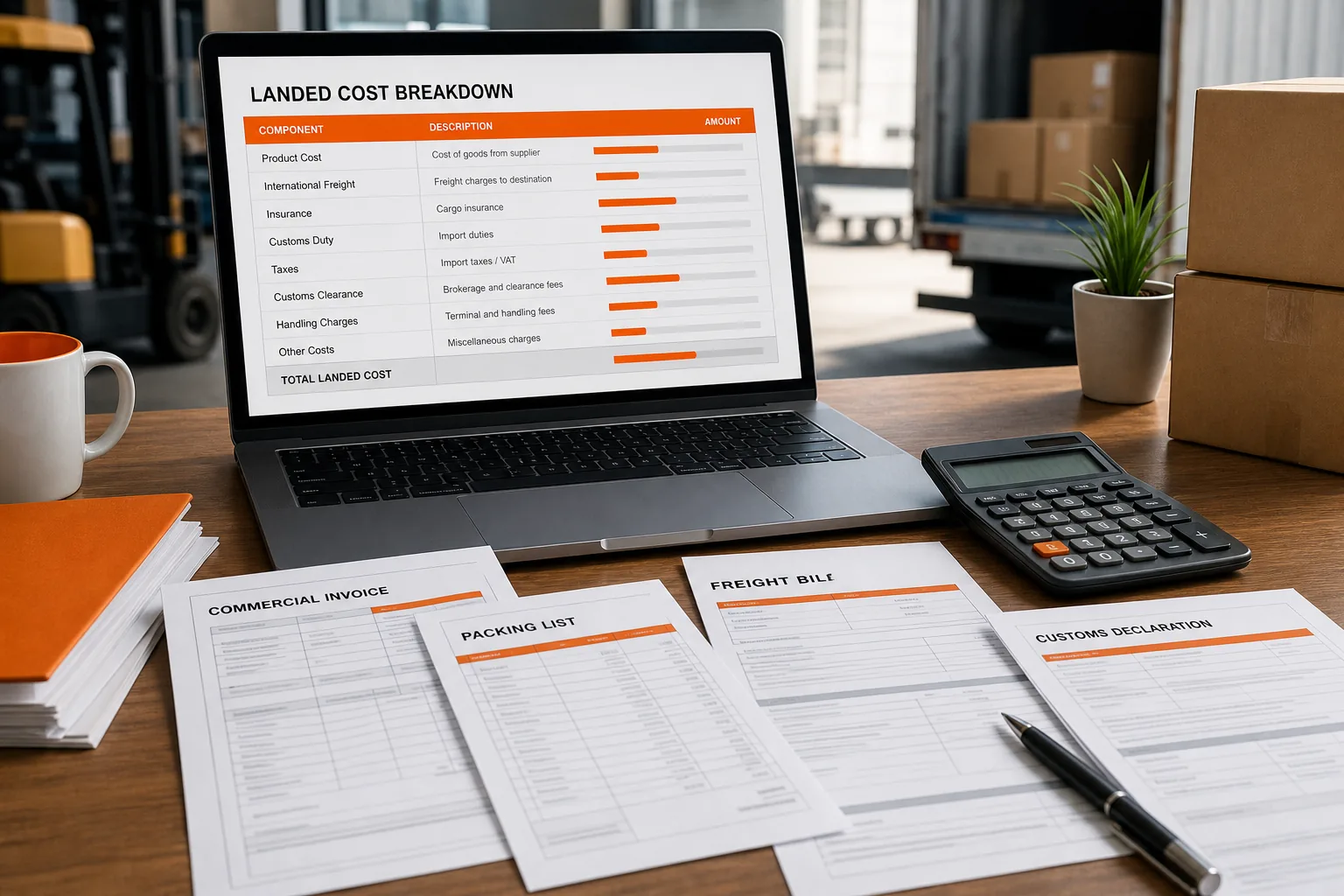
A supplier invoice can look profitable until freight, duty, and port fees arrive.
Landed cost is the inbound stack (every charge that makes one unit sellable) divided by the units you can actually sell.
Not the PO quantity.
Not the factory price.
Use this for the method: components, Incoterms, the formula, one worked shipment, then reconcile.
If you only need the identities on a card, use the landed cost formula.
If the SKU is going into Amazon, use how to calculate Amazon FBA landed cost for the fee stack.
If the store is Shopify, use how to calculate Shopify landed cost.
Stay here when you want the channel-agnostic arithmetic before you specialize.
The term itself is in what landed cost is.
The importer-policy version is how to calculate landed cost for imported products.
If You Need A Unit Cost Finance Will Accept
You buy finished goods and need a unit cost finance will accept.
Amazon FBA, Shopify, WooCommerce, or a warehouse: the inbound math is the same.
The POs repeat.
You have already priced something off a quote that ignored duty.
Skip a platform trial if you have one SKU, one lane, and a sheet you still trust.
The formula below is enough until the freight bill starts arriving after you have sold through the lot.
What Belongs On The Shipment
Start with the supplier price.
Work outward until the goods are available to sell.
If a charge helped get inventory into stock, it is a candidate.
If it happens because a customer bought the unit, it is a selling cost.
Mixing those two is how the next PO becomes impossible to reconcile.
One record per PO, shipment, and SKU.
Capture quote, quantity, currency, Incoterm, origin, and destination.
Then add the lines that show up later:
- Product: supplier invoice, plus packaging, tooling, or inspection you paid
- Origin transport: pickup and export handling, if not already in the quote
- International freight: ocean, air, rail, or courier
- Insurance
- Customs: duty, brokerage, entry fees, port charges; import tax only when it is a true cost
- Destination: drayage, trucking, warehouse receiving, or delivery into Amazon
- Currency: the rate you actually pay, plus the conversion fee
Referral fees, FBA fulfillment, ads, and payment processing belong in a margin view.
They are not inventory cost unless your accountant says otherwise.
A shared shipment needs a driver.
Units when SKUs are alike.
Weight when kilos drive the bill.
Volume when carton size drives it.
Customs value when the fee follows product value.
Allocating freight across SKUs is the long version.
A spreadsheet is fine for a small order.
The landed cost calculator is a faster first pass before you approve the PO.
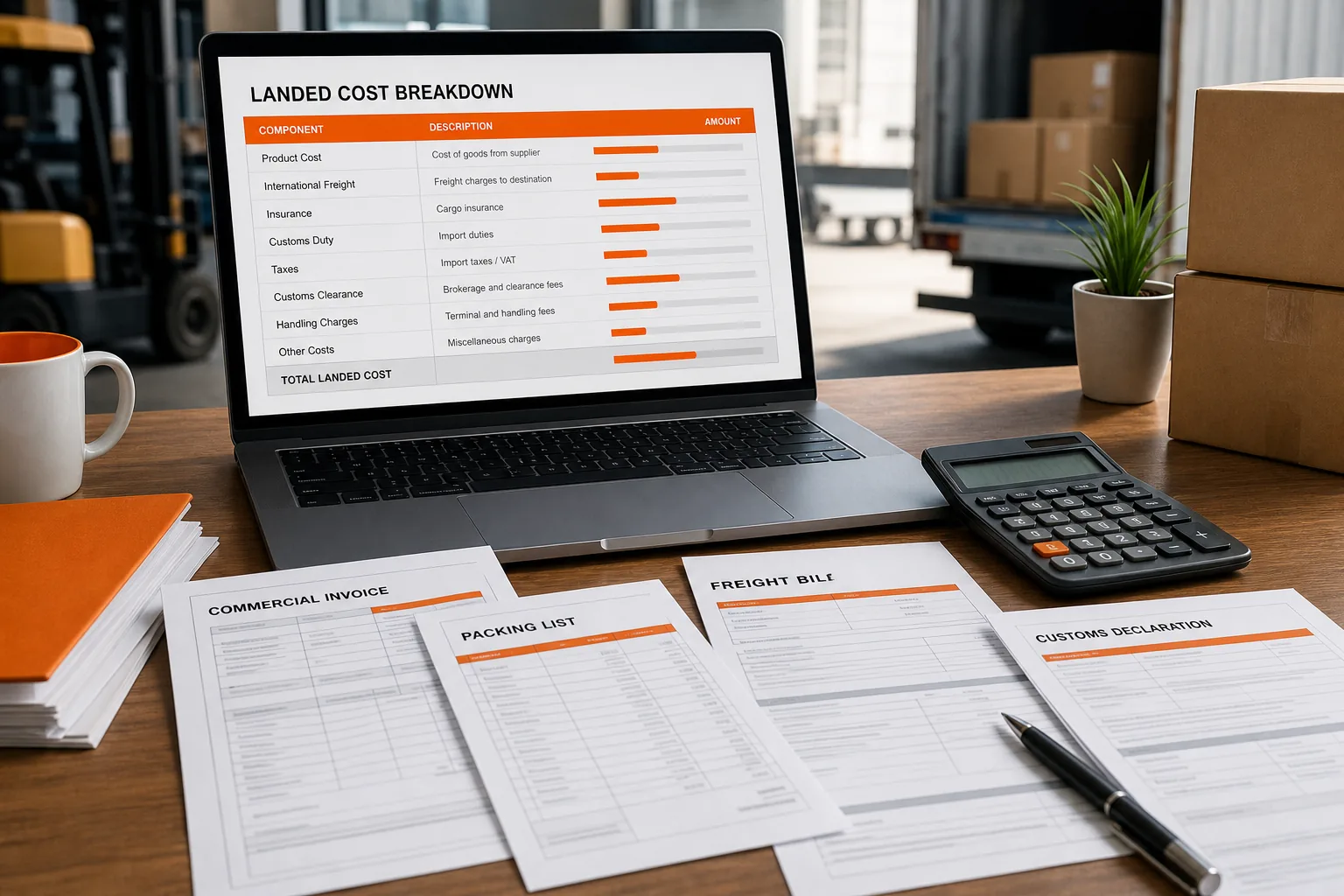
Incoterms And Customs Value Before You Add
The Incoterm tells you who already paid what.
Add a line the seller included and you double-count.
Leave out a line they did not and the model is fiction.
Under EXW you usually pick up local cartage and export handling.
A cheap EXW unit is often just an incomplete quote.
Under FOB the seller gets the goods to the named port and export-cleared; you own the main freight, insurance, import, and inland.
Under DDP more of that stack is inside their price.
You still need the breakdown.
Incoterms explain the labels.
Your contract controls the math.
Duty uses customs value × rate for the correct HS or HTS heading.
Customs value is not always the commercial-invoice total.
Freight and insurance may sit outside it, depending on the valuation basis.
For U.S. entries, check the HTS.
Do not copy a heading from a supplier quote.
Material, use, and origin matter.
A wrong heading can change the rate a lot.
That is a classification problem, not a formula problem.
Import duty from China is the tariff method.
Write the cost boundary before you calculate.
For Amazon, inbound landed cost usually ends when sellable stock is in the fulfillment network.
For Shopify or a 3PL, it ends when your warehouse can pick the unit.
Compare two suppliers only after the boundary matches.
The Formula
Total landed cost = product + freight + insurance + duties + true-cost taxes + brokerage + port + inland + other allocable inbound charges
Landed cost per unit = total landed cost ÷ sellable units received
Duty, when you have the rate:
Duty = customs value × duty rate
Insurance: use the premium on the invoice.
A planning stub such as 0.5% of cargo value is an estimate.
Label it.
Currency gets its own cell and a date.
Convert each foreign-currency bill at the rate you expect to pay, then add the fee.
A 2-3% move on a $50,000 invoice is $1,000-$1,500.
That is not a rounding error.
Do not hide surcharges inside "freight."
Ask for the base rate plus fuel, peak, port, documentation, and handling.
A cheap ocean number can stop looking cheap when those lines arrive.
If 20 units fail inspection, divide by 980, not 1,000.
The PO quantity is a hope.
For Amazon, keep FBA selling fees out of this inbound figure.
Add them in the FBA landed cost profit column.
The Amazon profit calculator sits on top of the unit you calculate here.
Keep estimated and actual columns.
Replace the estimate when the freight invoice and the entry summary arrive.
Worked Shipment: $10 On The Invoice, $14.10 Landed
1,000 units, FOB, $10 each.
Product is $10,000.
| Line | Amount |
|---|---|
| Supplier invoice | $10,000 |
| Ocean freight | $2,000 |
| Cargo insurance | $50 |
| Duty (7.5% of $10,000 customs value) | $750 |
| Brokerage and entry | $150 |
| Port handling | $250 |
| Trucking to the warehouse | $600 |
| Receiving and quality check | $300 |
| Total | $14,100 |
$14,100 ÷ 1,000 = $14.10 per unit.
The invoice said $10.
Inventory cost is 41% higher before ads, payment fees, or outbound shipping.
If 20 units fail inspection, the same $14,100 across 980 sellable units is $14.39.
Small on one unit.
Real on a low-priced SKU and on the inventory report.
For Amazon, add referral and fulfillment in a second view.
For Shopify or WooCommerce, add payment, pick/pack, and parcel in that second view.
Do not pour them into the $14.10.
A cheaper factory with worse freight can lose.
Run both quotes to the same boundary.
Change one factor at a time.

Reconcile, Then Decide Whether To Automate
The first pass is an estimate.
Attach the commercial invoice, packing list, freight bill, entry summary, duty receipt, broker invoice, and delivery record to the PO.
Ask what changed.
A freight miss points at the quote or a surcharge.
A duty miss points at classification, origin, or customs value.
A unit-cost miss often points at shortages or a packaging change.
Compare sourcing options on landed cost per sellable unit, not on the invoice.
Duty preference, freight validity, expected damage, and cash in transit all belong in that comparison.
A sheet holds one shipment.
Several POs, currencies, and late bills is the subject of spreadsheet vs software.
SupplyAutomate keeps invoices, freight bills, and the PO on one record so the estimate can become the actual without a new workbook.
It will not classify a heading for you.
A broker still owns the weird entry.
For a cost record that follows the product past one shipment, use tracking product costs.
If you are choosing a calculator rather than learning the math, use the ecommerce landed cost calculator roundup.
FAQ
What Is The Formula For Landed Cost?
Product + freight + insurance + duty + true-cost taxes + brokerage + port + inland + other allocable inbound charges.
Divide by sellable units received.
Keep selling fees in a separate margin formula when you want inventory cost.
Does Landed Cost Include Amazon FBA Fees?
Usually no, not in the inbound inventory number.
Start with the cost of one sellable unit delivered into Amazon.
Then add referral, fulfillment, storage, ads, and returns in the profit model.
The FBA how-to is that second column.
How Do Incoterms Affect Landed Cost?
They move who pays which leg.
EXW can leave you with pickup and export.
FOB usually leaves you the main freight and import.
DDP may bury those charges in the seller's quote.
Confirm the delivery point before you add a line.
Should I Use Ordered Units Or Received Units?
Sellable units received.
Ordered units overstate inventory when goods arrive damaged, short, or held.
If every unit is sellable, the two numbers match.
How Do I Calculate Landed Cost For Shopify Or WooCommerce?
Same inbound formula.
Then add payment, fulfillment, outbound shipping, ads, and returns in a margin view.
The Shopify how-to is the storefront layer, including DDP versus DDU.
Can Software Calculate Landed Cost Automatically?
It can read documents and tie charges to a PO.
You still need the heading, the sellable count, and a person who notices when the freight bill disagrees with the quote.
SupplyAutomate is built for that document-to-SKU job for FBA and Shopify sellers.
If you cannot reconstruct the $14.10 table from the bills on an open PO, you do not have a cost system yet.
You have a quote.
The landed cost calculator will rebuild the stack.
Amazon-bound SKUs pick up the fee column on the FBA page.
Shopify SKUs need the inventory number before a checkout widget.