
The supplier invoice is the opening line.
Freight, duty, insurance, brokerage, inbound, currency, and the units that never became sellable change the margin before the SKU hits FBA or available Shopify stock.
A free web form, a spreadsheet template, and a platform that wants to own the PO are different jobs.
Use this to tell them apart, not to crown a fake #1.
If the term itself is new, start with what landed cost is.
If you already know the formula and need Amazon inbound fees in the picture, use the Amazon FBA landed cost method.
Stay here when you are choosing the tool that will hold the number.
If A Quote Ignored Duty Or A Sheet Missed Freight
You import finished goods for Amazon FBA, Shopify, WooCommerce, or a mix.
The POs repeat.
You have already been burned by a quote that ignored duty or a sheet that never got the freight revision.
Skip a platform trial if you have one SKU, one lane, and one person who still has the current file.
A calculator or a sheet is enough until the documents leave the file.
What The Calculator Has To Answer
A useful ecommerce landed cost calculator does two things.
It estimates the full inbound stack before you approve the PO.
Then it lets you replace the estimate when the bills arrive.
The stack is product + freight + insurance + duty + taxes that are a true cost + brokerage + port/handling + delivery into sellable stock.
Divide by sellable units received, not the PO quantity.
How to calculate landed cost is the arithmetic.
Marketplace referral fees, FBA fulfillment, ads, and payment fees belong in a margin view.
They are not inventory cost unless your accountant says otherwise.
Mixing them in makes the next PO impossible to reconcile to the commercial invoice.
The software test is narrower than a feature page.
Can you open one shipment and see why the SKU cost what it cost, including the freight bill that showed up three weeks later?
$8.50 In The Calculator, $9.06 In The Documents
A Shopify + FBA seller reorders 2,000 units of a $6.40 factory SKU.
They run a quick calculator with the first freight quote.
| Line | Amount |
|---|---|
| Factory invoice | $12,800 |
| Ocean freight (first quote) | $2,200 |
| Duty and brokerage (estimate) | $1,140 |
| Trucking + FBA inbound prep | $860 |
| Units in the calculator | 2,000 |
Calculator version:
- ($12,800 + $2,200 + $1,140 + $860) / 2,000 = $8.50
After the documents are in (freight revised to $3,050, 30 units failed inspection):
- ($12,800 + $3,050 + $1,140 + $860) / 1,970 = $9.06
Price the listing off $8.50 and every unit is $0.56 light before ads, storage, or returns.
On a 2,000-unit cadence that is about $1,100 of missing cost per order.
The calculator did not fail.
Nobody replaced the estimate.
Run the same shipment through the landed cost calculator.
If you cannot reconstruct the $9.06 from the files you already have, you do not have a cost system.
You have a form.
Four Places To Look
These are category judgments from how the tools are sold and used.
Not a lab test of every calculator on the internet.
I am not quoting anyone's price.
If a vendor will not run the workflow with your documents, treat the claim as unproven.
SupplyAutomate, If The Number Has To Stay Attached To The PO
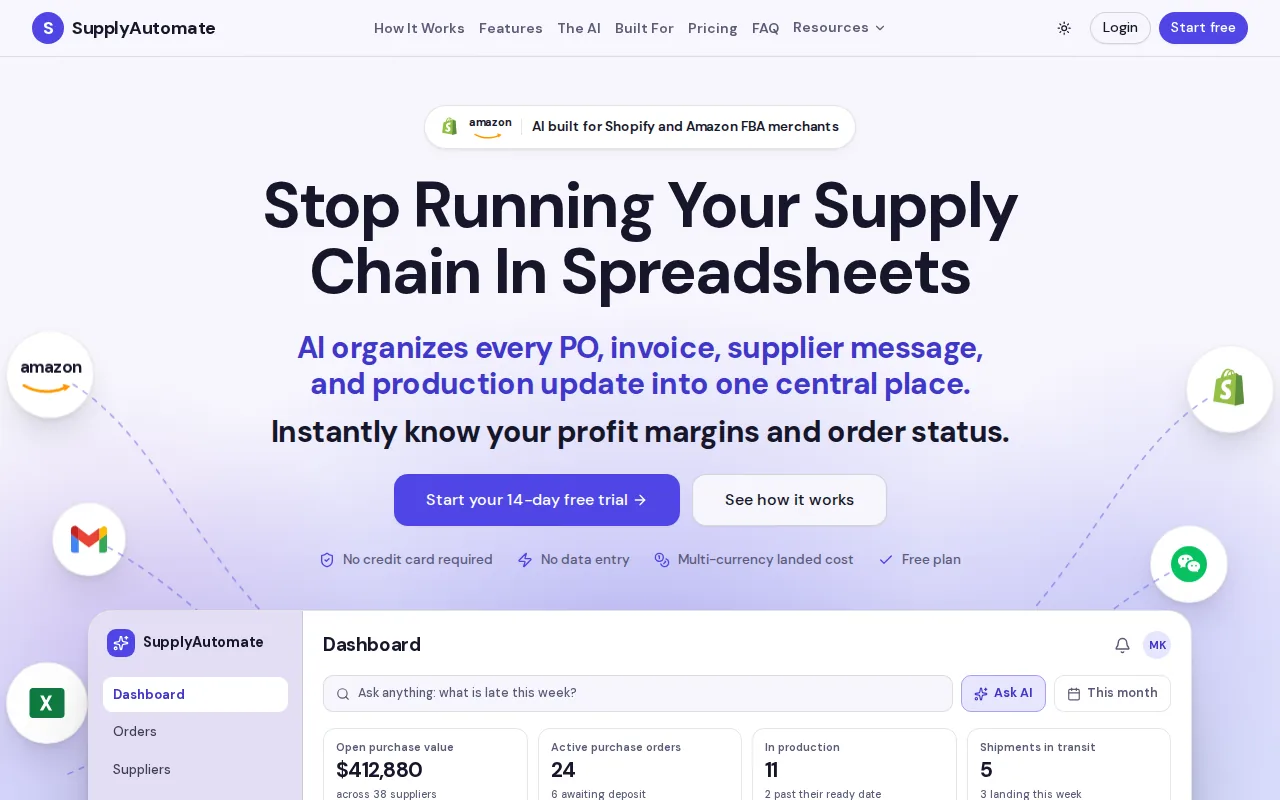
SupplyAutomate is not a one-shot web form.
It is the workspace for Amazon FBA and Shopify importers who need the estimate and the actual: purchase orders, supplier documents, freight bills, and the unit cost as those bills arrive.
Upload the invoice, packing list, and freight bill.
Match them to the PO.
See what the SKU cost after the revision.
For FBA, the useful boundary is one sellable unit delivered into the fulfillment network.
For Shopify or WooCommerce, it is usually one sellable unit in available stock.
Same model.
Different destination.
Start with the SupplyAutomate landed cost calculator when you need a planning number tonight.
Use the product when delayed invoices and a growing catalog make the sheet a rumor.
It will not classify your HTS code.
It will not file the entry.
You still need honest quantities and a freight bill that actually gets uploaded.
One SKU and a stable lane can stay on a spreadsheet.
Import Math, For A Free Pre-Buy Screen Across Channels
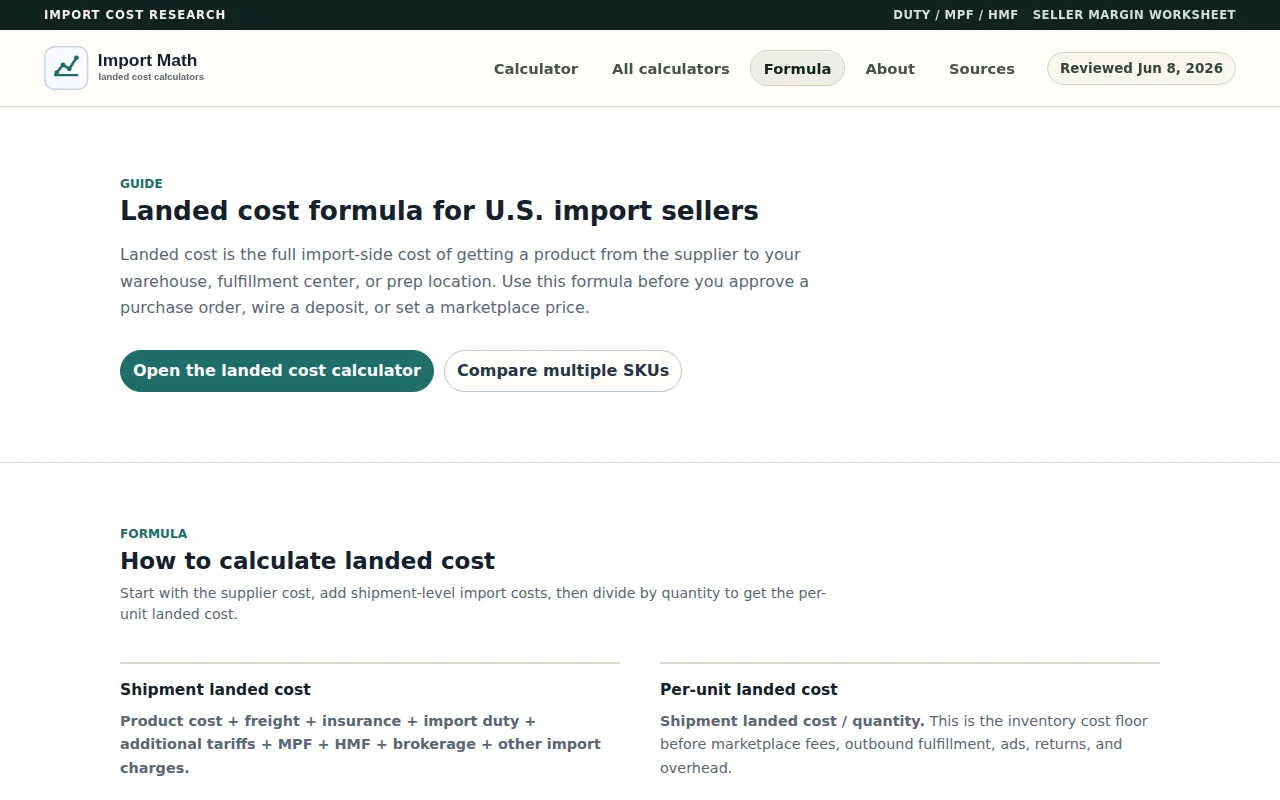
Import Math is a free web calculator.
Product + freight + insurance, then base duty from an HTS rate, possible Section 301 overlays for Chinese-origin goods, Merchandise Processing Fee, Harbor Maintenance Fee, then marketplace and fulfillment costs for the channel you pick.
It covers Amazon FBA, Shopify, WooCommerce, Etsy, TikTok Shop, eBay, Walmart Marketplace, BigCommerce, Wix, and Squarespace.
There is a CSV batch checker if you have too many variants for one-by-one entry.
You can also compare origins (China versus somewhere else) before you wire a deposit.
You must already know the HTS code.
It will not classify the product.
It is not a broker and not a document system.
Antidumping, CVD, and messy entries need a person.
Treat the result as a planning figure.
It is the right free check across several marketplaces.
It is the wrong place to keep actuals after the shipment lands.
A Spreadsheet, When You Own The Formulas And The Catalog Is Small

A sheet is still the most honest first system.
One row per SKU.
Supplier unit cost, ordered qty, sellable qty, currency, rate date, freight, insurance, duty, brokerage, port, inland, storage, receiving.
- Total landed cost = product + freight + insurance + duty + taxes that belong + brokerage + handling + delivery
- Landed cost per unit = total ÷ sellable units received
- Unit profit = selling price − landed cost − channel fees, ads, returns, and the other selling costs
Use sellable units as the divisor.
Damaged stock and inspection failures still have to be paid for.
How to calculate landed cost works a full shipment.
Shared costs need a rule you can defend.
Quantity when items are similar.
Weight when kilos drive freight.
Volume when the container is the constraint.
Customs value when the fee follows value.
Write the rule down.
Use it next time.
Keep estimated and actual in separate columns.
Freight and duty often arrive after you have already sold units.
If you overwrite the forecast, you lose the variance.
If you wait for perfect data, the first margin report is fiction.
Currency needs its own cell and a date.
Connect a finished unit cost to the profit margin calculator when you want contribution, not just inventory cost.
The weakness is upkeep.
A sheet will not read an invoice or match a freight bill to a PO.
It holds for a small catalog with one owner.
It gets dangerous when three people edit the file or the number has to flow into an inventory system.
Landed cost spreadsheet vs software is where that line usually falls.
A Basic Online Calculator, When You Need An Answer On A Call
These tools ask for supplier price, quantity, shipping, a duty rate, insurance, maybe a destination.
Good for a single SKU, a test order, or air versus ocean on a sourcing call.
The result is only as complete as the form.
Check the gaps:
| Decision point | What to check | If it is missing |
|---|---|---|
| Customs accuracy | HTS, origin, duty rate | Screening only |
| Shared shipment costs | Allocation by value, weight, volume, or units | Review each SKU |
| Local charges | Brokerage, port, drayage, receiving | Add them by hand |
| Tax treatment | Recoverable VAT/GST vs a true cost | Keep recoverable tax out of inventory |
| Marketplace view | Referral, fulfillment, storage, payment | Separate margin model |
Recoverable VAT can hit cash without belonging in inventory cost.
Your tax setup decides that, not the calculator.
For Amazon sellers, the Amazon profit calculator is the layer after the unit is in stock.
Selling fees, fulfillment, storage, ads, returns.
Basic tools stop at the estimate.
They will not reconcile to the final freight invoice.
Tracking product costs across the supply chain is the record version of that gap.
Use a quick calculator to kill a weak product.
Do not use it as the only file for a mixed container or a regulated heading.
How To Pick
Pick for the decision in front of you.
Need the number tied to the PO and the bills?
Trial SupplyAutomate with one real shipment.
Need a free pre-buy check and you already have the HTS code?
Import Math.
Need total control and the catalog is small?
A sheet, with one owner.
Need a rough answer on a call?
A basic form, then stop.
Whichever you use, test one active SKU against the supplier invoice, freight quote, duty record, and warehouse or FBA receipt.
Compare the estimate to the final.
That audit finds missing fees faster than another formula.
FAQ
What Is A Landed Cost Calculator?
A tool that estimates the full cost of getting inventory into sellable stock.
Product, freight, insurance, duty, taxes, brokerage, port, handling, inland delivery.
Some also add marketplace fees.
You want both the shipment total and the cost per sellable unit.
How Do You Calculate Landed Cost Per Unit?
Add the allocable product and inbound costs, then divide by sellable units received.
The landed cost per unit write-up and the per-unit formula are the same arithmetic.
Do not use ordered quantity if some units are damaged, lost, or held from sale.
What Costs Are Included In Ecommerce Landed Cost?
Supplier price plus freight, insurance, customs duty, brokerage, port charges, inland delivery, and handling.
Storage or prep when they are required to make the unit sellable.
Referral fees and ads usually stay in the profit calculation.
Is A Free Landed Cost Calculator Accurate?
Accurate enough to screen a product, if the inputs are honest.
Missing HTS, 301 overlays, brokerage, or trucking will move the answer.
Plan with the free tool.
Reconcile to customs documents and final invoices before you book the number.
What Is The Best Calculator For Amazon FBA Sellers?
Depends on the job.
SupplyAutomate if the cost has to stay on the order and the documents.
Import Math for a quick multi-channel estimate.
A spreadsheet for a small catalog with one owner who checks each final bill.
There is no single winner across those jobs.
Can Shopify And WooCommerce Sellers Use The Same Landed Cost Formula?
Yes.
Total product and inbound costs divided by sellable units.
The channel-specific part comes later: payment fees, fulfillment, returns, ads.
Same inventory cost.
Different margin model.
A calculator is only useful if someone updates it when the freight bill changes.
Rebuild one active SKU from the supplier invoice to the warehouse or FBA receipt, then compare that unit to the number you used to price the last PO.
The landed cost calculator is that rebuild.
If the estimate and the documents already disagree, the next tool you need is a record, not a prettier form.