The how-to is the method.
Stay here for the identities: total, per unit, duty, and the allocation fraction.
Same inbound idea (what landed cost is), written so you can put it on a sheet without rereading a walkthrough.
A $10 factory price is a line.
The formula is how that line becomes the number you price from.
If You Need The Algebra, Not The Walkthrough
You already know landed cost includes freight and duty.
What you need is what sits in each term, what you divide by, and what happens when one charge is billed per shipment instead of per unit.
If you are still gathering documents, go back to the how-to.
If the SKU is FBA and you need referral and fulfillment, that is a second column on Amazon FBA landed cost.
The Identities
Total landed cost
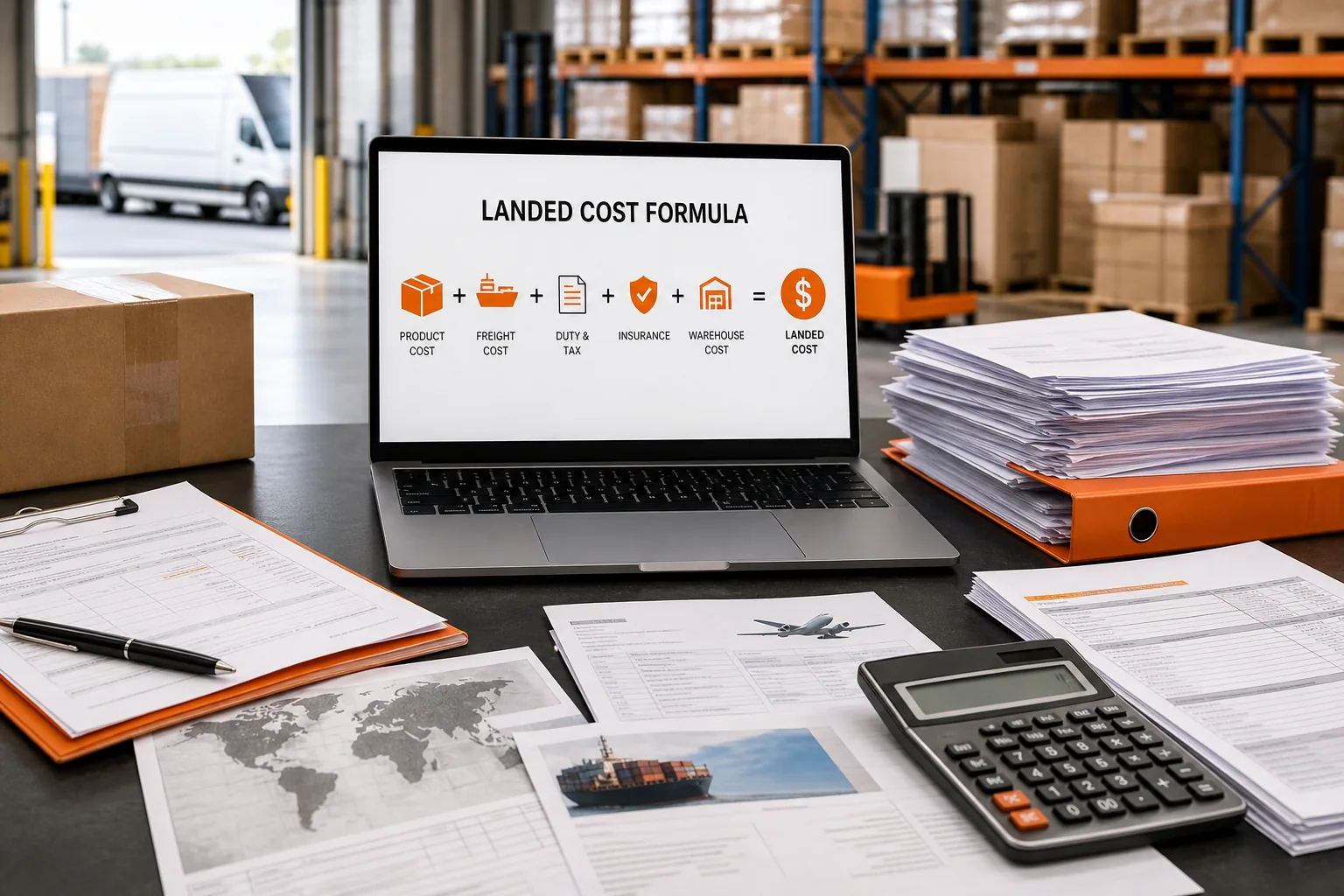
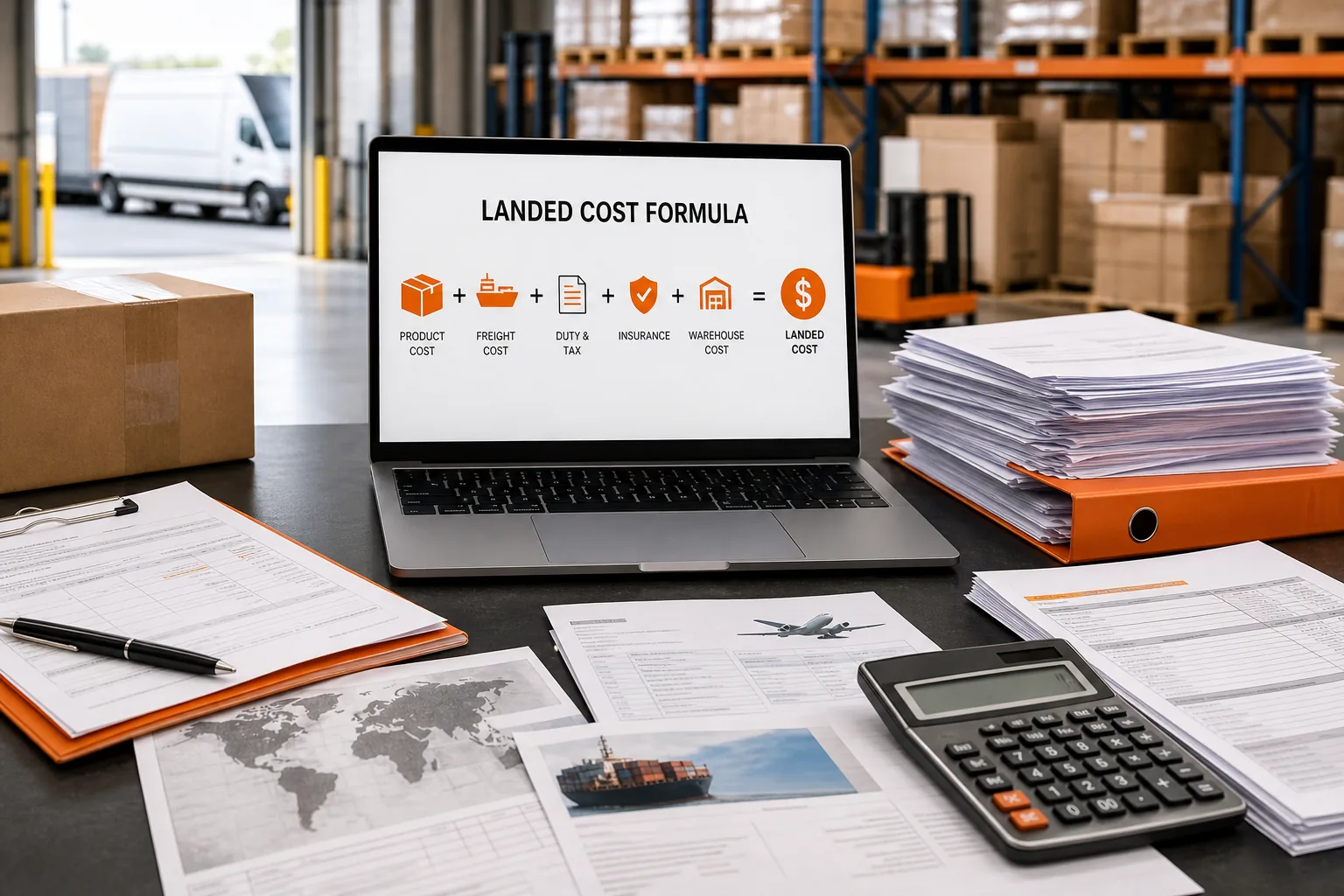
L = P + S + C + R + O
| Term | Meaning | Typical bills |
|---|---|---|
| P | Product | Commercial invoice, packaging, inspection you paid |
| S | Shipping | Origin pickup, ocean or air, fuel, port, inland, receiving needed to make the unit pickable |
| C | Customs | Duty, tariffs, entry fees, broker: import tax only when it is a true cost |
| R | Risk | Cargo insurance, QC you ran to release the lot |
| O | Overhead on the inbound | FX conversion, bank fee on the supplier payment, documentation |
That grouping is a filing aid.
In the sheet, keep the bills as separate rows.
Do not dump "overhead" into one cell you cannot audit.
Per unit
u = L ÷ n
n is sellable units received.
Not ordered.
Not "ex-factory."
If 20 of 500 fail, n = 480.
Duty
Duty = V × r
V is customs value.
r is the rate for that heading, origin, and entry date.
V is not always P.
Confirm the valuation basis.
Insurance (when you only have a rate)
Insurance ≈ insured value × rate
Use the premium when you have it.
A planning rate is an estimate.
Label it.
Allocation
For a shared charge F and a driver d (kg, CBM, dollars of value, units):
SKU share = F × (d_sku ÷ d_total)
Then u_sku = (P_sku + Σ shares) ÷ n_sku.
One driver for every charge is how a bulky cheap item funds a dense expensive one.
Freight allocation is the long table.
Marketplace referral, FBA fulfillment, ads, and returns are not in L unless you are building an all-in order cost on purpose.
Say so if you do.
Inventory valuation wants the inbound u.
What Sits In Each Term
Before you add, collect one PO's documents: invoice (SKU, qty, price, currency, origin, heading), freight quote and final invoice, entry or duty receipt, broker bill, insurance, receiving.
Fixed fees need the divisor in the open.
A $30 entry on 500 units is $0.06.
The same $30 on 80 units is $0.38.
Customs processing and receiving are often in that shape.
Record them anyway.
For Amazon, inbound placement or prep that is required to make the unit receivable can sit in S.
Referral and pick/pack sit outside L.
The FBA how-to keeps those columns apart so you do not count a fee twice.
Worked 500-Unit Sheet
Hypothetical.
Copy the order of operations, not the rates.
500 units at $20.
P = $10,000.
| Line | Amount | Per unit if ÷ 500 |
|---|---|---|
| Product | $10,000 | $20.00 |
| International freight | $1,000 | $2.00 |
| Duty (2% of $10,000) | $200 | $0.40 |
| Cargo insurance | $50 | $0.10 |
| Processing (if you wrongly treat it as $0.30 × 500) | $150 | $0.30 |
| L if processing is per unit | $11,400 | $22.80 |
The last line is the usual trap.
If processing is one $30 bill for the shipment, it is $0.06 a unit, not $0.30.
L = $10,000 + $1,000 + $200 + $50 + $30 = $11,280
u = $11,280 ÷ 500 = $22.56
The label on the invoice ("processing") does not tell you the basis.
The bill does.
A $10 factory SKU can pass $15 after freight, duty, FX, insurance, and handling.
Treat sample percentages as planning inputs.
If 20 units are unsellable, n = 480 and u = $11,280 ÷ 480 = $23.50.
Same L.
Worse unit.

Mixed SKUs: Two Drivers, One Shipment
Suppose the $1,000 freight is volume-driven and SKU A is 25% of CBM.
A's freight share is $250.
If A has 100 sellable units, freight is $2.50 on A, not $2.00.
Duty still follows each line's V × r.
Do not spread a 2% heading across a 12% heading by unit count.
Write the driver next to each shared row: weight, volume, value, or units.
Six months later that note is the audit.
A sheet holds a small catalog.
The templates give you columns.
Spreadsheet vs software is when the file stops paying for itself.
SupplyAutomate keeps a late invoice on the same PO so L can move when the bill arrives.
Recalculate when the final freight and duty receipts land.
Price from the estimate if you must.
Review margin from the actual.
Price From u, Not From P
u is a floor for inventory.
It is not the selling price.
Add channel fees, fulfillment, ads, returns, and target profit after.
Markup and margin are different.
Price = (u + other per-unit selling costs) ÷ (1 − target margin)
If referral is a rate r of price, put that r in the denominator.
Leaving it as a footnote is how a "30% margin" exists only on the slide.
Landed cost vs COGS is the accounting boundary.
SupplyAutomate's profit margin calculator uses landed cost as the unit cost, which is the point of the formula.
Freight moves.
FX moves.
Headings get corrected.
Re-run L when terms, route, or the entry disagree with the estimate.
SupplyAutomate is the document side of the same identities: bills on the PO, u you can open.
FAQ
What Is The Basic Landed Cost Formula?
L = P + S + C + R + O.
Product, shipping, customs, risk, inbound overhead.
Then u = L ÷ n with n = sellable units.
Keep marketplace fees out of L when you want inventory cost.
What Costs Are Included In Landed Cost?
Every expense required to place inventory at the warehouse or fulfillment point you chose as the boundary.
Common: product, freight, duty, entry, insurance, FX, brokerage, receiving.
Ads, outbound delivery, and returns usually sit in the margin view.
How Do You Calculate Landed Cost Per Unit?
Sum the shipment.
Allocate each shared charge with an explicit driver.
Divide each SKU's total by that SKU's sellable count.
Does The Amazon FBA Fee Belong In The Formula?
Inbound transport and delivery into FBA can sit in S.
Referral, fulfillment, storage, and ads belong in the selling-cost model.
Mixing them into u makes the next PO impossible to tie to the commercial invoice.
Can I Calculate Landed Cost In Excel?
Yes, if the columns are clean and the driver is written down.
Replace estimates with invoices.
Several POs and currencies is when a PO-level system earns its keep.
The identities only help if a second person can see why u is $22.56 instead of $22.80.
Check whether "processing" was per unit or per entry, then run the same L through the landed cost calculator.
The steps around the identities are in how to calculate landed cost.
Posting u into the books is landed cost in QuickBooks.