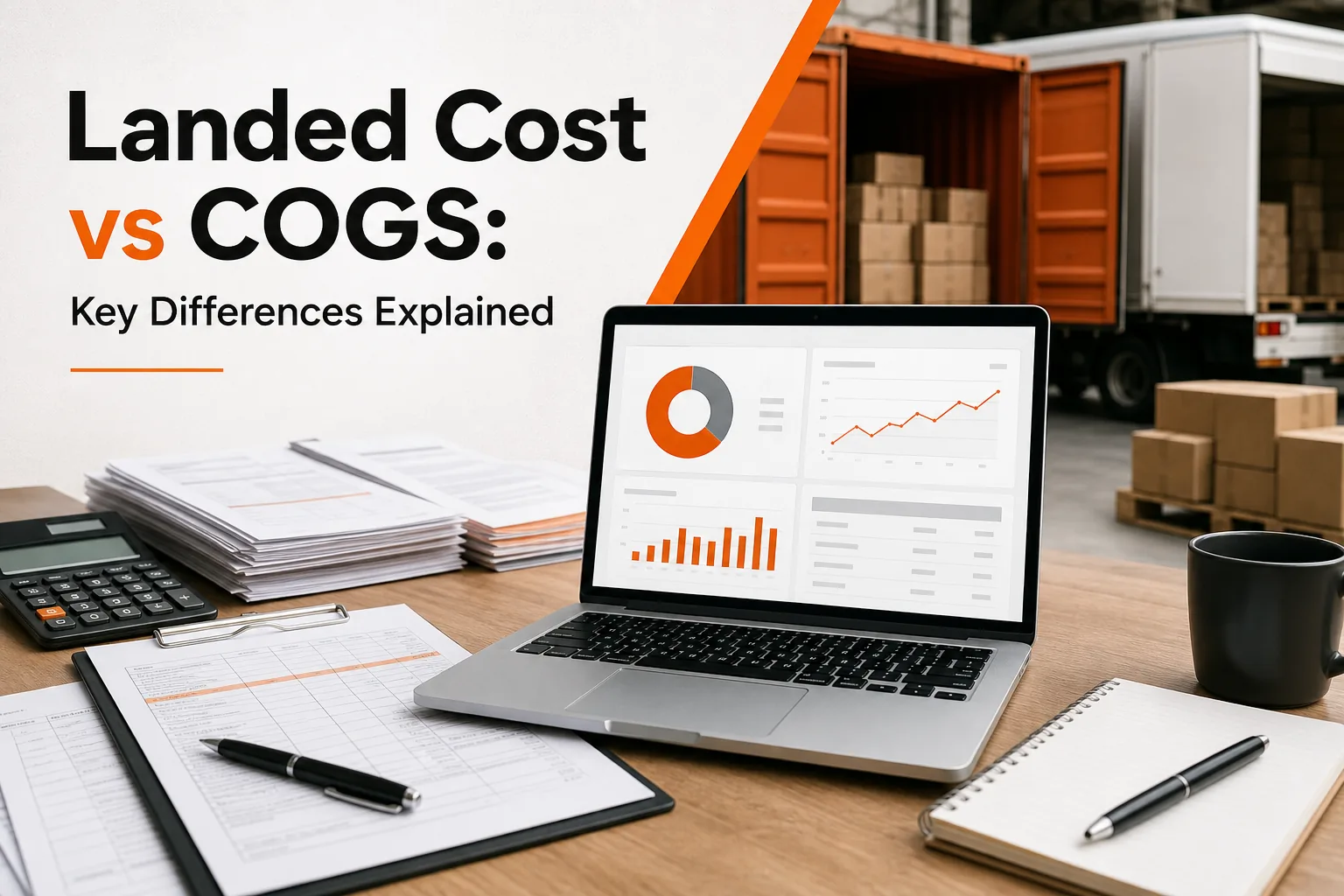
Landed cost and COGS answer different questions.
Landed cost is what it cost to get one sellable unit into inventory.
Factory price plus freight, duty, brokerage, inbound.
It lives on the shipment and the SKU before anyone buys it.
COGS is the direct cost of the units you sold in a period.
It shows up on the income statement when inventory leaves.
The unit inside COGS should be the landed figure, if you posted it.
Many teams never do.
They expense freight the week the bill arrives and call the factory invoice COGS.
Then both reports lie.
The inbound formula is how you get $14.10.
Landed cost in QuickBooks is how you post it.
Stay here for timing: when the $14.10 is still an asset, and when it becomes the P&L.
If the term itself is new, start with what landed cost is.
If Margin And The P&L Do Not Match
You import for Amazon FBA, Shopify, or WooCommerce.
Finance asks why the channel report and the P&L disagree.
Someone is still pricing off the supplier invoice.
Dropshipping and pure marketplace pass-through are a different model.
Two Questions, Two Clocks
| Question | Number | When it moves |
|---|---|---|
| What did this inbound cost? | Landed cost | When the goods (and the bills) make the unit sellable |
| What did we sell this period? | COGS | When those units leave inventory |
| Which factory or lane is cheaper? | Landed cost | Before the next PO |
| What was gross profit in August? | COGS | When the books close |
Landed cost can include freight, insurance, duty, brokerage, port, and inland delivery (the charges needed to place stock).
Trade.gov treats delivered cost as more than the factory quote.
Recoverable VAT is usually not product cost.
Ask the accountant.
COGS is not "every cost of being in business."
Outbound shipping, ads, and payment fees are cost of sales or opex in most ecommerce models.
Mixing them into inventory COGS makes the next receipt impossible to reconcile.
Total cost of ownership is wider still: storage, financing, dead stock.
Useful.
Not landed cost, and not COGS unless your policy says so.
The usual timing trap: the freight bill arrives after you received.
Accrue an estimate on the receipt.
Replace it when the invoice lands.
If you expense every inbound charge on the spot, the receipt month looks worse than it was and later months look too good.
$10 On The Invoice, $14.10 In Inventory, Then COGS
Same shipment as the how-to: 1,000 sellable units, FOB, $10 factory.
| Line | Amount |
|---|---|
| Supplier invoice | $10,000 |
| Freight, insurance, duty, broker, port, truck, receiving | $4,100 |
| Landed total | $14,100 |
| Per unit | $14.10 |
Inventory should hold $14,100.
Not $10,000.
Month 1 you sell 400 units at $29.
Ads and payment fees sit outside this table.
If landed cost is on the units
| Amount | |
|---|---|
| Revenue | $11,600 |
| COGS (400 × $14.10) | $5,640 |
| Gross profit | $5,960 |
| Remaining inventory (600 × $14.10) | $8,460 |
If you inventoried $10 and expensed the $4,100
| Amount | |
|---|---|
| Extra expense in the receipt month | $4,100 |
| COGS on 400 sold (400 × $10) | $4,000 |
| Gross profit on those sales | $7,600: $1,640 too high |
| Remaining inventory | $6,000: $2,460 too low |
You understated the asset and overstated the sale.
The next promo is priced off $10.
The P&L and the Shopify or Seller Central margin report will never agree, and both teams will be sure they are right.
Amazon selling fees still stay out of this inventory figure.
Add them in contribution.
Shopify payment fees the same.
FBA landed cost is the two-column version.
What Belongs In The Unit That Will Become COGS
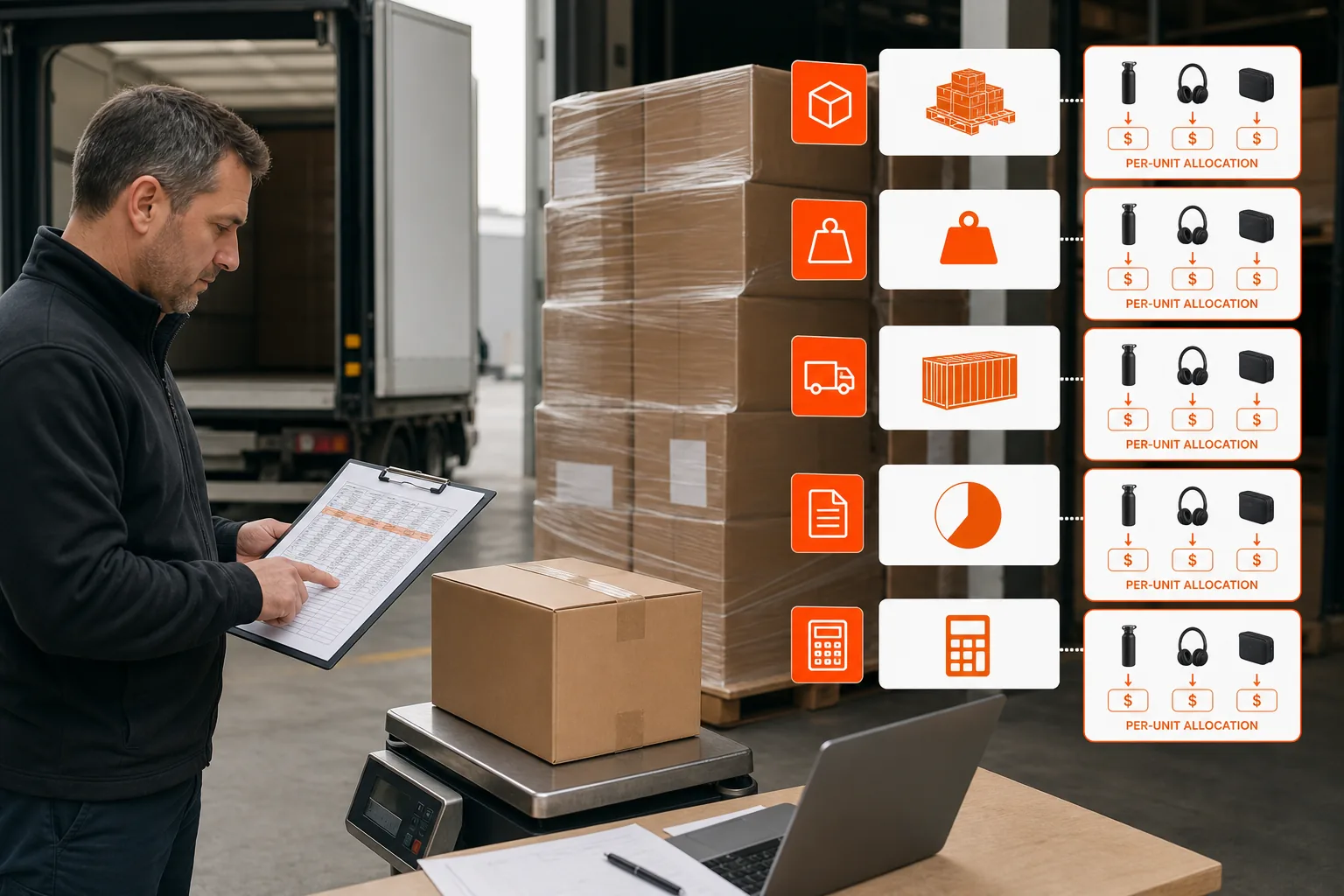
Use sellable units received as the divisor.
A short or a failed inspection raises u.
Allocate shared charges by the driver: units, weight, volume, or customs value.
Duty by unit count on a mixed container is how a cheap SKU funds an expensive one.
Freight allocation is the long table.
Estimate before the PO.
Replace with the bill.
A sheet is enough for one SKU and one owner.
Several people and late invoices is spreadsheet vs software.
FIFO sends the oldest layer to COGS first.
Average cost blends.
LIFO only where the rules allow it.
Attach a freight bill to the receipt it belongs to.
The policy decides the layer.
The operating rule does not change: inbound cost on unsold units is an asset, not this month's punishment.
When goods arrive before every bill is in, accrue.
When the duty receipt disagrees, adjust.
QuickBooks is one place that posting happens.
The journal depends on your file.
Ask the accountant about duties, recoverable taxes, and warehouse fees.
Returns and reimbursements change n and sometimes L.
That is the FBA duties and returns problem.
It still hits the same unit that will become COGS.
Where The Reports Disagree
The supplier invoice as "product cost" is the first error.
The rest is process:
- Freight or duty with no PO on the memo
- An estimate that nobody replaced
- FX with no date
- One allocation rule for every charge
- Freight already inside a DDP quote, added again
- Outbound postage sitting in inventory COGS
SupplyAutomate is the operations record: documents on the PO, the $14.10 you can open.
It is not the general ledger.
Finance still posts COGS.
The point is that both teams use the same unit.
Software will not fix a bad quantity or a SKU that does not match the invoice.
Review the source bills.
FAQ
What Is The Difference Between Landed Cost And COGS?
Landed cost is inbound cost before sale, usually by shipment or SKU.
COGS is the direct cost of units sold in a period.
Landed cost should be the unit inside COGS.
They are still different clocks.
Is Landed Cost Included In COGS?
It should flow into inventory and then into COGS when those units sell.
Policy decides the exact charges.
Inbound freight and duty often attach.
Outbound delivery, ads, and card fees usually do not.
What Should Amazon FBA Include?
Factory, prep, inbound freight, duty, delivery into the network, receiving.
Divide by sellable units.
Referral, fulfillment, storage, and ads belong in the profit model, not in the inventory unit unless the accountant says so.
How Do You Calculate Landed Cost Per Unit?
Sum allocable inbound charges.
Divide by sellable units received.
Document the allocation rule.
Replace estimates after receipt.
The landed cost calculator is a first pass.
Is Cost Of Sales The Same As COGS?
Often broader.
COGS is the product.
Cost of sales may add outbound shipping, packing, payments, or ads.
Keep them labeled.
Gross margin and contribution are not the same slide.
COGS is sellable-unit cost times units sold, not factory times units sold, and not freight dumped into opex.
Rebuild the $14.10 table from the last inbound, count how many of those units have sold, and post that.
The landed cost calculator is the check.
The factory invoice is an input, not COGS.