One freight bill on a mixed container does not mean every SKU used the same freight.
A dense accessory and a bulky storage item did not consume the same kilos or the same cube.
Split the bill by the driver that caused it, or the cheap bulky SKU will look fine while the dense one funds the ocean.
Use this for the allocation: one shared charge, several SKUs, and a rule you can audit.
The landed cost how-to is the full inbound stack.
Landed cost per unit is the divisor after the split.
What landed cost is is the term.
Stay here for the fraction.
If One Freight Bill Covers Mixed SKUs
You import mixed SKUs on one bill of lading for Amazon FBA, Shopify, or a 3PL.
The freight invoice is one number.
The SKUs are not one product.
Skip a hybrid model if every line in the carton is the same size, weight, and factory price.
Divide by units and move on.
Mixed cube or mixed value is where a flat split lies.
If one Amazon shipping plan goes to more than one fulfillment center, keep each destination's charges separate.
Mixing those bills makes the later margin check fiction.
Pick The Driver That Caused The Charge
Ask what the carrier or the broker actually billed against.
Then use that.
Two honest rules beat one easy rule.
| Method | Use It When | Share |
|---|---|---|
| Weight | The bill follows kilos | Freight × SKU weight ÷ shipment weight |
| Volume | Dimensional weight or bulky cartons | Freight × SKU CBM ÷ shipment CBM |
| Value | Duty or a fee on customs value | Charge × SKU value ÷ shipment value |
| Quantity | Units are nearly identical | Charge ÷ total units |
| Hybrid | Freight, duty, and handling on one shipment | A driver per line, not one dump |
Weight for line-haul that prices kilos.
Volume when the carton is mostly air.
Value for duty.
Quantity only when the SKUs could swap places in the same carton and nobody would notice.
Activity-based allocation is the same idea in research language: trace the resource to what consumed it.
Do not force freight, duty, and a flat receiving fee through one column.
Worked Container: Two SKUs, $3,050 Freight
Same ocean number as the supplier-software shipment.
Two SKUs on one booking.
| Line | SKU A, Dense Accessory | SKU B, Bulky Storage | Shipment |
|---|---|---|---|
| Units | 1,200 | 800 | 2,000 |
| Factory unit price | $6.40 | $4.80 | |
| Factory value | $7,680 | $3,840 | $11,520 |
| Unit weight | 0.40 kg | 1.20 kg | |
| Total weight | 480 kg | 960 kg | 1,440 kg |
| Unit cube | 0.002 CBM | 0.015 CBM | |
| Total cube | 2.40 CBM | 12.00 CBM | 14.40 CBM |
| Ocean freight | $3,050 |
Weight (what a weight-led ocean bill should use):
- A: $3,050 × 480 ÷ 1,440 = $1,016.67 → $0.85 per unit
- B: $3,050 × 960 ÷ 1,440 = $2,033.33 → $2.54 per unit
Volume (what a dimensional bill should use):
- A: $3,050 × 2.40 ÷ 14.40 = $508.33 → $0.42 per unit
- B: $3,050 × 12.00 ÷ 14.40 = $2,541.67 → $3.18 per unit
Value (wrong for freight, right for many duty lines):
- A: $3,050 × 7,680 ÷ 11,520 = $2,033.33 → $1.69 per unit
- B: $3,050 × 3,840 ÷ 11,520 = $1,016.67 → $1.27 per unit
Quantity (the lazy split):
- A: $3,050 × 1,200 ÷ 2,000 = $1,830 → $1.53 per unit
- B: $3,050 × 800 ÷ 2,000 = $1,220 → $1.53 per unit
Quantity makes A and B look equally expensive to move.
Volume says B ate more than six times A's freight.
Value does the opposite of weight: the expensive compact accessory absorbs the ocean bill the bulky item caused.
If this bill is weight-led, book $0.85 and $2.54.
Then add factory, duty (on value), and inbound.
Those freight lines are not the landed unit.
They are the split that has to be right before the rest of the stack can be.

Record carton SKU counts, carton weight, and dimensions before the goods leave the factory.
A formula cannot fix a packing list that never named which SKU was in which carton.
Do The Split In A Sheet, Then Tie Out
A sheet is enough for a small shipment if the inputs match the PO and the packing list.
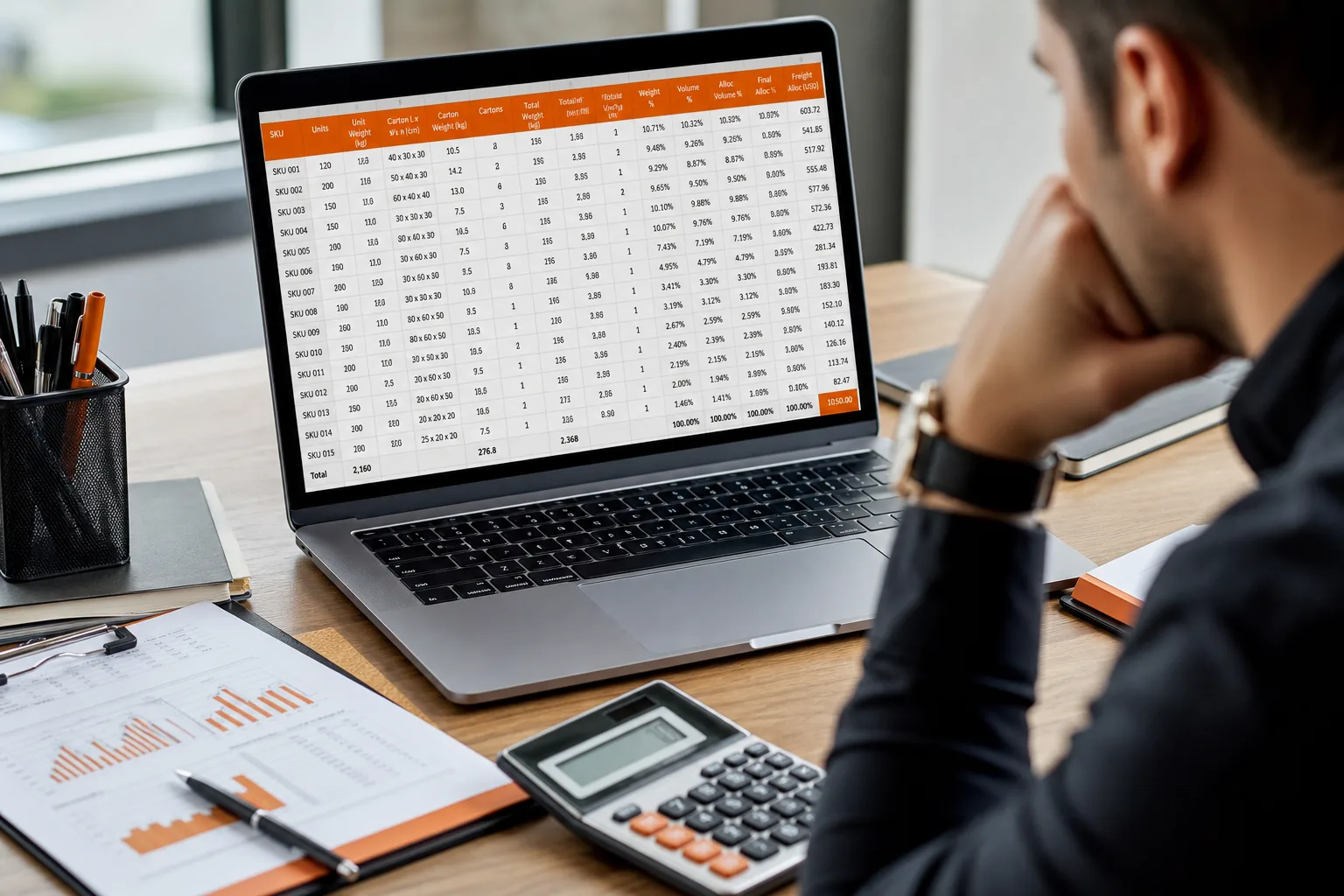
Keep one row per SKU: code, units, unit price, value, unit weight, total weight, L × W × H, total CBM.
Put the invoice total in its own cell.
Do not hide it inside a formula.
SKU freight share = total freight × SKU driver ÷ shipment driver
If the invoice has several lines, run the matching driver on each line.
Do not add ocean + duty + receiving first and then split the pile.
Unit inbound add = allocated shared costs ÷ SKU units
Keep the allocated dollars and the per-unit result in separate columns.
Sum the allocation column.
It must equal the invoice, except a rounding penny you document.
If the check row is not zero, find the missing SKU or the doubled charge before anyone posts the receipt.
Amazon-specific fee stacks sit on how to calculate Amazon FBA landed cost.
Shopify inventory cost sits on how to calculate Shopify landed cost.
Stay here for the shared-charge split.
One owner.
Version the file.
A late accessorial that nobody re-runs is how the books and the sheet diverge.
FOB, Accessorials, And What Goes Into Inventory
FOB origin usually means you own the goods in transit, so inbound freight belongs in inventory.
FOB destination usually means the seller bore that freight.
Read the contract.
The invoice heading is not the Incoterm.
Accessorials need their own question.
Fuel, storage, detention, exam, delivery: what caused the line?
A delivery charge that follows weight can use weight.
A customs service fee on declared value can use value.
A flat receiving fee can use units or POs.
Do not auto-spread every add-on by quantity.
If freight that belongs in inventory hits a freight-expense account, current margin looks worse and inventory looks cheap.
If you capitalize a charge that should be expensed, the opposite happens.
Landed cost in QuickBooks is the bookkeeping version.
One GL rule per charge type.
Review exceptions.
When The Sheet Stops Being Enough
Automation helps when one shipment feeds more than one warehouse or channel.
The key is a shared shipment ID on the supplier invoice, the freight bill, the receipt, the SKU list, and the accounting entry.
A usable workflow: capture the bills, match them to the PO, apply the saved rule by charge type, show the math on the SKU, then send approved values to inventory.
Save the rule on the shipment.
A reviewer next quarter should see why you used weight and not units.
SupplyAutomate is built for FBA and Shopify sellers who already have those PDFs and need them on the order.
It will not replace a WMS barcode walk.
Unusual fees still need a person.
Transfers between 3PLs have a cost too.
Track origin, destination, units, and date, or the "saving" from a closer node is a hope.
FAQ
How Do You Allocate Freight Cost Across Multiple SKUs?
Divide each SKU's driver by the shipment total, then multiply by the freight bill.
Weight for weight-led freight.
Volume for dimensional charges.
Value for value-led duty.
Several charge types: one driver per line.
In the worked container, weight put $1,016.67 on A and $2,033.33 on B.
What Is The Best Freight Allocation Method For Amazon FBA?
The one that matches the bill and the carton data.
Dense goods: weight.
Large light cartons: volume.
Freight plus duty plus handling: hybrid.
Keep Amazon destinations on separate shipments when a plan splits across fulfillment centers.
Should Freight Be Included In Inventory Cost?
When you owned the goods in transit and the charge helped get inventory to a sellable location, yes.
FOB terms decide that.
Apply the same policy on every PO.
Can I Use Quantity To Split Freight?
Yes, when the SKUs are nearly the same size, weight, and value.
On the mixed container above, quantity charged both SKUs $1.53 a unit and hid B's cube.
Do not use it there.
How Can Software Automate Freight Allocation?
Capture the invoice, match it to the PO, apply a saved rule, write the SKU cost.
SupplyAutomate is built for that importer workflow.
A person still approves odd fees.
A mixed freight bill is not a per-carton average.
List units, weight, cube, and factory value, then run weight and quantity side by side.
If they disagree by more than rounding, quantity is the wrong driver.
Spreadsheet vs software is the same gap when you cannot reconstruct why SKU B cost more to move.