You approved the purchase order because the factory quoted cargo ready on the 18th. The Shopify store and the Amazon listing both need that SKU before the next promotion. Weeks later the goods still are not sellable. The vessel slipped, a commercial invoice missed a carton count, and the inbound plan was rewritten after the forwarder had already booked one destination.
That gap is where small brands lose margin. Cash was committed against a date that was never a receipt date. For operators under $5 million in revenue, ecommerce supply chain management is not a separate department. It is the thread that connects supplier messages, purchase orders, production, quality checks, freight, customs, and warehouse receipt. When one handoff slips, every later step slips with it.
Table of Contents
- Why Small Brands Lose Margin Before Goods Ship
- The hidden cost of late decisions
- Four pressures small operators feel
- The Core Components of Ecommerce Supply Chain Management
- Upstream handoffs
- Movement stages
- Key KPIs for Tracking Your Ecommerce Supply Chain
- Timing measures
- Cost and quality measures
- Building SKU-Level Landed Cost and PO Visibility
- The cost build-up
- Duty collection at checkout
- PO visibility
- Amazon FBA and Shopify Examples in Practice
- Amazon FBA shipment splits
- Shopify locations that cannot be pooled
- Onboarding Suppliers Without Losing Control
- Documents and the sample
- Milestone PO and exception owners
- Scorecard and monthly review
- Comparing Tools and Taking Your Next Practical Step
- What a dedicated workspace covers
- A short checklist for brands under $5 million
<a id="why-small-brands-lose-margin-before-goods-ship"></a>
Why Small Brands Lose Margin Before Goods Ship
A purchase order date is not a sellable date. Teams treat the factory's ready date as the moment inventory will cover demand. It isn't. Production can finish on time and the cartons can still wait for equipment, a missed pickup, or a document the broker cannot file.
Ecommerce supply chain management is one connected flow. Supplier messaging feeds the purchase order. The purchase order sets production. Production ends in a quality check. A passed inspection enables freight booking and pickup. Customs clearance then decides when a warehouse can receive the goods. A delay in any step changes the cash date finance already used and the promotion date merchandising already promised.
<a id="the-hidden-cost-of-late-decisions"></a>
The hidden cost of late decisions
The expensive mistake is deciding after the goods have left the factory. A revised duty, a higher spot rate, or a split inbound plan shows up when the margin is already locked. The true cost from factory to warehouse is the figure that should sit beside the approval, not after the carrier invoice arrives.
Surveyed small and midsize businesses named tariffs as the leading factor affecting shipping, sourcing, or supply chains at 73.4%, while 71% cited rising shipping costs and 53.6% cited delivery delays, according to Digital Commerce 360's 2026 SMB report. Knowing the duty rate still doesn't protect profit if product cost, freight, and fees live in different files.
<a id="four-pressures-small-operators-feel"></a>
Four pressures small operators feel
- Scattered threads: WhatsApp holds the current status, while email holds an older promise.
- Buried PO versions: Attachments multiply, and nobody can say which quantity finance approved.
- Drifting landed cost: The original quote gets overwritten instead of kept next to the revision.
- Thin working capital: A small brand cannot fund a surprise airfreight bill and a stockout in the same week.
A quoted ready date is a planning input, not proof that inventory will be sellable that day.
Read the cost build if margin is the bottleneck. Read channel routing if Amazon or Shopify is where orders break. Read supplier onboarding if a new factory is the weak link. The rest of this guide follows that order, from the handoffs themselves to the numbers that should trigger a decision.
<a id="the-core-components-of-ecommerce-supply-chain-management"></a>
The Core Components of Ecommerce Supply Chain Management
Treat the chain like a relay. Each runner only helps the team if the baton is obvious, complete, and passed on time. A dropped baton doesn't stay with one person. Everyone after that handoff loses time.
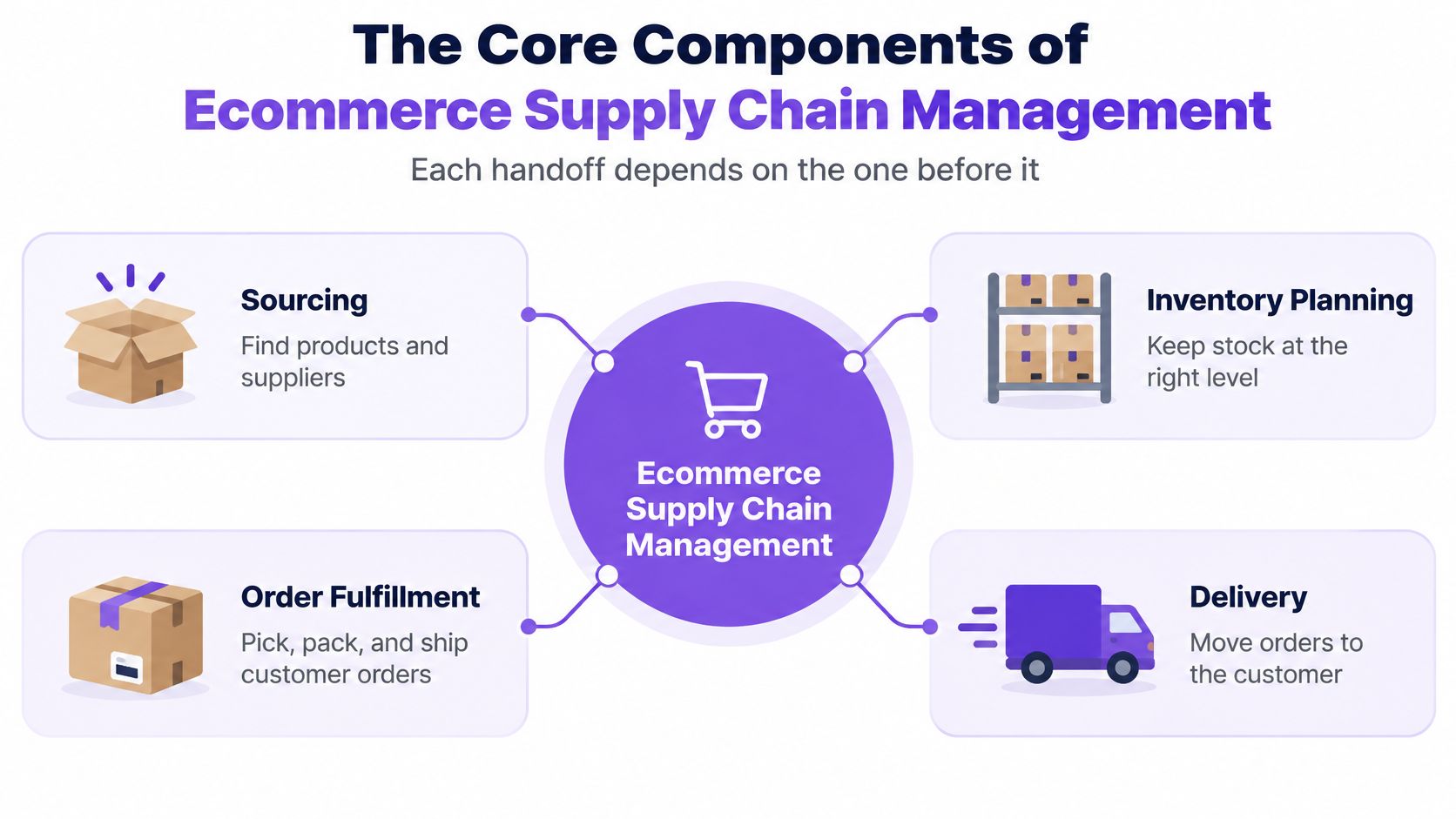
The diagram groups the work into sourcing, inventory planning, fulfillment, and delivery. Day to day, a small import team still runs six handoffs. Each one produces a record the next step cannot invent.
<a id="upstream-handoffs"></a>
Upstream handoffs
Sourcing produces more than a unit price. It produces the supplier's export documents, the Incoterm, the carton rule, and the person who answers when a milestone slips. Purchasing depends on that record before a PO is safe to send.
Purchase orders with version control produce the quantity, price, and date finance approved. Production depends on one current version. If a revised quantity lives only in a chat, the factory can build the wrong lot while accounting still holds the first cost.
Production tracking produces milestone dates, not a single "in production" label. Quality and freight both wait on cargo-ready status. A status with no date cannot drive a booking.
Quality control produces a pass, a fail, or a conditional release, plus the criteria used. Freight should not book against a verbal "looks fine." A failed inspection sends the lot back to production and resets the ready date.
<a id="movement-stages"></a>
Movement stages
Freight booking and pickup produce the carrier, the equipment, the pickup window, and the departure milestone. Customs and the destination warehouse depend on those facts. Booking against a hoped-for ready date creates rolled cargo and a cost that no longer matches the quote.
Customs clearance and warehouse receipt produce the entry, the duty outcome, and a received quantity. Only then is inventory sellable on Shopify or receivable into Amazon. Receipt that doesn't match the carton count is still not finished work.
The World Bank's 2023 Logistics Performance Index found that, on average across potential international trade routes, 44 days elapsed between a container entering the exporting country's port and leaving the destination port, with a standard deviation of 10.5 days. A PO date cannot anchor a reorder when port-to-port time already swings that widely. Brands that ship fragile or regulated goods, including teams building direct to consumer ecommerce for breweries, feel the same pattern. The physical product can be finished long before it is legally and operationally available to sell.
Stack the six records and you have one system. Supplier terms feed the PO. The PO feeds production and inspection. Inspection feeds pickup. Pickup feeds customs and receipt. Break the chain at any baton and the sellable date moves, even if the factory "hit" its original promise.
<a id="key-kpis-for-tracking-your-ecommerce-supply-chain"></a>
Key KPIs for Tracking Your Ecommerce Supply Chain
A small team doesn't need a dashboard with forty tiles. It needs a short set that changes a reorder, a supplier conversation, or a freight decision. The useful test is simple. If the number cannot name an owner and a next action, it is a report, not a control.
Sea-Intelligence's July 2026 schedule reliability figures put global schedule reliability at 56.4%, down 6.1 percentage points month over month, with late vessels arriving an average of 6.06 days behind schedule. Ocean transit is a probability, not a fixed promise. Track reliability by lane, carrier, and port. A global average will hide the lane that feeds your bestseller.
<a id="timing-measures"></a>
Timing measures
Quoted versus actual lead time runs from PO issuance to sellable inventory, not to the factory's ready claim. It tells you whether the reorder point is fantasy. The common mistake is reusing the supplier's stated lead time after three late receipts. Compare the quote with the observed distribution, then set the reorder point on demand during expected transit plus a buffer for the misses you have already seen. A lead time calculator for supply chain planning is only useful if you feed it actual receipts, not the first quote.
On-time production completion checks the production milestone on the PO, not vessel arrival. It tells purchasing whether the factory or the freight leg caused the slip. Mixing the two hides a supplier that is late before the cargo ever moves.
Supplier on-time delivery should be scored by the milestone you can still recover, usually pickup or departure, not by the day a customer complains. Days of inventory on hand versus the reorder point tells you whether to place, delay, or expedite. Counting units that are on the water as if they were in the bin is the mistake that creates a stockout during a promotion.
<a id="cost-and-quality-measures"></a>
Cost and quality measures
Landed-cost variance per SKU is actual landed cost minus the cost approved on the PO, kept by component. It tells finance whether to reprice, change quantity, or accept a thinner margin before the next order. Overwriting the original freight assumption makes the variance disappear.
Quality pass rate is lots accepted divided by lots inspected, using written criteria. It tells you whether to keep a supplier, add a pre-shipment check, or stop a booking. A pass rate with no defect notes cannot explain a later return spike.
Practical rule: Act on the earliest milestone you can still change, and ignore a KPI that doesn't name that milestone.
Teams that want fewer vanity metrics can borrow the habit in Fillaree's guide to choose meaningful business impact metrics. Pick one timing trigger, one cost trigger, and one quality trigger. Review them when a milestone is missed, not only at month end.
<a id="building-sku-level-landed-cost-and-po-visibility"></a>
Building SKU-Level Landed Cost and PO Visibility
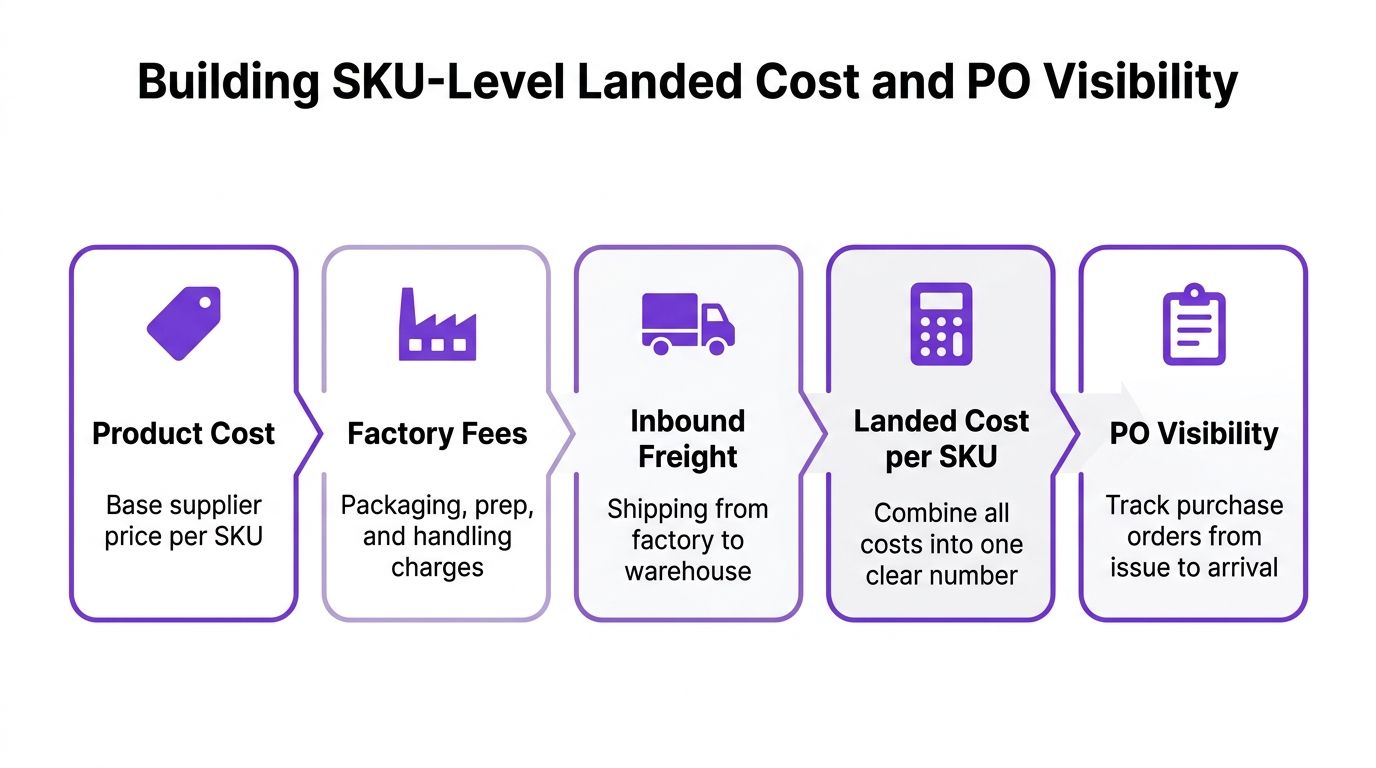
Margin clarity before arrival is a set of fields that nobody overwrites. Build the model at SKU level, before the goods ship, and keep every revision beside the one finance approved.
<a id="the-cost-build-up"></a>
The cost build-up
Take one 500-unit SKU. Do not collapse it into a single "landed" cell.
- Product cost stays as the supplier unit price on the approved PO. A later quote doesn't erase it.
- Factory add-ons sit in their own fields for packaging, prep, and handling. If the factory adds a carton charge, that line moves. Product cost doesn't.
- Inbound freight keeps the quoted rate, the booking date, and later the carrier invoice. When the invoice arrives, update freight only.
- Duties, insurance, and fees each keep a column. A tariff change moves duty. It doesn't rewrite freight.
- Landed cost per unit is the sum divided by units expected, then again by units received. The two totals are allowed to differ.
A revised quote, a changed PO quantity, and a final carrier invoice should each touch one field. If a new spreadsheet replaces the old one, you lose the reason the margin moved. Shared freight across several SKUs needs an allocation rule before anyone averages it. Allocating freight cost across multiple SKUs is the step that stops one heavy carton from hiding inside a blended rate.
<a id="duty-collection-at-checkout"></a>
Duty collection at checkout
Shopify merchants can collect estimated international duties and import taxes at checkout, with conditions. Products need Harmonized System (HS) codes. If the store uses Shopify shipping labels, the carrier must support Delivered Duty Paid labels. The feature is unavailable to stores on Shopify Fulfillment Network, and some merchants need a third-party app. Shopify's duty settings also apply a 0.85% transaction fee when duties and import taxes are calculated at checkout and Shopify Payments is the gateway. On a $100 international order that fee is $0.85, before duty, tax, freight, and carrier charges. The same fee can apply with a provider such as PayPal if Shopify Payments stays the primary gateway. Model that fee inside landed cost when you decide whether to collect charges upfront or leave the buyer to pay on delivery.
<a id="po-visibility"></a>
PO visibility
Finance and purchasing should read one thread, not two inboxes.
- One version history shows who changed quantity, price, or date.
- Approvals stay attached to the version they approved.
- Carton counts are recorded before pickup, not reconstructed at the warehouse.
- Milestone dates cover production completion, cargo readiness, pickup, departure, and arrival.
When the carrier invoice changes freight on the 500-unit SKU, both teams see the old assumption and the new one. That is the control. Visibility without separate fields is just a nicer status email.
<a id="amazon-fba-and-shopify-examples-in-practice"></a>
Amazon FBA and Shopify Examples in Practice
Channel rules change the replenishment math even when the factory, the SKU, and the freight forwarder stay the same. A 500-unit import can be cheap to coordinate and expensive to place, or the reverse.
<a id="amazon-fba-shipment-splits"></a>
Amazon FBA shipment splits
Amazon's inbound placement guidance gives FBA sellers two structures for U.S. inventory.
Minimal shipment splits send inventory to the fewest inbound locations, generally one. The seller pays an inbound placement service fee, and Amazon distributes the inventory. For a 500-unit SKU this is simpler at origin. One destination, one booking, fewer receiving appointments. The fee is a per-unit cost you only know after the plan is built, and it belongs in landed cost, not in a marketing budget.
Amazon-optimized shipment splits send inventory to multiple inbound locations and do not charge that placement fee. The shipment must contain at least five identical cartons or pallets per item. Each carton or pallet must hold the same quantity per item and the same item mix. Five cartons can erase the fee and add origin labor, more labels, and more chances a carton is short.
Amazon assesses the placement fee 45 days after the shipment is received, using quantities received. The rate depends on size tier, shipping weight, inbound locations, and how many locations or shipments are in the plan. Do not book the fee from the quantity you shipped if receiving can differ. Adding Amazon FBA shipment costs to landed cost keeps that fee beside freight instead of discovering it after the promotion has already been priced.
<iframe width="100%" style="aspect-ratio: 16 / 9;" src="https://www.youtube.com/embed/sl2otMlspsc" frameborder="0" allow="autoplay; encrypted-media" allowfullscreen></iframe>
<a id="shopify-locations-that-cannot-be-pooled"></a>
Shopify locations that cannot be pooled
A Shopify brand with a U.S. 3PL, a Canadian warehouse, and a retail store does not have one pile of stock. Shopify's fulfillment location rules track inventory separately at each place, including warehouses, retail stores, pop-ups, and fulfillment services. Inventory assigned to different locations is independent and cannot be pooled or shared automatically.
Order routing uses available inventory and the rules you set. If one location can fill the whole order, Shopify can assign it there. If none can, the order may split, or the highest-priority location may oversell, depending on configuration. The storefront can show units that exist somewhere and still cannot ship to that customer.
| Choice | What you gain | What you pay |
|---|---|---|
| FBA minimal splits | One inbound destination | Placement fee, assessed after receipt |
| FBA optimized splits | No placement fee | Five identical cartons or pallets, more coordination |
| Shopify multi-location | Local ship points | No automatic pooling, split-shipment risk |
Replenishment timing follows the channel. FBA needs carton identity decided before the factory closes the PO. Shopify needs each location's on-hand updated before routing rules promise an order. The same 500 units can be "in the network" and still miss both a Buy Box and a checkout.
<a id="onboarding-suppliers-without-losing-control"></a>
Onboarding Suppliers Without Losing Control
A new factory fails in the first month when the only record of the deal is one chat contact and a quoted lead time with no buffer. Onboarding is the moment to lock documents, samples, milestones, and an owner for exceptions.
<a id="documents-and-the-sample"></a>
Documents and the sample
Collect company and export documents before the first production PO. You want the legal exporter, not only the salesperson who answers WhatsApp. Then request a pre-production sample and write the inspection criteria in the same file as the PO template. "Match the sample" is not a criterion. Note measurements, materials, labeling, and what counts as a fail.
Relying on one contact is the first crack. If that person is offline, nobody else at the factory knows the carton rule or the ship window.
<a id="milestone-po-and-exception-owners"></a>
Milestone PO and exception owners
Set the PO template with dates for production completion, cargo readiness, pickup, vessel departure, and destination arrival. A delay found at pickup still leaves a rebooking, a partial air shipment, or a promotion change. A delay found after the sales window has closed leaves a markdown.
Assign an owner for each exception before the first miss. Purchasing owns a late production date. Logistics owns a missed pickup. Finance owns a cost change that breaks the approved margin. Shared ownership usually means no owner.
Skip two common shortcuts. Do not approve a PO without a carton-count rule, because receiving and FBA carton identity both depend on it. Do not accept the quoted lead time without a buffer tied to that lane's recent receipts. The supplier onboarding process should end with those rules written, not with a handshake.
<a id="scorecard-and-monthly-review"></a>
Scorecard and monthly review
Weight four items and stop there. Total landed cost, on-time milestones, quality against the written criteria, and document accuracy. Give on-time and quality enough weight that a cheap unit price cannot hide a late, dirty file. Review monthly on the milestones, not on a feeling about the relationship. Drop a supplier that misses the same milestone twice if you have an alternate. If you don't, the scorecard still tells you how much buffer and how much inspection to buy.
<a id="comparing-tools-and-taking-your-next-practical-step"></a>
Comparing Tools and Taking Your Next Practical Step
Small brands under $5 million don't fail for lack of software categories. They fail when the system of record can't hold a PO version, a SKU cost, and a factory milestone at the same time.
| Approach | PO Version Control | SKU-Level Landed Cost | Factory Milestone Tracking | Best Fit |
|---|---|---|---|---|
| Spreadsheets | Manual, breaks as versions multiply | Possible if fields stay separate | Weak, usually a date someone typed | One or two SKUs, one owner |
| Email and chat threads | None, history is buried | Almost never | Anecdotes, not milestones | Status questions only |
| Forwarder or 3PL portals | Shipment refs, not PO edits | Freight slice, not full landed cost | After pickup, not at the factory | In-transit tracking |
| Dedicated supply chain workspace | Version history with approvals | Component fields before arrival | Production through pickup | Brands that import regularly |
A spreadsheet costs little and collapses once two people edit the same PO. A forwarder portal can show a vessel and still say nothing about whether the factory finished the lot. Adding another portal doesn't fix a missing approval trail.
<a id="what-a-dedicated-workspace-covers"></a>
What a dedicated workspace covers
SupplyAutomate is one option built for this gap. It ties supplier messaging, PO version control, production milestones, and factory-to-pickup visibility into one workspace. Its Exact Landed Cost Engine combines product cost, freight, duties including Section 301, insurance, and fees into SKU-level landed costs before goods arrive. Invoices, carton counts, and approvals stay in a thread. Onboarding is described as under 10 minutes with no IT project, at $99 per month after a 30-day free trial with no credit card. Free calculators cover import duty, landed cost, freight comparison, MOQ, and lead time. It sits next to a 3PL or forwarder. It doesn't replace them.
<a id="a-short-checklist-for-brands-under-5-million"></a>
A short checklist for brands under $5 million
- Freeze one active SKU and list product cost, factory fees, freight, duty, insurance, and fees as separate fields.
- Attach the current PO version and the approval, then stop editing cost in chat.
- Write five milestone dates and name who acts if each one slips.
- Compare the model with the last shipment before you approve the next quantity.
Start with that one SKU. If the modeled cost and the last receipt don't match, you have found the field your current tools overwrite. Fix that field before you add another supplier, another lane, or another app.
Supply Automate gives Shopify and Amazon sellers one place to hold supplier messages, purchase order versions, production milestones, and SKU-level landed cost before goods arrive. That is the control small import teams need when a quoted ready date is not a sellable date. Visit Supply Automate to start the 30-day free trial, load one active SKU, and compare its modeled landed cost with the last shipment.