The supplier's latest WhatsApp voice note says production has started. The Shopify launch calendar still assumes an on-time arrival, the Amazon replenishment plan depends on the same date, and the approved purchase order is buried beneath a revised attachment. Nobody can confidently explain which commitment still holds.
Table of Contents
- The WhatsApp Thread That Cost a Brand $40,000
- A message needs an operational consequence
- What Production Tracking Software Actually Is
- Translate factory concepts into purchasing decisions
- Core Features and KPIs Small Brands Should Expect
- Rank capabilities by decision value
- Confidence needs evidence, not decorative scoring
- How Two Real Brands Use Production Tracking Day to Day
- An Amazon FBA replenishment
- A Shopify colorway launch
- A Founder's Selection and Integration Checklist
- Test the workflow, not the presentation
- Make the vendor demonstrate failure
- The Uncomfortable Truth About Status Dashboards Without Cost Control
- A hypothetical duty change during production
- Distinguish a forecast from accounting evidence
- Calculating ROI With Avoided Outcomes Instead of Vanity Metrics
- Separate fee exposure from proven savings
- Build the evidence file
- Putting It Together and Choosing Your Next Step
- Recognize purchase-stopping signals
The WhatsApp Thread That Cost a Brand $40,000
The dollar amount in this heading isn't a documented loss. It represents the kind of claim that shouldn't enter an operating report without evidence. The same discipline belongs in production tracking: a plausible supplier update isn't a verified production event.
Consider an illustrative small brand waiting for an overseas production run. Its founder manages Facebook ads while an operations coordinator chases samples, invoices, and freight bookings. A factory voice note reassures both employees, but neither has a dated production record or an inspection booking.
The immediate problem isn't missing communication. It's that the team can't distinguish an assertion from a commitment, or a commitment from completed work.

A message needs an operational consequence
A useful record connects the supplier's message to the relevant PO, milestone, evidence, and next action. If production has not started, the coordinator needs to identify which downstream commitments require revision, not change a dashboard color.
- Cash: Does the next payment depend on production progress or an approved inspection?
- Sales: Should the Shopify launch remain scheduled, move, or open with limited availability?
- Replenishment: Can existing Amazon stock cover the revised arrival window?
- Transportation: Has the factory confirmed readiness, or has someone booked freight against an unsupported date?
Practical guidance on managing supplier orders over WeChat addresses the communication side of this problem. The operating requirement goes further: decisions must remain traceable after the conversation moves on.
Practical rule: A supplier message should change a forecast only when its meaning, evidence, and downstream consequences are recorded.
Factory readiness also isn't warehouse arrival. Peak Transport's resource on reliable middle-mile delivery planning provides relevant context for evaluating the transportation handoff separately.
For small brands, production tracking software should turn that noisy thread into a decision-ready record. Adding another inbox won't accomplish that.
What Production Tracking Software Actually Is
Production tracking software records what was planned, what happened, what supports the update, and what needs attention next. For an importing e-commerce brand, its useful scope runs from PO issuance through production, inspection, readiness, and pickup.
Its roots lie in Manufacturing Execution Systems, or MES, which emerged in the late twentieth century to connect enterprise planning with shop-floor execution. Cloud computing and Industry 4.0 later supported more connected workflows, but the foundational principle remained a continuous production history rather than disconnected records, as described in this overview of MES development.
If an enterprise MES resembles a factory control room, the small-brand equivalent is a shared workspace that follows an outsourced order. It doesn't need to control a machine to provide operational control over supplier commitments.
Translate factory concepts into purchasing decisions
Execution control means assigning the next required action and responding when actual progress diverges from the plan. For a Shopify seller, that might mean withholding inspection approval until the factory supplies the requested evidence.
Genealogy means retaining the relationships between the finished goods and their underlying materials, batches, suppliers, and exceptions. NIST's product tracking and genealogy framework includes location, disposition, component materials, supplier identifiers, production conditions, and rework. An importer should translate that into batch identifiers linked to inspections, purchase orders, and shipments.
Track-and-trace then answers where affected goods went. That matters when a quality complaint concerns a particular batch rather than every unit carrying the same SKU.
| Tool boundary | What the brand should expect |
|---|---|
| ERP or accounting system | Financial and purchasing records |
| Production tracking workspace | Execution evidence, exceptions, and supplier commitments |
| Project management tool | Assigned tasks, unless production-specific relationships are deliberately built |
| 3PL portal | Warehouse activity, without assuming visibility into earlier factory events |
The buying decision should follow the missing workflow. A brand struggling with overseas supplier execution shouldn't purchase machine-monitoring capabilities merely because both products use the phrase production tracking software.
Likewise, a tracking workspace shouldn't become a second accounting ledger. It should preserve the operational evidence that purchasing, logistics, and finance need to trust their own records.
Core Features and KPIs Small Brands Should Expect
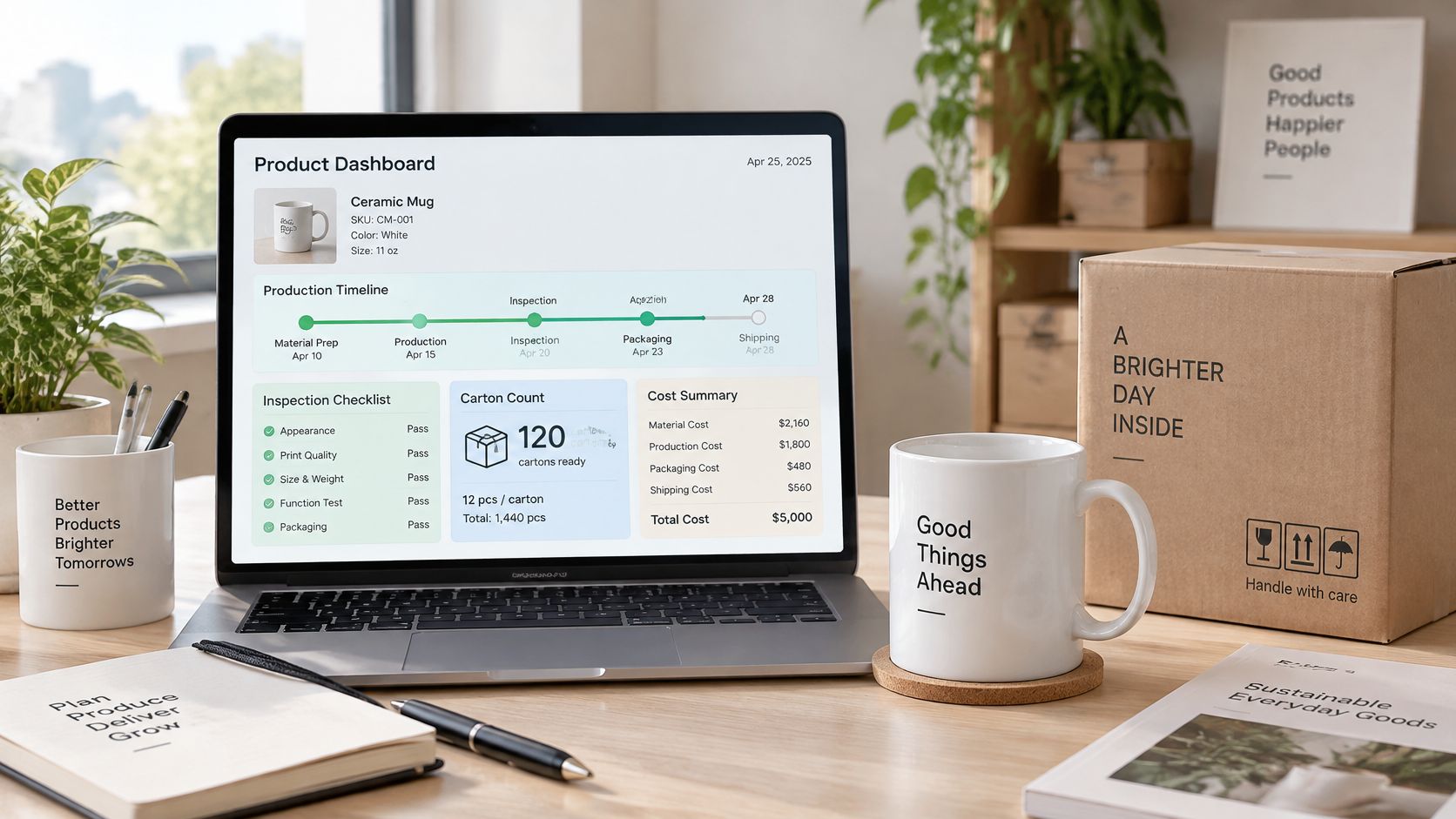
A useful feature earns its place by supporting a decision. NIST's manufacturing execution framework connects dispatching, execution, data collection, performance analysis, and traceability. For smaller brands, the practical equivalent is a short chain from supplier event to corrective action.
Rank capabilities by decision value
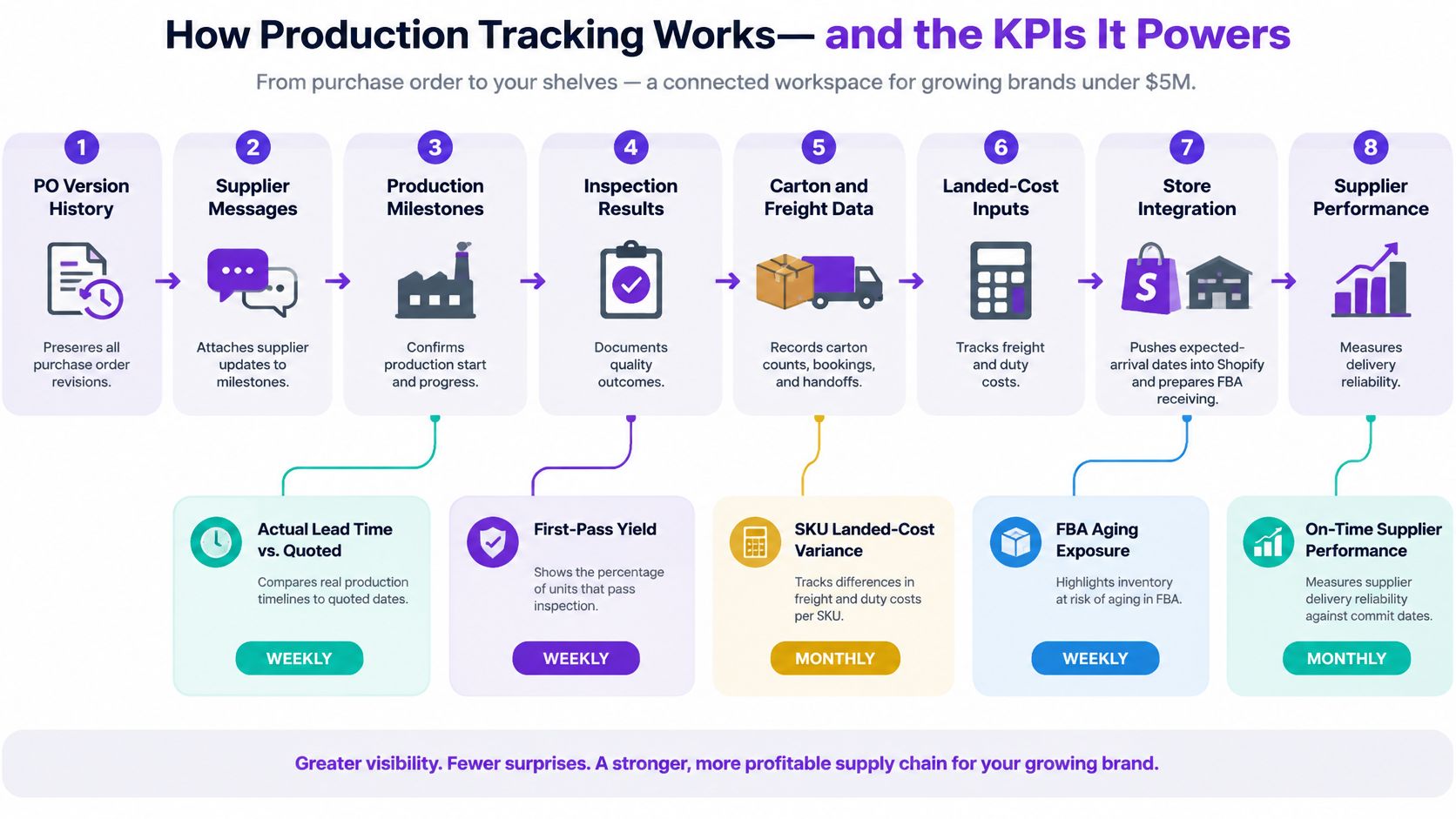
| Capability | Decision or KPI it should support | Review cadence |
|---|---|---|
| Approved PO version history | Open commitments and unresolved changes | Weekly operations |
| Messages attached to milestones | Forecast confidence and overdue evidence | Weekly operations |
| Planned and actual milestone dates | Actual lead time versus quoted lead time | Weekly operations |
| Inspection results with disposition | First-pass yield and rework exposure | Weekly operations |
| Carton counts and freight handoffs | Quantity reconciliation and pickup readiness | Weekly operations |
| SKU-level freight, duty, and fee inputs | Estimated versus actual landed-cost variance | Monthly finance |
| Store and fulfillment data mapping | Expected arrivals and FBA aging exposure | Weekly operations |
| Supplier performance history | On-time performance against a fixed baseline | Monthly supplier review |
For first-pass yield, divide accepted units requiring no rework by inspected units within the defined inspection scope. A sample inspection shouldn't be presented as though every unit was examined.
For supplier on-time performance, preserve the original approved commitment alongside revised dates. Otherwise, repeatedly moving the deadline can make an unreliable supplier appear punctual.
Confidence needs evidence, not decorative scoring
Use understandable confidence categories rather than unsupported precision:
- Unverified: A supplier assertion without supporting evidence.
- Supported: Relevant evidence exists, but an important dependency remains unresolved.
- Confirmed: The required evidence and approval for that milestone are recorded.
These are operational categories, not statistical probabilities. A completed inspection can support production readiness without proving that a carrier collected the goods.
The escalation design matters as much as the label. Guidance on flagging late supplier shipments early is relevant when defining which missing evidence warrants action.
Finance also needs consistent definitions. Jumpstart Partners' COGS and costing methods explained is useful context when agreeing how operational cost inputs should connect with accounting treatment. The controller should approve allocation rules before the team starts comparing SKU margins across orders.
How Two Real Brands Use Production Tracking Day to Day
The workflows below are illustrative scenarios, not documented customer case studies. They show how an Amazon replenishment and a Shopify launch can use the same operating sequence without pretending their risks are identical.
An Amazon FBA replenishment
An FBA seller issues a replenishment PO for an established SKU. Supplier confirmation records the accepted specification, quantity, and completion commitment; production start remains unverified until appropriate evidence arrives.
After inspection, the coordinator attaches the report and records whether goods are accepted, held, or awaiting rework. Carton information then supports freight planning, but readiness and pickup remain separate events.
- Before booking: Reconcile accepted quantities, carton data, and the approved shipment scope.
- At collection: Attach pickup evidence rather than treating a booking confirmation as movement.
- Before another reorder: Compare incoming quantities with existing inventory and expected sell-through.
If the supplier releases only part of the order, the remaining balance must stay open. A workflow for tracking partial shipments from suppliers prevents a shipped quantity from being mistaken for a completed PO.
A Shopify colorway launch
A Shopify merchant keeps a new colorway's launch PO separate from core-line replenishment. When sample approval slips, the coordinator changes the dependent production forecast without disturbing the confirmed core order.
The cost reviewer also checks whether the launch's current freight and duty assumptions remain valid. A launch date shouldn't stay approved merely because the goods can still be manufactured on time.
Shopify's inventory and location guidance describes managing inventory quantities, purchase orders, transfers, and locations. The integration should preserve the distinction between incoming production and inventory available for sale, with supported location behavior verified during implementation.
A forecasted arrival is planning information. It isn't permission to treat unfinished goods as sellable stock.
The shared workflow is evidence, approval, and handoff. The differing decision is commercial: the FBA seller evaluates replenishment exposure, while the Shopify merchant evaluates launch commitments and whether the new colorway still meets its margin target.
A Founder's Selection and Integration Checklist
The strongest demo starts with an existing PO, including its awkward revisions and incomplete records. A polished sample order proves little if the vendor can't preserve the relationships found in the brand's actual workflow.
The production tracking software selection scorecard below uses observable tests rather than feature claims. Each criterion should receive a demonstrated, unresolved, or failed result.
Test the workflow, not the presentation
| Criterion | What Good Looks Like | Weak Signal to Flag |
|---|---|---|
| Can existing POs be imported? | A real order imports with lines, dates, and attachments intact | Clean demo files only |
| How much onboarding work remains? | Named responsibilities and a clear migration scope | Setup described as effortless without examining data |
| Can suppliers collaborate practically? | A supplier can submit an update through an acceptable workflow | Mandatory duplicate entry |
| Are PO revisions preserved? | Prior terms and approvals remain accessible | Latest attachment overwrites history |
| Can inspections block progression? | Failed results create an explicit hold | Reports stored without operational consequences |
| Are carton and shipment balances linked? | Partial quantities reconcile to the original order | Shipment closes the entire PO |
| Can SKU costs be explained? | Allocation inputs and assumptions are visible | Unexplained landed-cost totals |
| Does Shopify mapping work? | The actual SKU reaches the intended arrival field or workflow | A logo substitutes for a demonstrated connection |
| What does FBA integration include? | Exact supported fields and responsibilities are documented | Broad claims of Amazon compatibility |
| Is the audit trail usable? | Actor, timestamp, approval, and changed values can be retrieved | Activity feed without change detail |
| What happens when access ends? | Roles can transfer and records can be exported | Messages remain tied to a departing employee |
| What is the total cost? | Subscription, migration, connectors, support, and export terms are clear | Essential work appears after purchase |
Make the vendor demonstrate failure
Ask the vendor to revise a supplier price, reject an inspection, split a shipment, and remove a user. The coordinator should still be able to recover the approved commitment and identify the remaining obligation.
A proposed migration from Excel to automated purchase order tracking should preserve useful history rather than discard it for a clean launch.
- After the trial: Establish where messages and attachments remain, and how exports work.
- During onboarding: Confirm who cleans supplier names, SKU mappings, and duplicate orders.
- During integration failure: Require visible errors and an owner for reconciliation.
A lightweight workspace with clear limits can be a better purchase than broader software whose essential workflows require continual manual repair.
The Uncomfortable Truth About Status Dashboards Without Cost Control
An on-time production run can still be a poor purchase. If supplier prices, freight assumptions, or applicable duties change, the purchasing team may approve inventory that no longer meets the brand's margin requirements.
In the business-owner supply-chain survey discussed by Gallagher, 90% of respondents expressed concern about tariff impacts and 93% about supply-chain disruption over the following year. Those findings don't establish a particular brand's loss, but they reinforce the need to test cost assumptions before committing more cash.
A hypothetical duty change during production
Suppose an importer's customs adviser confirms that a Section 301 change applies to goods currently in production. The cost reviewer needs the relevant origin, classification, applicable timing, and supporting advice before changing the estimate.
The approved supplier PO shouldn't be rewritten to make the new landed cost appear original. Instead, the team should preserve the commercial commitment, record the changed duty assumption separately, and identify who approved the resulting decision.
- Purchasing consequence: Does the remaining order still justify its cash commitment?
- Pricing consequence: Can the Shopify offer or Amazon selling plan support the revised economics?
- Audit consequence: Can finance reconcile the original estimate, approved changes, and actual charges?
The operational discussion should stay attached to the cost record rather than disappear into an unrelated spreadsheet. This video can serve as a discussion prompt during a purchasing and finance review.
<iframe width="100%" style="aspect-ratio: 16 / 9;" src="https://www.youtube.com/embed/dPRORzTokzg" frameborder="0" allow="autoplay; encrypted-media" allowfullscreen></iframe>
Distinguish a forecast from accounting evidence
Estimated landed cost supports decisions before receipt. Actual invoices and the controller's approved treatment support reconciliation afterward; the software should show that distinction.
A method for tracking product costs across the supply chain should make assumptions inspectable at SKU level. A green dashboard becomes dangerous when employees interpret its status as approval to spend, despite unresolved cost changes.
Control test: Finance should be able to explain why the current estimate differs from the approved purchase decision without reconstructing a chat history.
Calculating ROI With Avoided Outcomes Instead of Vanity Metrics
A defensible ROI model starts with events the brand can identify in its own records. Faster clicking isn't equivalent to avoided freight, prevented duplicate purchasing, or a corrected reorder decision.
Amazon states that FBA inventory stored for 181 days or longer is subject to an aged-inventory surcharge, assessed on the 15th of each month, with potentially affected units and estimated charges available in the dashboard, according to Amazon's aged-inventory guidance. Production planning should therefore consider existing stock before approving another inbound quantity.

Separate fee exposure from proven savings
Amazon's US storage-utilization surcharge has distinct eligibility conditions: a Professional account, a first US fulfillment-center shipment more than 365 days earlier, average daily inventory of at least 25 cubic feet for the relevant size tier, and a utilization ratio exceeding 22 weeks, calculated using the preceding 13 weeks, as detailed in Amazon's storage-utilization rules. It shouldn't be modeled as a universal seller charge.
Use formulas that retain supporting evidence:
- Avoided expediting expense: Emergency transport expense minus the standard transport expense that would otherwise apply.
- Prevented duplicate commitment: Cancellable duplicate purchase obligation minus any cancellation expense.
- Corrected cost exposure: Revised SKU landed cost minus the prior estimate, multiplied by affected units.
- Net monthly benefit: Documented avoided expense plus evidenced labor savings, minus subscription and allocated implementation costs.
The corrected cost exposure is a decision input, not automatically a saving. Savings require an action that changes the outcome.
Build the evidence file
Use QuickBooks records for posted costs, Shopify records for inventory and sales context, Amazon reports for fee exposure, and freight invoices for transport comparisons. Record the intervention and the outcome rather than crediting every favorable result to the software.
Compare a conservative monthly benefit with the vendor's complete monthly cost. If the business case works only by assuming every warning prevents a loss, the subscription decision isn't ready.
Putting It Together and Choosing Your Next Step
Production tracking software is worth evaluating when a brand can't reliably connect a supplier commitment to its evidence, financial consequences, and next decision. The purchase shouldn't depend on how many stages appear on the screen.
The final buying filter is deliberately short:
- Traceability: Can an operator follow an affected batch from supplier evidence to its shipment?
- Version history: Can purchasing recover the approved terms rather than merely find the latest file?
- Landed-cost integration: Can finance inspect the SKU-level assumptions behind a margin decision?
- Shopify and Amazon readiness: Does the workflow distinguish forecasts, physical movement, and received inventory?
- Total ownership cost: Are migration, maintenance, support, and exit obligations understood?
Recognize purchase-stopping signals
Opaque costing, demo-only workflows, and missing version history should stop a purchase. Each prevents the brand from validating an important operating claim.
The corresponding green flags are explainable calculations, successful tests with real orders, and recoverable approval history. Those are stronger signals than a long integration list.
The practical next step is to pull a recent completed PO and a current troubled PO. Reconstruct the decisions, identify avoidable expenses using the ROI method, and run shortlisted tools through the scorecard before committing to a trial.
A successful evaluation leaves the coordinator able to explain what changed, the controller able to explain its cost, and the founder able to approve the next action. If the team still needs to search a messaging app to answer those questions, the operating problem remains.
Supply Automate offers a shared workspace for supplier messages, version-controlled purchase orders, production milestones, and SKU-level landed-cost calculations alongside existing logistics providers. Its free calculators and 30-day trial provide a starting point for testing actual orders rather than demo-only workflows. Visit Supply Automate to evaluate whether its records support a real replenishment or launch decision.