
The price is a screenshot.
The ship date is three messages later.
The payment QR sits in a different chat.
The factory is building whatever they last said yes to, which may not be the PDF you think you sent.
That holds until they ship the old variant, freight moves, or someone pays a new QR because "boss changed the account."
Then you find out WeChat was the whole system.
Use this as the how-to for Amazon FBA and Shopify importers who run China factories on WeChat.
WeChat is the channel.
It is not the purchase order, the invoice folder, or the cost record.
- The document the factory has to acknowledge: creating a purchase order
- Where the PDFs go after the chat: organize supplier invoices
- The system that has to hold the PO, the files, and the dates: supplier management software
Stay here for the chat-to-record workflow.
If The Order Still Lives In WeChat
You import finished goods from factories or trading companies in China.
Day-to-day lives in WeChat.
The POs repeat.
You sell on FBA, Shopify, or both.
Skip a long process if you buy stocked domestic SKUs from one vendor who already ships the same carton on email.
You still need a number, a quantity, and a price.
You do not need a WeChat filing rule.
WeChat Is The Channel, Not The Record
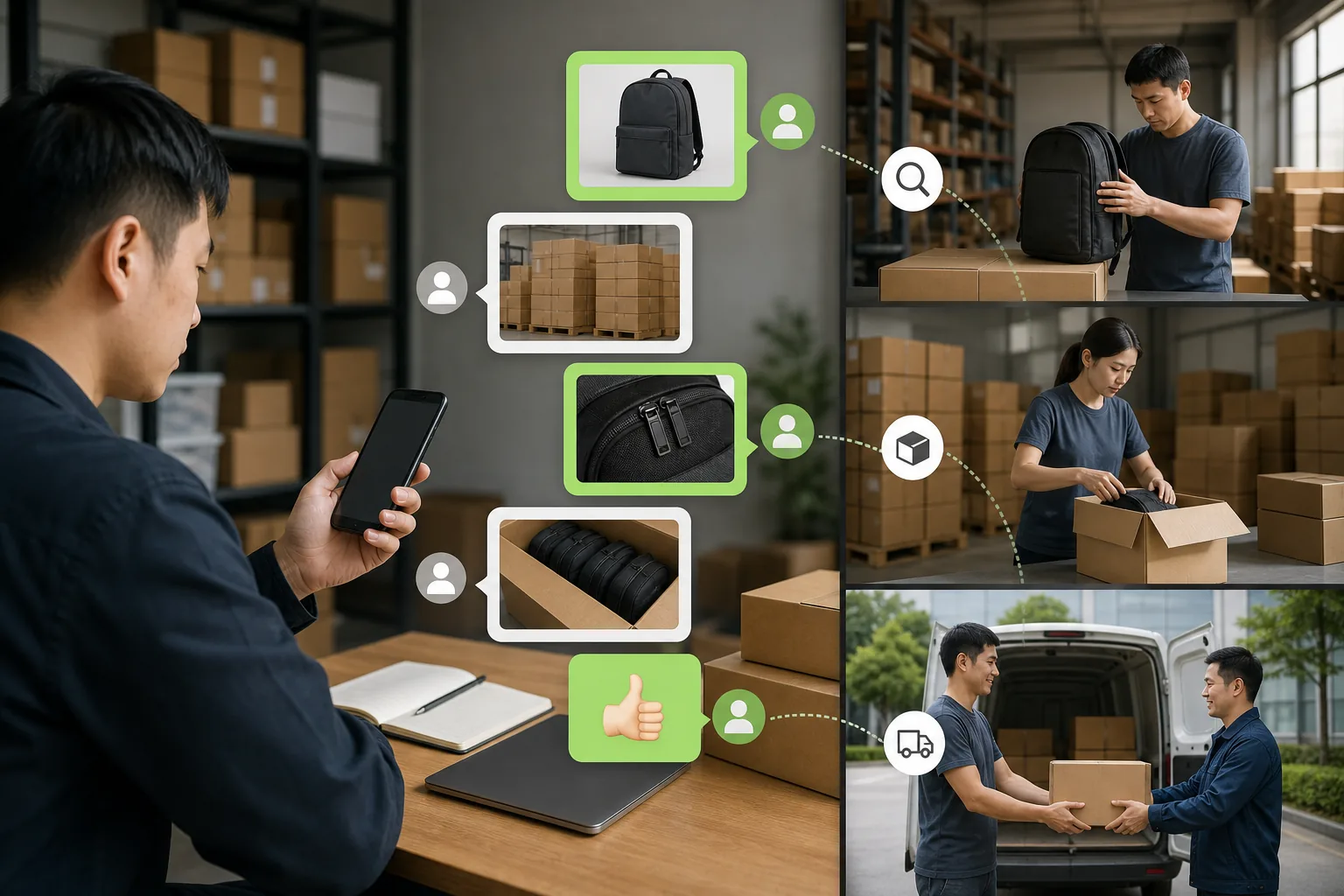
WeChat is the right place to talk.
Quotes, sample photos, carton marks, a slipped date, a payment receipt, a tracking number: that is what the thread is for.
Most factories will not log into a portal.
Do not build a process that assumes they will.
It is a weak system of record.
Messages scroll.
Screenshots get compressed.
A voice note is not a version.
Two people cannot reconstruct the order from a phone that belongs to one buyer.
| Object | Fine In WeChat | Has To Live On The PO |
|---|---|---|
| First quote | Photo or PDF in the thread | Agreed unit price, currency, MOQ |
| Spec or artwork | Sample photo, file drop | Named file version the factory is building |
| Date | "Maybe 20th" in chat | Promised production-complete and cargo-ready dates |
| Payment | QR, receipt, "paid" sticker | Amount, payee, method, matched to the PO |
| Shipment | Tracking paste | Carrier, booking, carton count, destination |
If a date change only exists in chat, the PO is decoration.
Same test as the supplier-software post.
The thread can notify.
It cannot be the current file.
Add The Supplier Once, Then Name The Contact
You can add a factory four ways: WeChat ID, mobile number, QR code, or a shared contact.
If a search by ID fails, try another method.
Some accounts have no searchable custom ID.
Send a short note with your name, company, product, and why you are adding them.
Friend requests expire.
A blank request from a foreign number looks like spam.
Name the contact so a teammate can find it.
Factory legal or trading name, role, product family.
Shenzhen Apex / sales / yoga-mat beats Amy and a flag emoji.
The usual trap is a personal WeChat that is also the company inbox.
That works while one person owns buying.
It fails the day that person is offline and the factory asks which carton mark to print.
A work account only helps if the factory will use it.
Most will not.
The fix is not a second chat app.
The fix is getting the decision off the phone and onto the PO.
Check Moments or an activity feed before you send money if you want.
Recent product posts are not due diligence.
They are not a business license, a factory audit, or a payee match.
A Screenshot Is Not The Quote
Marketplace listings and WeChat photos lie in the same way: they look current.
The page can change after you save it.
The screenshot can be last month's price, a different MOQ, or a cousin SKU with the same hero image.
Keep the listing as a reference.
Save the date, the variant, and the quoted terms.
Then compare that file with what the factory says in chat.
If price, MOQ, material, pack, or lead time moved, the purchase order moves.
The latest bubble is not the deal.
A risky confirm:
Price is 6.2 now. Same as last time. Can you pay today? Ship mid month.
"Same as last time" can mean the old insert, the old carton pack, or a price that no longer matches material cost.
"Mid month" is not a cargo-ready date.
On FBA, a carton-label miss is extra prep and a late check-in.
A usable confirm:
Please confirm PO-2026-0147. 2,000 units of SKU A, black, carton pack 20, FNSKU file v3. Unit price $6.40, FOB Ningbo, deposit 30%, balance against copy docs. Cargo-ready window 18 Oct. Reply with any exception before production.
The screenshot can sit on the order as evidence.
It does not replace the line.
If the photo says $6.20 and the PO says $6.40, someone has to resolve that before a deposit goes out.
Changes Get A New PO Version
Chat is where control dies.
One message, a new artwork file, a production update that caught half the request.
Risky:
Can we update the order to the newer packaging? Also maybe adjust quantities if possible.
Safer:
Please revise PO-2026-0147 to packaging file version B. Keep total units. Update the mix in the attached revision: SKU A up, SKU B down. Confirm any impact on unit price, carton count, gross weight, production timing, and booking readiness before you proceed.
Specific.
Tied to the PO version.
The factory has to answer the cost and date impact before they cut.
| Change | Version |
|---|---|
| Typo only, no commercial or ops change | Keep the version |
| Quantity, price, date, packaging, labels, or Incoterm | New version |
Name it PO-2026-0147-v2.
Mark v1 superseded.
Resend the whole document.
Get the factory to confirm they are building that version.
If you are costing v3 and they are building v1, that is inventory risk on every unit in the container.
Do not copy the whole thread onto the order.
Record the decision: what changed, who said it, the date, the new version.
Silence is not acceptance.
What To Pull Out Of The Thread
One PO number per order.
Hang later files on that number.
Organize supplier invoices by PO, including the ones that arrived as WeChat forwards.
| In The Chat | Save As | On The Record |
|---|---|---|
| Quote or PI photo | Named PDF or image | Current price, superseded if revised |
| Spec, artwork, carton mark | File plus version | The version named on the PO |
| "Can ship 20th" | Dated note | Promised date field, not a comment |
| Payment QR and receipt | Receipt plus payee | Amount matched to the PO, not a vibe |
| Tracking or bill of lading | Booking file | Shipment, carton count, destination |
| Production or label photos | QC evidence | Proof of build, not a new spec |
A shared sheet is fine while one person owns buying.
One row per SKU or PO line.
Supplier, SKU, qty, unit cost, currency, promised ship date, payment status, tracking.
A last-updated field.
The original quote in a locked file so nobody types over it.
Paste a short note or a message timestamp into the row.
Do not paste fifty bubbles.
The row holds the decision that changed the order: carton count, inspection date, revised unit price.
Paying Through WeChat
Paying through WeChat is not automatically safe.
Verify the payee against the PO before anyone scans a QR.
- The QR belongs to the legal payee on the order, not a new personal account that appeared this morning.
- The amount matches the deposit or the balance on that PO version.
- You save the receipt on the same record as the commercial invoice.
- You know what buyer protection you are giving up. A transfer to a personal wallet is not a letter of credit.
"Boss changed the account" is a common fraud pattern and a common real change.
Treat it as a payee change.
Get it in writing.
Update the PO.
Send a small test only if you still cannot verify, then stop until the name matches.
Start new factories small when you can.
A WeChat activity feed is not proof they will ship what you ordered.
Estimate Landed Cost Before You Reorder
A founder approves the next buy off a WeChat quote.
Two weeks later the forwarder revises freight, customs asks for the heading, and FBA prep adds a line.
The chat was "correct."
The buy was not.
Same shipment the other importer posts use.
2,000 units at $6.40.
Sheet used the first freight quote and the PO quantity: $8.50.
Documents and 1,970 sellable units: $9.06.
Approve the next PO off $8.50 and every unit is $0.56 light before ads.
The freight change was in someone's inbox.
The shortage was on the packing list.
Neither made it back into the WeChat number used to reorder.
What landed cost is is why that gap matters.
Run the last shipment through the landed cost calculator before you send PO-2026-0147 again.
The factory offering $6.20 at 3,000 instead of $6.40 at 2,000 is the other trap.
The bubble looks better.
The container, the storage, and the cash locked before sell-through may not.
When Chat And A Sheet Stop Being Enough
A phone plus a sheet holds while one person has the current numbers and the documents are findable.
It breaks when a date, a file, or a cost regularly lives in a place the PO cannot see.
Two messy factories are enough.
Then you need a record that keeps the supplier, the PO version, the documents, the dates, and the inbound cost attached to each other.
Supplier management software is that shortlist.
Do not buy a tool because it promises to "sync WeChat."
Ask whether a second person can reconstruct the shipment without opening the phone.
SupplyAutomate is built for that job: purchase orders, supplier documents, and landed cost in one workspace.
Upload the quote, the invoice, and the freight bill.
Match them to the PO.
See the SKU cost and what is still late.
It does not replace WeChat.
It does not invent a lead time you never recorded.
Start with one open order and the files already in the thread.
If the gap is follow-up as well as recordkeeping, outsourcing supplier order management is a staffing decision, not a chat decision.
The PO still has to exist.
Keep the templates until the software has earned the right to replace the sheet.
FAQ
Can WeChat Manage Supplier Orders By Itself?
It can carry the conversation.
Price questions, a ship-to, payment proof, and tracking often start there.
It should not carry the whole order.
Copy the final terms onto a PO the factory acknowledges.
Amazon FBA and Shopify sellers need a place to check what was ordered and what it cost after freight and duty.
How Do I Add A Chinese Supplier On WeChat?
Use their WeChat ID, mobile number, QR code, or a shared contact.
Open Contacts, add, and send a short note with your company and product.
If one method fails, ask for another instead of sending repeated blank requests.
Is It Safe To Pay A Supplier Through WeChat?
Not by default.
Match the QR to the PO payee, match the amount to that version, and save the receipt on the order.
Be cautious with methods that drop buyer protection, especially on a factory you have not shipped with.
How Do I Keep WeChat Orders Organized?
One PO number per order.
Record the decisions that change quantity, price, pack, date, or payee.
Save the quote, the receipt, the ship-to, and the tracking on that record.
A sheet works for a small team.
A supplier system is for when the files and the dates have to survive a second person.
What If The Factory Changes The Price In Chat After I Sent The PO?
That is a revision, not a chat update.
Issue v2, show the new price, and get a written yes before anyone produces or pays.
If they already started, get the impact on the units in process in writing.
Do not let a screenshot sit next to v1 and call it current.
The latest WeChat bubble is not the buy.
The useful record is the PO version the factory acknowledged, plus the last date change and the last payment.
The PO template or PO creator will get that on paper.
If dates, files, and cost still live in the phone, the next system to try is the one that keeps them on the order.