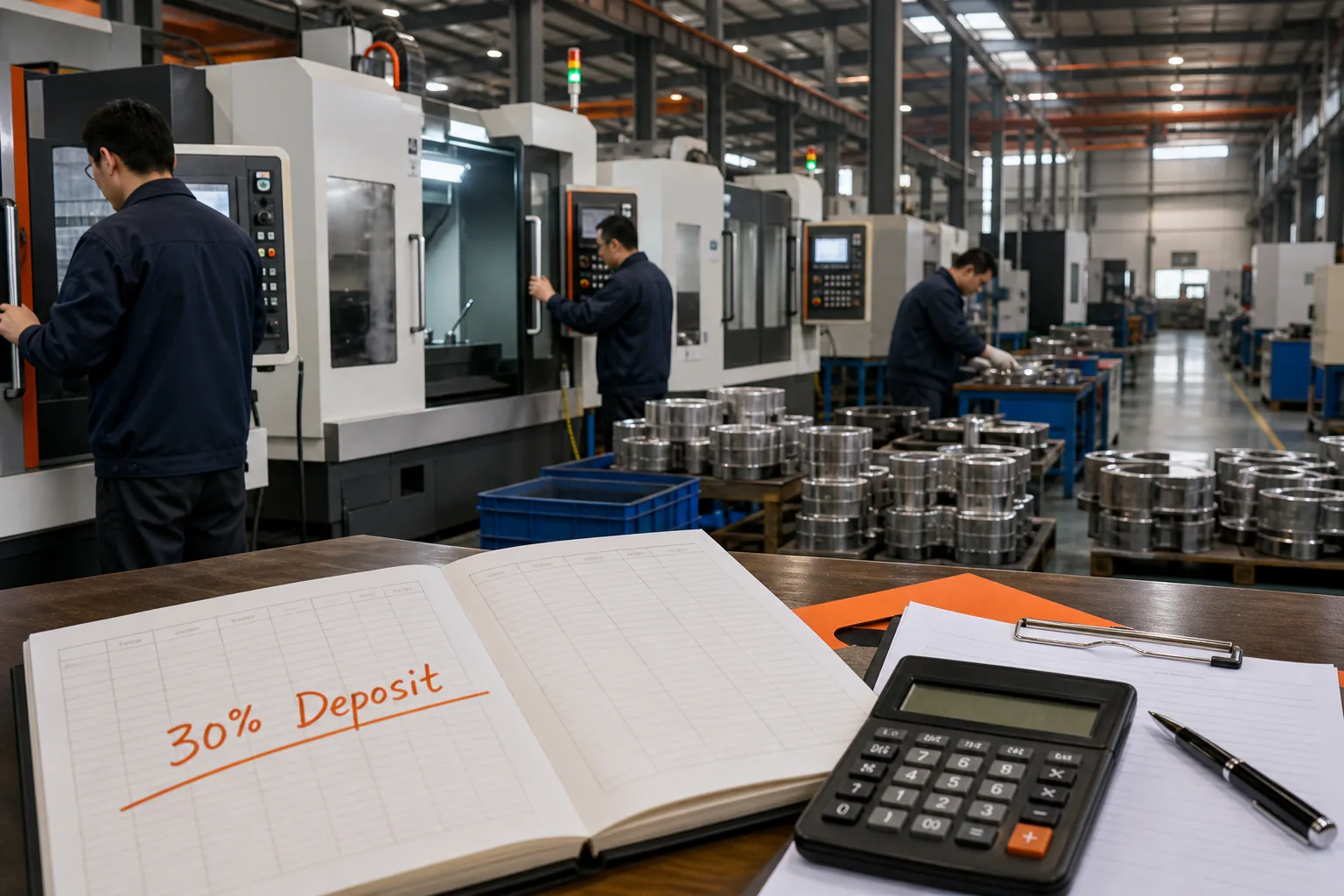
The quote looks good, the samples passed, and then the factory sends its standard line: 30% deposit to start production, 70% balance before shipment. If you sell on Amazon FBA or Shopify and buy from China, you will likely see that split on your first order with a new factory. It is common enough that it is easy to accept without asking what the balance is actually tied to.
I have wired plenty of 30% deposits on WeChat promises, and the split itself has rarely been the problem. The trouble usually came from a vague trigger for the 70%, or from a cash plan that forgot the freight bill and duty were still coming. This guide walks through how 30/70 terms work, why factories ask for them, how they compare with the other terms you will see, what to settle before the deposit leaves your account, and how to keep the payments tied to your purchase order and landed cost.
TL;DR
- Under 30/70 terms you pay 30% of the order value by bank transfer (T/T) when the purchase order is confirmed, and the remaining 70% at a point you agree on, usually after a pre-shipment inspection or against a copy of the bill of lading.
- Factories ask for the deposit to fund raw materials and line setup, so the split is a normal starting point for a first order with a new supplier.
- The 70% balance is your main leverage once production starts, so put the release trigger in writing: an inspection pass, a bill of lading copy, or both.
- Other terms you will see include 20/80, full payment upfront or against a bill of lading copy, and, rarely with a new factory, payment after delivery on open account. Each one moves risk and cash timing between you and the supplier.
- Plan cash for the whole shipment. Freight, duty, samples, and bank fees arrive on their own schedule, and your real unit cost only settles once those bills are in.
- SupplyAutomate keeps the PO, supplier invoices, freight bills, and customs entries for each order in one place and calculates landed cost from factory price, freight, duty, and samples. It has no Shopify, Amazon, or QuickBooks connection, so payments and sales stay in your own bank and store tools.
What 30/70 Payment Terms Mean In Practice
A 30/70 term splits the order value into two payments. The deposit goes out by telegraphic transfer when you confirm the PO, and the factory starts buying materials and booking line time. The balance goes out later, at a trigger written into your agreement with the supplier.
Here is a simple illustration with round numbers. On a $20,000 purchase order, the deposit is $6,000 and the balance is $14,000. That $14,000 is the money you still control after production starts, so the condition attached to it matters more than the percentages.
These are the balance triggers you will usually see:
| Trigger for the 70% | What you see before paying | What it protects |
|---|---|---|
| Before shipment, on supplier notice | A message that goods are ready | Very little, since you rely on the factory's word |
| After pre-shipment inspection | A third-party inspection report | Quality, quantity, and packing against your spec |
| Against a copy of the bill of lading | Proof the carrier has the goods | That the goods actually shipped |
| Inspection plus bill of lading | Both documents | Quality and shipment together |
The bill of lading is the carrier's receipt for the cargo. When the balance is tied to a copy of it, you know the goods are on their way before the last payment leaves. When the balance is also tied to an inspection report, you know what was packed matches what you ordered. If you are still deciding who books freight and where the factory's responsibility ends, read FOB vs EXW vs DDP for FBA sellers first, because the Incoterm changes which documents you will see and when.
Why Chinese Suppliers Ask For A 30/70 Split
Factories carry real cost before your goods exist. They buy raw materials, cut tooling or molds when needed, and reserve production time that could have gone to another buyer. The deposit covers that early spend and gives the factory some protection if a buyer cancels midway through a run.
The balance before shipment protects the factory on the other end. Once goods leave the port, a small factory has very little leverage to collect from an overseas buyer. Holding the goods until the balance clears is their version of the control you get from holding the 70%.
Seen that way, 30/70 is a reasonable compromise between two businesses that have not worked together yet. The parts worth negotiating are the trigger for the balance, the inspection rights, and what happens if the goods fail inspection. As the relationship builds, you can also ask for a smaller deposit or a split balance, such as part after inspection and the remainder against the bill of lading. Treat those as negotiation options for your own supplier.
When 30/70 Terms Work Well For Ecommerce Sellers
The split tends to work well when the order size is one you could absorb if something went wrong, and the supplier has already shown they can hit a spec. Your sample history, your supplier evaluation notes, and how clearly the factory answers questions about the production schedule all tell you a lot here.
Good signs before you agree:
- The factory gives you a production schedule with an expected ready date.
- They agree to a third-party inspection before shipment, at a date you can book.
- The proforma invoice and contract name the balance trigger in plain words.
- The bank details on the invoice match the company name you vetted.
That last check deserves a moment. Payment instructions that change partway through an order, or a request to pay a personal or differently named account, are reasons to stop and confirm by phone or video call with someone you already know at the factory.
Other Payment Terms You Will See
A 30/70 split is one of several structures a factory might put on a proforma invoice. The other common ones move the same two levers: how much you pay before production, and what has to happen before the rest goes out. I will keep using the $20,000 purchase order from above so the cash timing is easy to compare.
20/80 Deposit And Balance
A 20/80 term works like 30/70 with a smaller deposit. You pay 20% when the PO is confirmed, so $4,000 on a $20,000 order, and the remaining 80%, or $16,000, at the agreed trigger. The trigger options are the same ones from the table above, and an inspection report or bill of lading copy is still the safest condition to attach.
Factories usually offer 20/80 when the materials are inexpensive or already in stock, or when you have placed clean orders with them before. Some will also accept it on a larger repeat order where the relationship is worth the extra exposure. Asking for it on a first order is reasonable, and the answer tells you a little about how much working capital the factory has.
For you, the smaller deposit means less money at risk before any goods exist. The balance is bigger, though, so the release trigger carries even more weight. For the supplier, it means funding more of the material cost from their own cash and taking a larger hit if you cancel midway through production.
On cash flow, 20/80 keeps more money in your account during production. The tradeoff is a larger single payment right before shipment, which tends to land close to the freight bill, so plan for both in the same few weeks.
Full Payment Before Shipment
Full payment comes in two forms. With 100% upfront, you pay the whole $20,000 when you place the order. With 100% against a copy of the bill of lading, the factory produces and ships using its own money, sends you the copy once the goods are with the carrier, and releases the original bill of lading or a telex release after your payment clears.
Factories usually ask for 100% upfront on small orders, samples, stock items, and orders placed through trading companies. Payment against the bill of lading copy is the opposite case. It usually comes from an established factory that trusts you and can carry the production cost itself, often after several orders together.
The risk lands very differently between the two. With 100% upfront, you carry all of it, since the factory has your money before anything is made and your only leverage is the relationship. With payment against the bill of lading copy, you know the goods have shipped before you pay, and the factory keeps control of the cargo until your money arrives. You still want a pre-shipment inspection, because the bill of lading proves the goods shipped while the inspection report covers their quality.
For cash flow, 100% upfront ties up the most money for the longest stretch, often the whole production and transit time. Payment against the bill of lading copy keeps your cash until the goods are on the water, which is close to the best timing you will get from a new factory.
Payment After Delivery
Payment after delivery is usually called open account or net terms. The goods ship, arrive, and you pay within an agreed window, such as 30 or 60 days from the invoice or delivery date. What is net 30 covers how those windows work for importers.
Chinese factories rarely offer this to a new buyer. It usually shows up only after a long record of on-time payments, with large buyers, or when the factory has trade credit insurance covering the account. If a supplier you have never worked with offers it on the first order, ask a few extra questions about who you are dealing with.
This is the lowest risk position for you, since you can inspect the goods before paying and hold payment if something is wrong. The supplier carries the full production cost and the credit risk on top of it. That is why the terms usually come with a credit limit, and sometimes with a slightly higher unit price.
For cash flow, open account is the most comfortable term an importer can get. You may sell part of the shipment before the invoice is due. Check whether the clock starts at the invoice date, the bill of lading date, or delivery, because that changes how much selling time you actually have.
Payment Terms Side By Side
| Term | When you pay | Buyer risk | Supplier risk | Your cash tied up during production |
|---|---|---|---|---|
| 30/70 | 30% at PO, 70% at the agreed trigger | Medium, depends on the trigger | Medium | $6,000 on a $20,000 order |
| 20/80 | 20% at PO, 80% at the agreed trigger | Lower before production, higher at the trigger | Higher than 30/70 | $4,000 on a $20,000 order |
| 100% upfront | Everything at PO | Highest | Lowest | $20,000 on a $20,000 order |
| 100% against B/L copy | Everything once goods ship | Lower, quality still needs inspection | Higher, carries production cost | None until shipment |
| Open account or net terms | After delivery or invoice, within the window | Lowest | Highest | None until after delivery |
Whatever the structure, the same habits from the rest of this guide apply. Put the trigger in writing, tie each payment to a document, and plan cash for freight and duty on top of the supplier payments.
What To Lock Down Before You Pay The 30% Deposit
Once the deposit is sent, your negotiating position shifts, so do the paperwork first. I keep it to three pieces.
First, a purchase order with the details that will matter later. That means SKUs, quantities, unit prices, packaging, labeling for FBA if needed, the Incoterm, and the payment terms with the balance trigger spelled out. Creating a purchase order covers what a solid PO includes, and purchase order management for Amazon FBA sellers shows how to keep it current as things change.
Second, an inspection plan. Decide who inspects, against which spec, and roughly when. The report from that inspection becomes the document that releases your balance, so agree on what counts as a pass before production starts.
Third, a written record of the deal outside the chat thread. Many suppliers negotiate in WeChat, and that is fine for speed. Copy the agreed price, terms, and trigger into the PO and attach the proforma invoice so nobody has to scroll back through months of messages. How to manage supplier orders over WeChat has a routine for that.
Managing Cash Flow, Landed Cost, And Payment Risk
The deposit and balance are only part of what a shipment costs you. After the balance clears, the freight bill arrives, then the customs entry with duty, and you may have paid for samples weeks earlier. Your bank will usually charge a fee on each outgoing international wire as well. If your cash plan only covers the two supplier payments, the later bills land as a surprise.
A simple way to plan is to list every expected payment for the order with an approximate date: deposit, balance, freight, duty, and any inspection fee. Then line those dates up against the cash you expect from sales. If you also buy on longer credit terms with other suppliers, what is net 30 explains how those due dates interact with a shipment that is still on the water.
Landed cost is where all of those bills come together into a per-unit number. Add the factory price, freight, duty, and samples for the order, then divide by the sellable units. How to calculate landed cost and landed cost per unit walk through the math, and calculate import duty from China helps you estimate duty before the entry arrives. Wire fees are worth tracking alongside, especially on smaller orders where they make up a bigger share of the total.
Channel guides take that number further. Use how to calculate Amazon FBA landed cost if you sell through Amazon, and how to calculate Shopify landed cost if you sell on your own store.
Matching Each Payment To The Invoice
Every payment on a 30/70 order should trace back to a document. The deposit matches the proforma invoice. The balance matches the commercial invoice and, often, the packing list and bill of lading. If the commercial invoice total differs from the PO because of a short shipment or a price change, sort that out before the balance goes out.
That check is the same one you would run on any supplier bill. How to reconcile a supplier invoice to a purchase order goes through it line by line, and how to organize supplier invoices covers keeping the deposit, balance, and freight paperwork filed under one PO.
Where SupplyAutomate Fits
SupplyAutomate handles the document and cost side of a 30/70 order. You upload the proforma and commercial invoices, packing lists, freight bills, and customs entries against the purchase order, track the parcel or ocean container, and calculate landed cost from factory price, freight, duty, and samples. You can export the result to CSV or Excel for your books or pricing sheet.
It does not send payments and has no Shopify, Amazon, or QuickBooks connection, so you still pay suppliers through your bank and enter costs in your store and accounting tools yourself. If you would rather have someone else chase production, inspections, and freight for you, the Outsourced Supply Chain Manager option covers that work. Current plans are on the pricing page.
FAQ: 30/70 Payment Terms With Chinese Suppliers
What Does 30/70 Mean In Supplier Payment Terms?
It means you pay 30% of the order value as a deposit when the purchase order is confirmed and the remaining 70% later. The timing of the 70% depends on the trigger you agree on, such as an inspection pass or a copy of the bill of lading.
Can I Negotiate A Different Split?
Yes, the split and the trigger are both negotiable. The conversation is usually easier once you have placed a few clean orders with the same factory. Common asks include a 20/80 split, splitting the balance between inspection and shipment, or moving to payment against a bill of lading copy once the factory trusts you.
Will A Chinese Supplier Let Me Pay After Delivery?
Sometimes, though rarely on a first order. Open account or net terms usually come after a long record of on-time payments, and often with a credit limit attached. Until then, payment against a bill of lading copy is the closest you will usually get to paying after the goods ship.
Is 100% Upfront Ever Reasonable?
It can be for samples, small orders, and stock items where the amount at risk is small. On a full production order with a new factory, ask for a deposit and balance split instead, and attach the balance to an inspection report or bill of lading copy.
What Should Trigger The 70% Balance?
A third-party inspection report against your spec, a copy of the bill of lading, or both. Whatever you choose, write it into the purchase order and the proforma invoice so both sides read the same condition.
How Do I Protect My Deposit?
Vet the supplier, confirm the bank account name matches the company, and put the spec, schedule, and remedies for missed deadlines in writing before you pay. Keep the proforma invoice and payment confirmation filed with the PO in case you need to raise a dispute.
What Is A Bill Of Lading And Why Does It Matter Here?
A bill of lading is the carrier's document confirming it has received the goods for shipment. Tying the balance to a copy of it means you pay the final 70% once the goods have actually shipped.
Does The Deposit Change My Landed Cost?
The deposit and balance together make up the factory price, so the split only affects the timing of your payments. Your landed cost per unit comes from the factory price plus freight, duty, and samples for the order. Track bank fees on top if you want them in your margin view.
Related Guides
- What Is Net 30
- FOB Vs EXW Vs DDP For FBA Sellers
- How To Manage Supplier Orders Over WeChat
- Creating A Purchase Order
- Purchase Order Management For Amazon FBA Sellers
- How To Reconcile A Supplier Invoice To A Purchase Order
- How To Organize Supplier Invoices
- Supplier Evaluation Matrix Guide
- How To Calculate Landed Cost
- Landed Cost Per Unit
- Calculate Import Duty From China
- How To Calculate Amazon FBA Landed Cost
- How To Calculate Shopify Landed Cost