An EXW price is the supplier's charge for making goods available at a named place, usually the factory or warehouse, ready for collection, and it excludes loading, freight, insurance, duties and delivery. For example, 500 units quoted at $8 EXW can become $14 per unit once the buyer adds the shipment's logistics and import costs.
That difference changes the purchasing decision. An Amazon FBA or Shopify seller doesn't need the lowest factory invoice. The seller needs inventory delivered to the right warehouse at a cost that leaves room for a workable margin.
Table of Contents
- What an EXW Price Means in Plain Terms
- A defined rule, not pricing shorthand
- What the EXW Price Covers and What It Leaves Out
- Read the scope before comparing the number
- Where Responsibility and Risk Pass to the Buyer
- Collection isn't the only origin-country problem
- Turning an $8 Factory Quote Into a Real Unit Cost
- Build the calculation from shipment costs
- Allocate costs without distorting the SKU
- Amazon FBA and Shopify Costs EXW Quotes Miss
- Amazon FBA needs a documented inbound arrangement
- Shopify needs separate inbound and outbound views
- Risks Buyers Carry Under an EXW Deal
- Risk allocation doesn't settle every liability dispute
- Checkout collection must match the shipping service
- Confirm the Landed Cost Before You Accept EXW
- Compare equivalent outcomes
<a id="what-an-exw-price-means-in-plain-terms"></a>
What an EXW Price Means in Plain Terms
EXW means Ex Works, a delivery rule that ends at the supplier's door. A furniture shop quoting a boxed sofa sitting on its loading dock works the same way: the van, fuel, stairs and any applicable import tax stay outside that price.
The term is common enough to deserve careful attention. A 2023 Cargoflip analysis of EXW quotations reported that EXW appeared in 35.2% of quotations, making it the second-most-popular Incoterm in its dataset. That finding describes one dataset, not every international transaction. Still, it shows why buyers should recognize the term before comparing suppliers.
<a id="a-defined-rule-not-pricing-shorthand"></a>
A defined rule, not pricing shorthand
The International Chamber of Commerce created the Incoterms framework, first published in 1936, to standardize commercial delivery terms. Its history of the Incoterms rules explains the framework behind terms such as EXW.
A purchase order should identify both the named place and the applicable rule version, such as EXW Shenzhen, Incoterms® 2020. A full factory address makes that reference more useful operationally.
So what does an EXW price tell a buyer? Three parts answer that. The supplier's scope is the goods made available at the named place. The buyer's landed-cost calculation adds freight, insurance, duty and delivery on top of that figure. The pre-order checks confirm the named place, who files the export declaration and who acts as importer of record.
A low EXW quote only means something once all three agree. For an Amazon FBA or Shopify seller, the second part carries the most weight, because the platform decides which delivery costs belong in the per-unit total.
<a id="what-the-exw-price-covers-and-what-it-leaves-out"></a>
What the EXW Price Covers and What It Leaves Out
| Cost item | In the EXW price? | Who arranges and pays |
|---|---|---|
| Goods and factory packing | Yes | Seller provides them within the quoted price |
| Loading onto the buyer's truck at origin | No | Buyer |
| Origin inland transport and export clearance | No | Buyer |
| Main carriage, ocean or air freight | No | Buyer |
| Cargo insurance | No | Buyer, if purchased |
| Import duty and import taxes | No | Buyer |
| Destination brokerage and port charges | No | Buyer or its customs broker, at the buyer's expense |
| Delivery to Amazon FBA or 3PL warehouse | No | Buyer |
This is the standard allocation, not a substitute for reading the quotation. The International Trade Administration's Incoterms guidance explains that these rules allocate responsibilities for transportation, insurance, documentation, customs clearance and related logistics. Under EXW, the supplier's price is primarily the product component of cost, not an all-inclusive import budget.
Factory packing needs particular attention. Packing that prepares goods for collection shouldn't be assumed to include every preparation needed later in the journey or at the destination warehouse. Buyers should confirm carton count, dimensions and gross weights before requesting transport prices, while keeping product descriptions, classification and shipment values consistent for customs.
<a id="read-the-scope-before-comparing-the-number"></a>
Read the scope before comparing the number
A freight quote is only useful when it covers the actual route. Factory-to-port trucking, export handling, international carriage and destination delivery should each appear somewhere in the purchasing model, even if the forwarder bundles several services into one invoice.
For ocean shipments, sea freight rate calculators for e-commerce importers can support an initial comparison. The buyer should still request a shipment-specific quote based on the collection address, packaging specifications and final delivery point.
Quote test: If pickup, freight, duty and delivery are absent, the quotation isn't evidence of a landed cost.
The same discipline applies to less visible charges. Export brokerage, origin handling, inspection, storage and destination fees should be marked included, separately quoted or not applicable. An empty cell shouldn't become an assumed inclusion without anyone noticing.
That approach also avoids double counting. If a forwarder's destination package already includes brokerage, the buyer shouldn't add a second brokerage allowance without checking the scope.
<a id="where-responsibility-and-risk-pass-to-the-buyer"></a>
Where Responsibility and Risk Pass to the Buyer
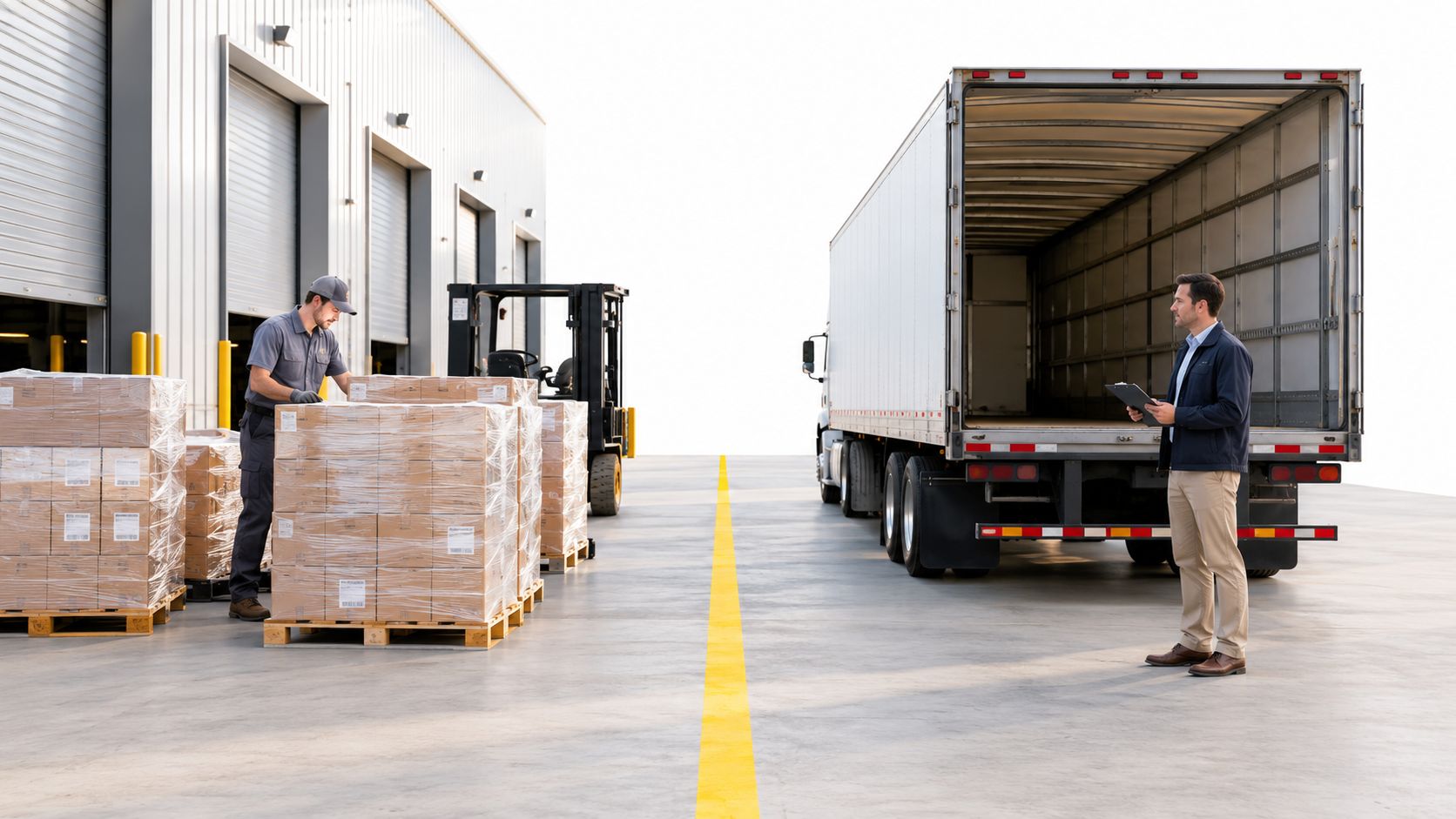
The factory's loading dock is a useful mental model for the EXW boundary. More precisely, the boundary is the agreed location where the seller places the goods at the buyer's disposal, not the moment the truck leaves or reaches the port.
The ICC's EXW delivery-point guidance places that point closest to the seller and identifies it as the point of risk transfer. An Amazon seller buying 500 units at an EXW Shenzhen factory therefore takes on transport risk once those goods are made available under the agreement.
The collection check should happen where that responsibility begins.
<a id="collection-isnt-the-only-origin-country-problem"></a>
Collection isn't the only origin-country problem
The buyer must also arrange export formalities. A foreign company may lack the local legal status needed to act as exporter of record, so hiring a truck doesn't necessarily mean the shipment can leave the country.
That's a reason to consider FCA. Where the seller must handle export clearance, FCA can provide a more practical arrangement, with the seller delivering to the buyer's nominated carrier at the agreed place. The ICC guidance discussed earlier identifies this distinction as important for cross-border transactions.
EXW moves cost and risk to the buyer at the factory gate.
That shorthand shouldn't obscure the exact contractual point. Goods can be available for collection before they're loaded, so a buyer shouldn't assume responsibility starts only after the driver signs a collection receipt.
The parties should confirm these details in writing:
- Exact named place: Record the factory address and the specific collection point, rather than a country or city alone.
- Loading responsibility: Identify who supplies the forklift and labor, who pays and how damage during loading will be handled.
- Export documents: Name the party that files the declaration and confirm that the arrangement is legally workable.
A friendly assurance that the supplier will “help with shipping” isn't enough. The purchase order and forwarder instructions should assign the actual tasks.
<a id="turning-an-8-factory-quote-into-a-real-unit-cost"></a>
Turning an $8 Factory Quote Into a Real Unit Cost
| Cost line | Total for 500 units | Per unit |
|---|---|---|
| EXW factory invoice | $4,000 | $8.00 |
| Factory pickup and origin loading | $300 | $0.60 |
| International freight | $1,200 | $2.40 |
| Cargo insurance | $180 | $0.36 |
| Import duty | $600 | $1.20 |
| Customs broker and destination charges | $250 | $0.50 |
| Delivery to Amazon fulfillment center | $470 | $0.94 |
| Total delivered cost | $7,000 | $14.00 |
These are illustrative shipment inputs, not market rates or a customer case study. The pickup allowance is treated as covering origin loading in this example; an actual forwarder quote must confirm that inclusion.
The factory invoice is straightforward: order quantity multiplied by the supplier's unit price. Every remaining row represents money the buyer must spend to move that inventory through the agreed inbound route.
<a id="build-the-calculation-from-shipment-costs"></a>
Build the calculation from shipment costs
The reusable formula is:
Landed unit cost = EXW unit price + origin logistics per unit + international freight per unit + insurance per unit + duty per unit + destination fees per unit + domestic delivery per unit.
That structure follows the practical distinction in the ICC Academy's explanation of EXW pricing: the supplier makes goods available, while the buyer must budget the remaining transport and import obligations.
In the example, pickup gets the cartons away from the factory, while international freight covers the main transport leg. Insurance is a separate allowance, not something assumed to be included in the carrier's price.
The duty row also needs its own calculation. A buyer shouldn't reuse this example's duty amount for another product or calculate duty from a guessed classification. The customs broker needs accurate product descriptions, HS codes, origin information and shipment values to assess the applicable treatment.
The destination rows deserve equal scrutiny. Brokerage and destination handling don't necessarily include the truck delivering inventory to Amazon. A quote ending at a port isn't equivalent to one ending at the fulfillment center.
A supplier comparison is incomplete until both quotations end at the same location and include the same cost categories.
<a id="allocate-costs-without-distorting-the-sku"></a>
Allocate costs without distorting the SKU
Small orders can carry a heavy per-unit logistics burden because some charges apply to the shipment rather than each item. Spreading an unchanged shipment-level charge over more units lowers that charge per unit, although the actual freight bill may also change with volume, weight and container utilization.
For a shipment containing different products, dividing every charge equally by unit count can be misleading. Buyers should allocate freight costs across multiple SKUs using a documented method that reflects the relevant cost driver, rather than making compact and bulky products absorb identical freight by default.
The comparison also needs complete coverage. This example doesn't assign separate allowances for every possible export, inspection, tax or storage charge. Before treating the total as complete, the operator should confirm whether those costs are included elsewhere or don't apply.
A higher supplier quotation can therefore produce a lower landed cost if it includes services the EXW buyer would otherwise purchase separately. Neither quotation wins on its headline number.
Finally, inbound inventory cost isn't contribution margin. Amazon referral, storage and fulfillment fees sit beyond this delivered-cost calculation and must be considered separately when evaluating selling economics.
<a id="amazon-fba-and-shopify-costs-exw-quotes-miss"></a>
Amazon FBA and Shopify Costs EXW Quotes Miss
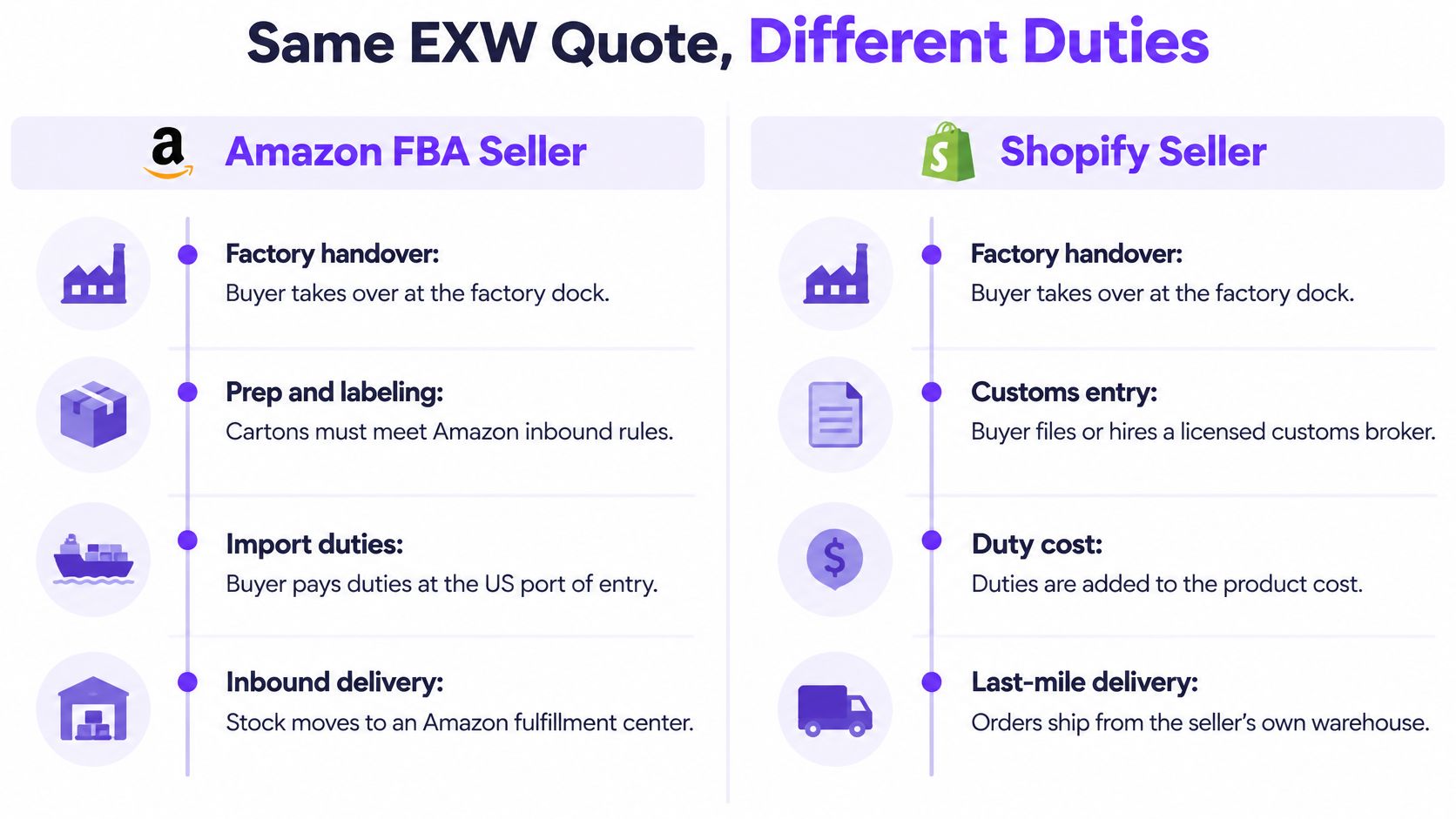
Take the 500-unit Shenzhen order. Once the goods leave the factory dock, an Amazon FBA seller and a Shopify seller are heading toward different endpoints, and each endpoint changes which lines belong in the landed-cost bridge.
The split works like this. The FBA route runs from the factory to a designated Amazon fulfillment center, with import clearance and inbound delivery sitting on the seller's side of the $8 quote. The Shopify route runs from the factory to the brand's own warehouse or 3PL, and everything that happens on customer orders afterward is a second movement with its own cost layer.
<a id="amazon-fba-needs-a-documented-inbound-arrangement"></a>
Amazon FBA needs a documented inbound arrangement
Before the 500 units leave Shenzhen, the seller has to settle who acts as importer of record, who files the customs entry and who pays duty and brokerage. A broker or forwarder can perform contracted services, but appointing one doesn't automatically make that provider the importer of record. That point is worth confirming in writing, because a shipment that arrives at a U.S. port without a clear importer of record stalls while storage and exam fees accumulate.
The inbound worksheet ends at the designated fulfillment center. Freight to that address, clearance charges and any separately contracted receiving services all sit on the seller's side. Sellers can use a separate process to add Amazon FBA shipment costs to landed cost so those expenses land in the right place.
<a id="shopify-needs-separate-inbound-and-outbound-views"></a>
Shopify needs separate inbound and outbound views
For a Shopify brand, the same 500 units land at a third-party warehouse, and the inbound calculation stops there. Freight, insurance, duty and brokerage get allocated across the units that arrive.
Customer orders start a second movement. A domestic warehouse-to-customer shipment has nothing to do with the original import, and a cross-border customer order needs its own customs and duty treatment. HS codes and country-of-origin data have to be right in the storefront as well as on the import entry, or the buyer either under-collects duties at checkout or hands the customer a surprise bill on delivery.
The accompanying video provides additional context for the shipping discussion.
The cost bridge should end with channel-specific lines:
- Amazon FBA: Record delivery to the designated fulfillment center and any separately contracted receiving-related services, while keeping marketplace selling and fulfillment fees outside inbound inventory cost.
- Shopify: Record delivery to the brand's warehouse or 3PL, then track customer-order delivery and any customer-facing cross-border duties as a separate cost layer.
The distinction prevents a common budgeting error: treating delivery to a warehouse as though it also covers delivery to the eventual customer.
<a id="risks-buyers-carry-under-an-exw-deal"></a>
Risks Buyers Carry Under an EXW Deal
| Risk | What triggers it | Where the cost lands | How to limit it |
|---|---|---|---|
| Damage during loading | Goods handed over at the dock without a loading check | Replacement, claim gap and delay for the buyer | Photograph and count cartons at pickup and obtain a loading record |
| Export clearance refused | Origin-country rules require a local exporter of record | Stock stuck at origin and additional service fees | Confirm the export filer before ordering, or consider FCA |
| Freight rate exposure | Buyer books alone with low volume | Higher freight per unit when rates move | Obtain a quote with a validity date and assess consolidation |
| Duty error | Wrong HS code or country of origin | Duty reassessment or checkout under-collection | Verify classification and origin before shipping |
| Double charge at delivery | Checkout collects duties but the shipment uses a non-DDP label | Customer may face a second payment demand | Use a carrier and label that support DDP |
| Loss after handover | Risk has transferred and no cargo insurance was purchased | Buyer's uninsured goods value | Arrange insurance from the agreed risk-transfer point |
<a id="risk-allocation-doesnt-settle-every-liability-dispute"></a>
Risk allocation doesn't settle every liability dispute
The handover rule explains why the buyer needs protection early in the journey. It doesn't mean a supplier can never be responsible for its own error, or that every damage dispute has the same outcome.
Loading arrangements, contractual promises and the circumstances of the loss still matter. The ICC's Incoterms questions and answers highlight practical EXW complications around loading and export clearance. Written instructions and pickup records are more useful than an assumption that one party's insurance will respond.
<a id="checkout-collection-must-match-the-shipping-service"></a>
Checkout collection must match the shipping service
Shopify's requirements for charging duties and import taxes connect checkout collection with the shipping arrangement. When a customer pays those amounts at checkout, the merchant must use an appropriate DDP label so the customer isn't charged again at delivery.
That's separate from the original EXW purchase. The merchant must coordinate product data, checkout settings, carrier capabilities and customs documents rather than expecting the factory's delivery term to solve the customer shipment.
A useful quote review includes a risk line alongside the cost lines: uninsured exposure, unresolved export filing and uncertain duty treatment. Buyers can work through calculating import duty from China before committing, then obtain clearance and insurance quotations instead of leaving those items as assumptions.
<a id="confirm-the-landed-cost-before-you-accept-exw"></a>
Confirm the Landed Cost Before You Accept EXW
The purchasing decision should rest on a complete route, a workable export arrangement and a comparable unit cost. This checklist turns the supplier quotation into information a forwarder and customs broker can use in practice.
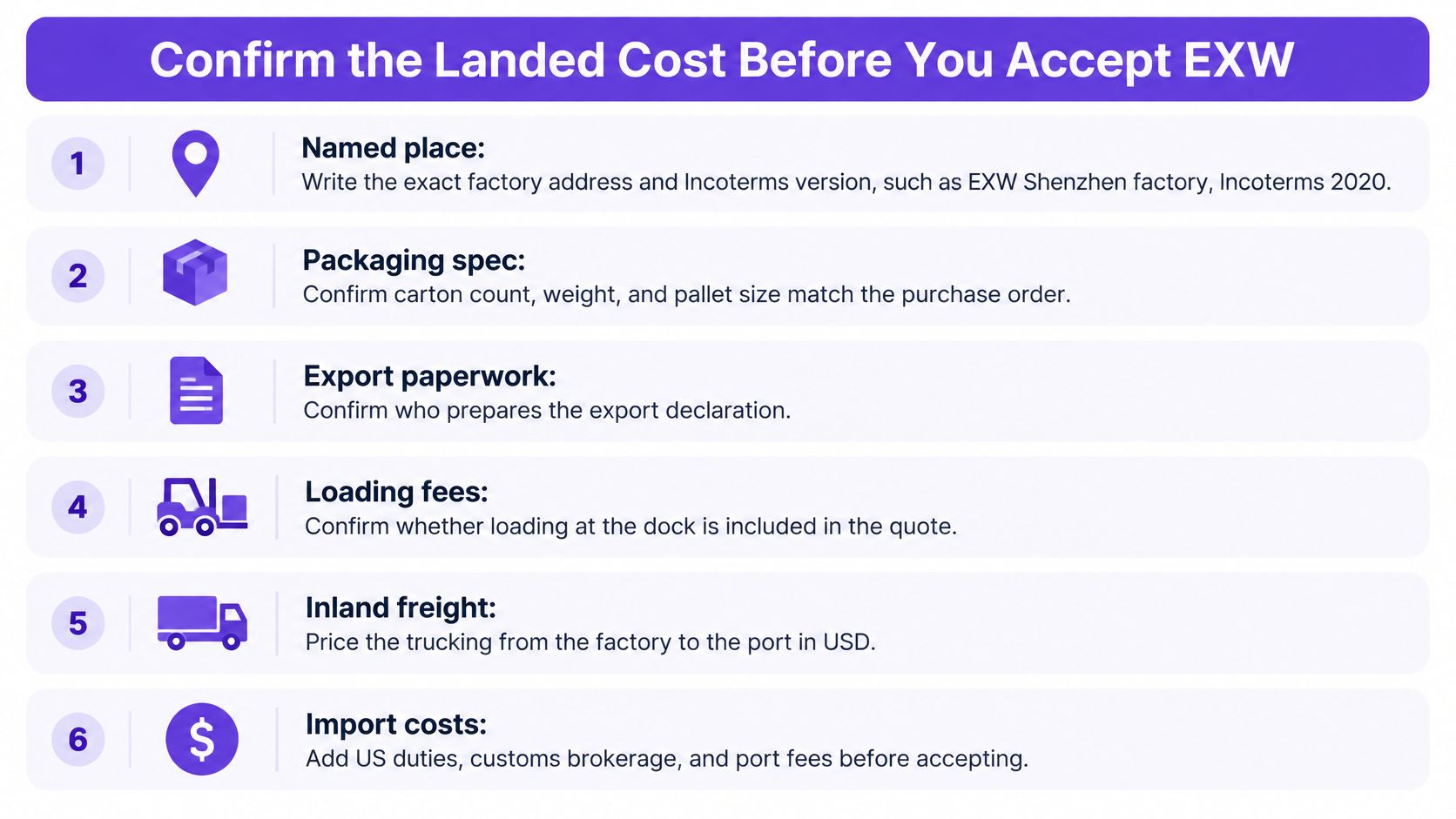
- Identify the named place. Record the complete factory address and applicable Incoterms version on the purchase order. Match that location to the collection instructions.
- Confirm the shipment specifications. Obtain carton count, carton dimensions, gross weight and pickup readiness date. The forwarder should quote the shipment that will be collected.
- Collect product and commercial data. Gather invoice details, product descriptions, HS codes and country of origin for every SKU. Resolve missing information before booking.
- Request the full logistics scope. Obtain prices for origin pickup, loading, export clearance, main freight, destination brokerage and final warehouse delivery. Name the export filer and importer of record.
- Price insurance. Request cover for the full goods value from the agreed risk-transfer point, including any relevant period awaiting collection.
- Estimate duty correctly. Use the applicable tariff classification and customs value, with broker confirmation where needed.
<a id="compare-equivalent-outcomes"></a>
Compare equivalent outcomes
Normalize EXW, FCA, FOB and DDP proposals to the same destination and cost coverage. An e-commerce landed-cost calculator or a maintained spreadsheet can support the comparison; the Exact Landed Cost Engine is another option for automating SKU-level calculations before arrival.
The decision rule is practical: accept EXW when the normalized landed cost is lower and the business has a workable export-clearance arrangement. Otherwise, request a term that assigns the troublesome services to the supplier, then verify its scope rather than assuming a different abbreviation solves everything.
Supply Automate offers an Exact Landed Cost Engine that combines product costs, freight, duties, insurance and fees into SKU-level costs before goods arrive. Visit Supply Automate to compare factory quotations against the full inbound cost and keep purchasing decisions tied to the margin each product can support.