
The first freight quote on a new product always feels like a guess. The factory has given you a carton count and a gross weight, your forwarder sends back a rate per cubic metre plus a list of terminal and document charges, and you have no idea whether the total is fair or whether air would be worth the extra money. A sea freight rate calculator is supposed to answer those questions, but the tools that use the name do quite different jobs.
Some calculators check the math on a quote you already have. Others give you a live estimate from a freight marketplace before you've asked anyone, and container indexes tell you where the market is moving so you know whether to lock a rate now. This guide covers the sea freight calculators and benchmarks I'd use as an ecommerce importer in October 2026, what each one is good for, and where its numbers come from. I checked each one on its official pages before writing about it.
A quick note on what SupplyAutomate does here so nothing reads as a promise. Our free freight cost estimator is a calculator you fill in by hand, and it doesn't pull live market rates. The SupplyAutomate software tracks your purchase orders and shipments from the documents you upload, such as freight bills and customs entries, plus parcel and ocean container tracking, and builds landed cost from the factory price, freight, duty, and samples.
TL;DR
- Use the free SupplyAutomate freight cost estimator to compare a sea quote and an air quote side by side, with correct W/M and chargeable weight math and a check on whether air's speed is worth the premium.
- Use the Freightos freight rate calculator for an instant ocean or air estimate before you have a quote, then compare and book on its marketplace if you like.
- Watch the Freightos Baltic Index and the Drewry World Container Index to see where 40 foot container rates are heading on your lane.
- Treat every calculator as a starting point. The rate you pay comes from a forwarder quote, and the charges that change the total most are the ones calculators leave out.
- Freight is only one part of what a unit costs you, so carry the final number into a landed cost calculation with duty before you price the product.
Sea Freight Rate Calculators At A Glance
| Tool | What it answers | Where the numbers come from | Price when checked |
|---|---|---|---|
| SupplyAutomate freight cost estimator | Is this sea quote cheaper than this air quote, and is air worth it? | Rates you copy from your own forwarder quotes | Free, no signup |
| Freightos freight rate calculator | Roughly what will this shipment cost to move? | Freightos rate data and marketplace providers | Free estimate |
| Freightos Marketplace | Which provider can move it, at what price and transit time? | Live quotes from 75+ providers | Free to search, you pay for bookings |
| Freightos Baltic Index | Where are 40 foot container spot rates heading? | Anonymized spot rates on the WebCargo platform | Some data free, full access by subscription |
| Drewry World Container Index | What did a 40 foot container cost on major lanes this week? | Drewry's weekly assessment | Free weekly summary |
What A Sea Freight Calculator Can And Can't Tell You
Ocean freight is priced in two different ways, and calculators are only useful once you know which one applies. A full container (FCL) is priced per box, usually per 20 foot or 40 foot container. A shared container (LCL) is priced per W/M, meaning weight or measure, where you pay on whichever is greater of your cubic metres or your tonnes, and most forwarders bill a minimum of 1 W/M however small the shipment is.
The base ocean rate is often not the biggest number on an LCL quote. Terminal handling, documentation, customs clearance, delivery from the port, and the origin charges can add up to more than the freight itself on a small shipment, which is why two quotes with similar per W/M rates can end up far apart. Your Incoterm decides which of those charges are yours, and our guide to FOB vs EXW vs DDP explains where each one hands over cost and risk.
No calculator includes duty in the freight figure either, and duty can easily be larger than the freight on a high value product. Our guide to calculating import duty from China and the free import duty calculator cover that part for US-bound shipments.
SupplyAutomate Freight Cost Estimator
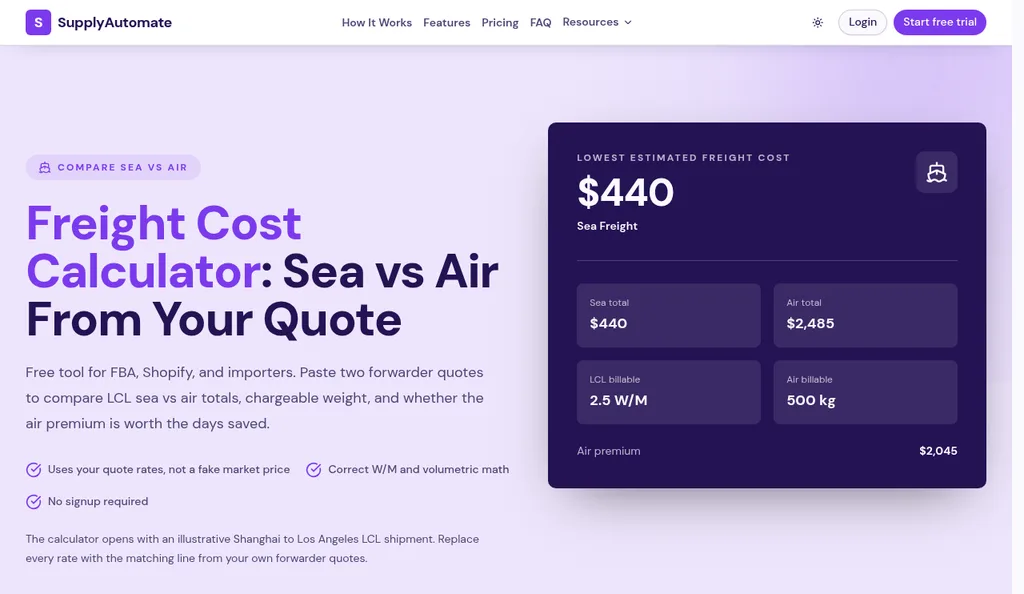
SupplyAutomate freight cost estimator with its default example, checked October 2026
I'll start with our own tool because it answers the question I most often had as an importer, which was whether a shipment should go by sea or by air. The freight cost estimator asks for the gross weight and volume from the packing list, then the rate and fixed charges from your sea quote and your air quote. It bills LCL on W/M with a minimum you can change and air on chargeable weight, which is the greater of gross or volumetric weight, so the totals match how forwarders actually invoice.
The default example is an illustrative Shanghai to Los Angeles LCL shipment of 2.5 W/M and 500 kg chargeable for air. Sea comes out at $440 against $2,485 for air, an air premium of $2,045 for about 8 days saved. If you add the cargo value, the tool prices the capital tied up in transit at 20% a year and tells you whether the days saved are worth the premium, which in the example they aren't.
It works in any currency and never converts, so you enter both quotes in the same currency. The one thing it won't do is invent a market rate, so you need at least one real quote first. That's deliberate, because a quote from your own forwarder for your own lane is a better number than any average.
Freightos Freight Rate Calculator And Marketplace
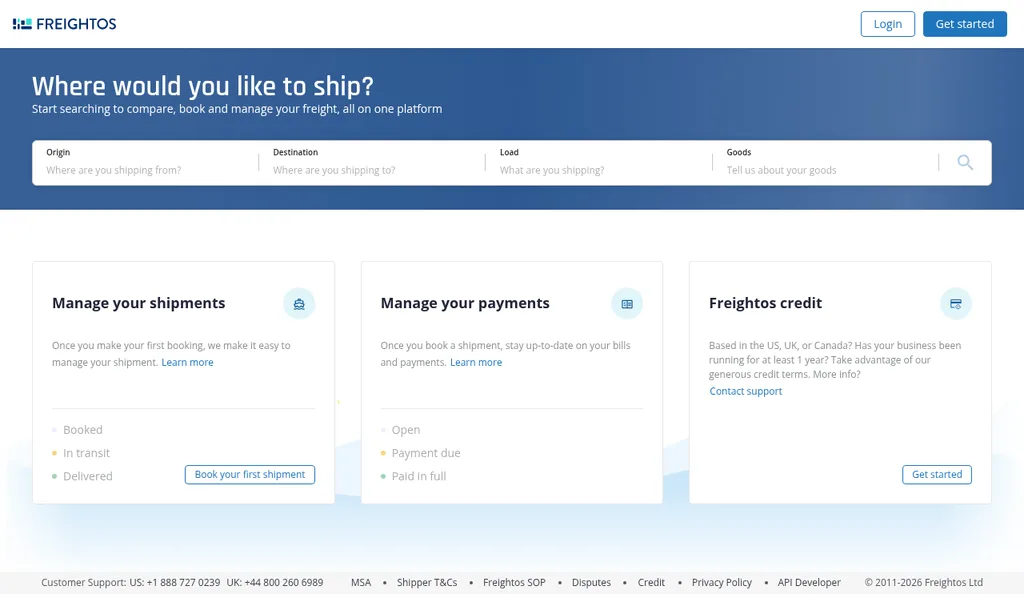
Freightos Marketplace search page, checked October 2026
Freightos is the tool to use before you have a quote. The Freightos freight rate calculator asks whether you're shipping full containers or boxes and pallets, then your dimensions, weight, quantities, origin, and destination, and returns an estimate for ocean or air. Freightos says the estimates come from live rates from forwarders and carriers and include costs and surcharges for the options you select.
If the estimate looks reasonable, the Freightos Marketplace lets you compare air, ocean, and trucking quotes from more than 75 providers, book, and manage the shipment and payments in one place. It also offers credit terms to businesses in the US, UK, or Canada that have been running for at least a year. Searching is free, and you pay the price of the quote you book.
I'd use the estimate as a sanity check on a forwarder's quote rather than as a budget figure. Marketplace pricing moves with the market, and your origin and delivery details can change the total a lot once a real booking is made.
Freightos Baltic Index (FBX)
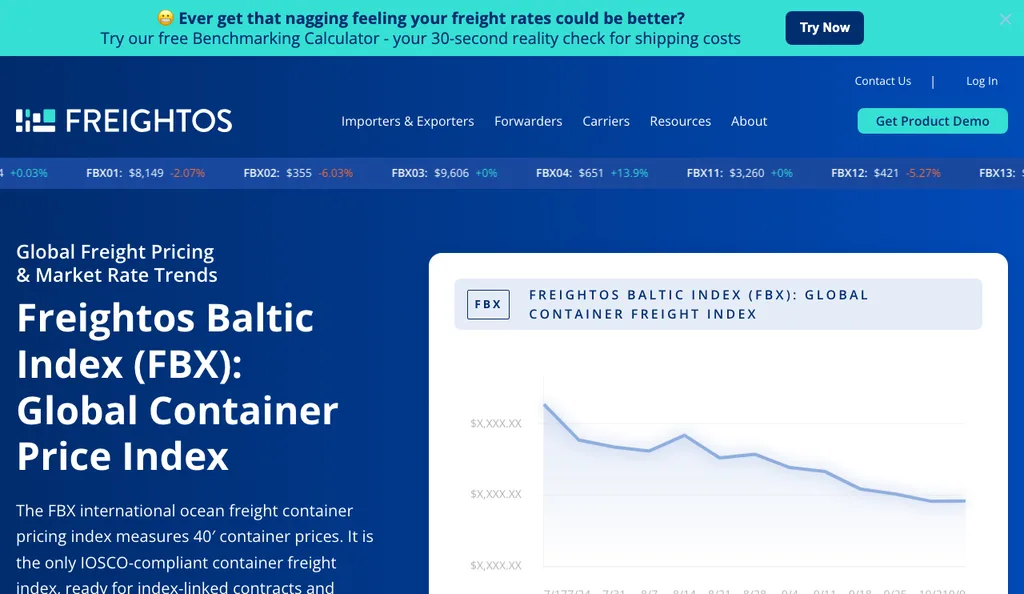
Freightos Baltic Index page, checked October 2026
The Freightos Baltic Index tracks what it costs to move a 40 foot container on major ocean lanes. The FBX page says the index is built from aggregated and anonymized real-time rates from carriers, forwarders, and shippers on Freightos' WebCargo platform, using the median of short term spot prices and surcharges. It covers twelve trade lanes, and the headline FBX is a weighted average of them.
For an ecommerce importer, the useful part is the lane you ship on, such as China to the North American West Coast, and the trend over the last few weeks. Freightos says FBX is IOSCO compliant and traded on the Singapore Exchange and the Chicago Mercantile Exchange, which is why it's used in index-linked contracts. Some data and reports are free on the site, and fuller data access sits in its paid Terminal product.
An index won't price your LCL shipment, since it measures full 40 foot containers. What it does tell you is whether rates are rising or falling, which is useful when you're deciding whether to book this week or wait.
Drewry World Container Index
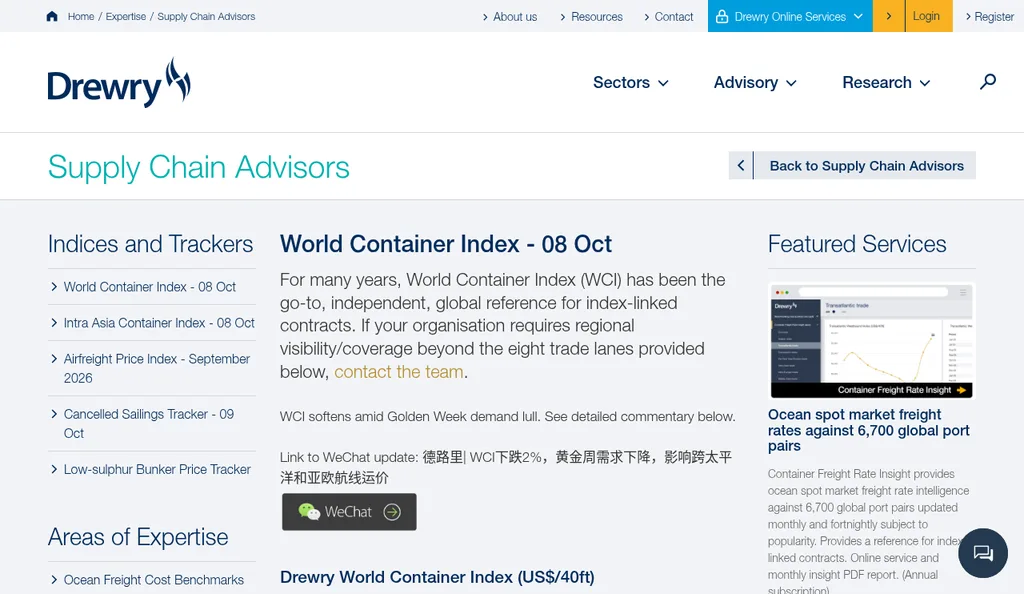
Drewry World Container Index page, checked October 2026
The Drewry World Container Index is the other benchmark worth bookmarking, and its weekly summary is free to read. Drewry publishes the composite index and eight trade routes from Shanghai in US dollars per 40 foot container, with a short commentary on what moved rates.
In its assessment for Thursday, October 8, 2026, Drewry said the composite WCI fell 2% to $4,351 per 40 foot container as demand weakened during China's Golden Week. Shanghai to Los Angeles fell 3% to $7,624, Shanghai to New York fell 2% to $10,220, and Shanghai to Rotterdam fell 2% to $3,337. Drewry expected rates to stay stable the following week.
I read WCI and FBX together, since they use different methods and a move that shows up in both is more likely to be real. Neither one replaces a quote, but both make you a better negotiator when a forwarder's number looks high.
Getting A Forwarder Quote You Can Compare
Calculators and indexes get you to a reasonable range, and the quote from a freight forwarder is what you actually pay. Ask at least two forwarders for the same shipment, with the same Incoterm, pickup point, and delivery address, and ask each one to list every charge separately. Then put the sea and air options into the freight cost estimator so you compare totals on the same basis.
Check what each quote includes before you compare totals. Pickup, terminal handling, fuel, security, customs, delivery, insurance, duty, and tax are the lines that most often differ between quotes, and one missing line can make the cheaper quote the more expensive one. If your volume is uneven across SKUs, our guide to allocating freight across multiple SKUs shows how to split the total fairly.
From Freight Rate To Landed Cost
The freight rate is one input. What you need for pricing is the landed cost per unit, which adds the factory price, freight, duty, and samples and divides across the units that arrived. Our guides to how to calculate landed cost for imported products and landed cost per unit walk through it with worked examples, and the free landed cost calculator does a single shipment.
When you're running several orders at once, SupplyAutomate keeps that work on the order. You upload the freight bill, packing list, and customs entry, each one is filed on the right purchase order, ocean container tracking shows where the goods are, and the landed cost per unit is built from those documents. You can export the results to CSV or Excel. The software is $199 a month or $1,999 a year with a 14-day trial and no card required.
Frequently Asked Questions
How Is LCL Sea Freight Calculated?
LCL is billed per W/M, meaning whichever is greater of your volume in cubic metres or your weight in tonnes, times the quoted rate. Most quotes bill a minimum of 1 W/M, and fixed charges for terminal handling, documentation, and customs are added on top.
Are Free Sea Freight Calculators Accurate?
They're accurate for what they measure, but none of them knows your exact pickup, delivery, and customs details. Use them to check whether a quote is in a sensible range, then rely on a written forwarder quote that lists every charge.
What Is The Difference Between FBX And The Drewry WCI?
Both track the cost of a 40 foot container on major lanes. FBX is based on anonymized spot rates on Freightos' WebCargo platform and covers twelve lanes, while Drewry publishes a weekly composite and eight routes from Shanghai with commentary.
Should I Ship By Sea Or Air?
Sea is usually much cheaper per unit, and air makes sense when the days saved protect sales, such as a stockout in peak season. The freight cost estimator puts both quotes side by side and tells you whether the carrying cost saved covers the air premium.
Does SupplyAutomate Give Live Freight Rates?
No. The free freight cost estimator uses the rates you enter from your own quotes, and the SupplyAutomate software tracks the freight you actually paid from your uploaded freight bills and builds it into landed cost.
What I'd Do Before The Next Booking
Before your next shipment, get two written quotes, run them through a calculator that uses your own numbers, and glance at FBX or the Drewry index for your lane so you know which way the market is moving. It takes about twenty minutes, and it's the habit that saved me the most money on freight. Then carry the final freight number into landed cost, because that's where it actually changes your margin.