
Most "best supply chain management software" pages rank Kinaxis, SAP, Blue Yonder, and a mid-market ERP.
If you import for Amazon FBA or Shopify, that list is a different industry.
You are not optimizing a multi-plant network.
You are trying to answer, before the next container is booked:
- What did we order, and what did the factory confirm?
- When will the units be sellable, not just "ex-factory"?
- What did each SKU cost after freight, duty, and inbound fees?
- Do FBA and Shopify already show different available quantities?
Use this as the category map for that job, not an 11-product enterprise roundup: how to tell what "SCM software" means for an importer, when the spreadsheet is finished, and which kind of system is worth a trial.
If you only need the factory record (POs, documents, WeChat dates), start with supplier management software for importers.
If you need an Amazon shipping and replenishment stack, use the Amazon FBA supply chain software guide.
If you are choosing a Shopify app, use the Shopify supply chain app review.
Stay here when you are still deciding which layer to buy.
If Vendors Are Selling SCM, ERP, And OMS As One Product
You import finished goods for Amazon FBA, Shopify, or both.
The POs repeat.
You already know the factory quote is not the number that hits margin.
Vendors are selling you "SCM," "ERP," and "OMS" as if they were the same product.
Skip the enterprise planning shortlist if you do not have a supply-chain organization, a network-design problem, or an ERP already in place.
Those tools solve real problems.
They are rarely the first system a growing importer needs.
What SCM Software Means For An Importer
"Supply chain management software" is a label vendors stretch in two directions.
Enterprise SCM / APS plans production, inventory, and transport across plants, DCs, and long-range forecasts.
The objects are networks, constraints, and S&OP cycles.
ERP is the general ledger plus the modules that touch it: inventory, purchasing, maybe CRM.
The ERP for Amazon FBA walkthrough is the finance-and-stock version of that decision.
An ERP can store a PO.
It is not automatically good at an import.
For an FBA or Shopify importer, the useful meaning is narrower.
Software has to follow one purchase from the factory to sellable stock, and keep the cost of that path on the SKU.
The objects are the PO, the documents, the dates, the inbound charges, and the channel inventory those units will land in.
If a demo leads with "AI-powered end-to-end visibility" and cannot open one of your shipments, it is the first definition wearing the second definition's name.
When The Spreadsheet Stops Working
A shared spreadsheet is the right first system.
Cheap.
Visible.
Honest about what you do not know yet.
It holds while one person owns purchasing, you have a handful of SKUs, freight lands on a predictable schedule, and you can still point at the current file.
The day you cannot do that without asking which version, you are already late.
The usual collapse is not a formula error.
The PO lives in email.
The ship date lives in WeChat.
The commercial invoice is a PDF in Downloads.
The freight invoice shows up three weeks later.
Shopify and FBA each show a different available quantity.
Someone prices the next order on the factory quote.
That is a record problem.
Landed cost spreadsheet vs software is the cost-model version of the same break.
Stay here for the operating view: the order, the dates, the files, the stock picture, and the cost have to stay attached.
Keep the templates until a system has earned the right to replace them.
A neglected app is worse than a dated sheet everyone still opens.
48 Days On The Sheet, 64 In The Documents
A Shopify + FBA seller reorders a $4.80 factory SKU that sells about 28 units a day.
They plan lead time as the factory's 25-day production promise, plus 18 days ocean and 5 days to FBA sellable: 48 days.
Reorder point in the sheet: 28 × 48 + 200 safety = 1,544.
The last three POs, measured to the day the unit was actually sellable:
| PO | Days to sellable |
|---|---|
| March inbound | 62 |
| May inbound | 58 |
| July inbound | 71 |
Average actual: 64 days.
The reorder point that matches the last three shipments is 28 × 64 + 200 = 1,992.
They place the next PO when on-hand + inbound hits 1,544.
That is 448 units late, about 16 days of stockout at this velocity.
If contribution after ads is $9.40, that is roughly $4,200 of missed margin, plus the ads that kept clicking on an empty listing.
The factory promise was in the sheet.
The three actuals were in email.
No "best SCM" demo asked for them.
Run the same legs through the lead time calculator and put the result in the reorder point formula.
If you cannot reconstruct those three inbound dates from one record, you do not have a supply chain system.
You have a plan.
For the cost side of the same shipment, use the landed cost calculator before you approve the next PO.
A product that looks fine at $4.80 is a different SKU after freight and duty.
What The Software Has To Cover
Score the product against the work between "we should reorder" and "this SKU is sellable."
Ignore the homepage that leads with connector counts.
The Purchase Order Is The Record
A useful purchase order is not a PDF you email once.
Supplier, SKUs, quantities, agreed cost, Incoterm, promised date, current status, including partials and the revised ship date, have to live on it.
If a date change only exists in chat, the PO is decoration.
Someone Has To Chase The Factory
Confirm the carton count.
Notice a slip before the listing goes OOS.
That is the daily work in supplier management software.
SCM software that cannot show which open PO is late is planning software with a purchasing tab.
Landed Cost By SKU And Shipment
Factory price, inbound charges, allocation rule: same record.
What landed cost is is the definition.
The software test is narrower.
Can you open one shipment and see why the SKU cost what it cost?
Estimates have to be replaceable when the freight bill arrives.
See how to calculate landed cost for imported products if you are still building the model.
Lead Time Is What Actually Happened
Promised production plus ocean transit is a plan.
Actual lead time is the date the unit became sellable.
Production slip, missed cutoffs, customs holds, FBA receiving: they all count.
Model the legs, then look at the last three POs.
Channel Inventory Is A Hint, Not The PO
Amazon FBA and Shopify do not share a warehouse.
Supply chain software does not have to replace your inventory app.
It does have to stop you from placing a PO against a number that is already reserved, inbound, or sitting in the other channel.
If stock across locations is the constraint, use the ecommerce inventory management comparison instead of stretching a PO tool.
Documents Sit On The Order
Commercial invoices, packing lists, bills of lading, freight invoices: same record as the PO.
Organizing supplier invoices is the filing version.
Extraction helps.
A human still has to confirm quantity, currency, and which PO the bill belongs to.
Score The Trial, Not The Demo
Do not buy from a ranked list.
Take two or three products.
Run the same SKU, the same open PO, the same freight invoice, the same delayed shipment through each one.
Use 0-5.
Write down what you saw.
Not what the deck claimed.
| Criterion | Weight | What "5" looks like | What "1" looks like |
|---|---|---|---|
| Purchase order as record | 20% | Status, qty, cost, and date changes live on the PO | The PO is an export of an email |
| Landed cost | 20% | Shared charges allocate to SKUs; estimates get replaced | Factory price only, or a disconnected sheet |
| Lead time truth | 15% | Promised vs actual by supplier and SKU | One "lead time" field, never updated |
| Document trail | 15% | Invoice, packing list, and freight bill attach to the shipment | Files live in Drive with hopeful names |
| Channel / inventory awareness | 15% | Open POs sit beside FBA and Shopify positions | One available-qty number, no inbound |
| Automation that matches the bottleneck | 10% | The task that wastes hours is the one that runs | "AI" that does not touch your files |
| Time to value | 5% | A three-person team can run it this month | You need a consultant to create a vendor |
Weighted score = sum(score × weight).
A 4.4 on an ERP and a 4.0 on an importer tool are not comparable if you cannot implement the 4.4.
That last row exists so a nine-month rollout loses to something you can run next week.
Two people should score independently.
If you disagree on "landed cost," you did not run the same shipment.
Six Places To Look, Not Eleven Logos
These are category judgments from how the products are sold and used.
Not a lab test of every SKU in the market.
Pricing is omitted on purpose.
Ask for it against your PO volume and order volume.
If a vendor will not run the workflow with your documents, treat the claim as unproven.
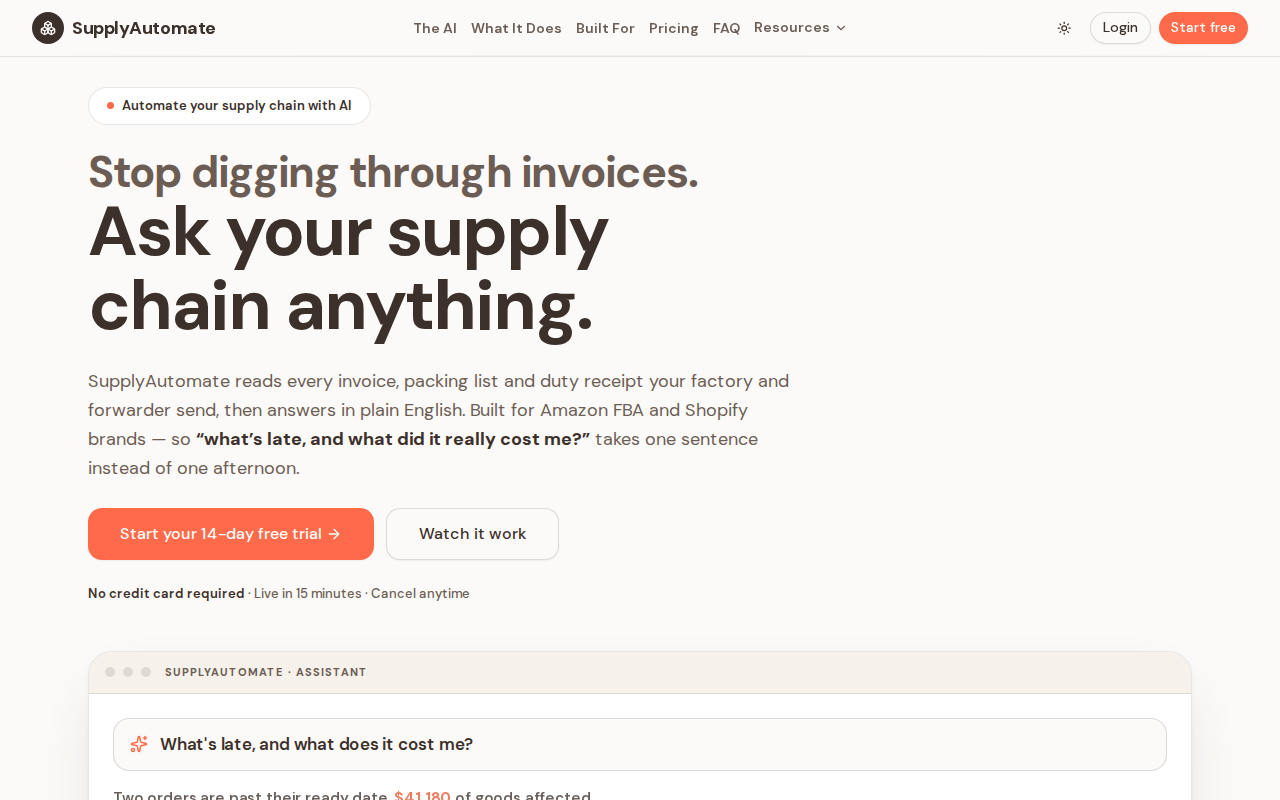
SupplyAutomate, If The Daily Questions Are "What Moved?" And "What Did It Cost?"
Built for Amazon FBA and Shopify importers who want purchase orders, supplier documents, and landed cost in one workspace.
Upload the invoice, packing list, and freight bill.
Match them to the PO.
See the SKU cost and what is still late.
It is not a global APS suite and not a high-volume order router.
Pick/pack across many marketplaces: look at the OMS row.
Multi-entity finance and warehouse planning: look at ERP.
You still need clean SKUs and honest dates.
The tool will not invent a lead time you never recorded.
Start with one recent PO and its documents.
Not a catalog import.
Inventory Platforms (Cin7 And Peers) When Stock Locations Hurt More Than Documents
If overselling and warehouse locations are the actual pain, buying a purchasing module bolted onto inventory is more honest than forcing an import tool to be a WMS.
These products can raise a PO from a reorder point and receive it against stock.
Ask to see a freight invoice allocated across a mixed container, and a factory date change that is not a stock receipt.
A lot of this category is strong after the goods land and thinner before they do.
If stock, not inbound execution, is the constraint, read the ecommerce inventory management software guide.
Amazon Replenishment Tools (SoStocked And Peers) For FBA Timing
FBA inventory math is its own problem.
A replenishment tool that knows sales velocity and inbound shipments can prevent the stockout a generic PO app will miss.
Restock alerts are not a supply chain.
They usually will not read a commercial invoice, hold a WeChat date change, or tell you landed cost after duty.
Add Shopify later and you will still need a shared PO and cost record.
For the Amazon-specific stack, including shipping tools, see Amazon FBA supply chain software.
Multichannel OMS (Linnworks And Peers) When The Fire Is The Outbound Order
Linnworks and similar OMS products are what a lot of "e-commerce supply chain software" searches actually need: one order queue, rules for which warehouse or channel ships, and marketplace connections.
If the bottleneck is the customer order, this is the right shape.
Routing every order correctly does not give you a landed cost per SKU.
A brand can be excellent at picklists and still reorder on the factory quote.
Ask whether a purchase order, a freight invoice, and a duty bill are first-class objects or an integration someone will "set up later."
Integration count is easy to overvalue.
Score the task you need to remove.
ERP (NetSuite And Peers) When Finance Already Needs One System Of Record
This is what many search results mean by "supply chain management software."
Multiple entities, locations, a controller who will not accept a sidecar app as the cost truth.
An ERP can be the right last system.
It is rarely the right first system for a four-factory FBA catalog.
Implementation is a project.
Product-level landed cost for a mixed container is not why these suites exist unless you build it.
A founder with six SKUs will spend the year configuring a process they do not have.
If you later need that control room, read ERP for Amazon FBA or Shopify ERP.
Do not start a comparison by demoing the PO screen.
Demand-Planning Tools (Inventory Planner And Peers) When You Already Know What The Last Shipment Cost
Planning software turns sales history into a suggested reorder.
Used well, it is the input to a PO, not a substitute for one.
A forecast that uses the factory's lead time is the worked example above.
Planning tools are only as honest as the actuals you feed them.
They will not attach a freight bill or tell you the SKU's landed cost.
Use the MOQ calculator as an independent check on order size before you let a forecast raise a PO.

How Those Categories Score If You Import
Judgments against the framework above.
Not lab benchmarks.
Adjust them after your own trial.
| Criterion | SupplyAutomate | Inventory-first | Amazon replenishment | OMS | ERP | Demand planning |
|---|---|---|---|---|---|---|
| Purchase order as record | Strong | Strong | Partial | Partial | Strong | Weak |
| Landed cost | Strong | Partial | Weak | Weak | Partial | Weak |
| Lead time truth | Strong | Partial | Strong | Weak | Partial | Partial |
| Document trail | Strong | Partial | Weak | Weak | Partial | Weak |
| Channel / inventory | Partial to strong | Strong | Amazon-strong | Strong | Strong | Partial |
| Automation vs importer bottleneck | Strong | Medium | Strong if Amazon-only | Strong if outbound | Weak until live | Medium |
| Time to value for a small import team | Strong | Medium | Strong if Amazon-only | Medium | Weak | Strong |
"Partial" means the category can store the data if you build around it.
It does not mean that workflow is the default.
How Much Does This Software Cost?
Search likes a price.
Vendors will not give you a useful one until they know your volume.
Treat any public "average cost of SCM software" as a different market, usually enterprise planning or ERP.
What you can plan for, without invented numbers:
- Spreadsheets and templates are free. They fail when dates, files, and costs leave the file.
- Focused importer tools are typically a monthly subscription. Price them against how many POs and documents you run, not against an ERP brochure.
- OMS and inventory platforms often scale with order volume or locations. A high-SKU, high-order retailer will pay more than a six-SKU importer, as they should.
- ERP is a license plus an implementation. If the quote needs a services partner to go live, you are buying a project.
"Which brands are cheapest?" is the wrong first question.
The expensive mistake is paying for outbound routing or a planning suite when the loss is a late factory and a freight bill that never reached the SKU.
A One-Week Trial With Your Own Files
Do not use the vendor's sample order.
Pick one high-volume SKU you sell on FBA, Shopify, or both.
Take the last closed PO, the commercial invoice, the packing list, the freight invoice, and the duty or brokerage bill.
Enter the PO as it was actually placed, including the first promised date.
Attach every document.
Correct whatever the parser gets wrong.
Record the mid-shipment date change if there was one.
Then produce a landed cost per sellable unit and compare it to the number you used to price or reorder.
Ask the system when to buy next.
Use the lead time calculator as an independent check.
It passes if a second person can reconstruct the shipment without Slack, the landed cost matches the documents (including the freight revision), and the next reorder quantity uses actual lead time.
It fails if you still need the spreadsheet to trust the number, channel stock and open POs disagree and you cannot see why, or the only automation on offer does not touch the task that wastes your week.
FAQ
What Is The Best Supply Chain Management Software?
For a growing Amazon FBA or Shopify importer, the best fit is the system that keeps the PO, the documents, the actual lead time, and the landed cost on one record.
SupplyAutomate is the trial I would run first for that job.
Enterprise SCM and ERP win a different contest: network planning and finance.
OMS wins if the customer-order queue is the fire.
There is no single winner across those jobs.
What Is The Best E-Commerce Supply Chain Software?
E-commerce supply chain software is not one product.
Importers need inbound execution (orders, suppliers, cost).
Multichannel retailers need an OMS.
Inventory-heavy brands need a stock system.
If you import and sell on FBA or Shopify, start with import execution, then add inventory or order routing when that layer is the constraint.
What Is The Best Software For Supply Chain Management, Or The Best Supply Chain Software?
Those queries usually mean the same buy.
Ignore the word "management."
Name the object: a purchase, a shipment, a warehouse, or a forecast.
Then use the scoring table.
A shortlist of six category fits is more honest than a ranked list of twelve logos.
How Much Does Supply Chain Management Software Cost?
It depends on the category, not on a blended industry average.
Importer tools are usually SaaS priced on usage.
OMS and inventory platforms often track order or location volume.
ERP is a project.
Ask each vendor against your PO count and your order count.
Anyone quoting a single "SCM software price" without asking those two numbers is selling a brochure.
Is "Supply Chain Automation Software" What I Need?
Only if you can name the task.
Automation that matches a freight invoice to a PO is useful.
Automation that routes thousands of customer orders is an OMS.
Automation that rebuilds a 26-week forecast is planning software.
Buy the task, not the adjective.
Does Supply Chain Software Replace Inventory Or Accounting Software?
Usually no.
It should sit beside the system that owns stock and the general ledger.
A small brand can run without a full ERP if the PO and cost record are solid.
A large brand should not rip out NetSuite because a supply tool has a prettier PO screen.
How Is This Different From Supplier Management Software?
Supplier software is the factory-facing slice: the vendor, the PO, the documents, the dates.
Supply chain management software, as buyers use the phrase, is the wider map, including inventory, OMS, ERP, and planning.
If your only gap is the factory record, use the supplier management guide.
If you are still deciding which layer to buy, stay here.
Most importer "supply chain" shortlists mix three jobs: documents and unit cost, warehouse locations, and marketplace routing.
The last shipment will tell you which one you actually missed.
SupplyAutomate is the first of those.
The landed cost, lead time, and MOQ calculators are a cheap way to see the date and the cost you have been reordering on.