
You've just placed your third container order of the year, and you spent most of last week chasing a factory about carton marks and a forwarder about a missing bill of lading. Somewhere around Thursday night you open a job board, type in "supply chain manager," and see salaries all over the map. One posting reads like a coordinator job and the next reads like a director job, and none of them tell you what the person will actually cost your business once payroll taxes, benefits, and the recruiting bill land.
I've been on that side of the desk. Before we built SupplyAutomate, we grew a $3M ARR Amazon FBA and Shopify brand, and the first ops hire was the biggest single line item I'd ever signed up for. This guide sticks to the numbers: what supply chain managers and the roles next to them earn according to U.S. government wage data, what employers pay on top of salary, what recruiting costs, and a worked year-one budget you can copy. If you're still deciding whether you need a person at all, our guide to hiring a supply chain manager vs using software covers that decision, and this post is the cost math that sits underneath it.
TL;DR
- The Bureau of Labor Statistics files supply chain managers under transportation, storage, and distribution managers, whose median pay was $107,230 in May 2025, with the lowest 10% under $65,120 and the top 10% over $194,900.
- A more junior supply chain hire usually looks like a logistician (median $82,320) or a buyer and purchasing agent (median $77,710), while purchasing managers had a median of $148,080.
- Insurance, retirement, and legally required payroll costs add about 22.6% on top of salary for private sector management jobs, based on the BLS employer costs survey for June 2026, and bonuses add more.
- Recruiting averaged $5,475 per nonexecutive hire in SHRM's 2025 benchmarking, and the median nonexecutive role took 39 days to fill in its 2026 data.
- A median supply chain manager works out to roughly $137,000 in year one before software, which is why many brands start with software or an Outsourced Supply Chain Manager and hire later.
What Supply Chain Managers Earn In 2026
The first thing to know is that the government doesn't publish a salary line called "supply chain manager." The O*NET database, which is run for the U.S. Department of Labor, lists Supply Chain Managers as a specialty inside the transportation, storage, and distribution managers occupation, and it uses that occupation's BLS wage data. So when you see a "supply chain manager salary" figure from an official source, that's the bucket it comes from.
The numbers below come from the BLS Occupational Outlook Handbook, which publishes national wages from the May 2025 Occupational Employment and Wage Statistics survey. They're the most recent official figures available in October 2026. Job board averages move around a lot depending on who posted that month, so I'd treat the BLS medians as your anchor and use job boards to see what's normal in your city.
Supply Chain And Logistics Managers
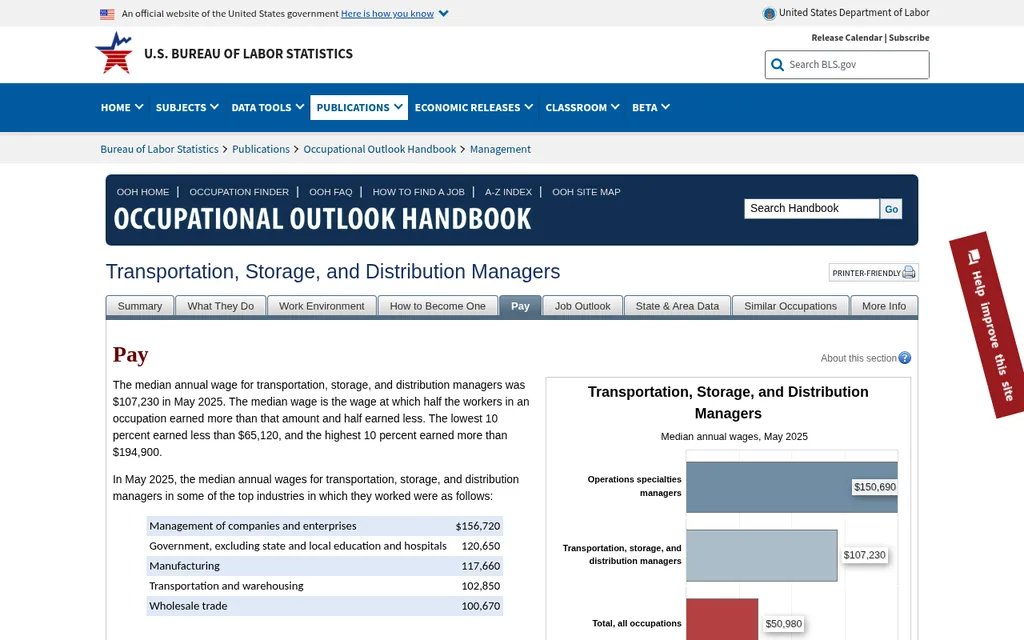
BLS Occupational Outlook Handbook, transportation, storage, and distribution managers pay tab, checked October 2026
The BLS page for transportation, storage, and distribution managers puts the median annual wage at $107,230 in May 2025. The lowest 10% earned less than $65,120, and the highest 10% earned more than $194,900. The handbook describes supply chain and logistics managers as the people who set the strategy for sourcing, storing, and moving goods, talk to suppliers and distributors, and fix disruptions when something breaks.
Industry matters more than most founders expect. The same page shows a median of $100,670 in wholesale trade and $102,850 in transportation and warehousing, compared with $156,720 at the management of companies and enterprises level, which is mostly corporate headquarters roles. An ecommerce brand buying from overseas factories looks a lot more like a wholesaler than a corporate HQ, so the lower end of that list is the more realistic comparison for most of us.
Logisticians And Supply Chain Analysts
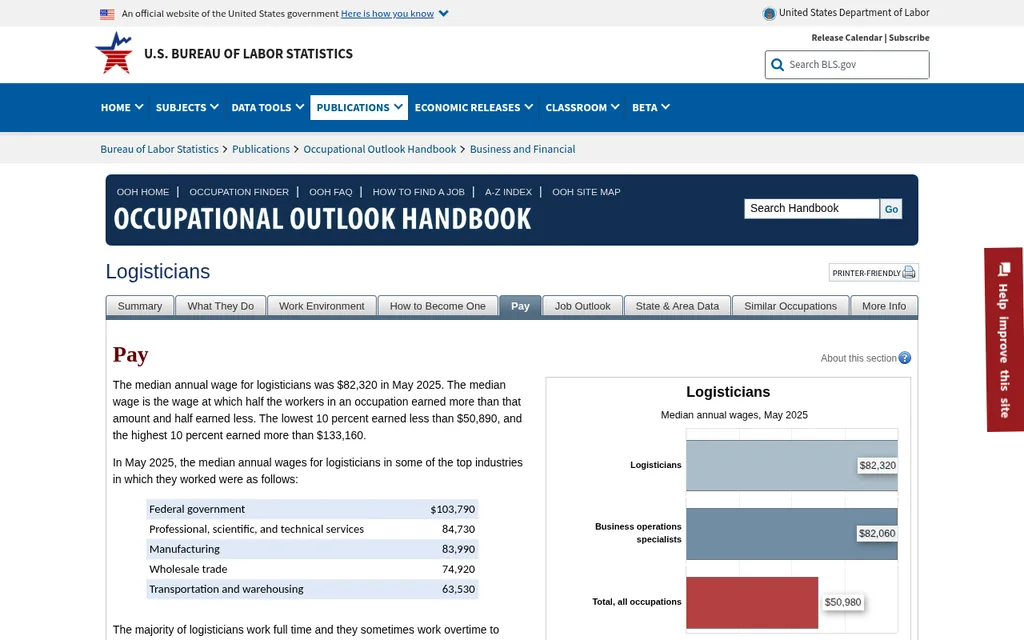
BLS Occupational Outlook Handbook, logisticians pay tab, checked October 2026
If what you need is someone to coordinate purchase orders, track shipments, and keep the spreadsheet honest, the closer match is a logistician. The BLS page for logisticians lists a median annual wage of $82,320 in May 2025, with the lowest 10% under $50,890 and the top 10% above $133,160. In wholesale trade, the median was $74,920.
The handbook says logisticians oversee purchasing, transportation, inventory, and warehousing, act as the liaison with suppliers, and may work under the supervision of a supply chain manager. It also notes that experienced logisticians can move up into supply chain manager roles. That makes it a reasonable first hire title for a brand that has real supplier work but no team for a manager to run yet.
Buyers And Purchasing Managers
Some brands really need a buyer, meaning someone who negotiates with factories and places orders. According to the BLS page for purchasing managers, buyers, and purchasing agents, buyers and purchasing agents had a median of $77,710 in May 2025, and purchasing managers had a median of $148,080. The lowest 10% of purchasing managers earned under $92,490, and the top 10% earned over $223,280.
Purchasing managers usually supervise a team of buyers, which is why their pay sits so much higher. If you're a small brand hiring your first person, you're almost certainly hiring at the buyer or logistician level, even if the title on the posting says manager.
Supply Chain Manager Salary By Role At A Glance
Here are the BLS medians side by side, plus the employer cost of insurance, retirement, and legally required payroll costs from the next section, which works out to about 22.6% of salary. Bonuses and paid time off are left out of the loaded column, and the next section explains why.
| Role (BLS occupation) | Median salary, May 2025 | Lowest 10% to top 10% | Salary plus 22.6% employer costs |
|---|---|---|---|
| Buyer or purchasing agent | $77,710 | $48,380 to $128,870 | $95,272 |
| Logistician | $82,320 | $50,890 to $133,160 | $100,924 |
| Supply chain manager (transportation, storage, and distribution managers) | $107,230 | $65,120 to $194,900 | $131,464 |
| Purchasing manager | $148,080 | $92,490 to $223,280 | $181,546 |
Location moves these numbers too. Each BLS handbook page has a State and Area Data tab that links to wages by state and metro area, and the O*NET profile has a state and ZIP code wage lookup, so check your own market before you write an offer. If you're hiring remotely, the candidate's market usually sets the expectation more than yours does.
Payroll Taxes And Benefits On Top Of Salary
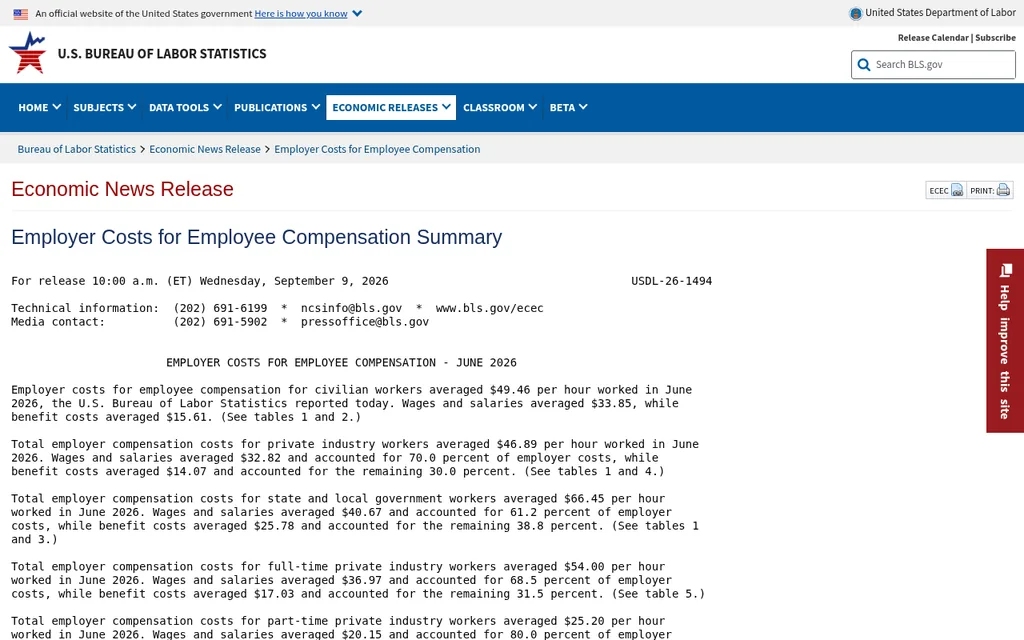
BLS Employer Costs for Employee Compensation release for June 2026, checked October 2026
The salary on the offer letter is only part of what you pay. The BLS Employer Costs for Employee Compensation release for June 2026 says that for full-time private industry workers, wages and salaries were 68.5% of employer costs and benefits were the other 31.5%. For management, business, and financial occupations in private industry, wages were 67.5% of total compensation and benefits were 32.5%.
That 32.5% isn't all extra money on top of a salary, though. Paid leave is counted as a benefit in that survey, but an annual salary already pays someone for their vacation days, so I take it out. For management, business, and financial jobs, the June 2026 table shows $59.85 an hour in wages, $8.47 in paid leave, $6.63 in insurance, $3.23 in retirement and savings, $5.56 in legally required benefits like Social Security, Medicare, unemployment insurance, and workers' compensation, and $4.89 in supplemental pay like bonuses and overtime.
Adding insurance, retirement, and legally required benefits gives $15.42 an hour, and wages plus paid leave come to $68.32 an hour. That works out to about 22.6% on top of salary for the costs you'll pay for almost any full-time hire. If you plan to pay bonuses at the typical rate for these jobs, supplemental pay adds about another 7.2%, which takes the total to roughly 29.7%.
Your own number depends mostly on your health plan, since insurance is the biggest of those three pieces. A small brand with a modest plan and no 401(k) match will come in under 22.6%, and a generous plan with a match can come in over it. I'd use 22.6% as the planning number and swap in the real quote from your payroll provider once you have it.
Recruiting Costs And Time To Fill
Finding the person costs money before they start. SHRM's 2025 benchmarking release put the average cost per hire at $5,475 for nonexecutive roles and $35,879 for executive roles, based on a survey of 2,371 SHRM members. A first supply chain hire at a small brand is a nonexecutive role, so $5,475 is the fair benchmark, while a director brought in through a search firm is closer to the executive figure.
Time is the other cost. SHRM's 2026 recruiting benchmarking brief says the median time to fill a nonexecutive position fell to 39 calendar days. During those weeks the purchase orders, shipment tracking, and supplier follow-ups are still landing on you, so plan your next production run around the gap.
If you use an outside recruiter, get the fee in writing before you share the role. Contingency recruiters usually charge a percentage of first-year salary, and that percentage applies to the whole salary you agree to, which can make the recruiting bill a lot bigger than the SHRM average.
Tools, Training, And Ramp Up
A supply chain manager needs a system to work in, and that's a real cost too. The O*NET profile for supply chain managers lists spreadsheets, ERP systems, inventory management software, and procurement software among the tools the job uses, and it says 85% of people in the role reported working more than 40 hours in a typical week. If the plan is for your new hire to run purchasing out of your inbox and a shared spreadsheet, you're paying a manager's salary for clerical work.
For a sense of scale, the SupplyAutomate software plan is $199 a month or $1,999 a year on our pricing page, with unlimited team members. It works from the documents you upload, meaning supplier invoices, packing lists, freight bills, and customs entries, tracks parcels and ocean containers, calculates landed cost per unit from factory price, freight, duty, and samples, and exports to CSV or Excel. It doesn't connect to Shopify, Amazon, or WooCommerce and doesn't sync your sales or orders, so your new hire would still pull sales numbers from those platforms directly.
The softer cost is ramp-up time. A new hire has to learn your SKUs, your suppliers, your 3PL, and the history behind every price you've negotiated. Having purchase orders, invoices, and shipping documents filed in one place before they start shortens that a lot, and our guide on organizing supplier invoices by purchase order is a good place to start.
A Worked Example: Year One Cost Of A Supply Chain Manager
Here's how I'd budget a first year for a hire paid the national median for supply chain managers. Every input comes from the sources above, and you should swap in your own salary offer, health plan quote, and recruiting cost once you have them.
| Line item | How it's calculated | Year one cost |
|---|---|---|
| Base salary | BLS median for transportation, storage, and distribution managers | $107,230 |
| Insurance, retirement, and payroll taxes | 22.6% of salary, from the BLS June 2026 employer costs table | $24,234 |
| Recruiting | SHRM 2025 average nonexecutive cost per hire | $5,475 |
| Year one total before bonus and software | Sum of the lines above | $136,939 |
That's about $11,400 a month. If you pay a typical bonus, add roughly 7.2% of salary, or about $7,700, and then add whatever software they'll work in. For a logistician paid the median of $82,320, the same math gives $100,924 with employer costs and $106,399 with recruiting, or about $8,900 a month.
Compare that with what the hire has to save or earn back. If the job is mostly keeping purchase orders, shipments, and landed cost per unit accurate, the question is whether you're losing more than that to stockouts, freight overcharges, and bad pricing decisions. If you can't point to the money, the hire is probably early.
Cheaper Ways To Cover The Work Before You Hire
At a lot of smaller brands, the supply chain workload is too big for the founder to keep doing at night and too small to keep a $131,000 a year hire busy. The hire vs software guide walks through that decision in detail, and here's how the costs line up against the example above.
The first option is software that handles the document work. Filing invoices, packing lists, and freight bills against each purchase order and keeping landed cost current is a big part of what a junior supply chain hire would do, and the SupplyAutomate plan at $199 a month covers that side. Our Shopify ERP and Amazon FBA ERP pages show how it fits next to each sales channel, and best supply chain management software compares other tools.
The second option is to hand off the supplier work itself. Our Outsourced Supply Chain Manager service is a flat $2,499 a month, or $29,988 a year, for a named US-based supply chain manager who places the orders, chases production, books pre-shipment inspection, and moves freight to your 3PL, with Pro software access included. Goods, freight, duty, and inspection fees are billed at cost with no commission on your goods, there's no minimum term, and takeover takes about two weeks, which is well under SHRM's 39-day median just to fill a role.
The third option is a part-time or fractional person, which can work well if you mostly need occasional strategy like supplier renegotiations or a quarterly planning review. Rates vary too much for me to quote a fair number, so get two or three proposals and compare them against the loaded salary math above.
Frequently Asked Questions
What Is The Average Supply Chain Manager Salary In 2026?
The most recent official figure is the BLS median for transportation, storage, and distribution managers, the occupation that includes supply chain managers, which was $107,230 in May 2025. The lowest 10% earned under $65,120 and the top 10% earned over $194,900. BLS updates these wage figures once a year, so check the handbook page before you set a salary range.
How Much Does It Cost To Hire A Supply Chain Manager?
At the median salary, plan on about $131,000 a year once you add insurance, retirement, and legally required payroll costs at the 22.6% rate from BLS employer cost data. Add about $5,475 for recruiting, based on SHRM's 2025 average nonexecutive cost per hire, and year one comes to roughly $137,000 before bonuses and software. Your health plan and your market will move that up or down.
What Does A Logistician Make Compared With A Supply Chain Manager?
BLS put the median logistician salary at $82,320 in May 2025, compared with $107,230 for transportation, storage, and distribution managers. Logisticians coordinate purchasing, shipping, and inventory, and the handbook notes they may work under a supply chain manager. For a small brand's first supply chain hire, the logistician range is usually the more realistic one.
How Much Are Payroll Taxes And Benefits For A Salaried Employee?
In the BLS employer costs survey for June 2026, benefits were 31.5% of total compensation for full-time private industry workers. After taking out paid leave, which an annual salary already covers, insurance, retirement, and legally required benefits for management, business, and financial jobs come to about 22.6% on top of salary. Bonuses at the typical rate add about another 7.2%.
Is An Outsourced Supply Chain Manager Cheaper Than Hiring?
For most smaller import brands, yes. Our Outsourced Supply Chain Manager service is a flat $2,499 a month, or $29,988 a year, with software included and goods, freight, duty, and inspection billed at cost. That compares with roughly $137,000 in year one for a hire at the BLS median, though a full-time hire may make more sense once you have enough suppliers and volume to keep one person busy every day.
How I Would Budget For This Hire
If I were planning this today, I'd start by writing down the hours I spend each week on purchase orders, factory follow-ups, freight, and landed cost, and what those hours are keeping me from. Then I'd price the role at the BLS median for the level I actually need, add 22.6% for employer costs and the recruiting line, and see whether the work justifies that number this year. Plenty of brands get there eventually, and the math is the quickest way to tell whether you're there yet.
If it doesn't yet, get your documents and landed cost in order with software first, or hand the supplier work to an Outsourced Supply Chain Manager until the volume is there. That way, when you do hire, the person walks into a clean system with real numbers, and you get the full value of the salary you're paying.
Related Guides
- Hiring A Supply Chain Manager Vs Supply Chain Software: 2026 Verdict
- Best Supply Chain Management Software For FBA And Shopify Importers
- Is ERP Software Overkill For A Small Shopify Store?
- Procurement Software For Small Business Importers
- Supplier Management Software Cost In 2026
- How To Manage Supplier Orders Over WeChat
- How To Organize Supplier Invoices By Purchase Order For Importers
- How To Reconcile A Supplier Invoice To A Purchase Order
- Landed Cost Spreadsheet Vs Software: When To Automate Imports
- Best Amazon FBA Supply Chain Software