U.S. rail transportation producer prices increased 70.8% from 2010 to 2025, while truck transportation prices rose 58.0%, according to the U.S. Bureau of Transportation Statistics. Those measures aren't shipment invoices, but they make the budgeting problem clear: transportation prices don't stand still. A freight cost calculator should help an importer test cost exposure, not turn a temporary rate into a permanent assumption.
For Amazon FBA and Shopify sellers, the quoted transport charge is only the beginning. Packaging, destination services, marketplace fees, and routing changes can turn an apparently profitable purchase order into inventory with inadequate margin. A useful estimate makes those assumptions visible before the order goes out.
What Makes Up a Freight Estimate by Mode
From 2024 to 2025, U.S. general freight trucking prices increased 3.3%, while all-truck transportation prices increased 2.6%, according to the Bureau of Transportation Statistics transportation-cost report. Every estimate is therefore a dated snapshot, not a fixed price.
The first comparison shouldn't be between headline totals. It should be between the services included in those totals. An ocean quote ending at the destination terminal isn't comparable with an air quote that includes delivery to the warehouse.
Freight cost components by mode
| Component | Ocean | Air | Truck |
|---|---|---|---|
| Base freight | Per container, FEU or TEU, or per CBM for LCL | Per chargeable kg | Per mile or per pallet |
| Fuel surcharge | Bunker-fuel surcharge | Per-kg fuel charge | Percentage of linehaul |
| Port and handling | Terminal handling and port charges | Airport handling per shipment | Pickup and drop fees |
| Insurance | Percentage of declared cargo value | Percentage of declared value | Declared value cover |
| Customs and duties | Duty, brokerage and CBP fees for U.S. imports | Duty, brokerage and CBP fees for U.S. imports | Duty, brokerage and CBP fees for U.S. cross-border imports |
| Inland delivery | Drayage to warehouse | Airport-to-warehouse delivery | Final-mile delivery |
| Accessorials | Documentation and container fees | Security and handling fees | Liftgate, residential and appointment fees |
These are charge bases to check, not universal carrier tariffs. Domestic trucking doesn't automatically involve customs, and cargo insurance shouldn't be assumed to provide the same protection as a carrier's declared-value arrangement.
The base-freight row establishes the transport price. Fuel and handling then need their own inclusion checks: a forwarder may bundle them, quote them separately, or leave a destination agent to collect them. Insurance requires confirmation of the insured value and coverage, not merely a checked box.
Compare the same service boundary
UN Trade and Development's maritime transport review explains that some benchmark quotations are gate-in, gate-out, incorporating terminal handling and ocean transport. A door-to-port description, by contrast, may still leave terminal charges or destination services outside the quoted amount. The written inclusions matter more than the label.
For a parallel example outside commercial importing, the Home Removals Sydney pricing guide offers context for assessing a transport service's scope. Household removal prices aren't freight benchmarks, but checking the service boundary is equally important.
Supply Automate's Freight Cost Estimator compares sea and air freight cost, chargeable weight, and transit time. The resulting freight figure can then feed a landed cost calculator, rather than being mistaken for the complete cost of imported inventory.
Quote-checking rule: Read every quote against all seven rows. Mark each excluded or unconfirmed charge, obtain an allowance for it, and only then compare suppliers.
How Dimensional Weight Changes Your Freight Bill
A light, bulky carton can cost like a heavy one. Carriers sell transport capacity, so a package that occupies substantial space can attract a higher rating weight than its scale weight.
The Shopify packaging and weights guide gives the UPS dimensional-weight calculation as length × width × height ÷ divisor, rounded up to the next whole pound, with 139 for daily rates and 166 for retail rates. The applicable billable weight is the greater of actual weight and dimensional weight.
A carton example that changes the estimate
For a Shopify order in a 20 × 15 × 12-inch carton, the volume is 3,600 cubic inches. Applying the daily-rate calculation gives 3,600 ÷ 139 = 25.9, rounded up to 26 pounds, even when the actual shipment weighs 10 pounds.
That's not an overweight product problem. It's a packaging and rating problem, and changing the product's weight field won't solve it.
Billable weight by carton size and divisor
The following calculations apply the cited divisors. They show dimensional billable weight, assuming actual weight doesn't exceed the calculated result.
| Carton (inches) | Volume (cubic inches) | Billable at 139 | Billable at 166 |
|---|---|---|---|
| 12 × 12 × 12 | 1,728 | 13 lb | 11 lb |
| 8 × 8 × 8 | 512 | 4 lb | 4 lb |
| 20 × 15 × 12 | 3,600 | 26 lb | 22 lb |
| 24 × 18 × 18 | 7,776 | 56 lb | 47 lb |
The larger carton illustrates why packaging deserves attention before freight negotiation. A modest reduction in outside dimensions can cross a billing threshold without any change to the product itself.
Apparel bundles, foam products, household organizers, and retail-ready packaging deserve particular scrutiny. These products can fill a carton before reaching a substantial actual weight. Excess void fill, oversized presentation boxes, and inconsistent carton selection can make the problem worse.
Packaging savings should come from removing unnecessary space, not removing protection that prevents damage.
A practical shipping-cost reduction workflow starts with a packed sample and a tape measure. The measurement must include bulges and the closed carton's outside dimensions, not the supplier's nominal box specification.
For imported inventory, the freight cost calculator needs master-carton dimensions, not the dimensions of the individual product box. Parcel divisors also shouldn't be copied into air-freight calculations without checking the forwarder's rating rule. After any packaging change, the estimate needs another run using the applicable carrier or service basis.
Inputs and Steps for a Reliable Freight Estimate
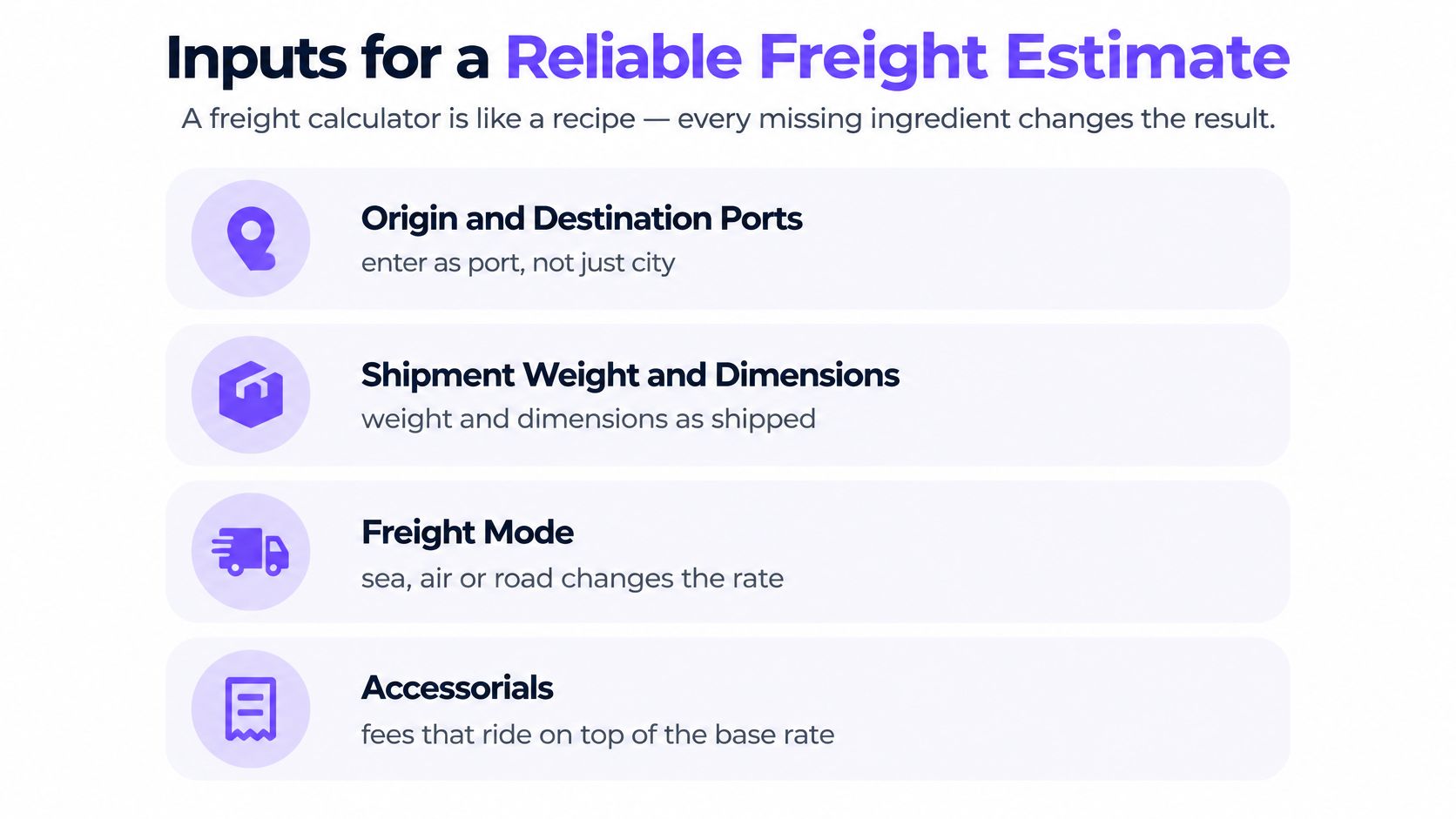
A freight calculator is a recipe: every missing ingredient changes the result. A polished interface can still produce an unreliable estimate when the shipment details are guesses.
The input checklist begins with the physical shipment and ends with the delivery requirements.
Gather the shipment facts
- Origin and destination: Record the actual port, factory, warehouse, or ZIP code. A city name alone doesn't identify the pickup or delivery obligation.
- Shipping mode: Specify sea LCL, sea FCL, air, or truck, together with the requested service.
- Packed weight: Weigh closed cartons and completed pallets. Product specifications exclude packaging unless expressly stated.
- Outside dimensions: Record the master carton's length, width, and height, keeping inches and centimetres clearly identified.
- Volume and equipment: For LCL, calculate cubic metres. For FCL, identify the required container type, such as a 20-foot or 40-foot container.
- Pallet count: Include pallet dimensions, loaded height, stackability, and total packaged weight for trucking.
- Declared cargo value: Use the value required for the insurance quotation and distinguish it from an unsupported retail valuation.
- Service and timing: Record requested transit days, cargo-ready date, ship date, and the quote's validity window.
- Accessorials: Specify liftgate, residential delivery, appointments, inside pickup, and arrival notification where required.
For LTL, freight class or density also belongs in the input record. Old Dominion's guidance on accurate LTL quotes emphasizes precise dimensions, packaged weight, shipment locations, and accessorial requirements. Weight alone doesn't describe the trailer space a shipment consumes.
Delivery-site details need confirmation from the receiving operation. A Shopify brand delivering to a small storage unit may need equipment that a loading-dock warehouse doesn't. An FBA delivery plan may require appointment coordination that a generic commercial-address quote hasn't included.
Run the estimate in eight steps
- Set the scope to factory door through warehouse receipt. Identify who pays for each leg. The agreed trade term should be checked against the actual quote, using the distinctions in FOB, EXW, and DDP for FBA sellers.
- Enter the lane and mode. Use the actual gateway and receiving address. A convenient nearby port isn't interchangeable with the port on the booking.
- Enter packed weight and master-carton dimensions. Apply the service's rating rule and compare actual with dimensional weight where applicable. Keep pallet and packaging weight in the shipment total.
- Match the charge basis to the supplier quote. Container, CBM, kilogram, and pallet prices belong in their respective fields. A spreadsheet can accept a unit mismatch without producing an obvious error message.
- Add the quoted surcharges. Include fuel, port or airport handling, and insurance on the appropriate declared value. Distinguish included charges from additional charges to avoid counting either twice.
- Add destination services and warehouse handling. Receiving, unloading, appointments, and special delivery equipment shouldn't disappear between the transport estimate and the inventory budget.
- Run another mode or supplier with identical shipment assumptions. Keep the same delivery endpoint and required services. A cheaper total is useful only when it buys the required outcome.
- Save the output with its date and validity window. Preserve the original quotation, assumptions, currency, and exclusions alongside the estimate.
For sellers moving between bulk inbound freight and individual resale orders, ScanFlip AI's guide on how to calculate resale shipping costs provides additional context for the outbound side. Import freight and customer delivery should remain separate cost records.
Check uncertainty before commitment
Supply Automate sets import country, currency, and duty defaults in settings, and its landed-cost, duty, and freight calculations follow that lane. Those settings deserve the same scrutiny as the shipment measurements, especially when a team handles different destinations.
A practical internal control is to measure any guessed input that could plausibly change the result by more than 10%. That's a recommended decision threshold, not a claimed industry standard.
The final check compares the estimate with the last invoice for a similar shipment. An unexplained gap above the same threshold warrants investigation before the purchase order is approved, particularly when the difference comes from omitted services rather than a documented rate change.
Amazon FBA and Shopify Cost Examples
Amazon FBA and Shopify expose different weaknesses in an incomplete freight estimate. Amazon sellers must account for the inbound shipping plan and downstream marketplace fees; Shopify sellers must connect packaging and customer delivery to checkout revenue.
For small/medium bulky products weighing 5 pounds or less, Amazon's inbound placement rate card lists approximately $1.10–$1.60 per unit for minimal shipment splits and $0.55–$1.10 for shipments to two or three locations, while Amazon-optimized splits have no placement fee. At the minimal-split rate, 1,000 units add $1,100–$1,600 before storage, fulfillment, duties, or domestic delivery.
Channel-specific freight costs with worked examples
The Amazon figures below follow the cited rate cards; current shipping-plan eligibility and rates still require confirmation.
| Channel | Cost item | Worked example |
|---|---|---|
| Amazon FBA | Inbound placement fee, minimal split | 1,000 small/medium bulky units at $1.10–$1.60 = $1,100–$1,600 |
| Amazon FBA | Inbound placement fee, two or three locations | 1,000 eligible units at $0.55–$1.10 = $550–$1,100 |
| Amazon FBA | Fulfillment fee with 3.5% surcharge | $8.00 becomes $8.28 per unit; 5,000 units add $1,400 |
| Shopify | Carrier-calculated checkout rate | Same SKU quotes differ by box size, ZIP code, and delivery speed |
| Shopify | Packaging change | Rerun the estimate after any carton change, since dimensional weight can move the rate |
Amazon's published fee information states that a 3.5% fuel and logistics-related surcharge applies to FBA fulfillment fees beginning April 17, 2026; its arithmetic turns an $8.00 fee into $8.28, adding $1,400 across 5,000 units, according to Amazon's surcharge guidance. This belongs on a separate fulfillment line, not inside ocean or air freight.
Different channel, different decision
Avoiding placement fees isn't automatically the cheapest inbound plan. Additional delivery destinations can require extra transportation and coordination, so the comparison must include both placement and delivery costs.
For Shopify, carrier-calculated shipping guidance identifies origin, destination, weight, declared value, box dimensions, dimensional weight, and delivery speed as rating inputs. Applied to the daily-divisor carton calculations, a 2-pound product can rate at 13 pounds in the larger cube-shaped carton but 4 pounds in the compact one. The product hasn't changed, but the shipping economics have.
Amazon's surcharge shouldn't automatically be applied to Shopify orders handled through an independent 3PL or carrier account. Each channel needs its own cost line, with cargo insurance identified separately from marketplace charges and customer-delivery costs.
Turning a Freight Estimate Into Landed Cost
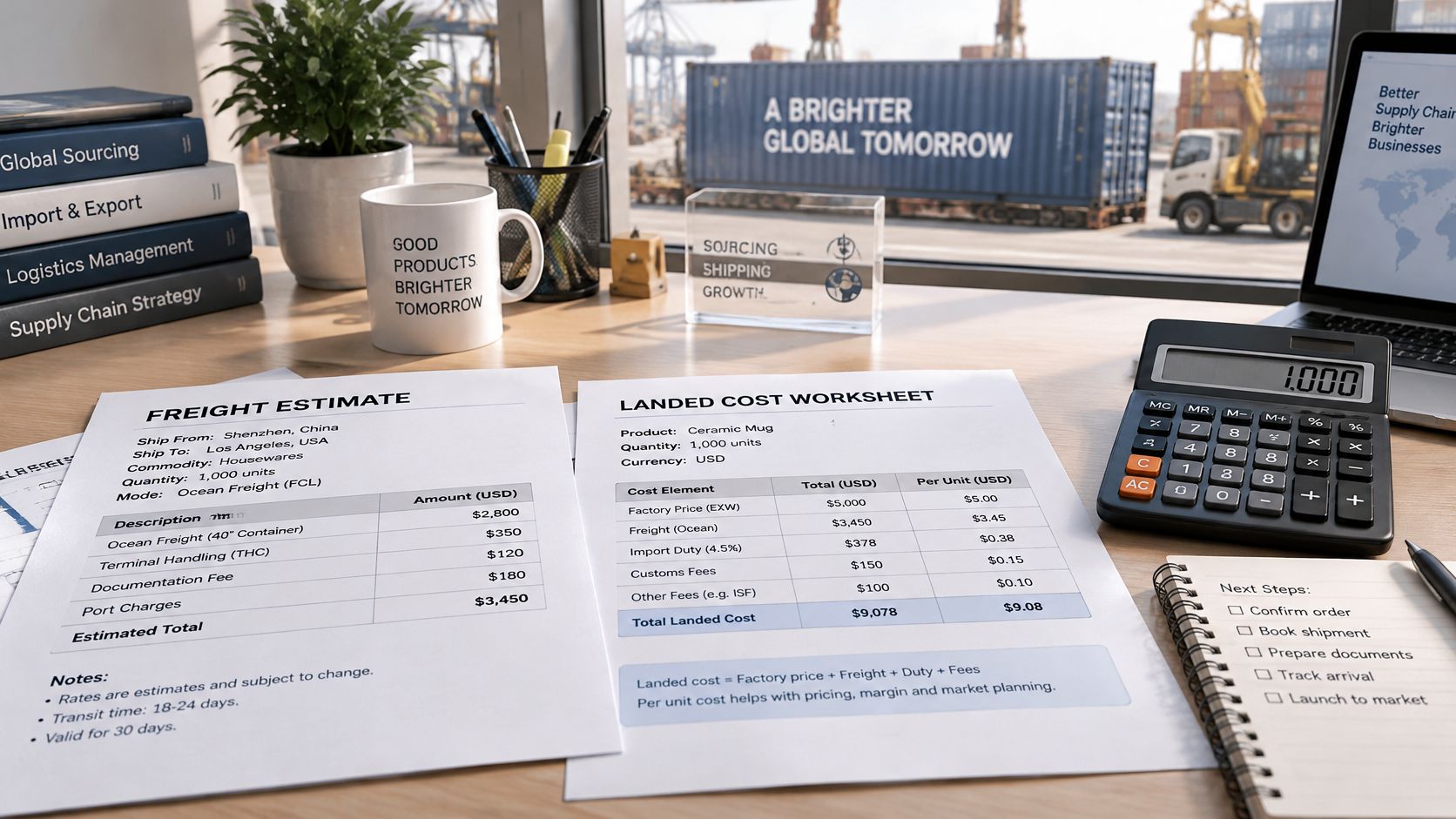
A freight estimate is an ingredient in landed cost, not its replacement. Landed cost combines factory price, freight, duty, and other import costs into a per-unit figure that can be checked against the product's selling economics.
Consider a hypothetical shipment of 1,000 units carrying $4,000 in freight. The freight allocation is $4.00 per unit; a 25% increase makes it $5.00 per unit. Those are planning assumptions, not market-rate claims, and the scenario table below extends the same example.
A documented estimate should sit beside the shipment paperwork rather than in an isolated calculator tab.
Allocate costs where they belong
Equal allocation works for identical units. Mixed-SKU shipments need a defensible allocation basis: volume for space-intensive cargo, weight where rating is weight-driven, and direct assignment for fees attributable to a particular SKU.
The process for calculating landed cost for imported products should preserve those distinctions. Otherwise, a compact, profitable SKU can appear to subsidize an oversized product without anyone recognizing the cause.
The lowest freight quote isn't necessarily the lowest delivered inventory cost.
Stress-test the route, not just the rate
In July 2024, Shanghai container rates reached $8,103 per FEU to the U.S. West Coast and $9,945 per FEU to the U.S. East Coast, as UN Trade and Development reported. Red Sea diversions around the Cape of Good Hope increased voyage distance, fuel consumption, vessel time, and insurance exposure.
That's a reason to preserve a range of outcomes with a quote date attached to each. An alternate port, longer inventory transit, or emergency replenishment should be modeled as a distinct operational scenario, not hidden inside an arbitrary contingency amount.
The free Landed Cost Calculator calculates the true cost per unit before an order is placed. As bills arrive, the landed-cost record is recalculated; it also flags a supplier invoice whose total disagrees with its own lines.
Any SKU whose contribution margin falls below its target in the stressed case needs a decision before commitment. Reducing the order, changing packaging, adjusting price, or buying a faster service can be more economical than accepting delay and stockout exposure.
Confirm Your Landed Cost Before You Order
No purchase order should go out until landed cost per SKU has been checked against target margin. A transport budget that looks affordable in aggregate can still leave individual products below the business's margin floor.
The purchase-order workspace provides a place to keep that decision connected to shipment records.
Set the release conditions
- Comparable options: Sea and air alternatives should share the same scope and receiving endpoint.
- Confirmed shipment facts: Carton measurements and charge bases should match the quotation.
- Acceptable downside: Base and stressed cases should be tested against a margin floor for each SKU.
- Assigned ownership: A named operator should resolve exclusions before purchasing approves the order.
Freight allocation across scenarios
This hypothetical example keeps unit quantity constant and changes only the freight bill.
| Scenario | Freight on 1,000 units |
|---|---|
| Base | $4,000 total, $4.00 per unit |
| +25% | $5,000 total, $5.00 per unit |
| +50% | $6,000 total, $6.00 per unit |
Supply Automate offers free tools including a purchase order creator, landed cost calculator, Amazon profit calculator, import duty calculator, freight cost estimator, MOQ calculator, lead time calculator, and dropshipping profit calculator. The Import Duty Calculator uses live U.S. HTS rates plus CBP fees before ordering and only answers for U.S.-bound shipments. Other destinations need a separate duty check, even when the platform's import-lane and currency settings are configured.
The video provides additional product context.
The next purchase order should have an estimate saved before approval. After arrival, the operator should compare actual invoices with that estimate and replace guessed inputs with confirmed charges, making the next calculation more reliable.
Supply Automate offers free freight comparison and landed-cost tools that help Amazon FBA and Shopify sellers assess purchase orders before committing cash. Visit Supply Automate to estimate the next shipment, check its SKU-level margin, and keep the assumptions ready for comparison with the arrival invoices.