“Find a cheaper carrier” is usually the wrong first move. A discounted label won't fix an oversized carton, an unprofitable delivery zone, or an import model priced as though duty-free de minimis still exists. For Amazon FBA and Shopify sellers, the better starting point is the SKU, packed carton, and destination that already loses money.
Learning how to reduce shipping costs means working backward from the paid invoice to the operational decision that created it. Packaging comes before parcel routing. Duty belongs beside freight. And consolidated replenishment only wins when the inventory sells before storage, markdowns, or stockouts erase the saving.
Shipping Cost Cuts Worth Making First
The invoice matters more than the quote. A carrier discount covers only part of a Shopify shipment, while a low ocean rate says little about the cost of getting inventory into an Amazon fulfillment center.
Start with the charges the brand pays: transportation, accessorials, duty, handling, placement, storage, and corrections. Then rank changes by recoverable margin, not by the size of the advertised discount.
Shipping cost levers and what they are worth
Treat the benchmarks below as screening tools. Savings from separate levers overlap and rarely stack.
| Lever | Typical saving | Fits | Watch-out |
|---|---|---|---|
| Right-size cartons and DIM weight | DIM surcharges can add a meaningful cost to affected parcels | Shopify parcels and light, bulky FBA units | Cutting board strength raises damage and returns |
| Multi-carrier and regional lanes | 10–40% on lanes a regional carrier can serve | Domestic US volume with clean zone data | Headline discounts lose to fuel, residential, and delivery-area fees |
| More efficient gateway and full route | Up to 12% from the 25th to 75th percentile of port efficiency; ports often represent 8–12% of transport cost | Importers choosing China-to-US gateways | A slightly higher ocean rate can still win on dwell and demurrage |
| Consolidate POs and fill the box | Load-factor elasticity of about 0.3 to 1.0; each extra border adds roughly 3–4% | Predictable replenishment that can wait to ship together | Waiting to fill a container creates stockouts |
| FBA price band and inbound placement | Up to $0.86 per unit below $10; minimal-splits increase averages $0.05, or $500 on 10,000 units | Amazon US standard-size products | A lower price can destroy margin after referral fees |
On gateways, a World Bank port-efficiency study found that moving from the 25th to the 75th efficiency percentile reduced shipping costs by 12%, while port costs have historically run 8–12% of total transport costs. That's a reason to compare terminal charges, inland transport, free time, and expected dwell rather than vessel rates alone.
Choose the changes that fit the shipment mix
A Shopify brand sending bulky, lightweight orders should usually investigate cartons before negotiating. An FBA seller should separate fulfillment economics from inbound placement. An importer weighing direct parcel against consolidated freight should cost both routes with duty included; quoting either model against a duty-free threshold that no longer applies distorts the comparison before the first booking.
Priority rule: A saving only matters when it survives delivery, damage, inventory, and customer-service costs.
Circle the two rows that match the brand's shipment mix. Measure those first. Opening every freight, packaging, and checkout project at once makes it harder to identify what improved margin.
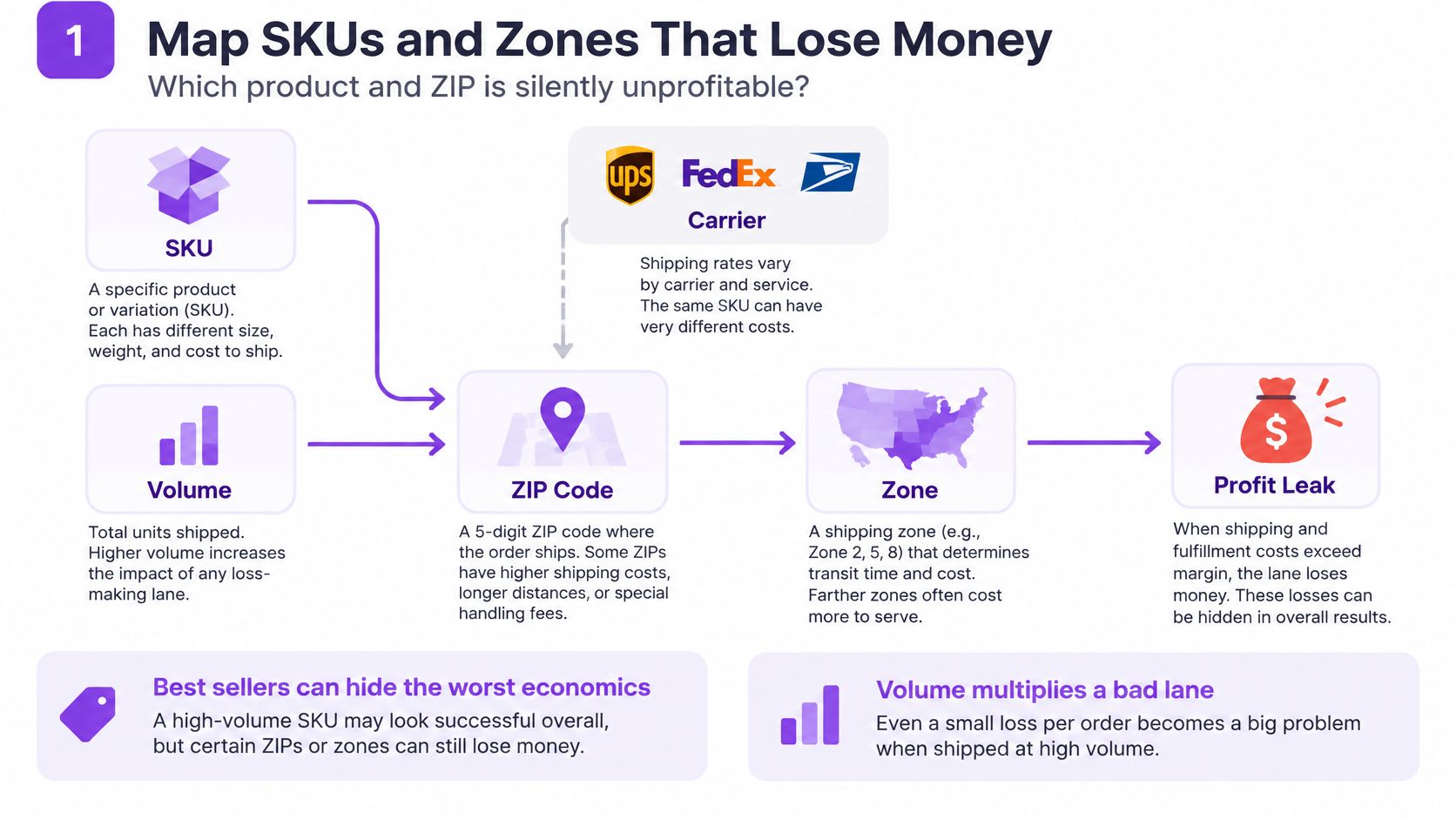
Map SKUs and Zones That Lose Money
The missing question isn't which carrier logo is cheapest. It's which product and ZIP code isn't profitable.
A best seller can deserve attention precisely because it sells well. Repeating a negative contribution order doesn't repair its economics. It multiplies the loss.
The profit map connects merchandise, package size, geography, and shipping expense.
Build an order-level margin file
- Export the operating detail. Pull a recent shipment history containing SKU, units, actual weight, packed dimensions, origin, destination zone or country, service, and every accessorial. Join the order record to the final carrier invoice, not just the label transaction.
- Calculate billable weight. Keep actual and dimensional weight in separate columns, then apply the carrier's greater-of rule. Preserve the measured dimensions so a corrected invoice can be traced to the package that caused it.
- Calculate contribution. Start with net selling revenue. Subtract product cost, allocated inbound freight and duty, marketplace or payment fees, fulfillment, outbound shipping, and attributable returns. Don't count an inbound charge again if it's already included in landed cost.
- Rank the losses. Sort SKU-zone combinations by total contribution dollars lost. Flag the worst combinations for action, then distinguish persistent losses from unusual claims or corrections.
The Branvas ecommerce shipping statistics guide reports approximately 5.9% general rate increases from UPS and FedEx in 2026, alongside surcharge exposure that makes package and destination analysis important. A discount card from the prior contract period isn't a substitute for current invoices.
Mixed-product imports need defensible allocation. A guide to allocating freight cost across multiple SKUs helps prevent a bulky product from receiving the same freight allocation as a compact item just because both share a purchase order.
Separate Shopify and FBA failure patterns
For a Shopify scenario, consider a lightweight hero product packed with unnecessary headspace. Distant residential orders may lose money even while nearby orders remain profitable. The remedy could be a smaller carton, a different shipping offer, or a restricted expedited option, not a catalog-wide price increase.
For Amazon, compare otherwise similar ASINs separately when price bands, packaged dimensions, or fulfillment weight differ. Averaging their fees can conceal the profitable configuration.
Don't redesign the whole packaging catalog yet. The map should identify which SKU-zone pairs will repay the work and which orders should stop receiving subsidized service.
Cut Dimensional Weight on Every Parcel
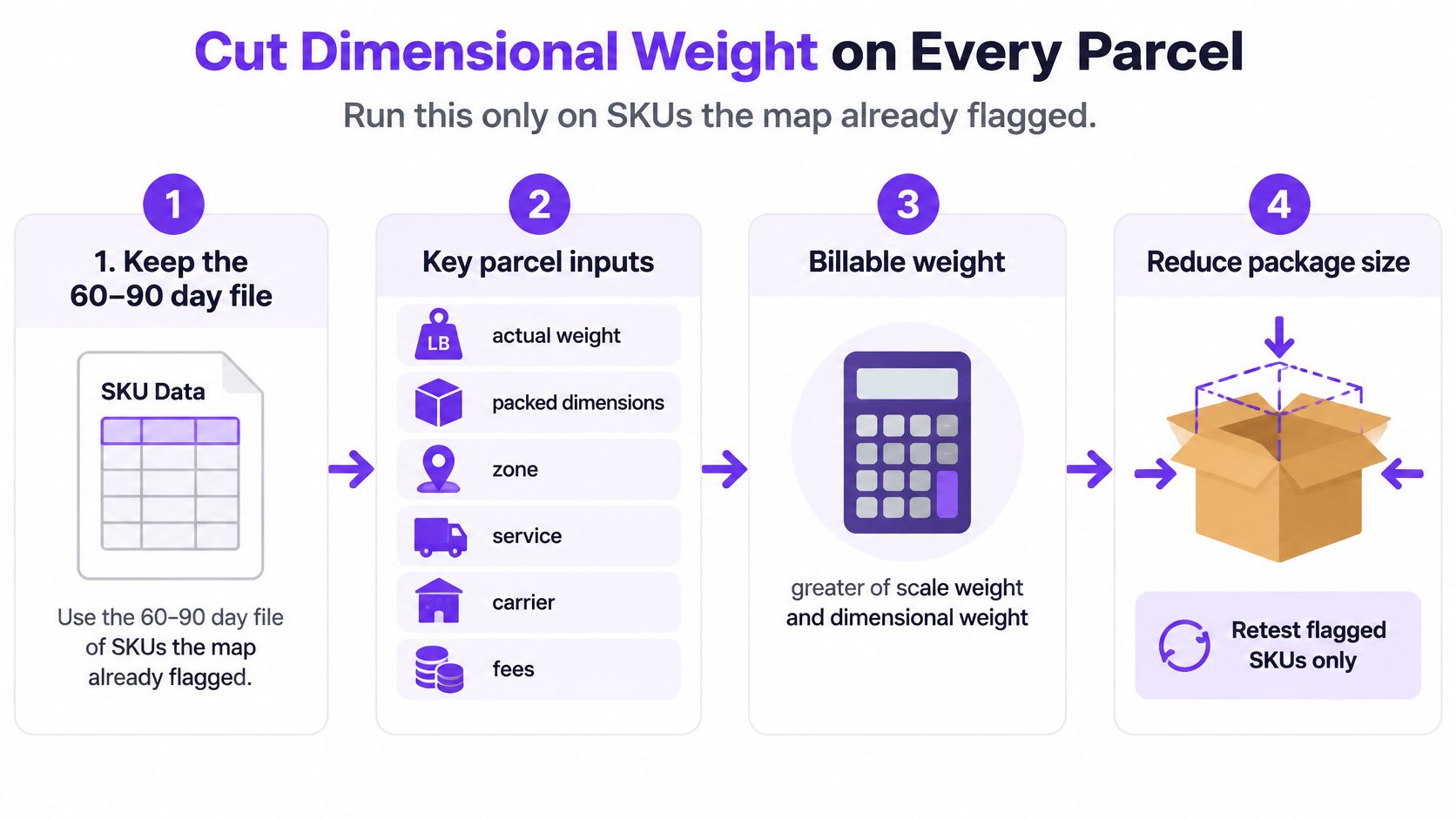
Start with the carton that is already losing money, not the whole packaging shelf. Using the daily-rate divisor in UPS's dimensional-weight guidance, a 24-by-18-by-12-inch carton produces about 37.3 pounds of dimensional weight for a 10-pound product, while a 20-by-16-by-10-inch carton produces roughly 23 pounds. UPS lists divisors of 139 for daily rates and 166 for retail rates.
That first carton bills for roughly 27 pounds of air. Cut the box, not the product.
Those are dimensional calculations, not final billed weights. Carrier rounding, service rules, and actual weight still decide the invoice, so run the test on the flagged SKU-zone pairs first.
Run a controlled carton test
- Keep the shipment file. Use a 60 to 90 day export of actual weight, packed dimensions, destination, service, carrier, and fees. Measure sealed parcels with the product and protective materials inside.
- Apply the correct service rule. Where applicable, calculate dimensional pounds as
ceil(length × width × height ÷ 139), rounding fractional dimensions according to the carrier's rules before calculation. Use the greater of dimensional and actual weight. - Reduce empty space safely. Trial a small set of right-sized cartons and mailers. Keep cushioning around vulnerable corners, prevent movement, and test the packed product rather than the empty box.
- Re-rate and validate. Include fuel, residential, delivery-area, oversize, and address-correction fees. Compare shipping cost, DIM-hit rate, damage, and returns by SKU and zone over a four-week test.
The USPS shipping-services guidance identifies dimensional pricing for applicable parcels exceeding 1,728 cubic inches and a $3 dimension-noncompliance fee for inaccurate dimensions. Entering accurate measurements is a cost control in its own right.
Protect the saving after downsizing
A right-sizing test that works shows up two ways on the invoice: lower billable weight per parcel, and fewer shipments priced on dimensional weight at all. Judge the test by those two lines, by SKU and zone, rather than by a storewide average that can hide a losing lane.
For FBA, distinguish the sellable unit's packaging from the inbound shipping carton. A smaller master carton doesn't automatically change the product's fulfillment size tier. Confirm the relevant packaged-unit measurements before changing listings or labels.
Packaging costs also belong in shipping offers. Once the revised package cost is known, sellers can work out free shipping thresholds instead of subsidizing an avoidable DIM penalty on distant-zone orders.
The accompanying video provides additional context for the packaging review.
Rate Shop by Lane and Service Class
With cartons fixed, the decision becomes which service can meet the delivery promise at the lowest complete cost. Assigning every order to the same carrier is convenient, but convenience doesn't establish lane-level profitability.
Stord's parcel-rate analysis identifies potential savings of 10–40% where regional carriers are viable. That range applies to eligible lanes, not the whole shipping budget.
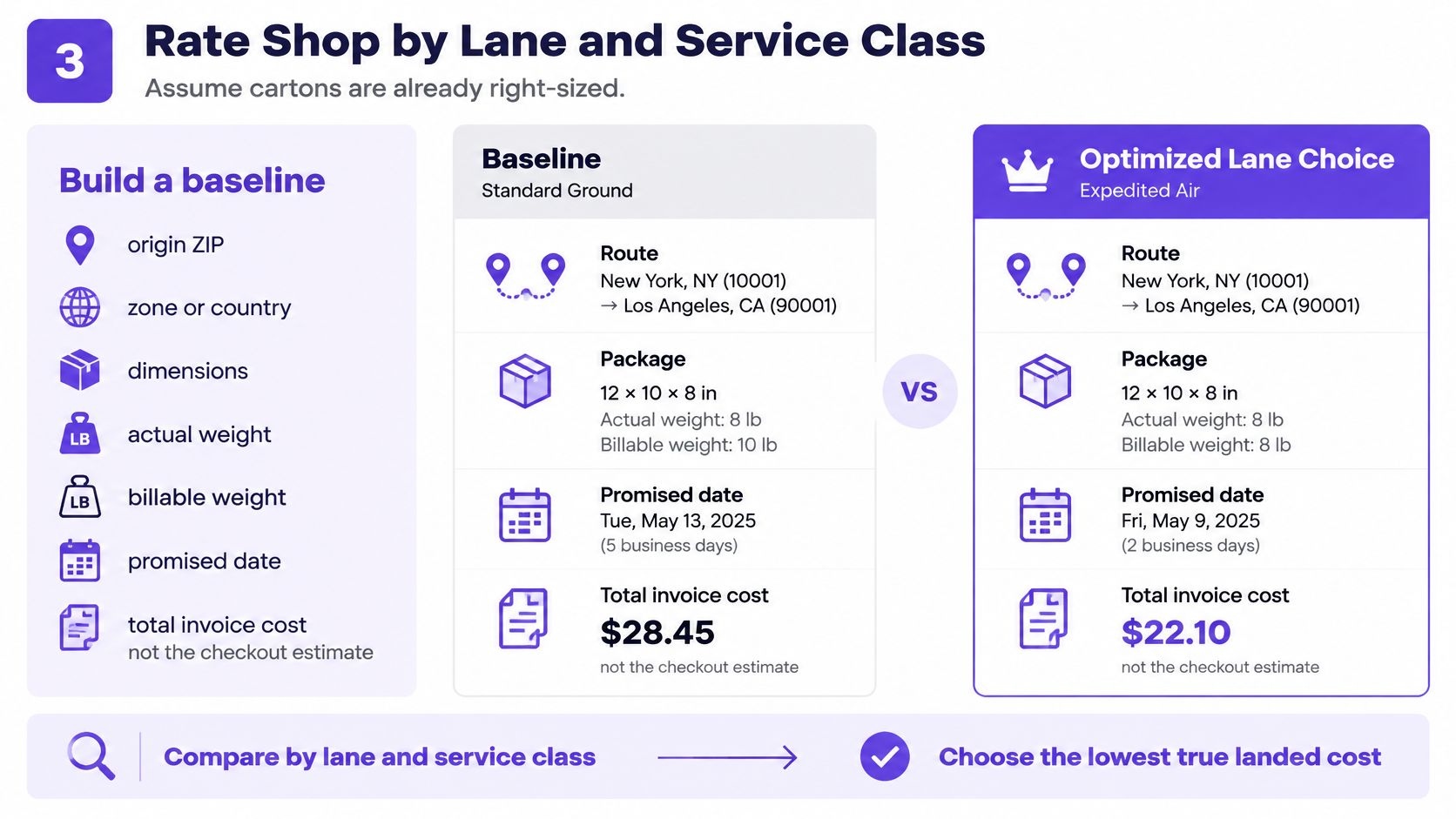
The comparison needs an invoice baseline and a delivery requirement.
Set routing rules before buying labels
- Build the baseline. Group shipments by origin ZIP, destination, packed dimensions, actual and billable weight, promised date, and final invoice cost. Separate exceptions from repeatable charges.
- Define service classes. Premium orders need an explicit arrival commitment. Standard and economy orders need their own latest acceptable dates. A service name isn't a customer promise.
- Model the whole charge. Include base transportation, fuel, residential delivery, delivery areas, signature, oversize, address correction, and return-label expense. Compare the same package and destination across services.
- Exclude unreliable options. Choose the cheapest qualifying service only after excluding carriers whose delivery or damage history fails the product's requirements.
- Review lanes weekly. Track cost per delivered order beside on-time delivery, exceptions, claims, customer contacts, and contribution margin. Negotiate with repeatable volume and clean records.
A freight cost estimator supports the separate replenishment comparison. It shouldn't replace parcel rating against actual carrier contracts.
Make checkout match the operating decision
According to Shopify's shipping-options documentation, carrier-calculated rates use weight, dimensions, and destination, and merchants can add a flat or percentage adjustment; a practical setup is a 3-pound parcel in a 12-by-9-by-4-inch box with a $2 handling addition.
That handling adjustment recovers a real operating expense. It isn't evidence that transportation became cheaper. Keep shipping-cost reduction and customer cost recovery in separate reporting columns.
The lowest label price isn't the lowest cost per delivered order when missed promises create refunds, replacements, or support work.
Regional services deserve a controlled lane trial, not an immediate nationwide switch. Keep the incumbent available while delivery performance is checked, and don't route low-margin standard orders through expedited services just because the checkout settings allow it.
Choose Parcel Import or Consolidated Freight
Treat de minimis as gone. The parcel-versus-freight question now starts with the SKUs, cartons, and zones that were already marginal before duty entered the label price, not with the cheapest option on a rate card.
Importify's de minimis analysis states that US duty-free treatment ended for China and Hong Kong shipments in May 2025, followed by low-value shipments from all countries in August 2025; its published hoodie example moves from $20 duty-free to $51.90 with duties and entry fees, versus $28.13 through bulk import and domestic fulfillment.
That example is not a tariff quote for your product. It shows why every overseas parcel still in the catalog has to be repriced with customs costs inside the unit economics before the mode gets chosen.
Three ways to land the same hoodie
| Model | Example landed cost | What is inside the number | Use it when |
|---|---|---|---|
| Direct parcel while duty-free de minimis applied | $20 | Product and overseas parcel, no duty | Historical comparison only, not a 2026 plan |
| Overseas parcel after duty and entry fees | $51.90 | Duty, entry fees, and parcel freight | Only when speed or avoiding a stockout covers the roughly $23 gap |
| Bulk ocean or air plus domestic fulfillment | $28.13 | Freight, duty, brokerage, and US fulfillment | Sellers whose inventory turns before markdowns |
| Hybrid replenishment | Weighted blend of the bulk leg and the parcel or domestic top-up leg | Bulk on hero SKUs, small air or domestic top-ups on the rest | Mixed demand where one mode would overstock the slow sellers |
The gap between post-duty parcel and bulk is $23.77 per hoodie in that example. Classification, origin, entry method, fulfillment, and order economics all move the number, so run it per SKU instead of borrowing the delta.
Speed is a reason to pay the parcel premium. Habit is not.
Choose capacity against demand
FCL, a full container load, fits a purchase order or planned SKU mix that fills the equipment without creating excessive stock. LCL, less than container load, fits replenishment that benefits from ocean consolidation but can't justify holding a full container's inventory.
World Bank road-freight research estimated freight-cost elasticity against weight or load factor at approximately 0.3 to 1.0 in absolute value, and additional border-crossing costs at roughly 3–4%. Its historical Chongqing-to-US West Coast example put land access at approximately 63% of a $3,650-per-TEU logistics cost, versus 21% for maritime transport.
Factory pickup, gateway access, and domestic delivery are therefore real line items in the decision, not rounding error. Consolidate compatible POs, but don't hold a shipment waiting for a full container when the expected lost contribution from a stockout exceeds the freight saving. A late bestseller costs more than a half-empty box.
Reprice the PO before committing
Compare direct parcel, consolidated import, and hybrid replenishment using product cost, freight, duty, applicable Section 301 exposure, brokerage, insurance, fulfillment, storage, returns, inventory cash, and stockout risk.
SupplyAutomate's Freight Cost Estimator compares sea and air freight cost, chargeable weight, and transit time. Its free Landed Cost Calculator calculates true per-unit cost before an order is placed, with import-country, currency, and duty defaults following the selected lane.
A guide to sea freight rate calculators for ecommerce importers helps organize the ocean side of that comparison. Employee merchandise is a different flow, since those units ship to recipients rather than into sellable inventory; FLYP LTD's guide on how to distribute company swag across borders covers that non-resale case.
Adjust Amazon FBA and Shopify Checkout
Platform settings can improve economics without changing the freight route. They can also conceal losses when pricing and fulfillment are evaluated separately.
Test the Amazon price threshold
Amazon's 2026 US Low-Price FBA schedule gives products priced below $10 fulfillment rates $0.86 lower than products above the threshold, making a move from $10.49 to $9.99 a candidate for SKU-level testing; it also lists non-peak small-standard fees of $2.43 at 2 ounces or less and $2.49 above 2 through 4 ounces.
In that price scenario, the seller gives up $0.50 in revenue to potentially save $0.86 in fulfillment, leaving $0.36 before referral-fee differences, advertising effects, and other costs. The test should use contribution per unit, not sales revenue or fulfillment fees alone.
Don't apply the result across similar-looking ASINs. Packaged weight, dimensions, advertising dependence, and conversion can differ enough to change the answer.
Price inbound placement as a transport choice
Amazon's 2026 fee-change notice says minimal-splits inbound-placement fees for standard-size products increase by an average of $0.05 per unit, equivalent to approximately $500 on 10,000 units, before actual product and destination differences.
Minimal splits can reduce origin-side coordination because inventory goes to fewer receiving locations. Multiple destinations may reduce placement expense but add transportation, prep, appointments, and delay exposure.
| Inbound option | Include in the comparison |
|---|---|
| Minimal splits | Freight, prep, receiving requirements, and the quoted placement fee |
| Multiple receiving locations | Separate freight movements, handling, appointments, and any applicable placement charge |
Use the same receipt quantity and shipment-ready date for both options. The average increase isn't the full placement fee, so it mustn't substitute for the actual shipment-plan quote.
A process for adding Amazon FBA shipment costs to landed cost keeps these charges attached to the inventory they brought into the network.
Audit Shopify package selection
Shopify needs a package preset that represents the packed order, especially when several SKUs share a carton. Test single-item, mixed-item, and bundled baskets so checkout doesn't rate a combination using the wrong box.
Keep handling adjustments explicit in the shipping configuration. Increasing customer shipping revenue may protect margin, but it shouldn't be reported as a reduction in carrier expense.
For supplier comparisons, an EXW quote leaves pickup and export responsibilities with the buyer, while a DAP quote still generally leaves import clearance and duties with the buyer, so neither should be compared with an all-in landed figure using factory price alone.
Lock Savings With a 30-Day Review
A shipping change isn't finished when a smaller carton is ordered or a routing rule is enabled. The test ends when the paid invoices and delivery outcomes show whether the change worked.
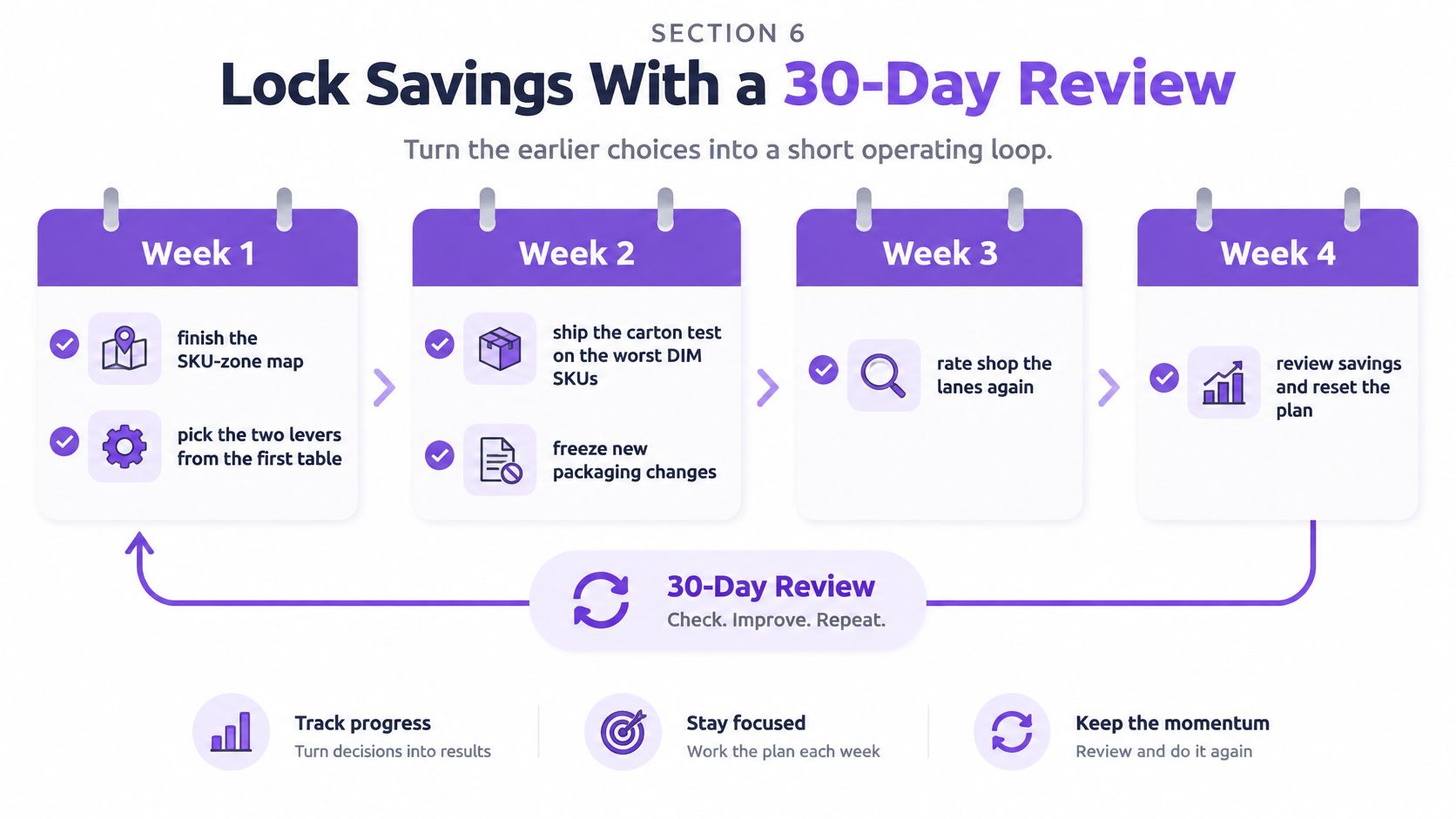
The review cycle keeps packaging, routing, and inventory decisions tied to the same baseline.
Follow the operating checklist
- Week 1. Finish the SKU-zone map and select the two relevant levers. Record the invoice baseline and assign an owner to each test.
- Week 2. Ship the carton trial on the worst DIM offenders. Approve only packaging that preserves protection, and freeze unrelated box changes.
- Week 3. Activate premium, standard, and economy routing rules. Price a replenishment order both as parcel import with duty and as consolidated freight.
- Week 4. Compare cost per delivered order, on-time performance, DIM-hit rate, damage, stockouts, and contribution margin. Keep changes only when the operating result supports the saving.
Savings that aren't on the invoice didn't happen.
Use a consistent set of supply chain KPIs, and renegotiate only after the shipment record is clean enough to support the volume claim. A cheaper service that produces more replacements hasn't passed.
Close the purchase-order cost
SupplyAutomate tracks supplier price, freight, duty, and fulfillment against each purchase order. Its landed-cost calculation combines factory price and import costs into a per-unit number that recalculates as bills arrive, rather than leaving the warehouse receipt valued at an early quote.
The platform covers POs, documents, landed cost, and supplier communication for Shopify, WooCommerce, DTC, and Amazon FBA sellers. A 3PL or internal warehouse team can post shipment and inventory updates directly to the PO, while shipping invoices and landed-cost reports can be exported for finance.
Keep the chosen changes only when cost falls without worse damage or stockout performance. Then add the next lever, not another batch of simultaneous projects.
Supply Automate brings purchase orders, supplier communication, shipping bills, and per-unit landed cost into one workspace. Visit Supply Automate to compare replenishment costs before committing a PO and track whether the shipping savings survive the final invoices.