67% of manufacturing decision-makers could collect and analyze data in near real time, but only 33% performed prescriptive analytics, according to ABI Research's 2024 survey of 461 decision-makers in the United States, Germany, and Malaysia. Seeing a status and knowing what to do about it are different capabilities.
For an Amazon FBA or Shopify brand buying from an overseas factory, that distinction matters more than the charting tool. A useful manufacturing dashboard connects a purchase order to its next decision: chase the ready date, block pickup, change the freight booking, or recalculate the SKU margin. It isn't an OEE wall for machines the brand doesn't own.
The Manufacturing Dashboard a Small Brand Needs
The minimum useful board is a purchase-order, milestone, QC, and landed-cost exception board. For a brand under $5M, every row should answer a buying or shipping question, not demonstrate how much information the software can display.
Minimum manufacturing dashboard for FBA and Shopify brands
| Metric | Decision it answers | Source of truth | Owner | Refresh |
|---|---|---|---|---|
| PO stage | Is this order quoted, deposit paid, in production, ready or shipped? | Current PO version with stage dates | Buyer | Daily |
| Supplier reply lag | Which factory thread is silent past one business day? | Messages attached to that PO | Ops coordinator | Same day |
| Milestone variance | How many days late versus confirmed ex-factory, through to sellable? | Production and receiving dates | Production coordinator | Twice a week |
| QC hold | Which units cannot be picked up yet? | Inspection report or accepted deviation | QC owner | On each inspection |
| Landed cost per SKU | Factory price plus freight, duty, insurance and fees versus price | Invoice, freight quote and duty calculation | Finance or founder | Before goods ship |
| FBA inventory age by FNSKU | Storage and aged-surcharge exposure on this variation | Seller Central age snapshot | FBA planner | Weekly |
| Shopify HS code and duty terms | Whether checkout duty matches origin, HS code and DDP or DDU | Product data plus commercial invoice | Ops | Every international shipment |
These refresh intervals are operating rules, not industry benchmarks. The team should assign them deliberately, then show the last confirmed update beside each value.
Build around decisions the brand controls
The buyer can challenge a quantity, approve a specification, or delay a deposit. The operations coordinator can chase a missing carton count, and the QC owner can stop a pickup. Machine utilization rarely gives those people a better answer.
The investment case should stay equally narrow. Coverage of the National Association of Manufacturers' Q2 2025 survey reported that 21.8% of manufacturers planned to prioritize digital transformation during the following 12 months, while 31.7% expected to moderately increase digital investment. The same coverage described budget and expertise constraints among smaller manufacturers, a useful reason to demand a clear business case rather than copy a smart-factory program.
For the importer, the clock ends at sellable inventory, not the factory gate. A ready notice doesn't mean Amazon has received the units, and a warehouse delivery doesn't necessarily mean the 3PL has completed putaway.
Keep evidence beside the exception
Each displayed value needs a document, an owner, and a refresh rule. Without a supporting document, the number stays off the decision board or appears explicitly as unconfirmed.
Landed cost should include applicable duty, including Section 301 where it applies, rather than a blanket duty assumption. Shopify product records should keep HS classification and DDP versus DDU terms visible beside the shipment assumptions.
Practical rule: A green status without a dated source is an opinion, not an approval.
Forge Reliability's resource on how to improve reliability across manufacturing operations provides useful plant-side context. An importer should translate that discipline into dependable handoffs rather than import an equipment dashboard wholesale.
The same boundary applies to broader e-commerce supply chain management: connect purchasing, production, freight, and receiving without pretending the brand runs the factory. A brand reordering three stable SKUs from a calendar it already trusts may need only the last actual inbound duration and an earlier reorder date.
How to Map One Live Purchase Order
A dashboard shouldn't be designed before someone follows an actual order through its documents. In the 2022 Minitab Insights survey of 582 manufacturing professionals across 66 countries and 10 sectors, 88.8% said their organizations collected defect and quality data, but only 6% reported fully integrated data sources. Collection alone doesn't connect a factory promise to a replenishment decision.
The starting point is a single hero SKU and its actual purchasing trail.
Follow the documents before drawing charts
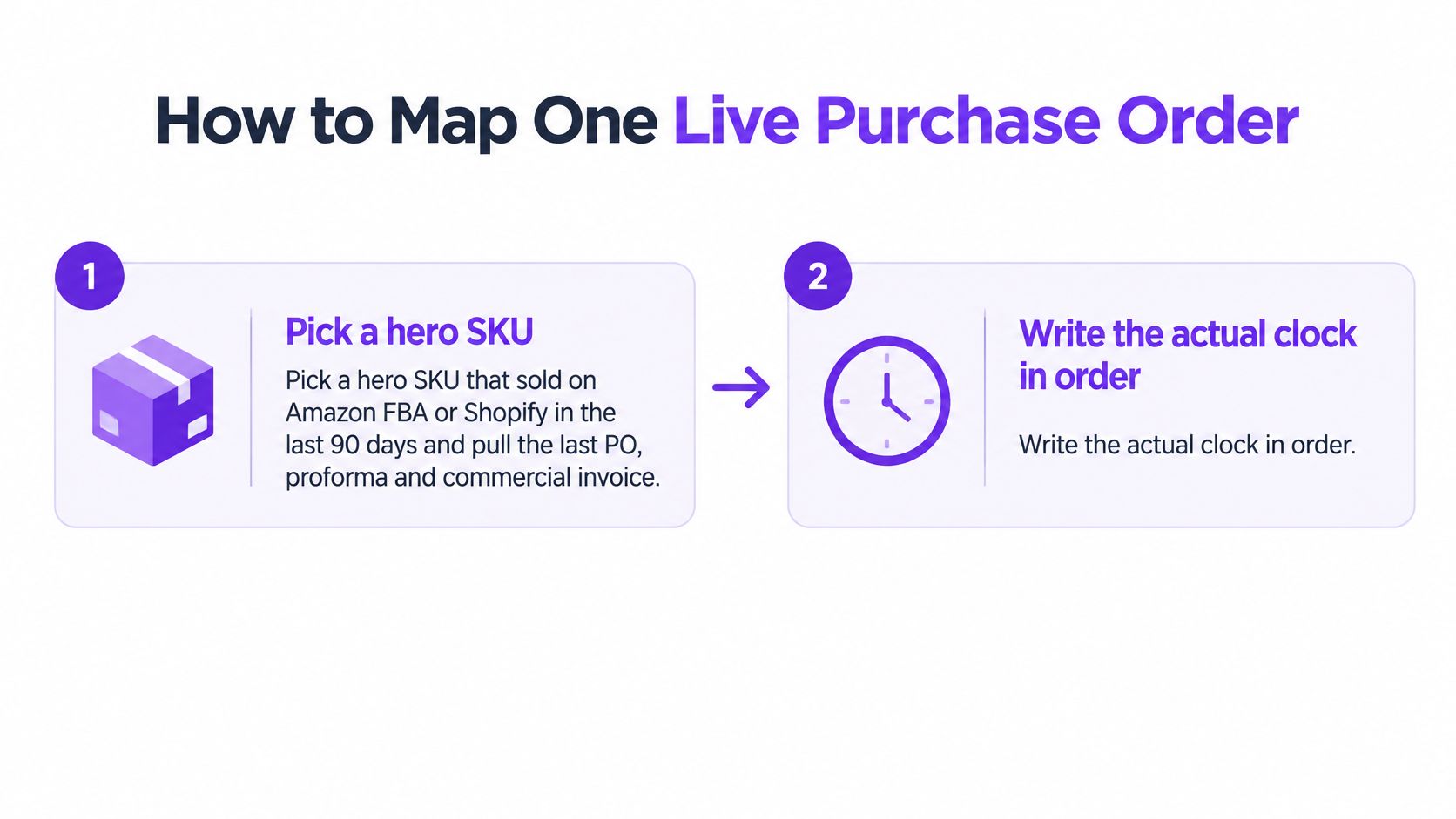
- Pick a hero SKU. Use an Amazon FBA or Shopify SKU that sold during the last 90 days as the pilot selection rule. Pull its latest PO, proforma, and commercial invoice, keeping the original files rather than copying selected fields into a fresh sheet.
- Write the actual clock in days. Record PO issuance, production completion, booking changes, transit, customs release, and FBA receiving or 3PL putaway. In a hypothetical order, a quoted 35-day production period might become 52 days to sellable after the remaining handoffs; buying against the production promise alone would leave the replenishment late.
- List every place the order lives. Include Excel, email, WeChat or WhatsApp, the forwarder portal, Seller Central, and Shopify admin. Record what each location contains, such as the revised finish approval in chat or the delivery appointment in the forwarder portal.
- Match the identifiers. Put the internal SKU, factory item code, FNSKU, and carton mark beside each other. A color variation that shares a loose description with another product needs an explicit mapping, not a memory-based match.
- Assign each handoff. Name the person who updates the stage and compare the event date with the date the team learned about it. A shipment that departed promptly but appeared in the sheet late is an update problem, not a transit problem.
- Mark the leaks as present or absent. Check for competing PO versions, supplier replies trapped in chat, landed cost discovered after receipt, and QC arranged after the container booking. Attach evidence rather than assigning a general supplier score.
- Keep a two-week baseline. Use that pilot period to count the leaks and test the definitions before automating. Don't average several suppliers together while the team still disagrees about what ready means.
A disciplined purchase-order creation process helps establish the document that anchors those events. The PO number should remain stable while revisions remain traceable.
The embedded video can sit alongside the team's document walkthrough.
Finish with a one-page map
One-page PO map template
| Stage | Owner | Source document |
|---|---|---|
| Quoted | Buyer | Quote and proforma |
| Deposit paid | Finance or founder | Deposit receipt |
| In production | Production coordinator | Current PO version |
| Ready at factory | Ops coordinator | Factory ready notice |
| Shipped | Forwarder | Bill of lading or air waybill |
| Sellable at FBA or 3PL | FBA planner | Receiving record |
Add the actual event date beside each stage in the working copy. Keep the original committed date separately, because overwriting it with the latest promise erases the variance.
The finished map should expose disagreements, not smooth them over. If the factory ready notice predates a failed inspection, the order may be physically finished but still blocked for pickup. That distinction belongs in the stage definition before another supplier enters the pilot.
Four Bottlenecks That Hide Margin
Expedited freight often starts with an ordinary document failure. The buyer approves a revised colorway in WhatsApp, the factory follows an older PO attachment, and the team discovers the mismatch when replenishment stock is already running short.
Consider a hypothetical kitchen brand with roughly $2M in revenue receiving 1,000 units in the wrong finish. The immediate problem isn't a low production KPI. The buyer must choose between air-freighting replacement stock and carrying inventory that doesn't match the listing.
Bottleneck priority for brands under $5M
| Bottleneck | What it looks like | Cost if ignored | First fix |
|---|---|---|---|
| PO version control | Factory built the old quantity or color while two sheets disagree | Air freight or unsellable stock | One current PO version with stage dates |
| Supplier communication | Ready date and tracking live in WeChat or WhatsApp | Missed sailing and a late FBA inbound | Replies attached to that PO, same-day rule |
| Landed cost visibility | Quote used as cost; duty and freight arrive later | Price and reorder set on a fake margin | SKU cost before pickup is approved |
| QC milestones | Inspection after the container is booked | Defects found in the US or at FBA | Pickup blocked until pass or accepted deviation |
Distinguish the symptom from the bill
A messy inbox isn't itself the largest cost. The commercial consequence appears when nobody answers the forwarder's carton-count question before the booking cutoff, or when the agent's revised ready date never reaches the FBA planner.
The same distinction applies to version control. A folder containing every revision is an archive, not a control system. The factory needs an unmistakable current version, written acknowledgment of the change, and a record of any quantity or price impact.
A hypothetical SKU quoted at $4.20 but landing at $6.10 illustrates another failure. The Shopify price may have been approved against the factory quote while freight, duty, and brokerage were still absent. Selling the same SKU through FBA adds channel expenses that shouldn't disappear inside a blended product-cost figure.
For teams rebuilding that calculation, a practical method for tracking shipping and manufacturing costs should connect each charge to the relevant order and allocation basis. Dividing every shipment charge equally across units can distort costs when bulky products consume disproportionate space.
Choose the first fix by the next commitment
If expedites follow specification changes, start with PO control. If the founder and finance lead argue about margin only after the goods are committed, start with the pre-pickup cost approval. If defects reach the destination warehouse, start with the QC release gate.
A print operation has different production economics, but Raccoon Transfers' a cost-saving guide for print shops offers a useful adjacent lens for examining production spending. An importing brand should apply only the parts relevant to its own purchasing and handling decisions.
Fix the leak that changes the next cash commitment, not the screen that looks untidy.
QC deserves particular care because booking pressure can turn an inspection into a formality. A booked container isn't evidence that the goods passed. The person approving a deviation should record the affected SKU, quantity, defect, and commercial consequence before releasing pickup.
What to Automate and What to Leave Manual
Automate the handoffs that already have an owner and a source document. Otherwise, software moves conflicting information faster while the operations coordinator still reconciles it manually.
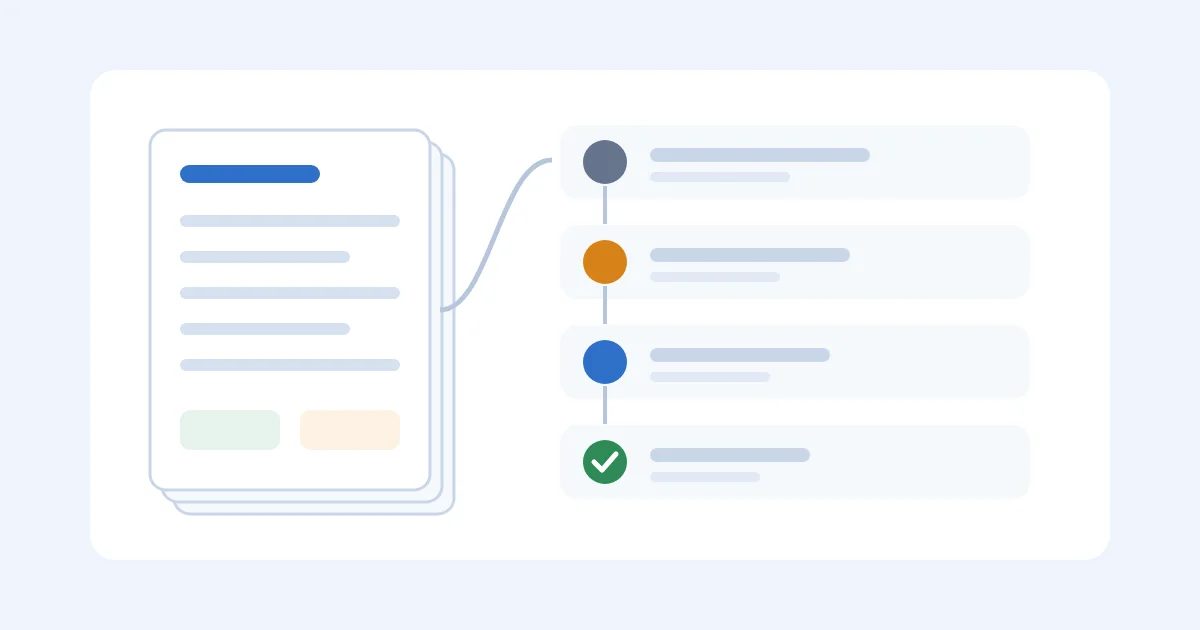
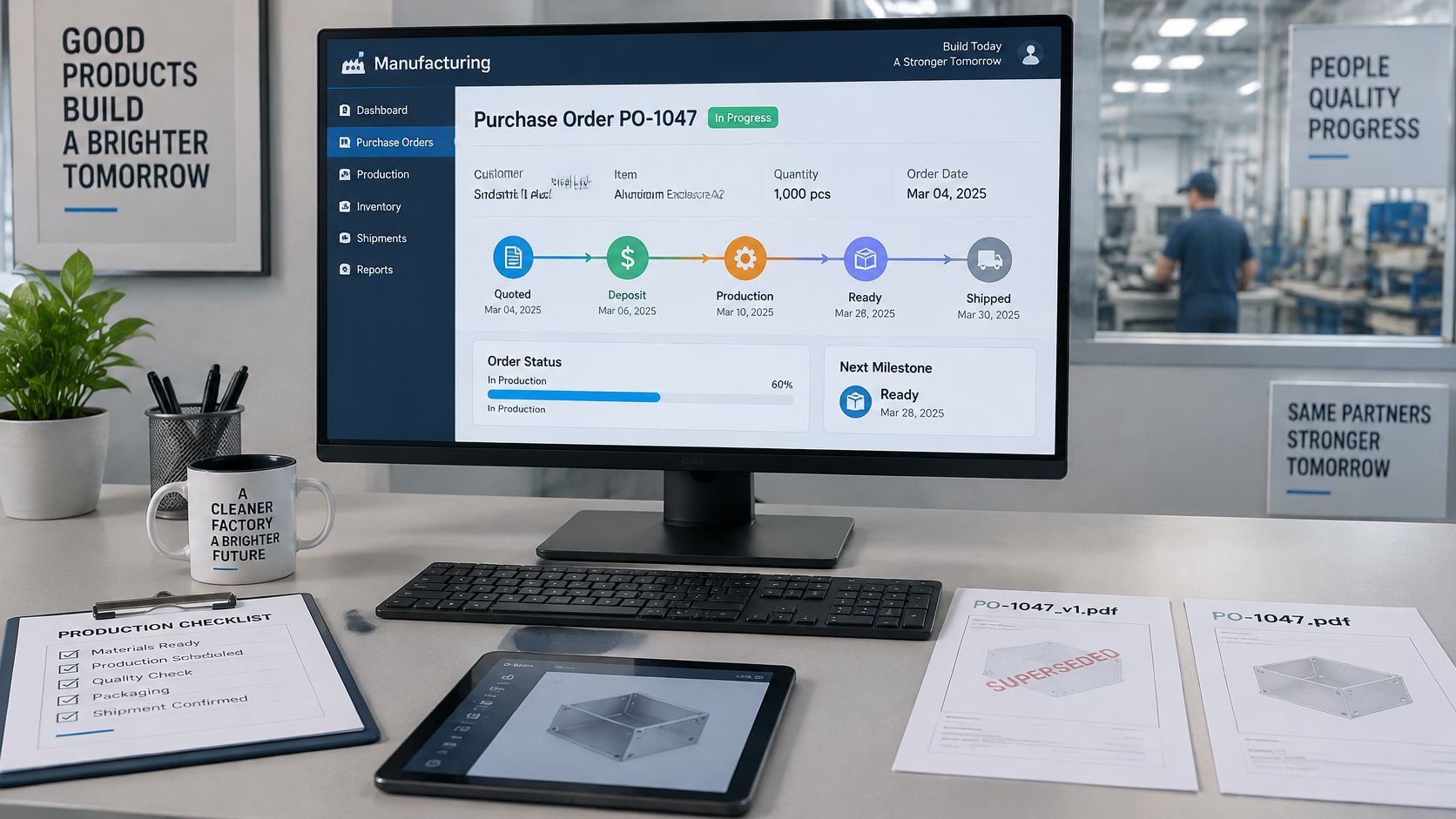
A suitable layout keeps order progress, supporting documents, and unresolved approvals close together.
Implement the handoffs in order
- Create the authoritative PO record. Store quoted, deposit, production, ready, and shipped dates against the same order. A revised PDF should become the current version while the previous version remains available for audit, not available for accidental production.
- Attach operational messages. Keep factory, agent, forwarder, and 3PL replies with that record. Apply the same-day handling rule to ready-date, carton-count, and commercial-invoice questions, and distinguish an acknowledgment from an actual answer.
- Calculate cost when the inputs exist. Combine the invoice and freight quote with SKU allocation, duty classification, insurance, and fees. Label estimates as estimates and retain the input version so a later invoice can explain the variance.
- Enforce the QC release. Pickup-ready status requires a passed inspection or written acceptance of a specified deviation. The release should identify the approver rather than inherit permission from a generic completed checkbox.
- Export the operational record. Use a weekly export into the spreadsheet or accounting workflow that still holds the ledger. Retain order references on costs and shipping documents so finance can reconcile them without reconstructing the supplier conversation.
Shopify international orders need particular attention at the cost step. The Shopify guide to charging international duties states that products need HS codes and stores using shipping labels need a carrier supporting Delivered Duty Paid labels for the described workflow.
For a hypothetical US Shopify brand shipping a $200 product from China to Canada, the order record should preserve origin, HS classification, estimated import charges, and carrier terms together. A checkout estimate doesn't repair an incorrect classification or a shipment booked under incompatible terms.
Treat validation as part of go-live
Manufacturing-dashboard implementation guidance identifies manual entry, infrequent refreshes, weak context, and poor drill-down as recurring problems in this manufacturing-dashboard study. Validation should therefore block bad inputs before they become reassuring charts.
- Quantity checks: Reject negative quantities and investigate cases where produced units don't equal good plus scrapped units.
- Sequence checks: Flag a ready date before the recorded deposit, allowing a documented exception for agreed credit terms.
- Classification checks: Hold duty calculations without an HS code and reject FNSKU aging copied from a parent-ASIN summary.
- Freshness checks: Route missing timestamps and stale confirmations to an exception queue rather than substituting zero or retaining a green status.
An invoice-matching workflow for e-commerce sellers should compare the commercial invoice against the approved PO and shipment evidence. A matching total isn't sufficient when the quantity or variation is wrong.
Manual entry is acceptable during the pilot. Persistent retyping afterward is a process defect worth removing, but factory OEE, payroll, and the general ledger should stay outside this project.
Review the exception queue with the person who talks to the factory before adding another supplier. Near-real-time status is enough when it arrives before the relevant decision; prescriptive AI can wait until definitions stop changing.
Proving the Dashboard Pays Back
A 12-day production slip can turn a planned ocean shipment into an air-freight bill. For 400 units, hypothetical air freight of $1,800 against a planned ocean allocation of $400 adds $1,400. A late-order alert has value only if it arrives in time for someone to keep the sailing, split the shipment, or reduce the buy.
Assess a quarter of orders using recorded decisions and invoices. Count costs the team avoided, not estimates of what might have happened.
Put the calculation beside the PO
For Amazon inventory, track age at the individual FNSKU level rather than relying on a parent-ASIN summary. The fee implications depend on the applicable Amazon charges, so use current account-specific information when estimating the cost of aging stock.
Payback checks on one quarter of orders
| Leak | Example math | Signal that should fire | Counts as payback when |
|---|---|---|---|
| Expedite freight | Hypothetical air $1,800 minus ocean $400 = $1,400 incremental expense | Milestone variance before the sailing cutoff | The team keeps ocean or cuts the buy |
| FBA aged inventory | Estimate the applicable fee for each FNSKU using current Amazon charges | Age by FNSKU, not parent ASIN | The team stops replenishing or exits the slow variation |
| Quote versus landed cost | Hypothetical $1.90/unit underestimate × 1,000 received units = $1,900 cost variance | SKU landed cost before pickup approval | Price or reorder quantity changes before the next deposit |
Calculate an underestimated cost as full landed cost minus quoted unit cost, multiplied by units received. Call it a cost variance, not lost profit: the calculation excludes other selling expenses.
Keep FBA fulfillment and monthly storage outside product landed cost when comparing channels. Otherwise, Amazon can appear more profitable because those fees have not been assigned.
Count actions and adoption
Operating measures should show whether the board changes decisions. Track supplier threads that remain unanswered past the agreed business-day rule, along with QC failures caught before pickup versus after arrival.
Then check whether the team maintains the board:
- Stage coverage: Share of open POs with a current, supported stage date.
- Cost readiness: Share of orders with refreshed landed cost before shipment approval.
- Exception aging: Unresolved exceptions older than the team's escalation rule.
These are working definitions, not external benchmarks. A focused set of supply chain KPIs is useful when each exception has a named owner and a clear next action.
Payback test: A metric earns its place when it changes a buy, a price, or a pickup.
Stop adding widgets while source documents disagree. A percentage is not useful if its definition changes to hide a cost or exclude inconvenient downtime. Predictive analytics can wait until the team can point to an avoided expedite.
For a brand that does not own its factory, the dashboard earns its cost by making purchase-order decisions clearer and less risky, not by resembling a plant control room.
Run the Next Purchase Order on One Board
The open PO with the nearest ready date is the best pass-fail test. Its quote, deposit evidence, production date, QC status, and freight quote should fit in a single order view.
Run a bounded trial
- Track dated stages against the current PO.
- Log factory replies against that order rather than in a separate recap.
- Compute landed cost before pickup, using the relevant HS classification.
- Count late updates for two weeks against the sheet the team would otherwise maintain.
Invite the factory or agent to that order only. If the record becomes clearer than the sheet, copy the tested stages to the next two suppliers.
SupplyAutomate is one workspace option judged by this test: it goes live in 15 minutes, and every PO moves through quoted, deposit, production, ready, and shipped stages with dates attached. Users can export purchase orders, supplier communications, shipping invoices, and landed-cost reports to CSV or Excel at any time, while the general ledger stays in existing accounting software.
A machine-centered plant dashboard won't solve this coordination problem. If the pilot order still isn't clearer than the sheet, the team should repair its definitions before expanding the software.
Supply Automate offers an order workspace that keeps supplier communication, dated PO stages, and landed-cost information together for Amazon FBA and Shopify brands. Visit Supply Automate and test the nearest-ready purchase order against its documents before moving the remaining supplier workflow.