Three weeks before peak, the factory says the cartons are ready in Shenzhen, the forwarder has no booking on file, and the ops lead's spreadsheet is two revisions behind the version the founder approved. Nobody is lying. The information lives in four systems and five threads, and no single record says which version is true.
A supply chain portal in e-commerce closes that gap by giving the brand, factory, agents and 3PL one shared purchase-order record to work from. Most small brands still run sourcing and shipping without that kind of real-time visibility, and it costs them sales.
The stakes also got sharper. The 2025–2026 de minimis and tariff shift turned landed cost into a decision you make per purchase order, so the portal conversation should start with purchase orders and cost math rather than with another tracking screen.
What a Supply Chain Portal in E-Commerce Actually Is
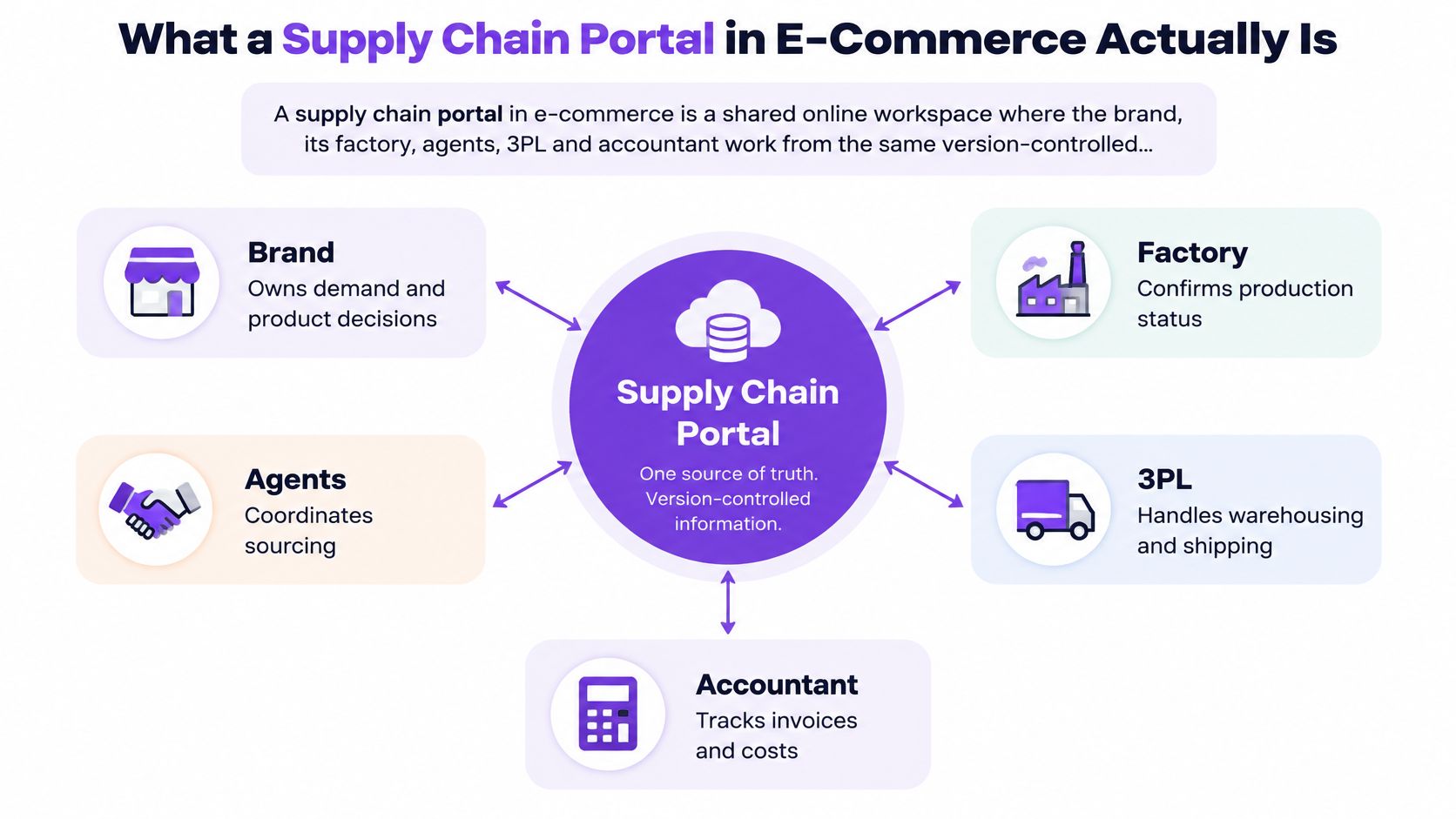
A useful test is to ask who last changed the quantity on your largest open order, and what that change did to landed cost. If the answer takes a pass through email, then WhatsApp, then a spreadsheet named final_v3, there is no control record. A supply chain portal in e-commerce is what makes that record exist: one version-controlled purchase order the brand, factory, sourcing agent, 3PL and accountant all work from, with messages, documents, production status, shipment events and landed cost attached to the order itself.
The difference works like moving a team from a group chat to a ledger. Nobody asks whether the carton-count message was seen. The record shows the approved quantity, who changed it, when, and what the change did to cost and timing.
Where the portal stops and your other systems start
Three tools get confused with it, and each does a different job. Shopify's admin holds products, checkout and sellable stock. A 3PL's warehouse system holds what is physically on the shelf and what ships out. A parcel-tracking page follows a box once a carrier scans it. None of them can say which version of the purchase order was approved, or what the goods will cost when they land.
The portal sits beside those systems as the control layer. It owns the PO record and answers what the other three cannot: what is in production, what is late, what it costs on arrival, and who has to act today.
Why it became core infrastructure
Business e-commerce sales across 43 developed and developing economies approached US$25 trillion in 2021, 15% above the pre-pandemic 2019 level, and UN Trade and Development estimated a further 10% rise in 2022 to almost US$27 trillion (UN Trade and Development). Trade at that volume does not run on threaded replies and screenshots.
For smaller brands, the same pressure shows up as a stockout traced to a missed supplier message, or a margin that only becomes clear weeks after the goods were committed. Since the 2025 de minimis shift ended the duty-free lane for low-value imports, landed cost belongs on the PO before goods ship, not discovered at the border. That number is the portal's real job.
For a brand under $5M, the payoff is unglamorous: one order record that survives a staff departure, a 12-hour time-zone gap and a change of factory. How sourcing, freight and fulfillment connect into that record is covered in e-commerce supply chain management.
How a Portal Connects Sourcing to Sellable Stock
A purchase order works as a chain of custody, starting with an RFQ and ending when a unit is buyable on your storefront. Every break in that chain surfaces later as a stockout, a fee or a margin surprise.
Follow one order: a 1,200-unit run of a silicone phone case from a factory in Dongguan, shipping to a US 3PL and then into FBA.
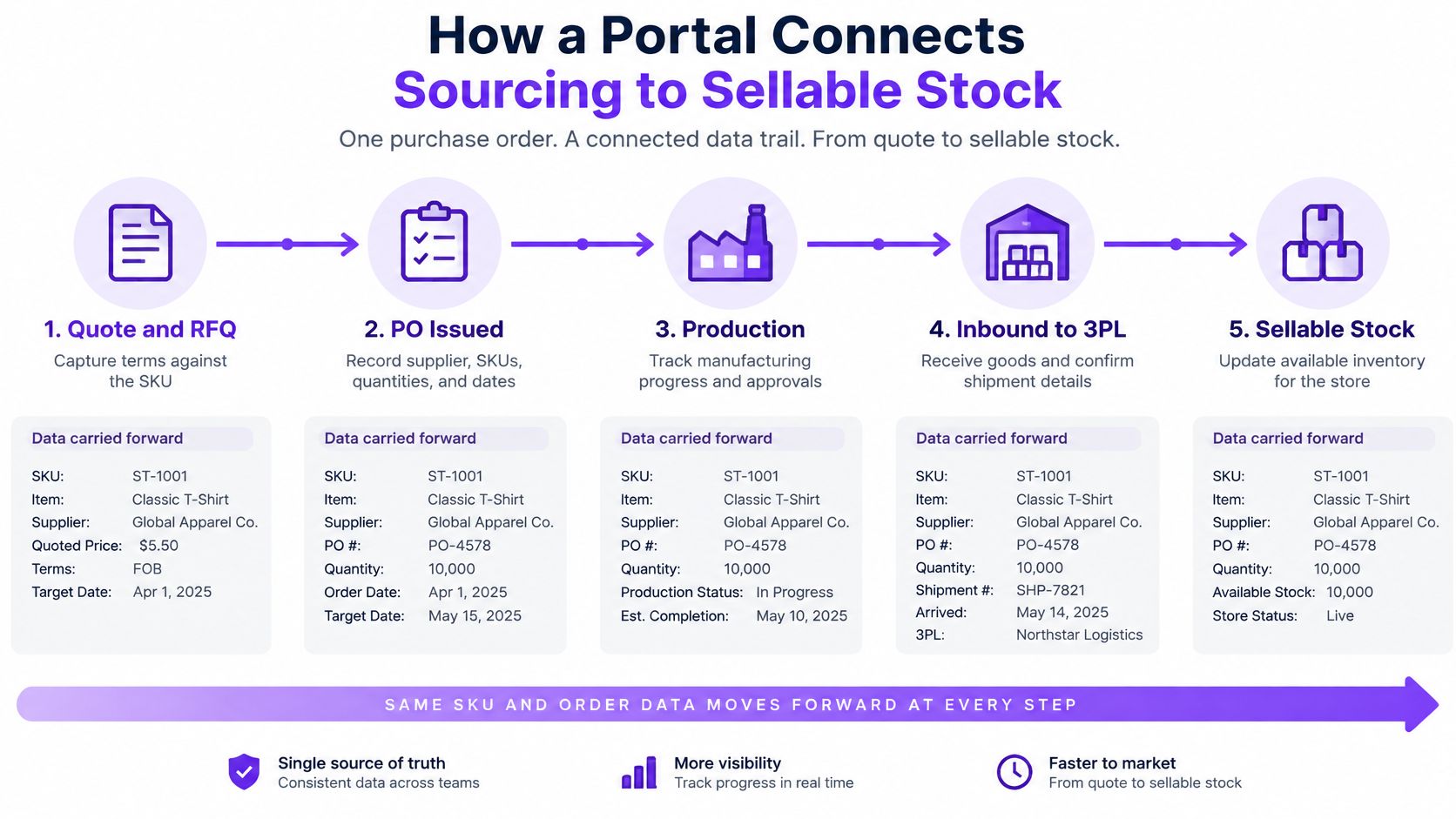
Seven stages, one record
- Quote and RFQ. Tooling cost, MOQ, unit price and quoted lead time get captured against the SKU, not left in an email attachment nobody can find in March.
- PO issued. Supplier, SKUs, quantities, prices and dates on one record, with every revision versioned. The "final_final_v3" file stops existing.
- Supplier acknowledgement. The factory confirms line by line, and mismatches surface only if something is checking them.
- Production milestones. Deposit paid, production started, QC passed, goods ready. Each needs an expected date, an actual date, a responsible party and evidence, whether that's photos or the inspection report.
- Carton counts, pickup booking and freight events. Tied to the same order ID so the forwarder, the 3PL and the brand are all describing the same shipment.
- Customs documents and duty inputs. Commercial invoice, packing list and classification detail attached before the container sails. With duty now carrying real weight in unit cost, these inputs decide whether the margin survives arrival.
- Warehouse or FBA receipt. Units become sellable stock and the landed cost finalizes against what shipped, not against the quote you approved two months earlier.
Each of those milestones needs the same five fields to be useful: expected date, actual date, owning party, evidence attachment and variance status. Without variance status, a milestone is a note. With it, it's a decision. QC expected June 10 and passed June 24 is a two-week slip you can act on, by pulling the launch date forward or splitting a partial air shipment, only because the gap is flagged on the record rather than buried in a chat thread.
The walkthrough below shows the same order-level view in motion, including how production status and shipment events sit on one record.
Why acknowledgement matching is the weak link
Visibility is a data-quality problem before it's a tracking problem. The variables worth holding are accessibility, usefulness, completeness, timeliness and accuracy, and they only mean something when acknowledgements, milestones, carton quantities, booking dates and exceptions share one PO identifier.
In IBM's supply chain visibility roadmap, only 37% of tracked order-acknowledgement events matched the purchase order, and only 24% of advance-shipment notices matched the PO. If most confirmations disagree with the order, attachments alone protect nothing. The portal has to compare line by line and flag the variance: a supplier who confirms 1,100 units against your 1,200-unit PO has just created your Q4 stockout.
Score suppliers on four numbers instead of vibes: acknowledgement-match rate, on-time milestone rate, quantity variance and document completeness. Clean order data matters most for the operators who can least afford a missed order, the brands running tight cash cycles on a handful of SKUs where one silent variance erases a selling season.
Threaded communication closes the loop. A message that lives on the order survives a handover, a holiday and a new merchandiser, and a supplier who only answers on WeChat can post updates to the order itself instead of a personal inbox. Building that record starts with disciplined purchase order creation and revision control. If the stock system underneath is still undecided, Rankozo's inventory software value rankings compare options on cost and fit before you bolt a portal on top.
Capabilities to Demand From a Supply Chain Portal
Vendor decks all use the same words. The useful filter is to score each capability against a decision you make in a normal week. Appetite for this is already there: in 2025, 53% of surveyed retail supply-chain leaders named implementing new technology as one of their top three strategic priorities, according to Blue Yonder's Supply Chain Compass study of 671 leaders.
| Capability | What it holds | The weekly decision it changes |
|---|---|---|
| PO version control and acknowledgement matching | Every revision with author, date and changed fields, matched line by line against the supplier's confirmation | Whether to approve a revision or hold the deposit |
| Production milestones with evidence | Expected and actual dates for deposit, start, QC and readiness, with photos and reports attached | Whether to chase, expedite or re-plan |
| Carton, pickup and freight events | Carton counts, booking dates, vessel or flight details, ETA changes | Which freight mode to book and when to brief the 3PL |
| SKU-level landed cost | Product, freight, duty, insurance, brokerage and fees per unit | Whether the selling price still clears your margin floor |
| Supplier scorecards | Match rate, on-time rate, quantity variance, document completeness | Whether to reorder, split the buy or qualify a second factory |
| Inbound and location inventory | Inbound quantities and dates against FBA shipments or Shopify locations | What to reorder today and where to send it |
| Exception alerts | A variance status and owner on every milestone | What gets worked on this morning |
| Collaborator access and export | Per-order permissions for factory, agent, 3PL and accountant, plus CSV or Excel output | Who posts the update, and how finance reconciles it |
Three buying notes
Sit beside, don't replace. The portal should coexist with Shopify, Amazon and the 3PL's systems. A vendor promising to replace all three is selling a migration, not a tool, and migrations are how brands lose a quarter of trading.
Permissions beat features. If the factory and the forwarder can't post updates themselves, you're paying for a dashboard you feed by hand at midnight. Per-order access controls, where each collaborator sees and edits only what's relevant, are the difference between adoption and abandonment.
AI drafting is table stakes. Summarizing a 90-message supplier thread and drafting a PO from a quote is now standard. Check that any summary links back to the order line it came from, because a confident summary with no source is worse than a long thread.
The test: If a capability doesn't change a weekly decision, whether to reorder, approve a revision or pick a freight mode, it's dashboard decoration.
Score every shortlisted vendor against all eight rows, not against the three screens in the demo. The rows a vendor can't show are the ones you'll rebuild in a spreadsheet six months later.
What a Portal Changes for an Amazon FBA Seller
Amazon's Inventory Performance Index guidance sets a target most sellers quote and few apply: hold 30 to 60 days of expected sales at fulfillment centers, balance sold inventory against inventory held, avoid excess and aged stock, and resolve stranded listings so inventory stays buyable (Amazon Seller Central). For a seller forecasting 20 sales a day, that implies roughly 600 to 1,200 units of coverage, before supplier lead time, ocean transit, customs or receiving delays get a vote.
Online retail now makes up a large share of U.S. retail sales, and each year brings more replenishment cycles. Every cycle is a fresh chance to get PO timing wrong.
The reorder math behind 600 units
The 30-to-60-day figure describes stock sitting in the fulfillment center. It says nothing about the pipeline feeding it. Say your door-to-door lead time runs 52 days: 30 in production, 18 on the water, 4 through customs and receiving, with one rolled sailing along the way. At 20 units a day, demand during lead time is about 1,040 units before a single unit of safety stock.
Order when the fulfillment center balance hits 600 and you stock out before the container lands.
The reorder trigger has to read real inbound dates off the order: the production-ready date the factory posts, the sailing date the forwarder confirms, the FBA receiving appointment. A steady Amazon FBA inventory management rhythm depends on those dates living on the same record, updated by the people doing the work, rather than the promise date typed onto the PO once and never touched again.
Where the wrong PO gets expensive
| Guardrail | Amazon's rule | What it means for your PO |
|---|---|---|
| Inventory coverage | Hold 30–60 days of forecasted sales at fulfillment centers | The reorder point must add the upstream pipeline on top of this buffer |
| Excess inventory | More than 90 days of forecasted supply is flagged as excess | Over-ordering locks cash into storage fees; pause or split POs |
| Sell-through rate | Units shipped in the last 90 days divided by average units held | A falling rate argues against repeating the last PO quantity |
| Aged inventory surcharge | Units stored 181 days or more are surcharged on the 15th monthly | Old POs create fee exposure; check stock age before reordering |
| Stranded inventory | Listings must stay buyable for stock to sell | Resolve stranded listings before placing the next PO |
The mechanics sharpen the point. Amazon treats an item as excess when it carries more than 90 days of forecasted supply, and units held 181 days or more draw an aged-inventory surcharge assessed on the 15th of each month (Amazon FBA inventory reference). A seller sitting on 1,000 units against demand of 10 a day is already at 100 days of supply, past the excess line, and every carton still there at six months adds fee exposure that never appeared in the factory quote.
Those fee rows change what a PO is for. Quantity is a landed-cost decision: supplier price, freight and duty set the per-unit cost, and the storage and surcharge exposure decides how much of it you can afford to hold. Since the de minimis shift and the tariff changes that followed, duty belongs in the order-quantity math up front, rather than in a reconciliation weeks after the goods ship. When landed cost sits on the order next to the sell-through rate, the reorder decision becomes arithmetic instead of memory.
Stock at the fulfillment center is the end of the pipeline. Plan from the far end and the buffer takes care of itself.
If you're shortlisting software anyway, find software for your Amazon store before the demo calls start. Hold the shortlist to the guardrail rows above, and ask each vendor to show the order record those dates actually live on.
What a Portal Changes for a Shopify Seller
A DTC apparel brand keeps 400 units of a hoodie inbound to a domestic 3PL plus a small reserve in a backroom warehouse. Shopify supports multiple inventory locations and can route each order to a fulfilling location using rules such as customer proximity or available inventory, and products generally need available stock at a fulfilling location unless the merchant keeps selling while out of stock (Shopify fulfillment setup).
The hoodie that lands on the 12th
The sequence that protects the delivery promise runs in order. On the 2nd, production shows ready with the QC photos attached. On the 5th, freight is booked with a sailing date and an ETA. On the 11th, the 3PL receives an advance notice with carton counts. On the 12th, the 3PL confirms receipt of 388 units against 400 expected, and the 12-unit variance is flagged on the order instead of discovered at cycle count.
Only then does Shopify location inventory update, and only then should the storefront promise delivery dates from real stock. Without that chain, sellers pick the wrong damage: leave continue-selling on and oversell into a backorder you can't ship, or switch it off and lose sales for days while someone updates the location by hand.
A portal doesn't replace any of this. It connects inbound quantities and expected receipt dates to location-level availability, so routing doesn't send an order to a warehouse that has no stock.
Where margin leaks
Landed cost per SKU, covering product, freight, duty, insurance and payment processing, sets the pricing floor. A $32 hoodie at $11 landed looks healthy at a glance. Add a duty change, or omit card fees, and contribution margin flips while the supplier quote never moves.
Payment costs depend on provider and market. Stores using Shopify Payments pay the applicable credit-card rate without an extra Shopify transaction fee, while stores on a third-party provider pay that provider's processing charges plus Shopify's transaction fee, with rates varying by plan and market (Shopify payouts and fees). Run both scenarios on the same SKU before choosing a checkout, then keep the winner in the landed-cost model.
Margin rule: If card processing and duty aren't in your per-SKU cost model, your gross margin report is a guess with a decimal point.
The portal sits alongside Shopify rather than writing to the storefront. Products, checkout and sellable stock stay where they are, and the Shopify inventory management layer keeps the storefront honest while the order record, inbound dates and true cost live in the control layer.
Misconceptions That Cost Small Brands Money
"A portal is a tracking dashboard." Then it is overhead. The Monday test is stricter: which SKUs are at risk, what action is required today, and what happens to contribution margin if nobody acts. A useful portal sits on the purchase order: stage, dates, documents, supplier thread and landed cost in one record.
"Buying more inventory is the safest hedge." Pulling orders forward can reduce policy exposure while raising storage, working-capital and obsolescence risk at the same time. I would size buffers inside the landed-cost model, with deposit timing and the sell-through window visible, instead of treating extra stock as a separate judgment call.
"My supplier price has not changed, so my margin has not." U.S. de minimis imports fell from about 1.3 billion parcels worth $64.6 billion in 2024 to 942.5 million parcels worth $48.1 billion in 2025, after the exemption was suspended for most imports from China and Hong Kong in May 2025 and for other countries in August 2025 (ClickPost de minimis statistics). Further repeal for commercial shipments is scheduled rather than already settled, so a duty change can flip a SKU while the factory quote stays flat.
"The portal will make my data perfect." Visibility follows supplier adoption. Plan for missed updates, manual exceptions and time-zone gaps. Invite WeChat-only suppliers onto the order, keep their files on the PO thread, and mark each milestone as confirmed, estimated or stale.
Rebuilding Landed-Cost Workflows After the De Minimis Shift
Treat the duty change as a permanent input to the model rather than a one-time cost to absorb. With the exemption suspended and a repeal of Section 321 for commercial shipments on the legislative calendar, the duty line on a China-origin SKU moves with each order's origin, declared value, and freight mode. A portal earns its place here by holding that calculation on the purchase order itself, where the spending decision gets made.
Three steps that hold up
Store the inputs on the SKU record. Country of origin, declared value, classification and freight mode belong on the item, one click from the order. When the broker asks a question six weeks after the PO was cut, nobody should be digging through an inbox for the answer.
Run three scenarios per SKU. Current duty, the suspension in force, and a post-repeal assumption. Compare contribution margin under each before the deposit leaves the account. Approving a PO on stale duty assumptions is how a healthy margin goes negative.
Gate approval on a re-run. Any change to origin, declared value or freight mode triggers a fresh landed-cost calculation before the PO is confirmed. Build that into the approval step itself. Good intentions do not survive a busy week.
| Component | When it hits cash | Accounting treatment |
|---|---|---|
| Product cost | Deposit at PO, balance before shipment | Inventory asset |
| Freight and insurance | At booking, pickup and carrier invoice payment | Capitalized into landed cost |
| Duty and brokerage | At customs entry, before release | Typically capitalized into landed cost |
| Merchant processing | At each customer sale | Selling expense (excluded from landed cost) |
The split that trips up founders is cash landed cost versus accounting landed cost. Cash landed cost is timing: deposit at the PO, balance before shipment, freight at booking, duty at entry. Accounting landed cost is what your accountant capitalizes into inventory and releases through cost of goods sold as units sell. Merchant fees charged at checkout sit with marketplace commissions and other selling expenses; they never enter either figure. Both versions run on the same inputs, and both fail when the duty estimate lives only in the broker's file.
Duty is assessed at customs entry before release, so carry an expected duty figure on the PO and reconcile it against the broker's entry when it lands. That variance is where margin disappears. Running the full calculation against each order is what a proper landed cost calculation for imported products looks like in practice.
How to Roll Out a Portal in Your First Week
Don't start with a data migration. Start with the messiest order you have open.
- Map where order information lives. List every thread, sheet and inbox, then pick the three SKUs that generate the most disputes. Those are your pilot, because the pain is already visible to everyone involved.
- Rebuild one live PO. Documents attached, dates entered, quantities matching the supplier's latest confirmation. Invent nothing.
- Invite the counterparties. Factory, agent and 3PL get per-order access so they post updates themselves rather than routing everything through you.
- Set milestone dates and name an owner for each. Deposit, production start, QC, readiness, shipment. Agree in writing who updates which one, and in whose time zone the date is stated.
- Run the landed cost. Compare it against the margin you've been assuming and write down the difference. That number is the business case.
- Export and reconcile. Hand finance a clean CSV or Excel extract at month end so the first close isn't an archaeology project.
Then the tool decision. Sellers under $5M don't need an enterprise suite with a six-month implementation and a consultant on retainer. They need a portal built for this workflow. SupplyAutomate, for example, was built by operators for Shopify and Amazon FBA sellers, lets a brand invite its factory, agent, 3PL or accountant into its own portal so updates stay attached to the purchase order, and during onboarding turns uploaded PDF invoices and shipping documents into an organized order view in well under a minute. Its free landed-cost, import duty, lead time and freight calculators are worth running before any paid commitment to see what your real cost per unit looks like.
Supply Automate gives Shopify and Amazon FBA sellers one workspace for purchase orders, supplier messages, production milestones and SKU-level landed cost, so a duty change or a rolled sailing shows up while there's still time to act on it. If the de minimis shift has you re-running margins in a spreadsheet at midnight, put your next live PO into the portal and see landed cost before the goods ship. Start a 30-day free trial with no credit card at Supply Automate .