Typical international cargo insurance costs 0.10% to 0.60% of insured value per shipment, which puts a $50,000 shipment at roughly $50 to $300. General merchandise moving by ocean full container load narrows to 0.30% to 0.50%, and that band is where most e-commerce importers land.
Global cargo underwriters collected USD 24.2 billion in premiums in 2025, up 6.9% year over year, according to the International Union of Marine Insurance, which also described the market as soft and attributed much of the growth to trade volumes and asset values rather than tighter underwriting. That's the tell. No single rate sets the price, and no single percentage tells you what a policy pays.
A quote is a starting point, not a cost. The same 0.40% can mean $40 on a small carton run or $4,000 on a container of electronics, and it can buy either an all-risks promise or a named-perils wording that responds to almost nothing. What matters for an Amazon FBA or Shopify seller is the cents per unit the premium adds to landed cost, and the size of the exposure it leaves open.
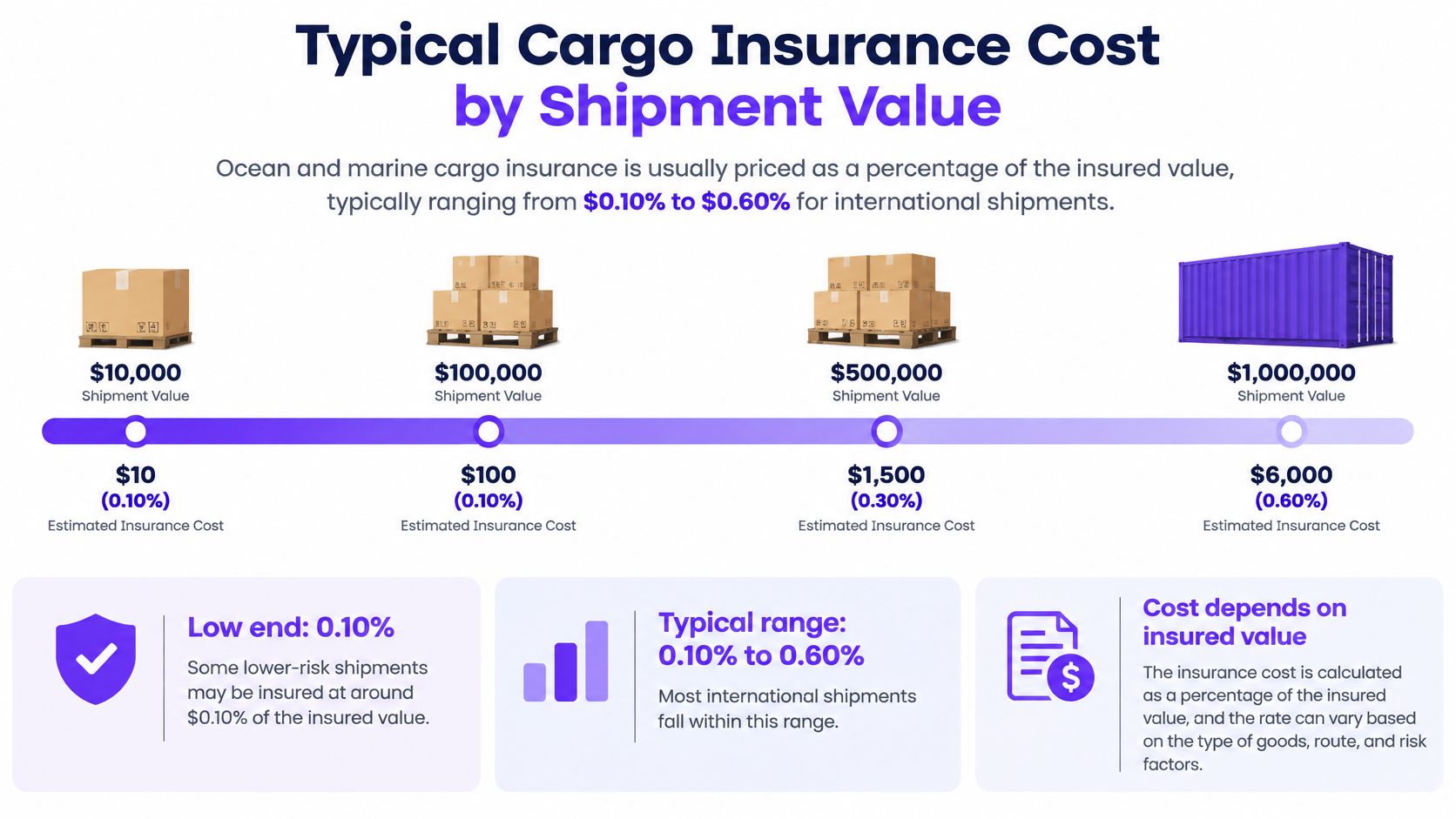
Typical Cargo Insurance Cost by Shipment Value
Marine cargo cover is priced as a percentage of the insured value, not as a flat fee per container. The benchmark for typical international ocean or marine cargo insurance sits at approximately 0.10% to 0.60% of insured value per shipment, while broader cargo pricing stretches from about 0.10% to more than 1.50% depending on transport mode, commodity, route, theft exposure, fragility and policy terms, according to LogRock's cargo insurance cost benchmark.
Run a $50,000 shipment through those rates and the spread widens fast: $50 at 0.10%, $300 at 0.60%, $750 at 1.50%. Same container, same route, five times the premium from one end of the band to the other.
Where Most Importers Actually Land
General merchandise shipped by ocean full container load prices in a tighter 0.30% to 0.50% of insured value, so a USD 100,000 shipment typically costs about USD 300 to USD 500, based on GoFreight's 2026 cargo insurance guide. Apparel, packaged home goods and plain accessories live in that band. Batteries, glassware, temperature-sensitive food and anything with a ready resale market push a quote toward the top of the wider range.
| Insured value | At 0.10% | At 0.30% | At 0.50% | At 1.50% |
|---|---|---|---|---|
| $10,000 | $10 | $30 | $50 | $150 |
| $50,000 | $50 | $150 | $250 | $750 |
| $100,000 | $100 | $300 | $500 | $1,500 |
Reading a Quote Against the Table
Start with the insured value of the shipment in front of you, not the annual insurance spend. Read across to the column that matches the goods, then ask whether the quoted premium sits inside it. A quote at three times the typical band needs a named reason: fragile cargo, a high-theft corridor, a war-risk extension, or all-risks clauses with a low deductible.
A quote well under the band needs a different question. Cheap cover usually shows up somewhere else, in a deductible that swallows the claim or an exclusion that voids it. The premium is small next to freight and duty, but it belongs in the same per-unit model, which is the method set out in this guide to the true cost of a product from factory to warehouse.
How to Calculate Your Insured Value and Premium
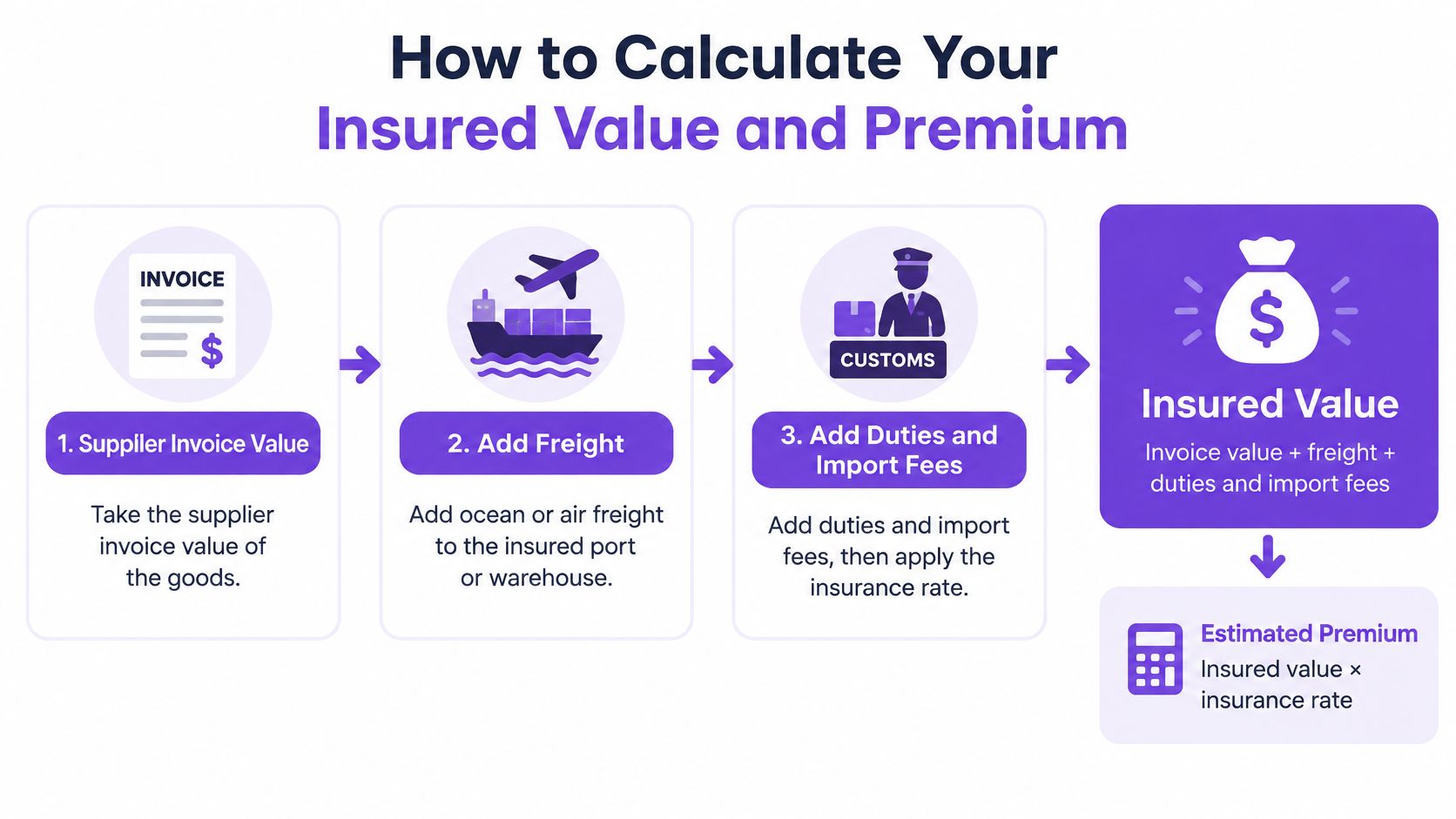
The number worth budgeting isn't the rate. It's the insured value multiplied by that rate, plus the fixed charges the percentage hides. Here is the order that gets it right.
- Start with the supplier invoice value. Take the commercial invoice total for the goods, not the retail price and not the PO value if the invoice was revised after production.
- Add freight to the insured destination. Ocean freight, origin handling, and any drayage to the warehouse the policy names as the end of transit. A CIF or DDP deal may already include some of this, so read the Incoterm before you add.
- Add duty and import fees. Many policies insure full landed value rather than goods value, and Section 301 tariffs on Chinese-origin goods can rival the invoice on some categories. A policy written on invoice alone leaves that money with you.
- Add a contingency margin if the wording allows it. A 10% uplift is the common figure, and it exists to cover the profit the shipment would have produced, not just the cash spent on it.
- Multiply the total by the quoted rate. This is the only step where the percentage matters.
- Add the fixed costs. Minimum premium, deductible, and any endorsement fee for war, strike, storage or temperature cover.
One Large Shipment, Worked Through
Say the invoice is $40,000, ocean freight to the US warehouse is $3,000, and duty lands at $4,000. The total is $47,000. Add a 10% margin and the insured value becomes $51,700. At 0.30%, the premium is $155.10. Spread across 1,000 units, that's about $0.16 per unit, which is a real line in landed cost but a small one.
Now set the minimum premium next to it. If the policy carries a $75 minimum, the percentage never bites on small loads, and the arithmetic has to start from the fixed charge instead of the rate.
The Small-Volume Case
A Shopify seller moving $8,000 of goods at 0.50% pays $40 on the rate alone. With an illustrative $75 minimum premium, the actual cost is $75, or roughly $0.94 per unit across 80 units. That's more than five times the per-unit figure on the container, and it's the case where comparing quoted percentages is close to meaningless.
The last check is the one people skip. Confirm the insured value covers the largest shipment the business sends, not the average order, then record the premium as its own line so the per-unit figure recalculates when the freight bill arrives. A landed cost calculation for imported products is only as good as its weakest assumption, and insurance is usually it.
What Moves Your Premium Up or Down
Commodity is the biggest lever an importer controls. Apparel, packaged home goods and printed materials price at the low end because they're hard to steal and hard to break. Electronics, loose lithium cells, glass and anything with a resale market move a quote up, and mixed containers get rated on the riskiest goods inside them.
Transport mode comes next. A full container load travels sealed from origin to destination and involves fewer hands. Less-than-container shipments get co-loaded, handled at a consolidation warehouse and repacked, and every one of those touches is a chance for damage that the underwriter prices in.
| Factor | Lower-premium profile | Higher-premium profile |
|---|---|---|
| Commodity | Apparel, packaged home goods | Electronics, batteries, fragile glass |
| Transport mode | Ocean full container load | Less-than-container with more handling |
| Route | Established lanes, clean loss record | Politically disrupted or high-theft corridors |
| Packaging | Palletised, strapped, well protected | Loose cartons, weak pallet work |
| Deductible | Higher deductible per claim | Low or zero deductible |
| Cover scope | Single-shipment transit only | Storage, war, strike or open-cover extensions |
| Claims history | No recent claims | Prior losses on the account |
Route Risk Is Priced, Not Abstract
Route pricing looks arbitrary until you see the loss data behind it. IUMI's figures put Asia at 36.4% of global cargo premiums in 2025, close to Europe's 37.6%, while Asia's cargo loss ratio sat just below 70%, against about 40% in Europe and the United States, per IUMI's facts and figures. Those averages don't predict what happens to one container. They do explain why a Shenzhen to Los Angeles lane prices differently from an intra-European move.
The test that works: when two quotes for identical cargo differ, ask which factor in the table is doing the work. An answer that can't name one is a quote you can't compare.
Deductible and scope finish the job. A policy with a $2,500 deductible per claim is cheap until the loss is $3,000 of damaged cartons, at which point the seller absorbs nearly all of it. Storage extensions, war and strike cover, and open-cover arrangements that roll every shipment into one annual policy all add premium, and they add it for a reason worth understanding before you decline them.
Coverage Clauses That Change What You Pay For
Two policies at the same rate can pay out very differently, because the rate prices a promise and the clauses define it. Institute Cargo Clauses (A), the standard all-risks wording used across marine cargo, cover accidental loss or damage subject to stated exclusions and also respond to general-average and salvage charges incurred to avoid or limit an insured loss, per the Institute Cargo Clauses (A) wording.
The exclusions are where claims die. Standard wording excludes wilful misconduct, ordinary leakage, loss in weight or volume, ordinary wear and tear, and war or civil-war risks unless separately endorsed. Inadequate packaging, inherent vice and routine evaporation produce no indemnity even when the shipment was insured and the premium was paid on time.
| Clauses | Cover basis | Common exclusions | Premium direction |
|---|---|---|---|
| Institute Cargo Clauses (A) | All risks of accidental loss or damage, subject to exclusions | Wilful misconduct, ordinary leakage, ordinary wear and tear, war unless endorsed | Highest of the three |
| Institute Cargo Clauses (B) | Named perils listed in the wording | Any peril not listed in the policy | Middle |
| Institute Cargo Clauses (C) | Major named casualties only, narrowest wording | Broader losses not listed in the policy | Lowest of the three |
What to Compare Beyond the Rate
The comparison that matters happens line by line, not on the headline percentage. Ask for five things: the deductible per occurrence, the per-shipment limit, any warehouse or storage extension, the war and strike endorsements, and the claims documentation list. Then check the limit against a full-container loss rather than average order value, because a limit built on averages leaves the one bad container underinsured.
Valuation is the other field people miss. A cargo wording sets out what the insured amount includes, which transport legs it covers, and whether freight and duty sit inside the number, as the Aviva cargo policy document sets out in its claims conditions. Freight and duty inside the insured value raise the premium and raise the payout by the same logic.
Insurance pays for the insured event, not for the loss. If a container is ruined because wet, unstrapped cartons collapsed in a storm, the insurer will point at packaging, not at the weather.
One habit closes most of this gap. Request the full policy wording before booking, highlight every exclusion that touches the product, and match the cover to who holds risk under the sale terms with this comparison of FOB vs EXW vs DDP for FBA sellers. Cover bought by the wrong party protects nobody.
Why Carrier Liability Covers Far Less Than Your Cargo
Carrier liability is not insurance, and the arithmetic proves it. Under the U.S. Carriage of Goods by Sea Act, enacted in 1936, ocean carrier liability is generally capped at $500 per package or customary freight unit unless a higher value is declared, and that cap has never been adjusted for inflation, as Jah Insurance's comparison of forwarder liability and cargo insurance explains. On modern commercial goods, $500 rarely covers a single carton.
The gap depends entirely on how the freight is packed. A $20,000 shipment divided into 40 packages could theoretically recover the full $20,000 under that baseline. The same shipment consolidated into 10 packages recovers $5,000, leaving $15,000 with the seller. Identical goods, identical value, a quarter of the protection, purely because of carton count.
Where the Cover Starts and Stops
The 2009 revision of the Institute Cargo Clauses, effective January 1, 2009, attaches cover when goods are first moved in the warehouse for immediate loading and ends it after unloading at the final warehouse. That wording matters for an FBA shipment, because the risky part is often the drayage and the handoff, not the ocean leg.
Four steps settle what a policy covers:
- Read the bill of lading beside the policy wording. The declared value on the B/L and the insured value on the certificate are two different numbers, and only one of them pays.
- Count packages and multiply by $500. That's the carrier baseline before any policy responds.
- Subtract that figure from the insured value. The result is the exposure the seller carries personally.
- Confirm the cargo policy covers the remainder and identify which exclusions apply to the specific goods, route and packaging.
A $500 cap per package is not a cushion. On ten cartons of electronics it's a rounding error against the invoice.
The only fix is cover the seller buys. A separately purchased cargo policy responds to the insured value, subject to exclusions and deductibles, which is why the bill of lading and the certificate have to be read as one document rather than two.
Amazon FBA and Shopify Coverage Gaps
Cover rarely fails all at once. It fails at a seam between two policies, and an importer shipping from a factory into a marketplace or a parcel network crosses at least three of them.
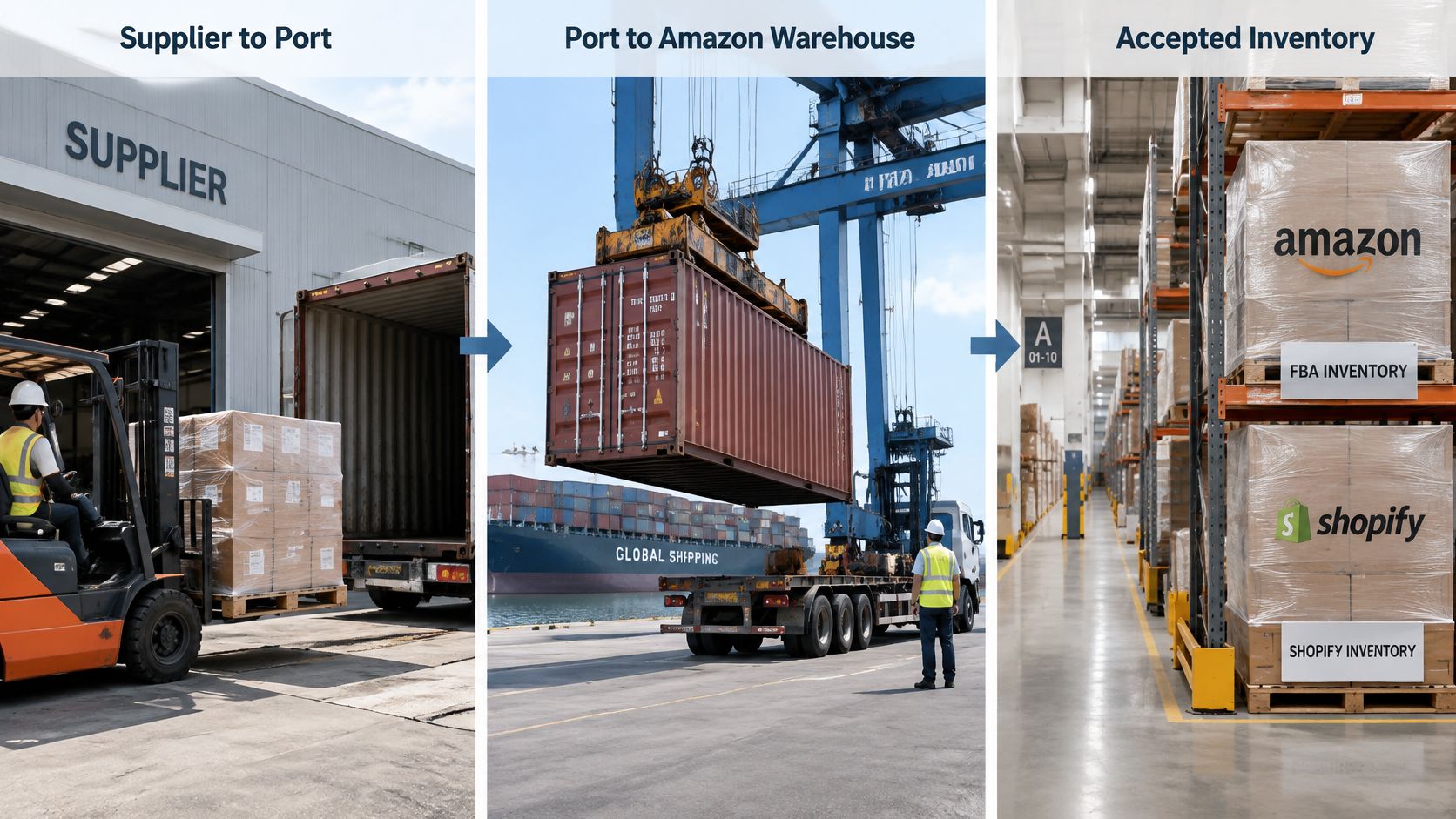
Supplier to Amazon warehouse is in-transit cargo, and only a cargo policy responds to it. Inventory inside Amazon's network falls under marketplace reimbursement, and sellers shouldn't treat that as a substitute for cover. Amazon may replace a unit or reimburse the seller, but the maximum reimbursement for one eligible unit is $5,000, and Amazon recommends third-party insurance for items above that threshold, per Amazon's FBA reimbursement policy. For shipments sent to Amazon, removals and certain pre-fulfillment incidents, reimbursement is generally based on sourcing cost rather than retail price.
Take a product with a $2,000 landed cost that retails at $6,000. A loss before fulfillment gets evaluated near sourcing cost, which is the money already spent, not the margin the item would have earned. And a unit whose value clears $5,000 still runs into the cap regardless of what the invoice says.
There's a deadline attached to that stage too. Fulfillment-center operation claims must be submitted no later than 60 days after the loss or damage is reported in the Inventory Defect and Reimbursement portal or Inventory Ledger, and claims outside that window are ineligible, according to Amazon's claim window guidance. The effective reimbursement can also be reduced to Amazon's assessed fair-market value less FBA and selling fees, so the payout is usually smaller than the retail price suggests.
The parcel stage is where Shopify sellers meet a different product. Shopify Shipping sells shipment-level insurance at published rates of $0.89 per $100 of coverage on domestic shipments and $1.29 per $100 on international ones, so $10,000 of international cover costs $129, per Shopify's shipping insurance documentation. Claims on an insured label that already carries carrier coverage go to Shipsurance rather than the carrier. That's useful for DTC orders going to customers. It is not a blanket policy for a 1,000-unit import.
Watching a forwarder walk through the handoff points makes the seam problem easier to spot:
Insuring the shipment's actual exposure, product cost plus freight plus duty, is the only way the numbers reconcile. Recording that premium against the PO, in the same place as the freight and duty, is what adding Amazon FBA shipment costs to landed cost looks like in practice.
Confirm Your Insured Value Before You Book Cover
Booking cover is a four-part check, and each part points back to a number already in the model.
- Match the insured value to your biggest shipment. Freight, duty and any margin uplift included. Not the average order, not last quarter's container.
- Test the rate against the goods. General merchandise by ocean full container load should sit inside the standard band. A quote outside it needs a stated reason, such as fragile cargo, batteries or a high-theft lane.
- Check the clauses, deductible and extensions against the route. War and strike cover, storage cover and the deductible per occurrence all change what the policy pays on the day.
- Carry the premium as its own landed-cost line. Then the per-unit figure updates every time a freight, duty or insurance bill arrives.
Then map each policy to its stage: the supplier-to-warehouse leg, the Amazon stage, and the parcel stage. A gap between two policies is the same as no cover at all. On air freight, where charter pricing behaves nothing like liner rates, the 2026 freight charter cost tips from Approved Jets are worth reading before assuming the usual percentage applies.
Landed cost combines factory price, freight, duty and other import costs into one per-unit number that gets recalculated as each bill arrives, and Supply Automate's free Landed Cost Calculator shows the true cost per unit before an order is placed. Keeping that number current matters most at the end of the cycle, when a purchase order tracker sits next to the carton counts and inventory adjustments. Reconcile them as each shipment lands, because the fulfillment-center clock starts when a discrepancy is reported, not when someone finally notices the gap. An unreconciled loss is a claim that never gets filed.
Supply Automate puts the insurance premium where it belongs, inside the landed cost of every purchase order rather than buried in a forwarder's PDF, so a $155 cargo premium shows up as $0.16 per unit against the SKU that carries it. Drag in the freight bill, customs entry and insurance invoice, and the platform recalculates your true cost per unit while the goods are still in transit. Visit Supply Automate to turn your next shipment into one number you can price from.