The factory has sent a commercial invoice, the forwarder wants booking confirmation, and the warehouse is waiting for an arrival date. Meanwhile, the latest carton count sits in a supplier message, the agreed price is buried in an email, and the purchase order still shows the original quantity. For a Shopify or Amazon FBA seller, a routine shipment can turn into an expensive document chase.
A purchase order tracker should connect those records before the shipment leaves the factory. Treating the commercial invoice as the financial end of the purchase order trail helps the operations team catch mismatches before the customs broker asks for corrections. The work starts with clear invoice fields, then moves through approval, shipment matching, and receiving.
Required Fields Every Commercial Invoice Needs
A commercial invoice for an international shipment should carry the thirteen fields below as an operational checklist. The broker and carrier use this information to identify the parties, understand the goods, and prepare shipment documentation. Destination-specific requirements still need confirmation with the broker.
The following worked example uses a hypothetical shipment of 500 knitted cotton T-shirts. The company names and city references illustrate the fields, but an issued document needs complete legal names and street addresses, not city names alone.
Commercial invoice fields and examples
| Field | What to Enter | Example |
|---|---|---|
| Seller name and address | Legal name and full address of the exporter | Lumen Home Goods Ltd, Shenzhen; add the complete registered street address |
| Consignee name and address | Consignee's full address, with importer of record and delivery destination identified separately if different | Lumen Trading LLC, Los Angeles; add the complete address and identify the receiving warehouse |
| Invoice number and date | Unique, sequential number and actual issue date | INV-0088; dated on the actual day of issue |
| Purchase order reference | PO number and approved revision | PO-0088, revision 2 |
| Description of goods | Material, function and model, not a general category | 500 knitted cotton crew-neck T-shirts, model LH-T01 |
| HS code | Tariff classification code confirmed for the product | 6109.10 as an illustrative candidate for knitted cotton T-shirts, subject to broker confirmation |
| Country of origin | Where the goods were manufactured | China |
| Quantity and packaging | Units and cartons, matching the packing list | 500 units; carton count copied from the final packing list |
| Unit price and currency | Agreed price per unit in invoice currency | USD 4.20 per T-shirt |
| Total value | Quantity multiplied by unit price | 500 × USD 4.20 = USD 2,100 |
| Incoterm and place | Trade term and named location | FOB Shanghai |
| Freight and insurance | Separate amounts when paid or included, with payer identified | USD 320 freight shown separately; insurance entered at the actual documented amount |
| Signature and declaration | Accurate declaration, signed and dated by an authorised person where required | Signed by export manager, dated on issue |
Descriptions must identify the actual product
A description such as home goods gives the broker little basis for classification. Material, construction, function, and model help distinguish a knitted cotton T-shirt from a woven shirt or a synthetic garment. Size and colour breakdowns can sit on separate SKU lines when those distinctions matter to the order.
The HS code isn't a substitute for the description. The broker needs both, and the destination may require a more detailed tariff code than the international heading shown in the example.
Values must explain the transaction
The value fields should let a reviewer reproduce the arithmetic without interpreting supplier messages. Each line needs a quantity, unit price, currency, and extended value, with discounts or additional charges clearly identified.
A deposit, a freight payment, and the price of the goods aren't interchangeable amounts. Keeping them distinct prevents the amount outstanding from being mistaken for the full shipment value.
How Your Purchase Order Tracker Feeds the Invoice
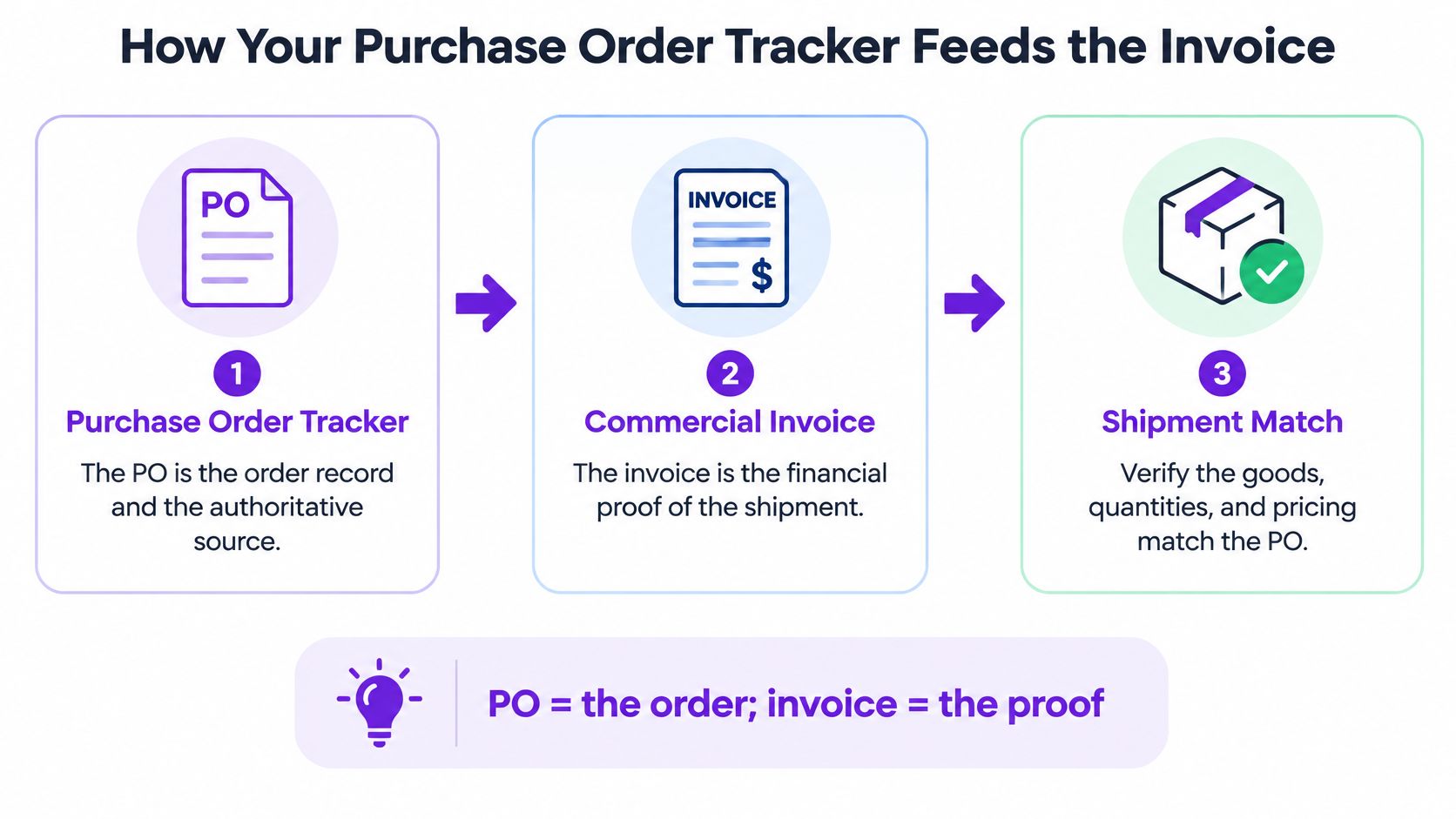
The purchase order is the authoritative order record. The commercial invoice states the supplier's financial claim for the shipment, but it doesn't independently prove that the supplier packed the correct goods. That proof comes from matching the invoice with approved terms and physical shipment evidence.
The restaurant analogy is useful once: the PO is the order ticket, the packing list records what the kitchen sends out, the invoice is the bill, and the tracker is the board showing each table's progress. A bill can look complete while still charging for something that never left the kitchen.
The workflow below connects the commercial commitment to the shipment check.
Build the record in shipment order
The buyer first issues and locks the approved PO version. Production updates then record completion, inspection results, and any approved changes, followed by actual carton counts on the packing list. The supplier generates the invoice from that approved commercial record and the shipment allocation before pickup and customs-entry preparation.
This extends the procurement control described in Brex's purchase order management guide, which connects approval, receipt, invoice verification, payment, and closure. A practical purchase order tracking template should therefore hold document references and exceptions, not just a shipment status.
The pre-booking comparison needs explicit checks:
- Ordered against packed quantity: Any unshipped balance remains visible against the PO.
- Packed against invoiced quantity: The invoice covers the goods allocated to that shipment.
- Invoiced against approved price: Any commercial change has an approval record.
Preserve what the supplier actually agreed to
A supplier's message accepting a different price or ship quantity must become part of the approval trail. Otherwise, the buyer and supplier can work from conflicting versions, a problem explored in LineNow's guide to where online shops get stuck.
For Shopify and Amazon FBA sellers, the planned receiving quantity should reflect the shipment allocation, not automatically the entire order. Actual acceptance happens later, after inspection, so a planned short shipment and damaged goods on arrival need different exception records.
Release rule: Never issue a commercial invoice from a draft PO.
Pricing, Quantity and Incoterm Entries That Must Match
In the hypothetical T-shirt shipment, 500 units at USD 4.20 produce a goods total of USD 2,100. If freight is USD 320, a separate freight line preserves the distinction between the merchandise price and transport charges. The goods line remains USD 2,100, although the broker must determine the correct customs value under the destination's valuation rules.
The starting point is generally the price paid or payable, subject to applicable adjustments. International freight and insurance may be excluded under some destination rules when separately identified, but that treatment isn't universal. A commercial invoice total, a customs value, and a landed-cost total can therefore be different amounts.
Incoterm and what the invoice must show
| Incoterm | Seller Pays | Invoice Value to State |
|---|---|---|
| EXW (Ex Works) | Makes goods available at the named premises, generally not loaded | Ex-works goods price; identify buyer-arranged transport and duties separately |
| FOB Shanghai | Costs through loading the goods aboard the vessel at Shanghai | Goods price under FOB terms; separately identify international freight if included in billing |
| CIF Los Angeles | Goods, freight and required insurance to the named destination port | Contract price with goods, freight and insurance separately identified |
| DDP (Delivered Duty Paid) | Delivery to the named place and import clearance and duties; insurance isn't automatically required by the term | Full agreed price with included charges itemised; identify the importer of record correctly |
The distinction between cost responsibility and risk transfer also matters. Under CIF, for example, payment for freight to the destination doesn't mean the seller retains transit risk until arrival. The comparison of FOB, EXW and DDP for FBA sellers helps buyers align the commercial term with the actual booking arrangement.
Separate payment status from shipment value
A deposit reduces the balance due, not the full value of the merchandise. The invoice can show the full goods amount, the deposit already paid, and the remaining balance as distinct entries.
If the supplier renegotiates a price after PO approval, the tracker needs a dated revision and acknowledgment before invoicing. A silent edit removes the evidence needed to explain why the invoice differs from the original order.
Keep landed cost open after invoicing
Freight, duties, insurance, and port fees should be allocated to the relevant SKUs using a documented method, such as weight, volume, or goods value. Expected allocations should remain distinguishable from final actual costs.
The Stealth Agents review of purchase order matching highlights quantity, price, and timing discrepancies between purchase orders, receipts, and invoices. Operationally, an order can arrive on schedule while the buyer's margin shrinks because logistics charges remain outside the SKU record.
Compliance Mistakes That Hold Shipments at Customs
Deliberately understating the shipment value is the most serious mistake in this checklist. Dividing a transaction across invoices to conceal part of its value doesn't make the declaration accurate and can expose the importer to penalties. Legitimate partial shipments or multiple suppliers require transparent documentation, not an artificially reduced total.
Many avoidable document queries begin with ordinary inconsistencies rather than obscure tariff questions. A broker comparing the invoice, packing list, payment evidence, and product details needs a coherent explanation of the shipment.
Common invoice compliance mistakes and fixes
| Mistake | Example | Consequence | Fix |
|---|---|---|---|
| Vague goods description | Home goods entered for knitted T-shirts | Entry delayed while the broker requests detail | Describe material, function and model |
| Wrong HS code | A hypothetical knitted T-shirt entered under woven-shirt heading 6205 | Duty mismatch and possible penalty | Confirm each code with the broker before booking |
| Invoice value differs from payments | The hypothetical invoice shows only a deposit instead of the full goods price | Valuation query and possible hold | Reconcile full invoice value, deposits, balance and payment records |
| Missing country of origin | Field left blank | Entry rejected or delayed where the field is required | Enter the country of manufacture |
| Split invoices for one shipment | Multiple invoices used to conceal the full declared total | Potential undervaluation finding | Use a consolidated shipment invoice where appropriate, or disclose all legitimate invoices |
| Unsigned or undated invoice | No signature or date on the document | Possible rejection under the receiving party's requirements | Date and number every invoice; obtain the required signature or declaration |
Correct the explanation, not just the number
A payment difference isn't automatically undervaluation. It may represent a deposit, a credit, a separate freight payment, or a banking charge, but the tracker must make the explanation visible. Finance should attach the supporting record rather than leaving the broker to reconstruct the transaction.
Likewise, changing an HS code solely to obtain a lower duty rate isn't a valid classification method. Product facts come first, followed by broker review and the applicable tariff treatment. An import-duty calculation guide can support budgeting, but it doesn't replace destination-specific classification advice.
Customs release and FBA readiness are different checks
An accurate commercial invoice doesn't prove that Amazon-bound cartons have the right preparation or labels. Alongside the customs review, operations teams can consult Agent Central's FBA labeling and prep requirements to check the receiving preparation separately.
Issued documents should never be overwritten. Corrections need a revision identifier, the reason for the change, an approver, and a record of which parties received the replacement.
A short review before booking is easier to manage than document corrections after cargo reaches a port.
These are operational controls, not legal advice. The broker should confirm which signatures, declarations, valuation adjustments, and correction procedures apply to the shipping lane.
Shopify and Amazon FBA Invoice Mistakes in Practice
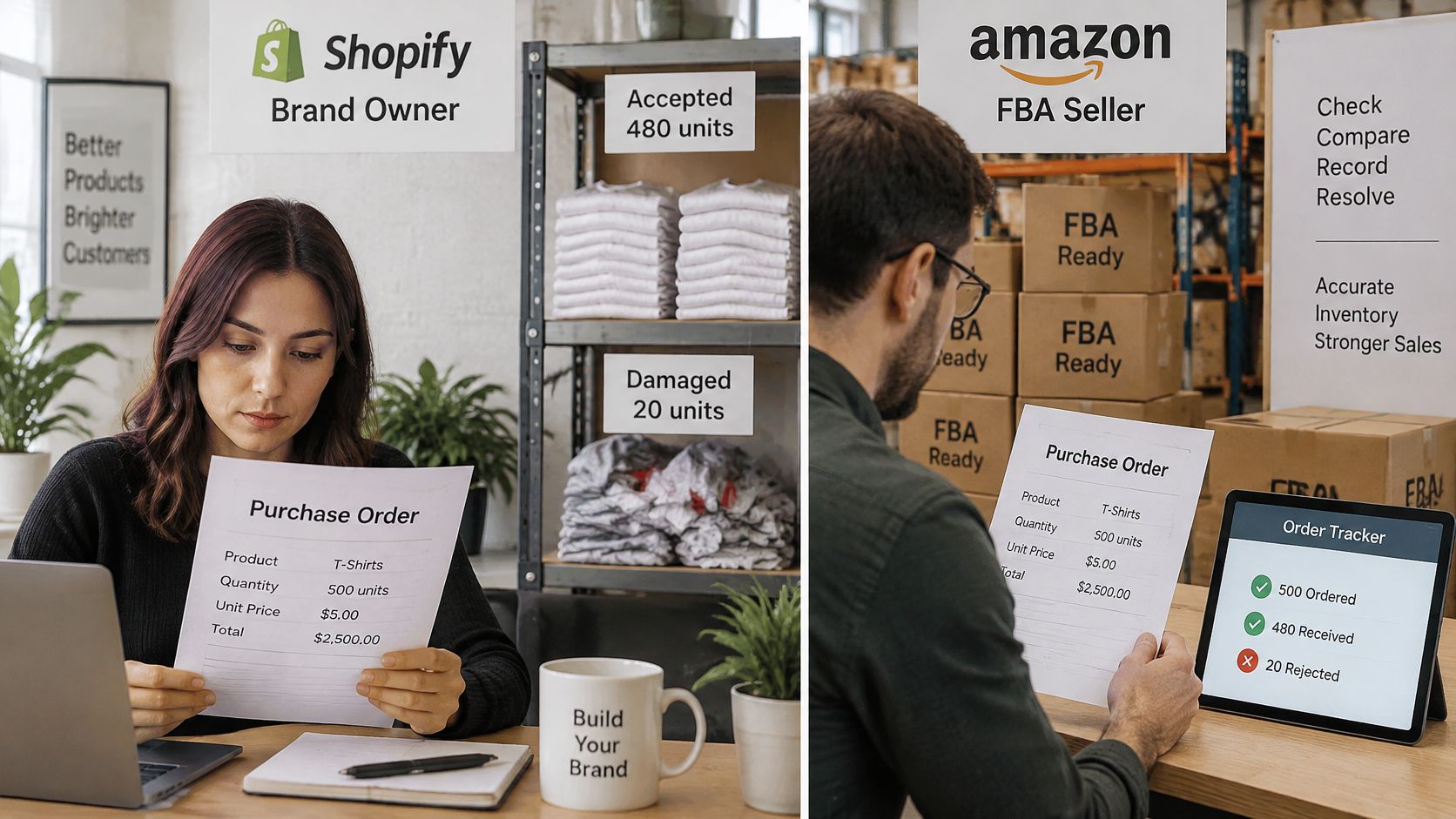
A hypothetical Shopify brand orders 500 T-shirts, and its invoice covers the full shipment. The warehouse later accepts 480 and rejects 20 damaged units. The distinction is between goods received and goods accepted, not necessarily between goods invoiced and goods shipped.
The platform comparison illustrates why receiving outcomes belong beside the original purchase record.
Shopify receiving needs a financial follow-up
The buyer records the damaged quantity, inspection evidence, and a damage reason code, then requests a supplier credit note. The issued invoice stays preserved; if a corrected invoice is appropriate, it references the original and remains attached to the same PO. Damage discovered after import shouldn't automatically trigger a retrospective reduction in customs value.
Shopify's inventory-transfer guidance explains how an ordered PO can feed a transfer and how receiving can distinguish accepted, rejected, and canceled quantities. Inventory tracking and receiving locations must be configured for that workflow.
In another hypothetical receipt, a PO shipment of 1,000 units resolves into 970 accepted and 30 rejected. Shopify's purchase order reporting documentation identifies shipped, received, accepted, and rejected quantity fields, allowing the seller to distinguish the full shipment from sellable stock.
Amazon carton changes need document control
Consider an FBA seller shipping 2,000 units. The invoice lists 80 cartons, but a last-minute repack increases the packing-list count to 84, prompting the hypothetical broker to pause processing until the documents agree. The fix is to verify the physical count, replace the outdated document through a controlled revision, and attach the final packing list to the PO.
Amazon's FBA shipment requirements distinguish preparation, packaging, labeling, routing, and capacity considerations. A factory run may need allocation across Amazon shipments or a 3PL, with each shipment's invoice and carton records reflecting its actual allocation.
The accompanying video provides an additional visual reference.
A documented Amazon FBA invoice-processing workflow should connect those shipment allocations to the commercial records. Both scenarios demonstrate the same practical limit: an invoice is only as reliable as the record used to create it.
Run a Seven-Step Invoice Check Before Every Booking
The booking review should be a release gate, not an informal request to glance at a PDF. A purchasing coordinator can own the checklist, while finance verifies payment evidence and the broker resolves classification or valuation questions. Each unresolved exception needs an owner before the shipment proceeds.
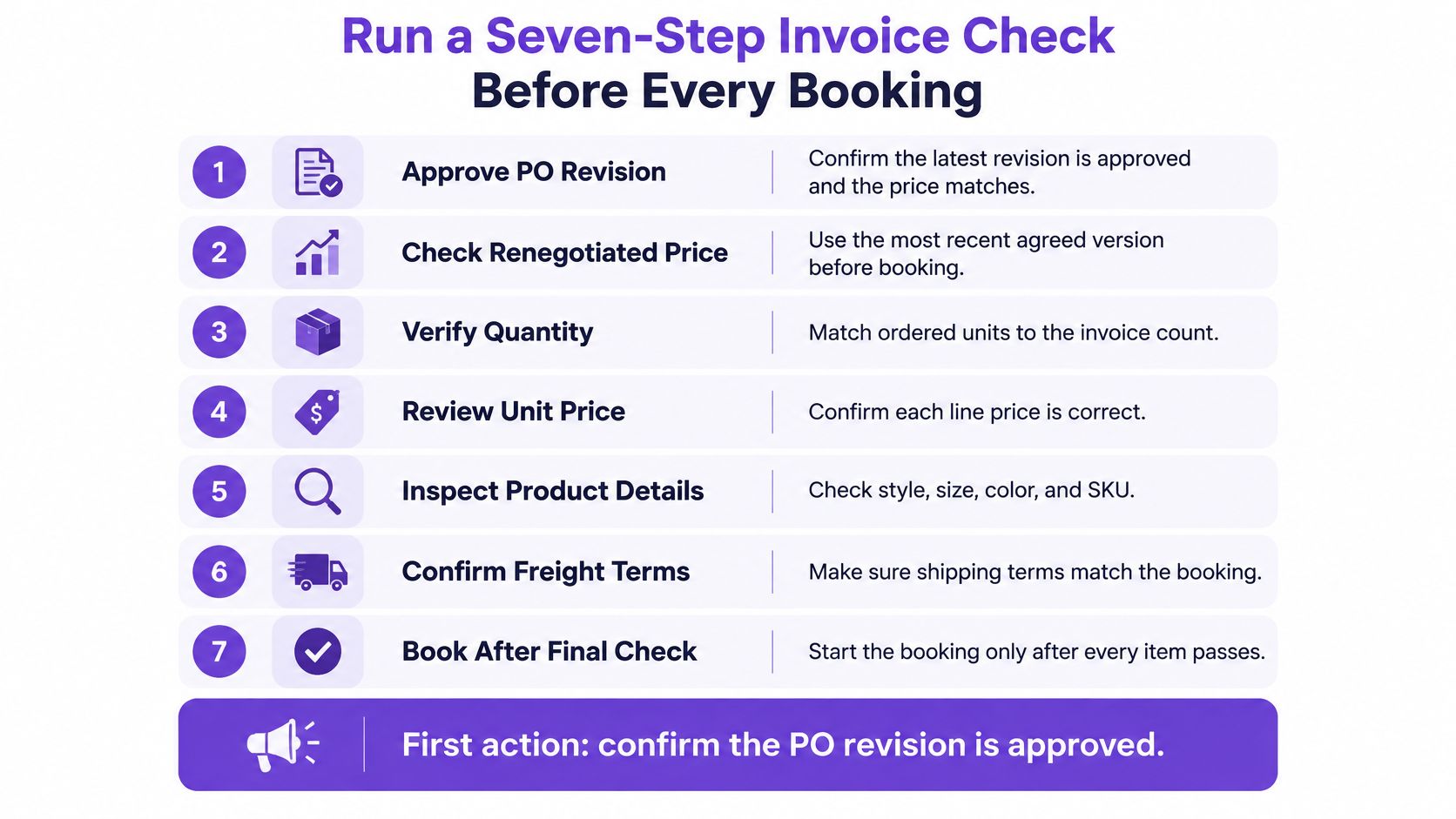
The visual checklist supports the review, while the procedure below covers the document and payment checks needed for release.
The pre-booking release procedure
- Confirm the approved PO revision. The reviewer checks approval, supplier acknowledgment, and the latest agreed price. A renegotiated price must already exist as a dated revision, not merely as a message awaiting entry.
- Compare quantities across the documents. The PO shipment allocation, packing list, and invoice must agree at SKU and carton level. A partial shipment can differ from the total PO, provided the remaining balance and shipment allocation are explicit.
- Review descriptions and classification. Material, construction, function, model, and relevant SKU attributes should describe the actual goods. The reviewer checks the HS code against the broker's advice or the applicable current tariff schedule rather than copying an unrelated earlier invoice.
- Confirm the Incoterm and cost presentation. The named place must match the agreed arrangement. Freight and insurance should be separately identifiable where paid or included, with no assumption that invoice presentation alone determines customs treatment.
- Reconcile the invoice with payments. Finance checks the full goods value against deposits, outstanding balances, credits, and separately paid charges. A documented invoice reconciliation procedure helps explain legitimate differences without changing the transaction history.
- Complete the issue details. The supplier adds the actual date, sequential invoice number, required declaration, and authorised signature where applicable. The reviewer also checks that the document identifies the correct legal parties.
- Attach and lock the final PDF. The checked invoice belongs on the PO record alongside the final packing list and approval evidence. The broker and forwarder must receive the same released version, not separate email attachments with uncertain status.
Close exceptions after arrival
Receiving staff compare actual cartons and units with the shipment documents, then log shortages, overages, damage, and rejected units under distinct reason codes. A commercial adjustment may require a credit note or revised invoice with a new version identifier; any customs amendment needs broker guidance. The original issued document remains available.
Independent receiving evidence matters. The GS1 US retail supply-chain data-exchange study demonstrates the control principle of reconciling shipment information against captured physical events rather than relying only on supplier-entered status.
Standing control: No invoice without a locked PO version, and no booking without a checked invoice.
A useful internal escalation rule is to review the process before the next booking if more than one invoice in the previous quarter required correction after shipping. The review should identify the failure point, such as late repacking, an unapproved price change, or an outdated invoice template.
Supply Automate offers free downloadable purchase order, packing list, and commercial invoice templates; purchase orders, supplier communications, shipping invoices, and landed-cost reports can also be exported to CSV or Excel at any time. Today's first action is concrete: the operations owner copies the fields from the opening checklist into an invoice template and runs the release checks on a shipment still in production.
Supply Automate keeps supplier details, SKUs, quantities, prices, dates, and documents on a single purchase order record, helping e-commerce teams connect invoice checks with shipment progress and actual costs. Shopify and Amazon FBA operators can visit Supply Automate to organise the next order's commercial paperwork before booking.