
The supplier is chasing payment, the warehouse has only logged part of the shipment, and the freight forwarder hasn't sent the final bill. Meanwhile, the Amazon FBA or Shopify margin report still treats the factory price as the product's cost. Paying the invoice might clear the supplier balance, but it won't prove the order was billed correctly or that the SKU is profitable.
To reconcile an invoice, the operator needs to establish what was agreed, what arrived, what remains payable, and which acquisition costs are still missing. Those are separate checks, and closing one shouldn't silently close the others.
<a id="what-a-reconciled-invoice-has-to-match"></a>
What a Reconciled Invoice Has to Match
Reconciling means checking the invoice against supporting records before payment approval. A supplier invoice alone proves nothing about whether the amount is valid. It states what the supplier wants paid, not necessarily what the buyer authorized or received.
The starting point is the approved purchase order, including its latest revision. A disciplined process for creating a purchase order gives finance an agreed baseline instead of forcing someone to reconstruct terms from supplier messages.
Records to pull before approving an invoice
| Record | What It Confirms | Fields to Compare | Typical Mismatch |
|---|---|---|---|
| Purchase order (latest revision) | Agreed quantity, unit price and terms | SKU, quantity, price, payment terms, revision number | Invoice billed on an older PO revision |
| Supplier invoice | Amount being requested | Invoice number, date, currency, line totals, tax | Lines don't add up to the invoice total |
| Receiving record or warehouse count | Units that physically arrived | Received quantity per SKU, carton count, damage notes | Partial receipt billed as a full shipment |
| Freight, duty and broker bills | Import costs that change landed cost | Charge type, shipment ID, allocation basis | Bill arrives after invoice approval |
| Payment history and bank details | Whether this amount or account was used before | Prior payments, supplier bank account on file | Duplicate invoice number or changed bank account |
The administrative burden is material: a 2025 benchmark summarized by Docsumo reports an average processing cost of $9.84 per invoice, an 8.2-day cycle time, and 18.4% of invoices requiring an exception or manual intervention. Skipping checks doesn't eliminate that work; it moves investigation until after cash has left.
<a id="include-the-import-documents"></a>
Include the import documents
For an importing brand, matching the factory's unit price isn't enough. Freight, insurance, duty and brokerage belong in the order record because they change the cost used to judge SKU profitability.
Pre-check: Gather the records in one order folder before reviewing the invoice. Confirm that each document carries the PO number or has an explicit cross-reference to that PO.
Where a carrier or broker uses only a shipment reference, record the connection rather than altering the original document. That preserves evidence while making the order traceable.
<a id="how-to-reconcile-an-invoice-in-seven-steps"></a>
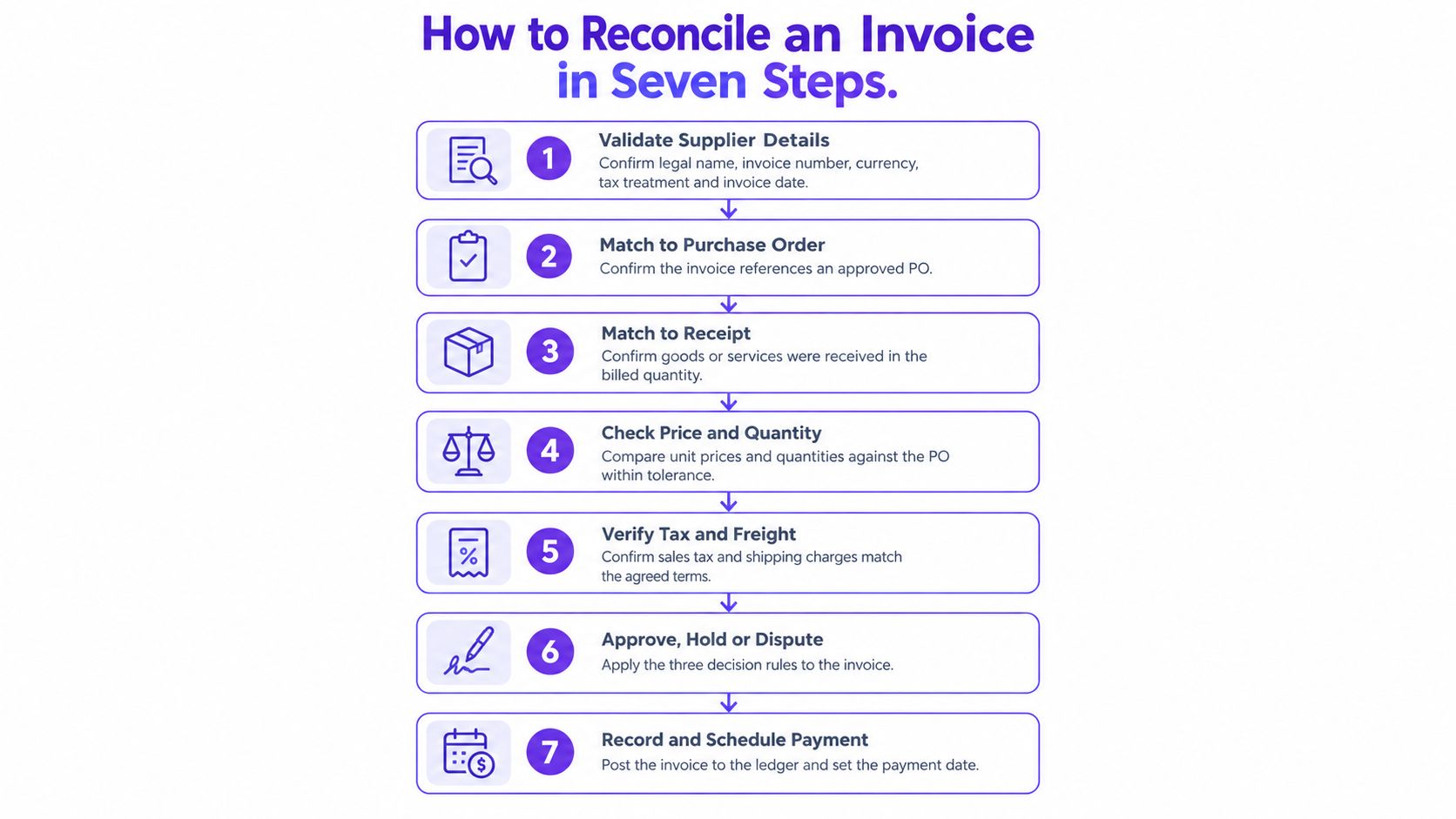
How to Reconcile an Invoice in Seven Steps
A useful checklist produces a decision for every invoice line, not merely a tick beside the invoice total. APQC benchmarking cited by Astera reports that only 75.0% of invoice lines match successfully on the first attempt, which makes exception handling a core responsibility rather than cleanup.
- Validate the supplier and invoice header. Check the legal supplier name, invoice number, invoice date, currency and tax treatment against the vendor record. A familiar trading name doesn't excuse an unexplained change in the legal entity requesting payment.
- Link the approved PO version. Match against the revision the buyer authorized, not whichever attachment appears first in an email thread. Preserve earlier versions so a reviewer can establish when a price or quantity changed.
- Compare every commercial line. Check the SKU, billed quantity, unit price, discounts, freight, duties and other charges against the agreed terms. Recalculate extensions and the total rather than accepting a PDF's arithmetic.
- Verify the physical receipt. Compare billed units with the goods-receipt record, warehouse count and damage notes. For partial deliveries, distinguish units received from units still in transit or awaiting inspection.
- Route variances through written tolerances. Assign price questions to the buyer, receipt gaps to the warehouse, and import-charge questions to the forwarder or broker. Each exception needs an owner and the document required to resolve it.
- Record named approval. Attach the approver's name, decision, date and supporting evidence to each accepted exception. An approval buried in a messaging thread isn't useful unless it remains linked to the invoice.
- Post the reconciled amount to accounts payable. Record the supported liability and keep the unresolved balance in a controlled exception workflow. Don't rewrite a supplier invoice without a documented reason just to make the accounting entry match.
The workflow can be kept beside the invoice-review queue.
<a id="put-a-price-difference-on-hold"></a>
Put a price difference on hold
Consider a hypothetical mug order: the supplier invoices 1,000 units at $4.20, while the approved PO specifies $4.05. The $150 variance goes on hold until the buyer confirms an authorized change or the supplier issues a correction. A receipt confirming all the mugs arrived doesn't authorize the higher price.
Document organization matters before automation. A consistent method to organize supplier invoices keeps original files, revisions and credits distinguishable.
For teams assessing automated capture and matching, Cyndra's AI-powered invoice processing workflows provide a resource for evaluating the workflow. The purchasing team should still define which discrepancies require human approval.
Reusable reconciliation sheet, one row per SKU
| PO and Revision | SKU | PO Quantity | Billed Quantity | Received Quantity | PO Unit Price | Billed Unit Price | Allocated Import Costs | Variance | Owner | Status |
|---|---|---|---|---|---|---|---|---|---|---|
| Approved PO reference | Supplier and internal SKU | Authorized units | Invoice units | Confirmed units | Agreed price | Requested price | Actual or accrued, labeled | Amount and cause | Named reviewer | Pass, hold or dispute |
<a id="variance-tolerances-that-decide-pass-or-hold"></a>
Variance Tolerances That Decide Pass or Hold
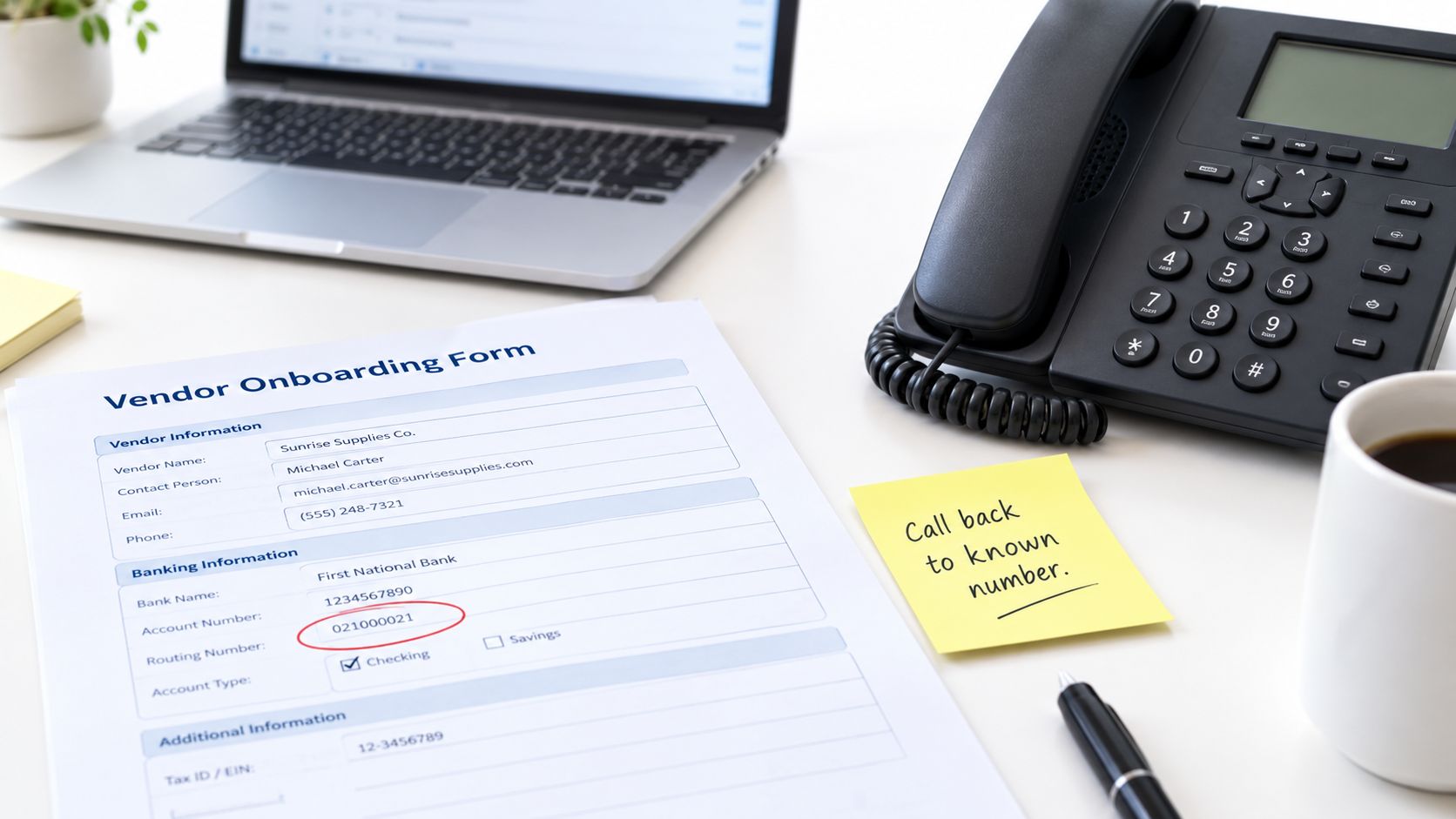
Bank-detail changes and existing invoice numbers are zero-tolerance checks. A changed remittance account requires independent verification through a phone number already on file. An invoice number already present in the supplier's AP history requires a duplicate check before another payment can proceed.
Arithmetic alone can't establish legitimacy. The Association for Financial Professionals' 2025 survey, summarized by Gennai, reported that 79% of organizations experienced payment fraud attacks or attempts in 2024.
The vendor record should remain available during payment review, not just during onboarding.
<a id="set-commercial-thresholds-deliberately"></a>
Set commercial thresholds deliberately
The following are proposed starting policies, not industry benchmarks or permission to override a contract. A tolerance determines routing; it doesn't make an unauthorized charge legitimate.
Starting tolerances for pass or hold
| Check | Starting Tolerance | Action When Exceeded |
|---|---|---|
| Vendor bank or remittance details | Zero: any change needs a call-back to a number already on file | Hold payment until verified |
| Invoice number already in AP history | Zero | Block as possible duplicate |
| Unit price versus PO | 0% on PO-priced SKUs unless a revised PO exists | Hold and request an authorized revised PO or credit note |
| Billed versus received quantity | Zero on cartons counted; shrink only if written in the PO | Pay supported received quantity under agreed terms, dispute the remainder |
| Freight versus quote | Within 5% of quoted freight | Hold and request the freight bill |
| Currency conversion | Within 1% of the rate shown on the invoice | Recalculate at the invoice rate, then re-check |
| Tax on invoice | Exact match to the rate on the invoice and accounting records | Hold for tax review |
A reliable supplier's history can support tighter, more precise controls. Loosening a commercial threshold should require a written agreement, while fraud controls remain unchanged.
For a hypothetical order, 2% price creep on 500 units at $12 adds $120. That difference shouldn't pass just because it looks small; the PO must permit it.
A new sender domain, unusual payment urgency or split invoices should trigger review even when individual totals pass. Duplicate screening should compare supplier, amount, dates and PO references, not invoice numbers alone.
A perfect arithmetic match can still lead to payment into the wrong bank account.
Pay authorized, supported charges within policy. Hold correctable commercial differences, and escalate identity, banking and duplicate-payment concerns before anyone releases funds.
<a id="fixing-discrepancies-and-late-landed-costs"></a>
Fixing Discrepancies and Late Landed Costs
Most exceptions should begin with a record check, not an immediate payment or rejection. A warehouse receipt may be incomplete, a carton may need recounting, or the forwarder's proof of delivery may explain why stock appears missing.
The owner should establish which document is wrong before asking someone to change it. Updating the PO merely to match an unexplained invoice removes the control instead of resolving the difference.
Common discrepancies and how to resolve them
| Discrepancy | Likely Cause | First Action | Who to Contact |
|---|---|---|---|
| Quantity short | Partial shipment, carton miscount or stock still being received | Recount, check receiving log and carrier proof of delivery | Forwarder or 3PL |
| Unit price above PO | Price changed after PO issuance | Request evidence of approval, then an authorized revised PO or credit note | Supplier sales contact |
| Invoice with no PO | Order placed by message, or PO number typed incorrectly | Find original authorization, then raise and link an exception-approved PO | Supplier and internal buyer |
| Duplicate invoice number | Invoice resent or numbering altered | Compare amount, date, PO and bank details | Supplier accounts |
| Freight or duty missing | Bill arrives after invoice approval | Accrue the estimate and adjust when the bill lands | Forwarder or customs broker |
| Lines don't sum to total | Keying error or an unlisted charge | Request a corrected invoice | Supplier |
| Charges on wrong SKU | Carton allocation doesn't reflect SKU quantities or weight | Reallocate using a defensible basis and record it | Internal cost owner |
<a id="keep-late-costs-open-after-approval"></a>
Keep late costs open after approval
Electronic documents don't guarantee complete costs. The Vertex global e-invoicing report reports that 55% of businesses in mandated markets face implementation difficulty. A structured invoice still needs operational documents and accounting judgment.
Commercial approval and landed-cost completion should therefore have separate statuses. Finance can recognize a valid supplier liability while keeping estimated logistics costs open for adjustment.
Consider a hypothetical FBA seller approving a $6,400 invoice for 800 units at $8 each. A $380 duty bill arriving three weeks later adds about $0.48 per unit. Without an accrual, the seller's initial margin calculation excludes a real acquisition cost.
At approval, record the best supported estimate from the freight quote or broker calculation. When the actual bill arrives, replace the estimate and post only the difference, avoiding double counting.
Margin control: A payable can be settled while the order's landed cost remains provisional.
The cost owner should allocate freight across multiple SKUs using a documented basis appropriate to the charge. Units suit comparable products; weight can better represent transport costs for mixed-density goods.
Supplier quantity or price changes require a new approved PO version, not an overwritten original. Close the discrepancy log only after recording the cause, financial adjustment, owner, supporting document and date closed.
<a id="reconciling-amazon-fba-invoices-to-unit-cost"></a>
Reconciling Amazon FBA Invoices to Unit Cost
A supplier invoice for 1,000 units at $8.00 each arrives with a $500 discount off the top, and the $1,200 inbound freight bill lands on a separate document. The inventory cost is $8,700, or $8.70 per unit before other capitalizable charges. Tax rules generally capitalize the invoice price less trade discounts plus freight and other acquisition costs, so a SKU priced against the $8.00 invoice figure is already carrying a wrong unit cost.
Inventory cost build-up for 1,000 units
| Line | Amount | Per Unit |
|---|---|---|
| Supplier invoice before discount | $8,000 | $8.00 |
| Less supplier discount | -$500 | -$0.50 |
| Inbound freight | +$1,200 | +$1.20 |
| Inventory cost for the SKU | $8,700 | $8.70 |
The supplier payment alone does not produce the inventory value. Reconciliation has to tie the discount and the freight bill to the same SKU and the same acquisition, and keep those capitalizable charges separate from operating expenses.
<a id="track-split-fulfillment-center-receipts"></a>
Track split fulfillment-center receipts
An inbound shipment divided among Amazon fulfillment centers needs receipt tracking per segment. A seller who closes the purchase on the first delivery confirmation leaves the remaining units unresolved while the invoice reads as paid in full.
The working record should distinguish ordered, invoiced, shipped, received and outstanding quantities. Those fields answer different questions, particularly when goods pass through a prep center before reaching Amazon.
- Connect shipment references. Link each inbound shipment ID to its PO, supplier invoice and dispatch documents, so a warehouse transfer never gets booked as a second purchase.
- Split shared freight. One freight bill covering several fulfillment-center segments has to be divided across them, with the allocation basis recorded alongside the calculation.
- Reconcile receipts cumulatively. Compare total confirmed receipts across fulfillment centers against dispatched quantities, and keep shortages separate from receiving delays.
- Carry the open balance. Hold unreceived units as an unresolved receiving item until evidence supports receipt, loss, a supplier credit or another documented adjustment.
The workflow for adding Amazon FBA shipment costs to landed cost also has to stop the same freight bill from posting at both the parent order and the individual shipment. Freight counted twice inflates the unit cost just as surely as freight never counted deflates the margin.
For a Shopify brand selling the same SKU from a 3PL, channel routing does not end the acquisition trail. The verified unit cost still follows the inventory wherever it ships from.
Have the accountant confirm which freight, duty, prep and other charges capitalize under the business's accounting method. The operational landed cost and the book figure should tie out per SKU.
<a id="matching-shopify-payouts-to-your-bank-deposit"></a>
Matching Shopify Payouts to Your Bank Deposit
A Shopify bank deposit should match the Shopify payout, not gross order sales. In a hypothetical week, $10,000 in customer charges minus $290 in processing fees, $180 in refunds and a $60 chargeback produces an expected payout of $9,470. A deposit matching that amount isn't missing cash.
The payout review needs both settlement details and bank evidence.
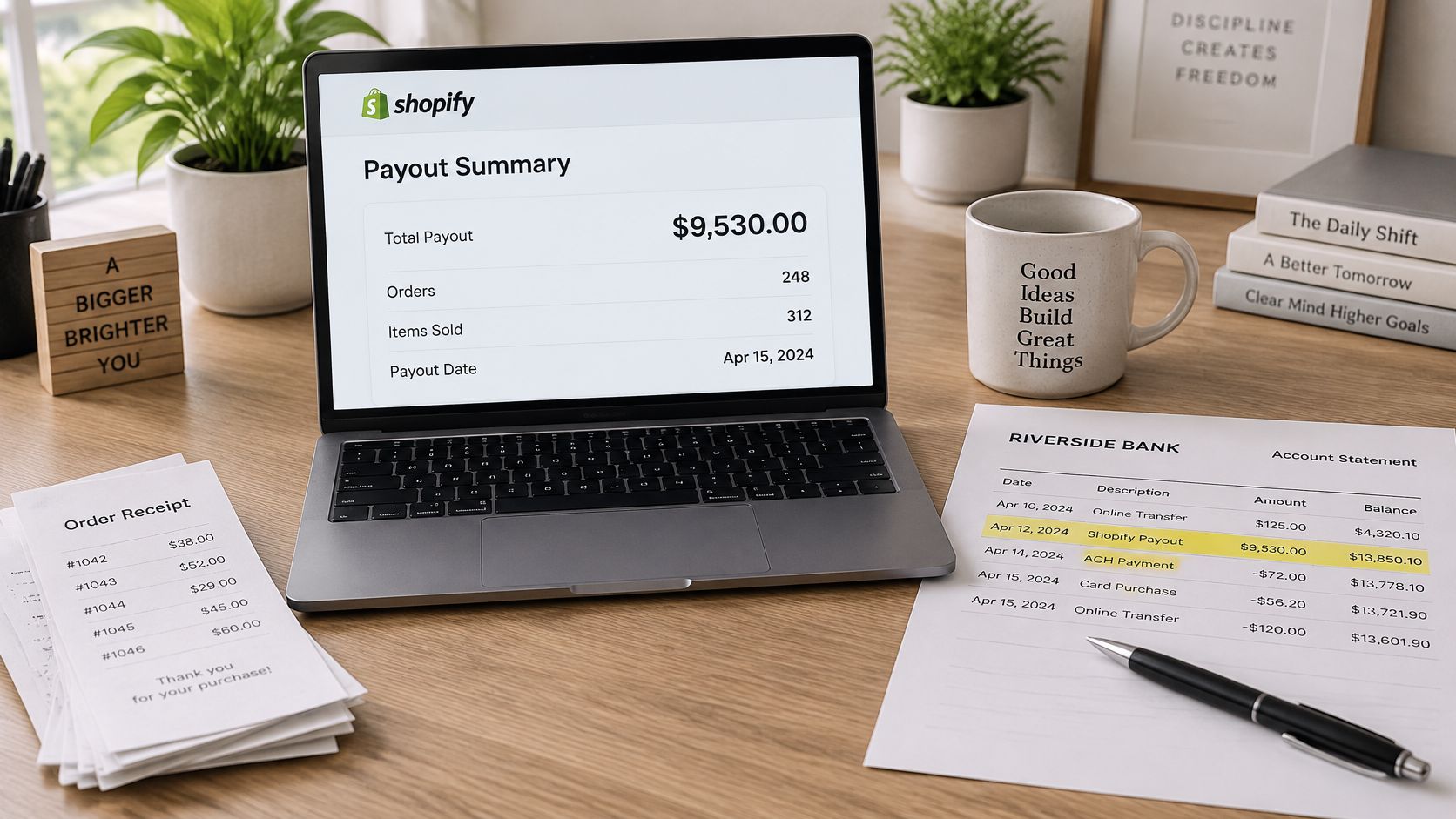
Shopify Payments documentation describes the Payments activity report and payout exports used to review balance activity, fees, adjustments and settlements. This is a settlement reconciliation, distinct from validating supplier invoices.
<a id="trace-the-settlement-to-its-transactions"></a>
Trace the settlement to its transactions
- Find the payout ID and payout date. Use the Payments activity report to identify the settlement rather than choosing an order-sales date range.
- Match the total to the bank deposit. Check the amount and settlement timing, keeping the payout ID in the accounting reference.
- Export that payout's transactions. A single-payout export avoids mixing settled transactions with unrelated activity.
- Check transaction IDs and components. Verify gross charges, refunds, fees and adjustments, including whether a chargeback belongs to the settlement under review.
- Inspect unsettled activity. Check pending transactions, reserves and retried payouts before recording an unexplained loss.
- Check transaction time zones. A transaction appearing on a different calendar date doesn't, by itself, indicate missing cash.
The related walkthrough can support the settlement review.
For brands adding another marketplace, HiveHQ's guide to reconcile TikTok Shop payouts provides a channel-specific reference. Teams should use each platform's settlement records rather than force different fee structures into the same sales-to-bank shortcut.
Any difference remaining after these checks belongs in the discrepancy log with the payout ID, bank reference, transaction export and assigned owner. Finance shouldn't post a balancing adjustment just to make the bank reconciliation clear.
<a id="approve-hold-or-dispute-the-invoice"></a>
Approve, Hold or Dispute the Invoice
The payment decision should be explicit and supported by evidence. These rules separate routine approval from an unresolved difference or a potentially invalid request.
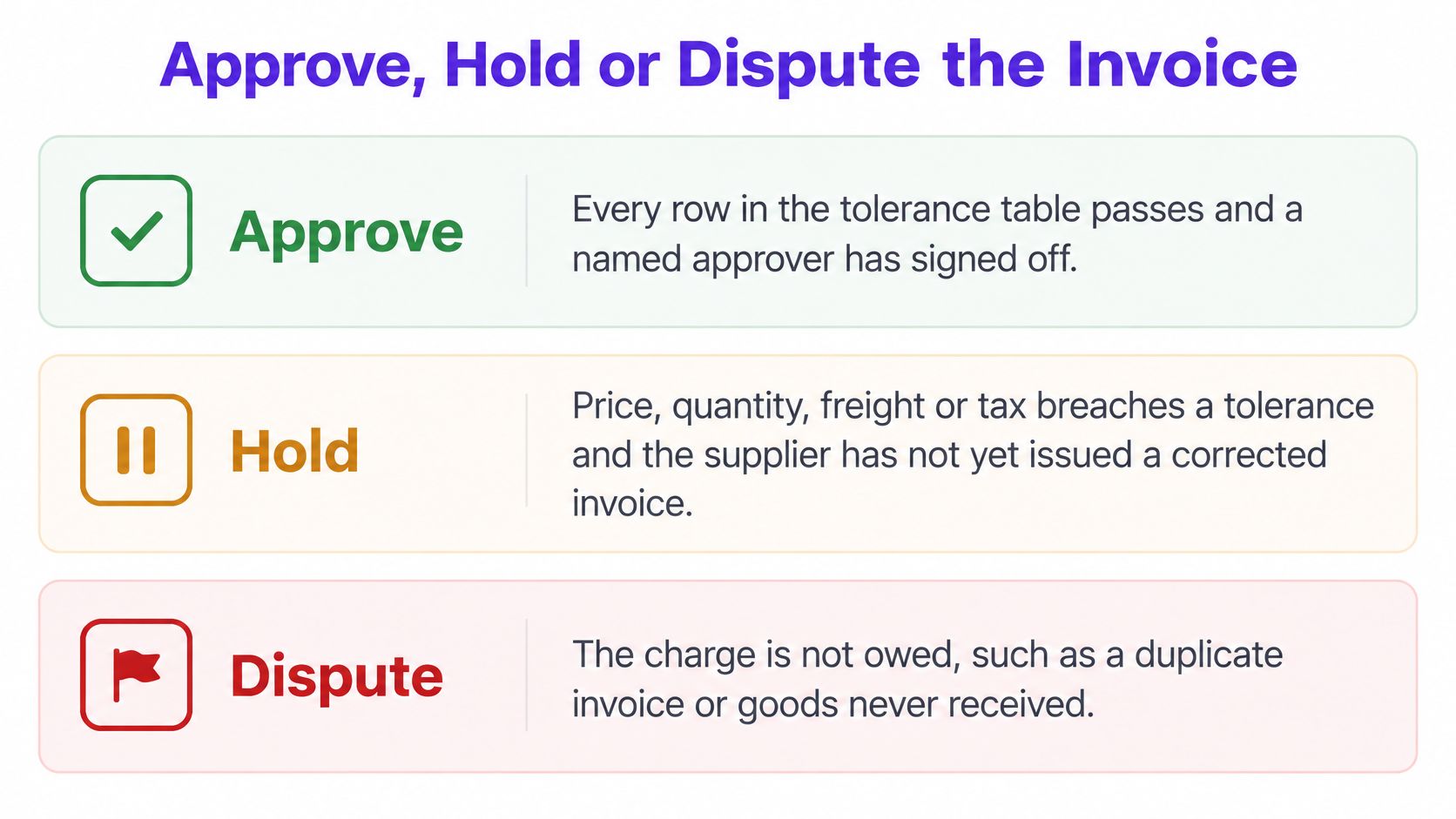
- Approve when every applicable tolerance passes and a named approver has signed off.
- Hold when price, quantity, freight or tax breaches policy and supporting documents or corrections remain outstanding.
- Dispute or escalate when bank details change, an invoice appears duplicated, or no authorized PO can be established. A missing PO requires investigation, not an assumption that the debt is invalid.
The decision should remain attached to the invoice.
<a id="keep-the-control-active-after-posting"></a>
Keep the control active after posting
Payment isn't proof of full reconciliation. Finance should review exception age weekly, retain the PO revision on every line, and track first-pass match rate, exception rate, exception age, duplicate-payment rate and recovered value monthly.
A documented Xero invoice approval workflow can keep accounting handoffs clear. Tax reviewers can use TaxID's invoice checks for VAT compliance as a separate document-review reference, without treating a commercial match as tax clearance.
Supply Automate's landed-cost check flags a supplier invoice whose total disagrees with its own lines. Its trial starts with uploading one supplier invoice to show what the units really cost, and the whole trial takes about ninety seconds. Purchase orders, supplier communications, shipping invoices and landed-cost reports can be exported to CSV or Excel at any time.
Supply Automate connects supplier documents and import charges to per-unit landed cost, helping FBA and Shopify operators assess more than the factory invoice. Visit Supply Automate and start with one supplier invoice to establish an order-level cost record before approving the next payment.