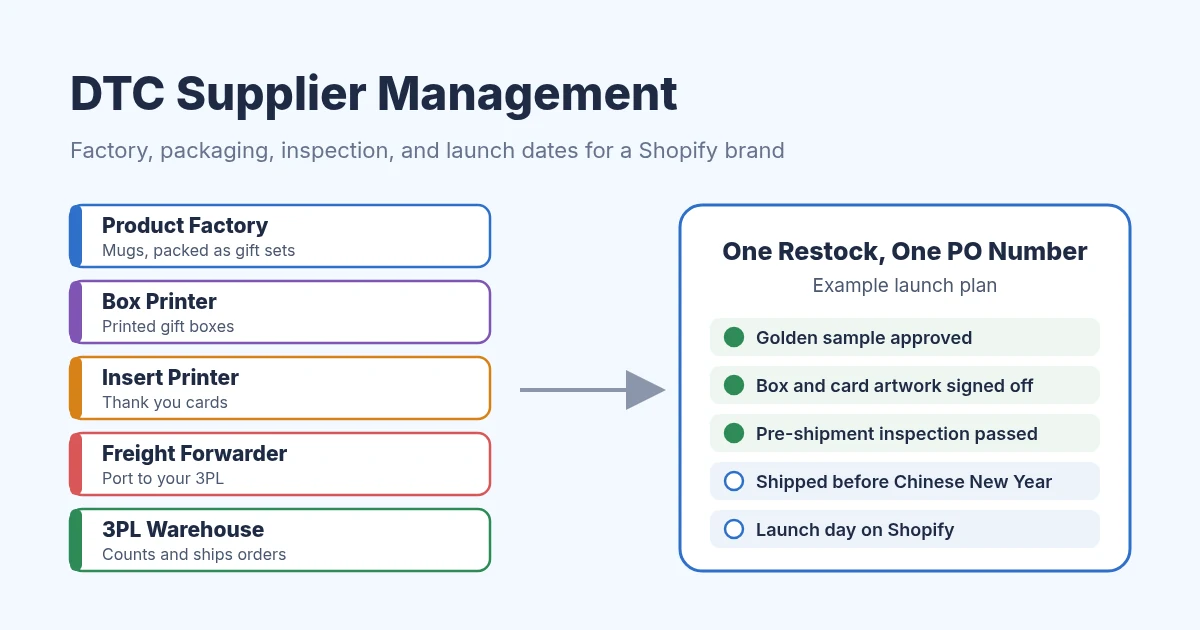
A buyer's order is the purchase order a brand issues to a supplier, naming the goods, quantities, prices, and terms for that purchase. That numbered order, not the chat thread around it, is the version production should follow.
That distinction matters on the morning a factory asks whether to build the matte or glossy finish, use the old carton, or ship to a 3PL instead of an Amazon prep center. If the answer lives across WeChat, email, and a spreadsheet tab, each person can find a different deal. A useful buyer's order ends that search. It gives the factory, finance, and receiving team one reference they can each check without asking who remembers best.
What a Buyers Order Is for FBA and Shopify
Say a Shopify founder agrees a price in a factory chat, pays a deposit against a screenshot, and never turns the conversation into a document. Three weeks later the factory ships the prior label version because that file was attached to its internal job. The founder has messages, but there's no single instruction tying SKU, quantity, price, destination, and ship date together.
From chat to kitchen ticket
That's the gap a buyer's order fills. In the Federal Acquisition Regulation definition hosted by Cornell Law, a government purchase order is an offer to buy supplies or services from a commercial source under specified terms, with the cited simplified-acquisition threshold capped at $100,000. Ecommerce teams use the same logic at smaller scale. The supplier quote is the menu conversation. The buyer's order is the kitchen ticket the line cooks from.
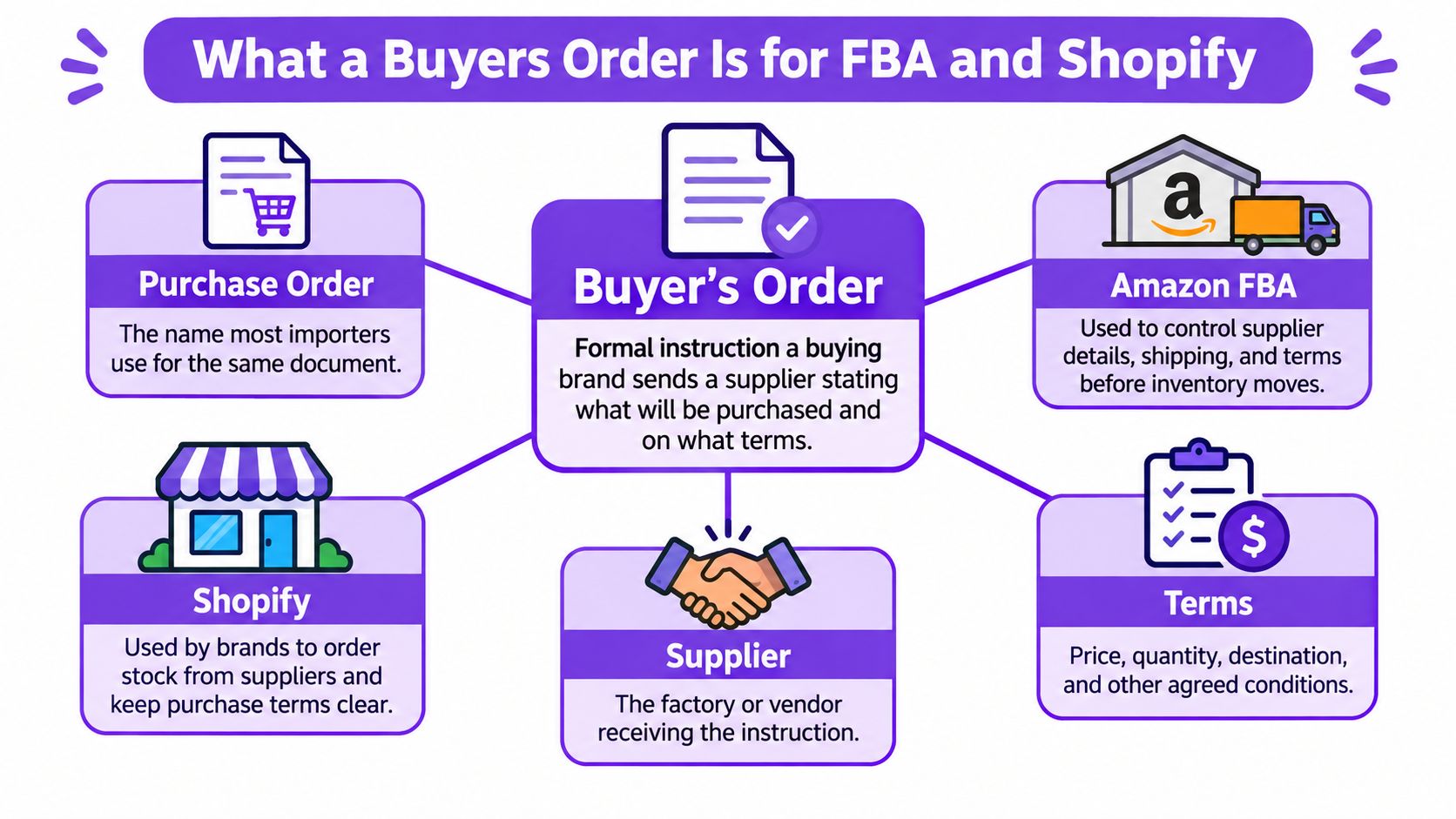
A usable ticket identifies the supplier, SKU or item, quantity, unit cost, total value, required ship date, destination, and approved commercial terms. It also covers delivery requirements, payment terms, and shipping instructions in one place. Later, receiving can match that file against the supplier confirmation, shipment, receipt, and invoice instead of rebuilding intent from messages.
- For Shopify: the order is the saved record exported for the factory before production starts.
- For Amazon FBA: it's the file that explains what an inbound shipment should contain when cartons reach prep or a warehouse.
- For ready-stock buying: even catalog purchases need that discipline, and ready-stock jewelry ordering guidance from HonHo Wholesale Jewelry shows how a supplier can set ordering steps clearly for repeat buyers.
In the United States, purchase orders sit within commercial contract law, including the Uniform Commercial Code, but binding effect turns on prior agreement and seller acceptance. Operationally, the rule is simpler. Any change to quantity, price, or delivery belongs on a revised order or written amendment, not in an unlogged message.
If nobody can point to one file and call it the deal, the factory will choose a file instead.
Buyers Orders Compared with Nearby Documents
Four documents travel with the same goods, and treating them as interchangeable creates payment and production errors. The table below separates who issues each one from the job it performs.
| Document | Who issues it | What it does | Usual legal role | How the seller uses it |
|---|---|---|---|---|
| Buyer's order (purchase order) | Buying brand | Names SKU, quantity, price, and dates | Offer until the supplier accepts | The file sent to the factory before production |
| Sales order | Supplier | Records the factory's commitment to fulfill | Supplier-side mirror of the accepted deal | Do not treat it as the brand's authorization |
| Pro forma invoice | Supplier | Previews price, currency, and a payment request | Usually a quote, not proof of shipment | Used to collect a deposit |
| Commercial invoice | Supplier | Bills the goods that actually shipped | Supports payment and customs entry | What customs and the books see at export |
| Quote or RFQ response | Supplier | States price and lead time before commitment | Not an order | Used to compare factories before a PO |
What each document can and cannot prove
A sales order can confirm that the factory entered the job, but it doesn't prove the brand approved its wording. Factories sometimes shorten specifications, convert currency, or substitute their own SKU on that mirror document. The buyer should compare it line by line, then keep the buyer's order as the authorization.
A pro forma invoice previews the expected charge so the brand can wire a deposit. It isn't evidence that goods shipped, passed inspection, or match the final carton count. Using a clean layout helps, and a proforma invoice template gives finance consistent fields for price, currency, and payment reference before money moves.
A commercial invoice belongs later in the chain. It bills what left the factory and supports customs entry and accounts payable. A quote sits at the opposite end. It helps compare factories on price and lead time, but nobody has committed to produce anything yet.
- Production follows: the accepted buyer's order.
- Deposit follows: the pro forma invoice checked against that order.
- Balance follows: the commercial invoice checked against shipment and receipt evidence.
Operating rule: Production starts from the buyer's order after supplier acceptance, the deposit can follow a pro forma, and the balance waits for the commercial invoice.
Confusing those roles has a predictable cost. A team pays a deposit from a quote with no ship date, accepts a sales order with a changed pack count, or books FBA freight from a pro forma quantity that production later cuts. Each document is useful. None should borrow another document's authority.
Fields That Keep the Factory on One Spec
A coordinator needs fields that stop a quiet change from reaching production. The University of Pennsylvania purchase order terms treat a purchase order as a controlled purchasing authorization, and they commonly treat written acknowledgment, shipment, or commencement of work as acceptance. Those terms also support excluding conflicting supplier terms unless the buyer expressly agrees in writing.
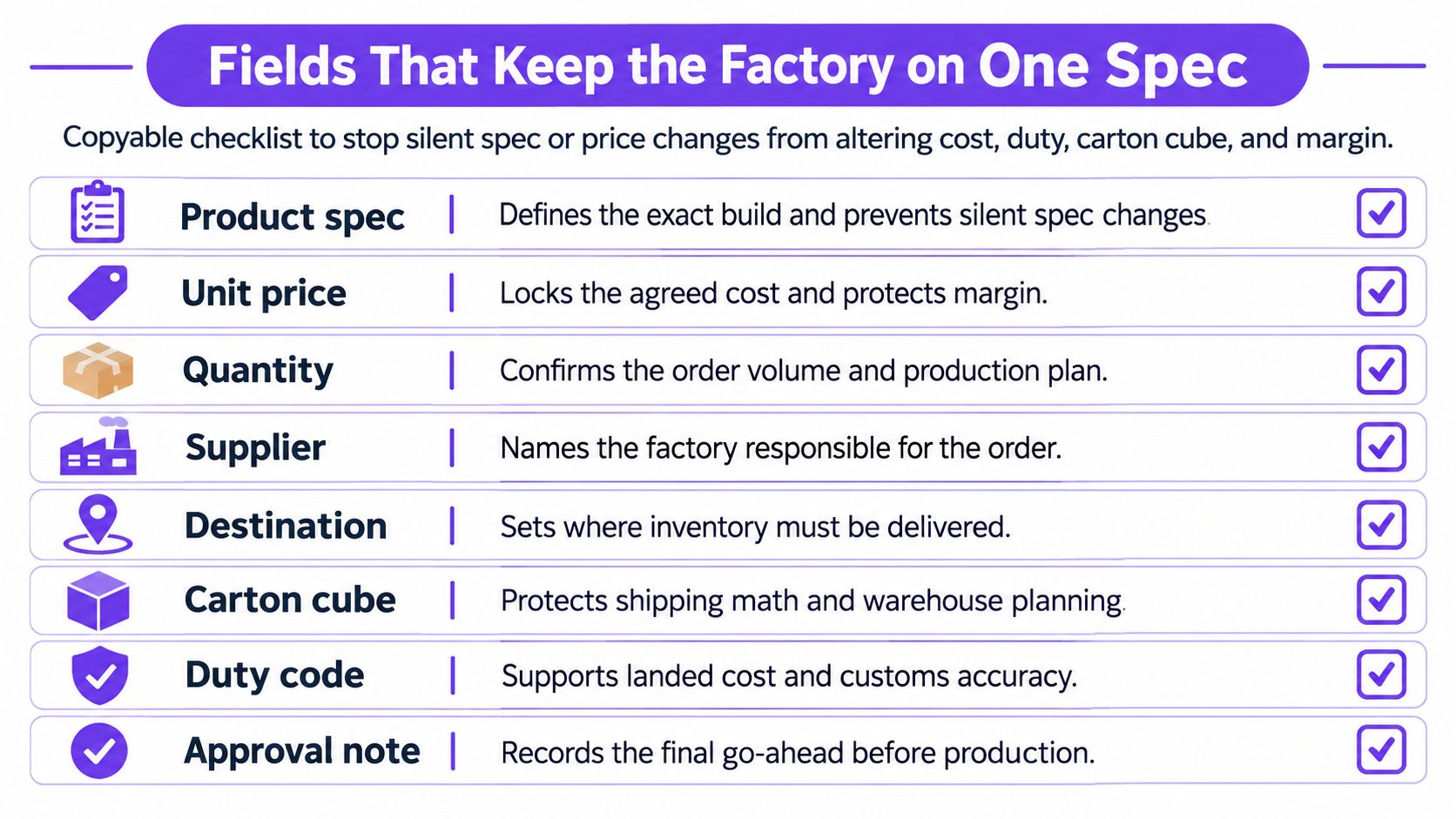
Required buyer's order fields
| Field | Why it matters | Private-label example |
|---|---|---|
| Unique order number | Every receipt and invoice cites one reference | One number per revision |
| Legal names of buyer and supplier | Identifies the parties bound by the order | Registered company names, not trade nicknames |
| SKU and version | Ties production to one revision | SKU plus revision letter |
| Specification and approved sample | Defines what the factory builds | Gold sample controls color |
| Quantity and tolerance | Defines what a shortage or overrun looks like | 500 units with agreed variance |
| Unit price and currency | Keeps product price separate from freight and duty | USD unit cost |
| Packaging and carton count | Feeds freight cube and receiving counts | Carton count per master case |
| Delivery term and Incoterm | Shows who pays freight and carries risk | FOB Ningbo |
| Requested ship date | Starts the production and inbound clock | Ship-by date |
| Inspection rights | Lets the buyer reject before shipment | Pre-shipment inspection right |
| Payment milestones | Ties deposits and balance to events | Deposit on order, balance after inspection |
Say a Shopify line reads 500 units, USD unit cost, FOB Ningbo, with a ship-by date and the note that the approved gold sample controls color. That one line links costing, freight responsibility, timing, and the physical standard. Remove the sample note, and a slightly different dye lot becomes an argument about taste rather than a failed requirement.
Version details deserve the same care because a revised quantity or specification can change production cost, duty exposure, freight cube, and expected margin. The order should also state which attachment controls if the order, tech pack, and supplier acknowledgment disagree. A standard purchase order template helps a coordinator keep those fields in the same place on every factory order.
Copyable pre-production check
- Order identity: unique number, revision, and legal buyer and supplier names appear.
- Build standard: SKU, version, specification, tolerances, packaging, and controlling sample are named.
- Commercial terms: quantity, unit price, currency, Incoterm, ship date, inspection right, and milestones are complete.
- Acknowledgment: every field appears on, or is expressly accepted in, the supplier acknowledgment.
Production shouldn't start until that acknowledgment comes back clean. Silence isn't confirmation that the factory read page two.
Shopify and Amazon FBA Order Examples
The layout below shows the two records side by side before the worked examples separate their workflows.
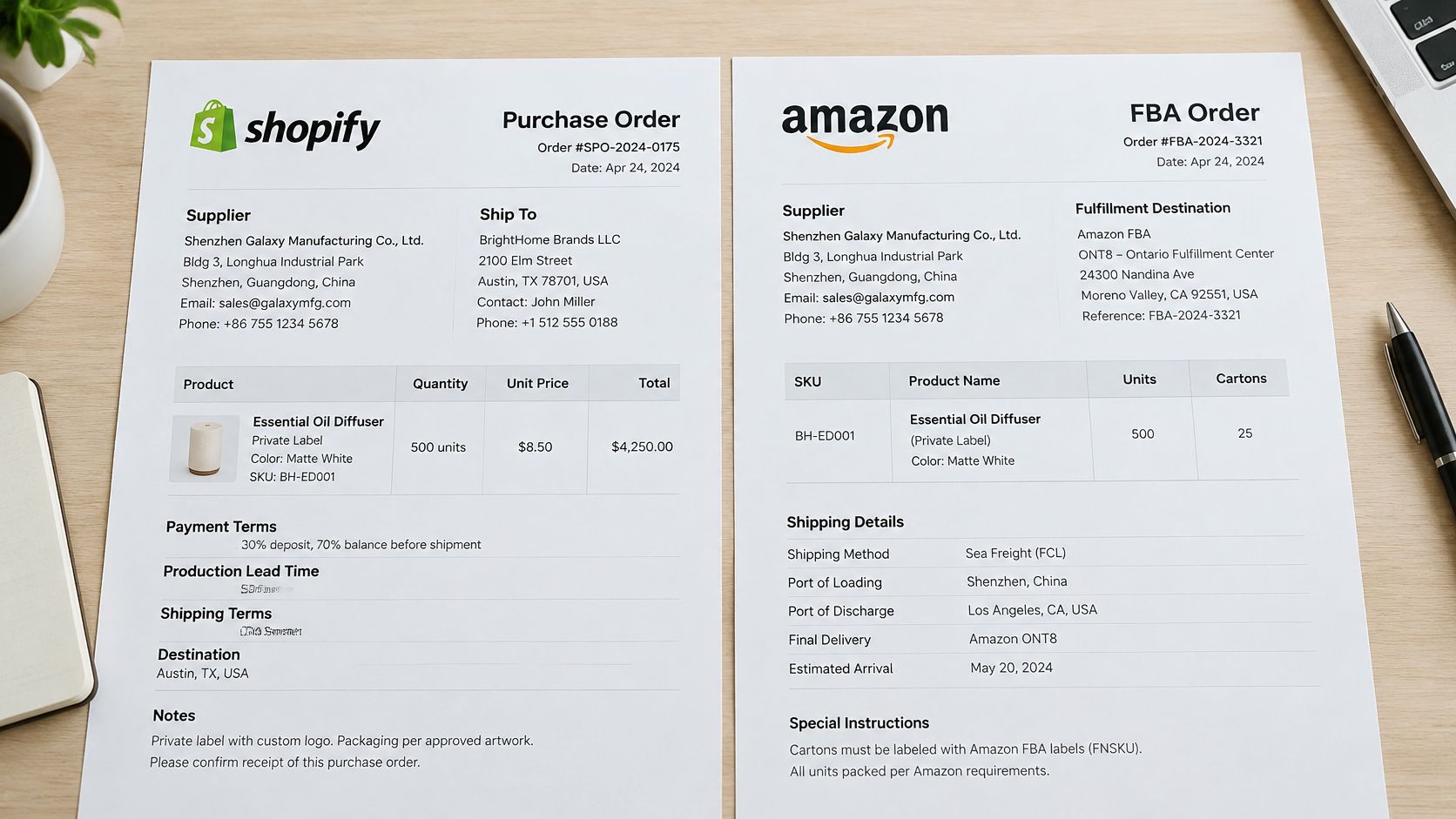
Shopify example with 500 private-label units
A Shopify brand orders 500 private-label units for its own warehouse. According to Shopify's purchase order creation guide, the workflow requires the supplier and destination location, plus the products, quantities, costs, payment terms, and supplier details. The seller saves a draft, exports a PDF for supplier review, and marks it Ordered only after the supplier confirms the details.
That sequence matters. The draft is internal preparation, the exported PDF is the instruction under review, and Ordered records the confirmed state. The brand documents the supplier SKU, agreed unit cost, payment terms, and receiving location before the factory starts, rather than reconstructing them from email or messaging threads.
Payment setup needs separate attention. Shopify's supplier management documentation records payment terms on the individual PO rather than treating them as universal supplier defaults, with examples including cash on delivery, payment on receipt, and Net 30. Shipping, fees, or duties can be recorded as adjustments, but payment itself happens outside Shopify using the method agreed with the supplier.
Amazon FBA example with 2,000 units
The short walkthrough below shows how the confirmation step fits between issuing an order and relying on it for inbound planning.
An FBA seller orders 2,000 units at Net 30 from an overseas factory. The order states the exact SKU, agreed price, expected delivery date, and payment terms, then the seller retains the factory confirmation. Shopify's procurement guidance recommends transmitting the PO electronically for an audit trail and requesting supplier acknowledgment, using a 24-hour acknowledgment target in its example workflow.
If the factory can't meet quantity or lead time, that discrepancy gets settled before production or shipment. Otherwise the seller may book prep, freight, and an inbound plan around an unconfirmed quote. The supplier can approve the order, reject it, or flag the exact lines it can't meet.
Accepted looks different by channel, but the evidence is equivalent. Shopify shows a confirmed PDF marked Ordered. The FBA file holds a retained factory confirmation against the numbered order. In both cases, the next coordinator can see what was requested and what the supplier accepted without opening a personal inbox.
When the Order Actually Becomes Binding
Sending a tidy PDF doesn't, by itself, create a contract. A buyer's order may begin as an offer and become binding when the supplier signs it, acknowledges it, or fulfills it. The pdfFiller purchase order guide notes that legal effect depends on the wording, acceptance method, and conduct of both parties, while quotations, pro forma invoices, email confirmations, and conflicting terms may affect the final agreement.
Enforceable is not the same as controlled
An order can be enforceable and still put the wrong goods into production. Legal staff may later prove which terms governed, but that doesn't help when the factory has already cut material from an older specification. Operational control requires the current version to be the one on the production floor, with its revision visible to everyone using it.
The order should therefore state whether it's an offer to buy or an acceptance of the supplier's offer. It should also carry a version number, revision date, product specification, approved samples, Incoterm, delivery window, tolerances, inspection rights, tooling ownership, defect remedies, and a clear written amendment process.
- Written acknowledgment: the clearest acceptance artifact.
- Shipment or start of work: conduct that institutional terms may treat as acceptance.
- Conflicting supplier terms: excluded unless the buyer expressly agrees in writing.
- Chat approval: weak evidence when it doesn't identify the version being approved.
One 12-day change, handled properly
Say the factory moves the ship date by 12 days and raises the unit price after the first order is issued. Someone replies "fine" in a messaging app, but production, finance, and freight still hold the original PDF. The governing file shouldn't be that first PDF or the casual chat. It's the revised order both sides acknowledged, carrying the new version number, revision date, price, and ship window.
That revision also protects the payment conversation. A deposit schedule tied to production or shipment can shift when dates move, which is why the amendment should restate the milestone rather than leave the old one attached. The trade-offs behind common split terms are covered in the guide to 30/70 payment terms with Chinese suppliers, but the accepted order revision remains the artifact that shows which schedule applies.
The question isn't only whether an order binds. It's whether the evidence proves which version the factory agreed to build.
Match the Order Before You Pay
After issue, the buyer's order becomes the baseline for receiving, payment, and landed cost. Three records do different jobs, and payment should wait until they agree.
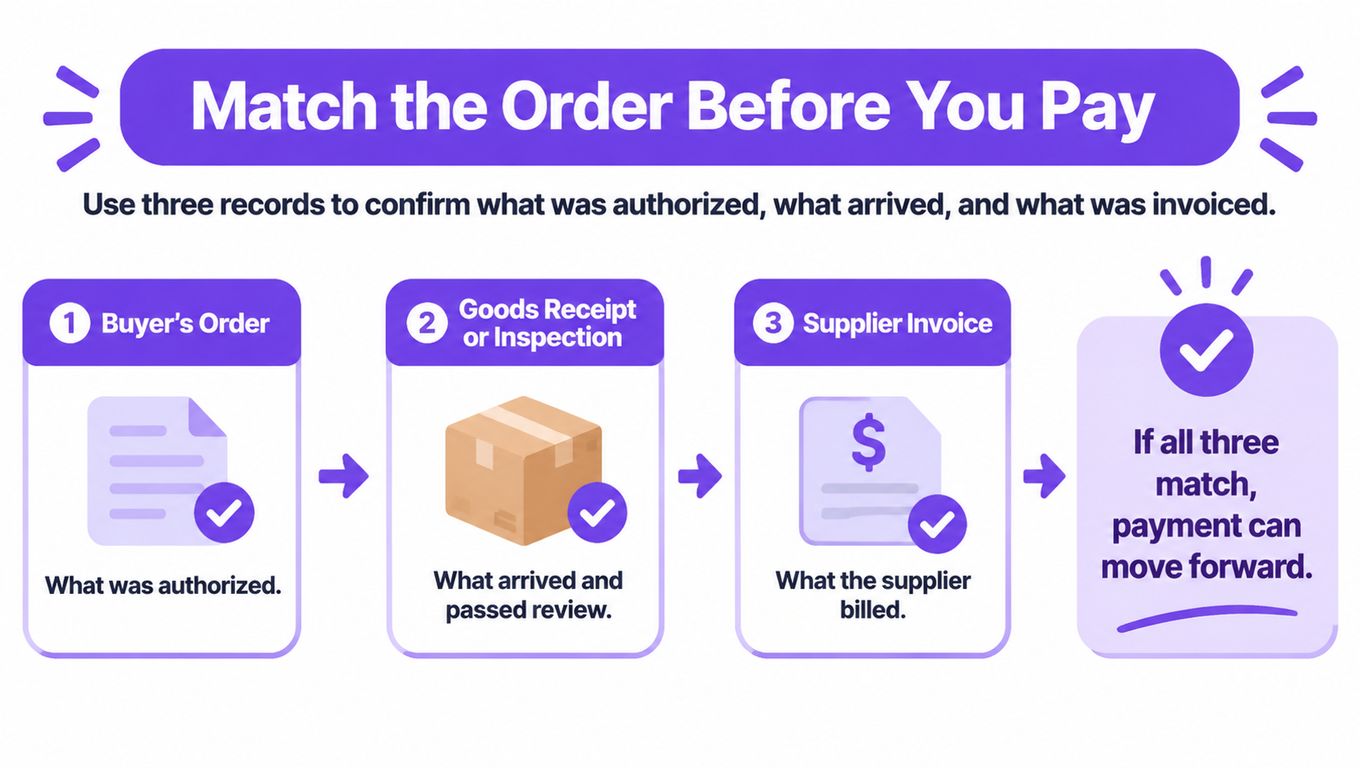
The three records
- Buyer's order: what the brand authorized, at the approved revision.
- Goods receipt or inspection record: what arrived and passed acceptance.
- Supplier invoice: what the supplier billed.
Match SKU, quantity, price, currency, tax, freight, and approved changes before releasing payment. The need isn't theoretical. A PandaDoc comparison of buyer's orders and bills of sale cites a 2025 industry analysis reporting that nearly four in ten invoices contained issues such as incorrect amounts, missing information, or purchase-order mismatches.
Receipt isn't necessarily acceptance. Cartons can arrive while inspection, testing, or intact-delivery requirements remain open. For categories where finish, materials, or workmanship drive returns, buyers can verify wholesale jewelry quality through JewelryBuyDirect's guidance before treating delivered stock as accepted stock.
What should block or route an invoice
- Quantity billed above the order: route it instead of paying the excess automatically.
- Unit price differs from the approved revision: stop until the governing version is identified.
- Cartons or SKUs missing: match the receipt before finance relies on the invoice.
- Inspection unresolved: don't convert physical receipt into acceptance by paying early.
Keep the supplier's product price separate from estimated freight, duty, insurance, and other fees. The order should preserve currency, tax treatment, Incoterm, freight responsibility, customs classification, duty assumptions, payment milestones, carton counts, and acceptable variance thresholds. That separation keeps an FBA SKU's margin visible when freight or tariffs move after production.
When a tariff, freight rate, or quantity changes, revise the order and keep the original approval trail. Overwriting the first file destroys the evidence finance needs later. A practical walkthrough on how to reconcile a supplier invoice to a purchase order shows how those comparisons work line by line.
A complete buyer's order isn't the longest one. It's the one that preserves commercial, logistics, and accounting evidence through fulfillment.
Run the Next Order on One Record
The next factory order should start on one record, not in five places. In Supply Automate, each purchase order holds the supplier, SKUs, quantities, prices, dates, and documents on a single record. That structure gives operations and finance the same file from quote through shipment.
Five dated stages
- Quoted: supplier price and lead time are written against the order number.
- Deposit paid: the pro forma is matched and the payment is logged.
- In production: the factory acknowledges the current version.
- Ready: inspection passes and cartons are counted.
- Shipped: carrier and tracking reference are attached.
Every purchase order moves through quoted, deposit, production, ready, and shipped stages, with dates attached. Those dates stop an Amazon inbound appointment or a Shopify receiving location from being rebuilt from memory. They also show a 3PL when cartons should exist, not merely when someone hopes production will finish.
Supplier access matters as much as the stage labels. Suppliers who communicate only over WeChat can be invited to a purchase order to share updates and documents directly. Supplier messages then stay on the order thread, so the next coordinator can continue without searching a personal inbox or asking the factory to resend files.
A team that still runs orders in spreadsheets can start smaller. A free purchase-order template standardizes the first file, and a purchase order tracking template adds the stage dates that a 3PL and finance will check against. The practical move is modest but strict. Issue one numbered order, get acknowledgment, revise it in the open, and let every later document cite that record.
Put the next buyer's order on one dated record that holds the supplier, SKUs, prices, documents, messages, and shipment stages from quote to delivery. Supply Automate gives FBA and Shopify teams that shared purchase-order workspace, including a way to invite WeChat-only factories onto the order itself. Visit Supply Automate to run the next factory order without rebuilding it from scattered chats and spreadsheets.