The popular advice is simple: take the cheaper ocean quote. That advice fails for Amazon FBA and Shopify sellers because the ocean rate is only one line in the landed cost per unit. A low LCL rate can arrive with destination warehouse fees and weeks of waiting, while a higher FCL rate can spread a fixed container price across enough units to win. A proper landed cost calculator tests both modes on the same sellable unit, not on the freight invoice alone.
LCL vs FCL at a Glance
The direct answer is volume driven. LCL (less than container load) usually gives the lower landed cost per unit for shipments under about 15 CBM, while FCL (full container load) usually wins from about 15 CBM upward when a 20ft container, about 28 CBM, or a 40ft container, about 58 CBM, is filled at a fixed rate.
That's a starting point, not a booking rule. The winner is decided by total landed cost per unit, not by the ocean quote alone, so a cheaper LCL rate can lose once destination fees, waiting time and storage are added.
LCL and FCL compared on the criteria that change landed cost
| Criteria | LCL (less than container load) | FCL (full container load) |
|---|---|---|
| Best-fit volume | Under about 15 CBM, pallets or partial cartons | About 15 CBM upward, 20ft at about 28 CBM or 40ft at about 58 CBM |
| Billing unit | Per CBM or per tonne, whichever is greater | Per container (20ft, 40ft or 40ft high cube) |
| Typical transit | Often 1-3 weeks longer on the same lane due to consolidation | Shorter, with a direct container movement |
| Handling | Shared warehouse at origin and destination, more touchpoints | Sealed container, loaded and unloaded once |
| Cost sensitivity | Minimum charges and per-CBM rates; a small misfit raises cost | Fixed container price; unused space is wasted cost |
| Shipper mix | Goods from several shippers can share one load | One shipper's goods in the container |
Three variables drive every comparison that follows. Cargo volume sets the billing math, handling touchpoints add fees and risk, and the cost of waiting for consolidation ties up cash before stock can sell.
Amazon FBA and Shopify sellers should compare both modes on the same per-unit basis. The examples that follow use a 500-unit restock and a 6 CBM quarterly load to keep that comparison concrete.
What Each Mode Adds to Your Landed Cost
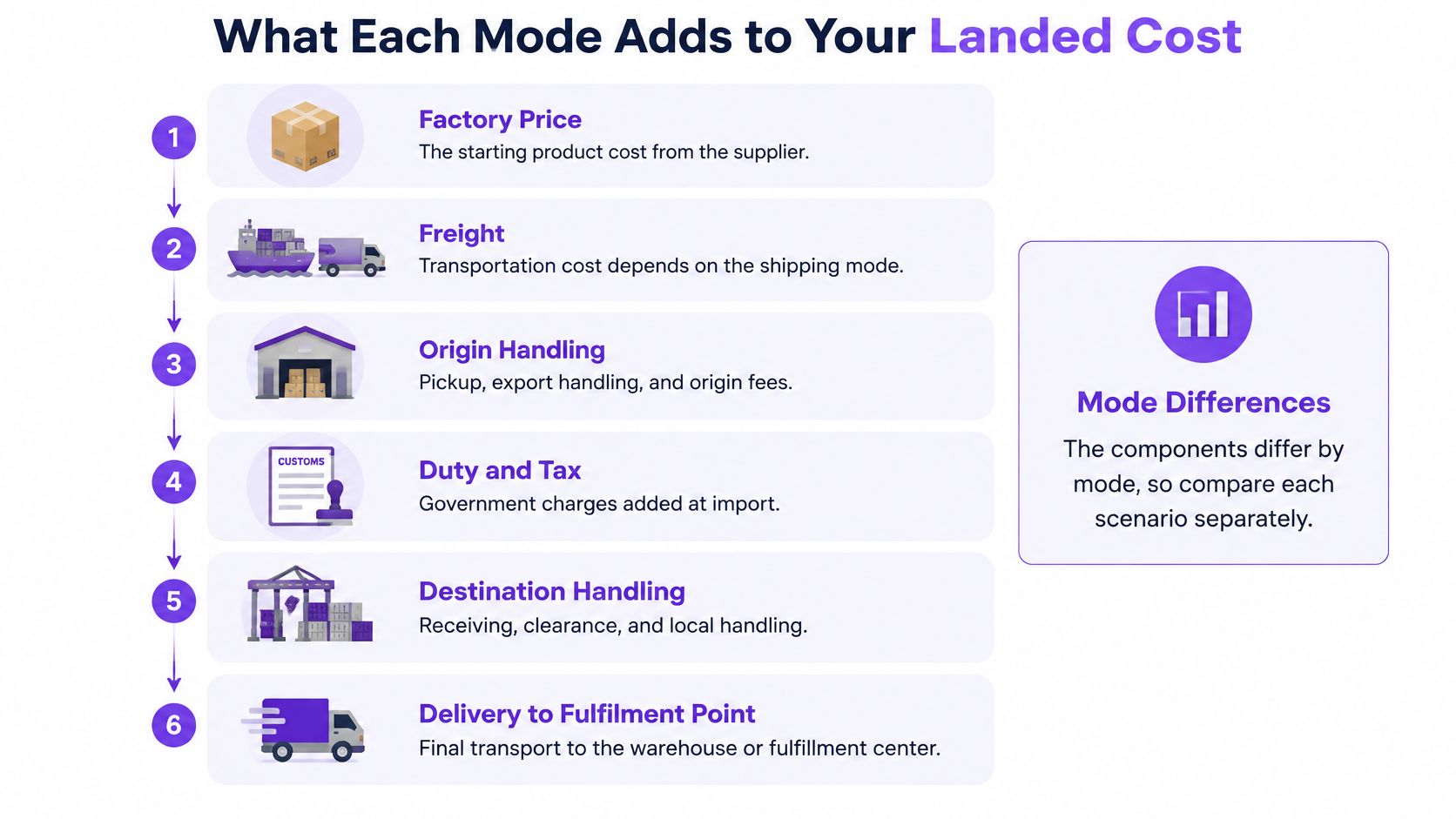
A landed cost calculator is a total-cost model. It combines the supplier price with transportation, insurance, customs duties, taxes, clearance charges and other logistics fees, because the World Bank analysis of Central American trade found overall logistics costs could exceed 50% of the final price of traded goods, with customs-related costs at approximately 10% and duties at around 5%.
The diagram below breaks that total into the layers a seller has to enter separately.
The Five Charges That Differ by Mode
- Ocean freight: LCL charges per CBM or per tonne with a minimum. FCL charges a flat container rate.
- Origin handling: LCL adds consolidation fees per CBM or per shipment. FCL adds one terminal charge per container.
- Destination handling: LCL pays deconsolidation and warehouse fees per shipment. FCL usually pays none at that stage because the container moves as one unit.
- Duty and tax: Both modes follow HS code, origin and customs value, so this layer doesn't change with mode.
- Delivery to fulfilment: LCL is billed per shipment and FCL per container, sometimes split by pallet onward to Amazon or a Shopify warehouse.
Duty sits apart from freight. U.S. Customs and Border Protection guidance in CBP customs valuation guidance states duty is generally assessed on the price paid for the goods, excluding freight and insurance, unless a tariff uses another basis such as quantity or volume. Freight still belongs in landed cost, it just doesn't belong in the duty base.
Allocation turns shipment charges into a unit decision, and sellers splitting a mixed load can follow the method for how to allocate freight cost across multiple SKUs. For example, a 200-unit LCL shipment of 1 CBM with $300 of freight and destination fees adds $1.50 per unit.
Landed cost combines factory price, freight, duty and other import costs into one per-unit number that's recalculated as each bill arrives. Sellers funding that gap between supplier payment and sale can explore import funding with Zaro before committing to the larger mode.
Practical rule: Per-shipment charges must be spread across units or CBM before LCL and FCL can be compared at all.
Duty, De Minimis and Low-Value Entry Traps
A single duty percentage hides where low-value imports now lose money. The calculator needs the SKU, tariff line and fulfilment path as separate inputs, because entry structure can cost more than the tariff rate itself.
When Exempt Parcels Start Paying Entry Costs
The U.S. de minimis exemption was suspended for China and Hong Kong in May 2025 and expanded to other countries later in 2025, as set out in the Atomix Logistics landed cost guide for 2026. The same guide notes the EU ended its €150 duty exemption on July 1, 2026, and EU guidance indicates the new €3 charge for low-value B2C imports can apply per line of the customs declaration.
That per-line detail changes mixed-cart math. A parcel with several HS classifications can attract several charges, so a cheaper unit price from a split shipment may create more tariff lines and brokerage events than a consolidated load.
Low-value shipments that previously entered duty-free now require formal or informal entry and may incur brokerage or per-shipment charges, according to Saltbox coverage of the end of de minimis. A $600 shipment at a 7.5% HTS rate would owe $45 in duty, while a 25% classification would owe $150, before brokerage and other entry costs.
The useful question isn't only what's the duty. It's at what order value, shipment frequency or fulfilment model direct importing stops being cheaper than consolidating inventory or holding regional stock.
The China-Origin Layer Sellers Miss
Section 301 adds a separate check. The USITC Section 301 China tariffs reference says a product is subject to an additional duty when its eight-digit HTS subheading appears on the China-tariff list and the product is of Chinese origin. On a $20,000 customs value at an additional 25% rate, that component alone is $5,000, before ordinary duty or freight.
Sellers sourcing from China should verify classification and origin through a dedicated workflow to calculate import duty from China rather than trusting a supplier's product name. The calculator inputs that prevent surprises are HS code and origin for each line, entry type, and per-line or per-entry fees.
Where LCL and FCL Break Even on Cost
Break-even depends on the lane, carrier rates and minimum charges. The bands below are rules of thumb to test with live quotes, not fixed rules, and the free Landed Cost Calculator calculates the true cost per unit before the user places an order.
The chart image below shows how operators typically plot that crossover before booking.
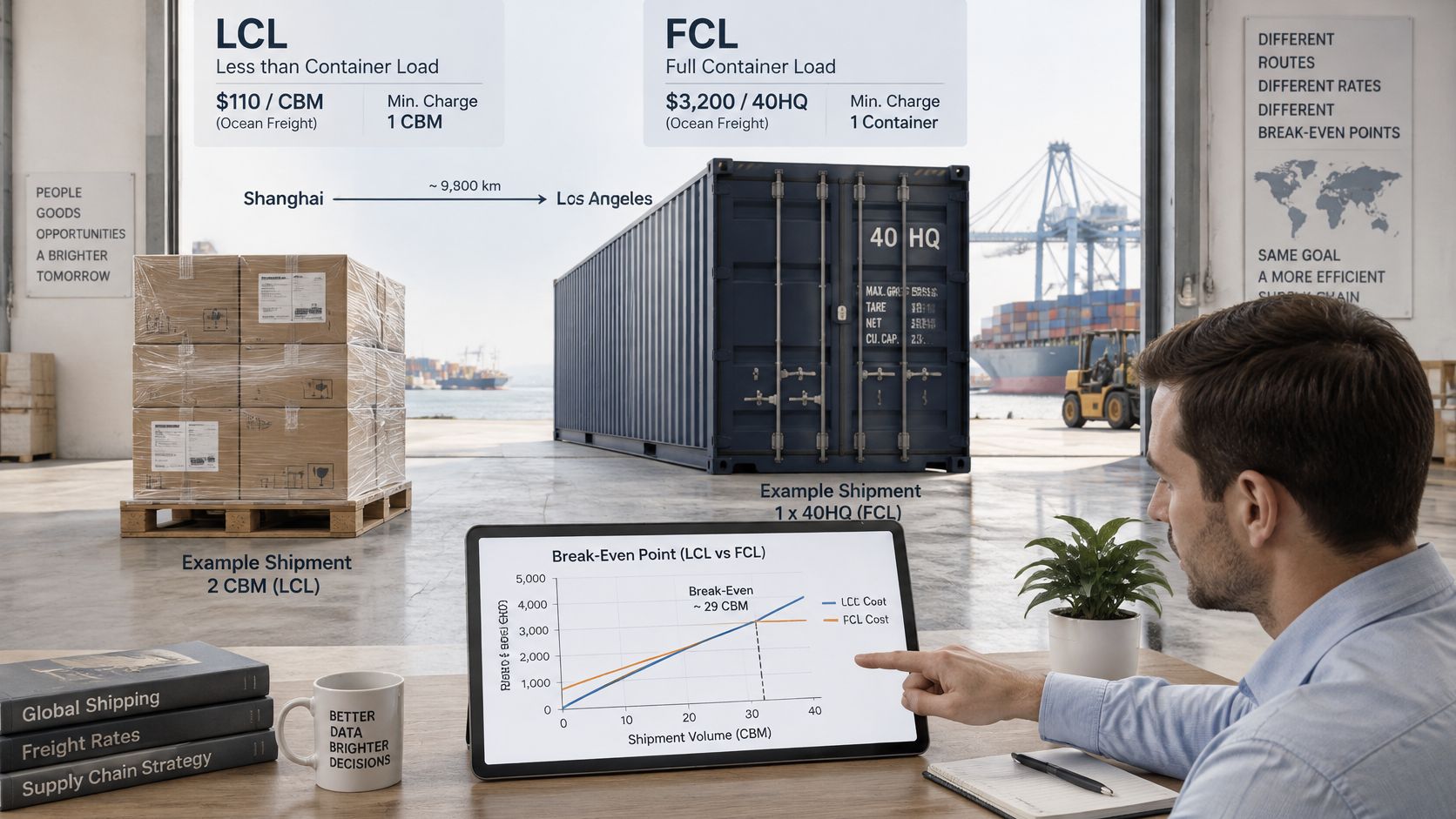
Rule-of-thumb mode choice by cargo volume
| Cargo volume | Usually cheaper | Why | Check before booking |
|---|---|---|---|
| Under 3 CBM | LCL | An FCL container would be mostly empty | LCL minimum charge and CFS fees |
| 3-10 CBM | LCL in most lanes | Per-CBM rate stays below container cost | Destination deconsolidation fee |
| 10-15 CBM | Compare both quotes | Break-even moves with the lane and rate | Total per unit under each mode |
| 15-25 CBM | FCL 20ft in most cases | Container cost spread across more CBM | Unused space in the 20ft container |
| Over 25 CBM | FCL 20ft or 40ft | Lower per-unit container cost at volume | Container size and loading plan |
A 500-Unit Example in Real Money
International pricing has to count more than the supplier quotation. Shopify international shipping guidance identifies packaging, carrier charges, handling, duties, taxes and profit margin as components businesses may need to account for when setting an international price.
Say an Amazon FBA seller orders 500 units at a $12 product cost per unit. Merchandise value is $6,000, and if freight and handling total $1,500, the shipment adds $3 per unit before duty and tax, giving $15 per unit before other charges. A calculator reporting only $12 understates the inventory basis from the start.
Run the same 500 units as LCL with a higher destination fee and the gap appears quickly. If LCL freight looks cheaper by shipment but adds extra CFS and warehouse charges per shipment, those charges still divide across the same 500 units, and the per-unit total can pass the FCL figure.
Sellers comparing quotes can shortlist tools from the roundup of the best sea freight rate calculators for e-commerce importers, then feed the winning landed cost into pricing. Once the unit cost is known, a break-even ROAS calculator helps test how much ad spend that margin can support.
The short video below walks through comparing two freight scenarios side by side.
Run both quotes through the same calculator, using the same units, so the per-unit numbers can be compared directly.
That single discipline removes most bad bookings. Different unit counts, different carton assumptions or a missing destination fee in one scenario will manufacture a winner that doesn't exist.
Transit Time, Handling and Damage Risk Compared
The cheapest ocean rate isn't always the cheapest landed unit. Time and handling convert a low per-CBM quote into storage, stockouts and replacement cartons if the route adds enough touchpoints.
What LCL Handling Really Adds
LCL cargo waits at origin until enough freight fills a consolidation, then waits again at destination while the container is unpacked and sorted. That process adds one to three weeks on many lanes, and each extra touchpoint raises the chance of damage, short shipment or lost cartons.
Palletising and labelling cartons clearly helps the destination warehouse verify counts quickly. Loose, mixed cartons in a shared warehouse are the format most likely to be miscounted or separated from their paperwork.
Sellers reducing that exposure can work through practical steps on how to reduce shipping costs without chasing a lower headline rate. Insurance terms also matter on shared loads, so it's worth taking time to understand cargo transit limits and exclusions before assuming a claim will cover a consolidation delay.
What FCL Handling Avoids, and What It Risks
An FCL container is sealed at loading and opened at unloading. Fewer hands touch the goods, counts stay intact more often, and the container can move directly to drayage once cleared.
The risk shifts to time at the terminal. A late pickup or slow customs clearance can trigger demurrage and detention charges, and a calculator must carry those as a separate line rather than burying them in freight.
- LCL risk concentrates in handling: More sorting and shared storage raise damage and loss exposure.
- FCL risk concentrates in turnaround: Missed free days turn a sealed container into daily charges.
- Both modes carry delay cost: Stock can't sell while it sits at a CFS warehouse or terminal.
Turning Days Into Dollars
Inventory valued at landed cost ties up cash while it waits. A three-week delay on 500 units at $15 each means about $7,500 of stock sitting idle, before storage or lost sales enter the picture.
Costing rule: Add transit days as a cost input, so the cheaper per-CBM rate is only chosen when the time saving is worth less than the difference in landed cost.
For a fast-moving FBA SKU, arriving late can also mean paying for air freight on a top-up order. For a slow Shopify line with buffer stock, the same delay may cost almost nothing, which is why the calculator needs the seller's stock position, not just the carrier's schedule.
Which Mode Fits Amazon FBA and Shopify Shipments
The cheapest freight rate stops being cheap the moment storage, fees and waiting time reach the per-unit figure. Mode choice changes with restock rhythm, sales channel, and who pays duty, and three common batches show where the decision flips.
Case 1 Amazon FBA Quarterly Restock at 6 CBM
An Amazon FBA seller restocking 6 CBM of small standard-size products every quarter has no business booking a 20ft container. LCL suits a single quarterly load at that volume, because the per-CBM rate usually beats paying for unused container space.
The fulfilment side still belongs in the SKU margin. Amazon's 2026 U.S. fee update in Amazon Seller Central fee update guidance states FBA fees increased by an average of $0.08 per unit sold, with most changes effective January 15, 2026. Small standard-size products priced from $10 to $50 saw an average fulfilment-fee increase of $0.25 per unit, so 1,000 units add $250 in fulfilment expense.
Storage costs build up while stock waits in Amazon's warehouses, and a quarterly LCL load that lands weeks ahead of demand keeps paying that rate until the units sell. Check the current AWD or FBA storage rate card for your region before pricing the restock, and add Amazon FBA shipment costs to landed cost rather than burying those charges in overhead.
The figure that flips this case is quarterly volume. If the restock grows toward the compare-both band, FCL spreads the fee increases and storage exposure across a denser load.
Case 2 Shopify DDP Restock at 25 CBM
A Shopify brand shipping about 25 CBM per restock on a DDP basis gets more from a sealed container. FCL 20ft is usually cheaper per unit at that volume, and delivery planning compresses into one warehouse appointment.
DDP forces the duty question early. Duty and tax must be calculated before the delivered price is set, because the merchant, not the customer, carries those charges at the border. A low ocean rate quoted on a DDP batch that ignores duty layers is a landed cost that hasn't been finished yet.
The figure that flips this case is unused container space. If demand drops and the 25 CBM load becomes a half-empty container, the fixed rate stops helping and the per-unit figure climbs back toward LCL territory.
Case 3 Shopify Seasonal Test Batch at 2 CBM
A Shopify seller testing a seasonal product with a 2 CBM batch should stay on LCL. Cash risk stays low, nothing goes toward empty container space, and leftover stock is capped if the product misses.
The trade-off is the calendar. A test batch that arrives late in a short season can miss its selling window even though the freight bill was small, so the cheaper rate only wins if the consolidation schedule still lands the goods before demand peaks.
The figure that flips this case is sell-through speed. A proven seller that reorders immediately may justify consolidating the next batch upward instead of repeating small LCL shipments.
How to Run Both Scenarios in a Landed Cost Calculator
Both scenarios only compare fairly when every input matches except the mode. The steps below keep the units constant and force the commonly missed charges into the open.
The process flow below summarises the sequence before the detailed steps.
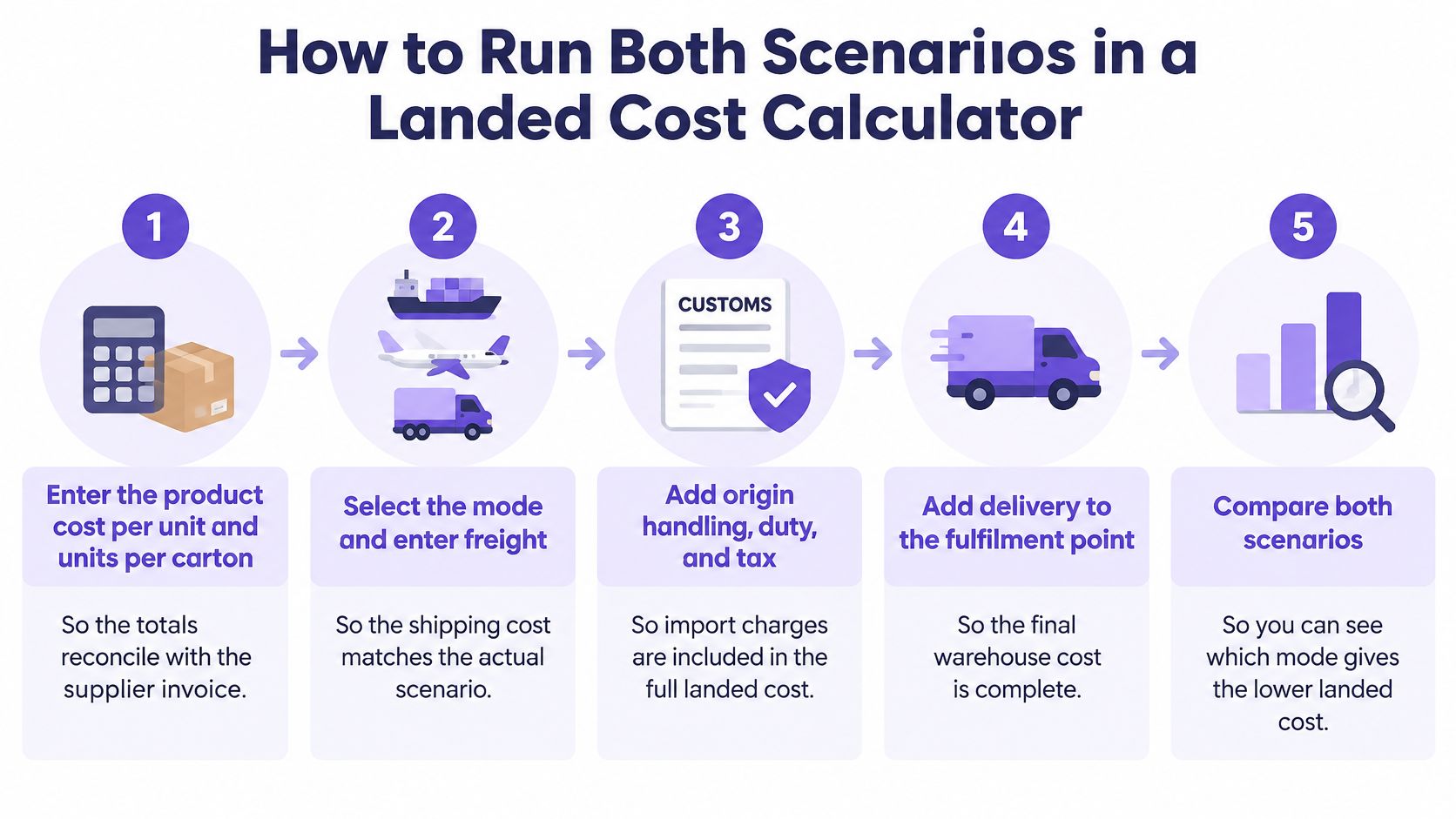
The Eight-Step Run
- Enter product cost per unit and units per carton. Totals must reconcile with the supplier invoice, or every later allocation inherits the error.
- Select the mode and enter CBM for LCL or container type for FCL. The billing unit differs, so the freight field has to follow the mode.
- Enter origin charges. LCL needs consolidation fees, FCL needs the terminal charge, and both belong before the ocean leg is judged.
- Enter destination charges such as CFS, deconsolidation, drayage and warehouse delivery. These are the charges sellers most often miss, and they're where LCL quotes tend to creep upward.
- Enter the HS code and country of origin. Duty follows classification and origin, and China-origin goods may carry additional duties.
- Set the Incoterm or DDP and DDU treatment. Record whether the customer or merchant pays import charges on arrival.
- Add insurance and clearance fees, then allocate the total by units or CBM. Allocation converts a shipment bill into a priceable unit cost.
- Run the same units through both modes and compare per-unit totals. Book only after both scenarios carry identical quantities and duty assumptions.
Shopify Checkout Settings to Record
Checkout treatment changes who feels the duty cost. Shopify duties and import taxes guidance states Shopify's checkout collection feature requires valid HS codes on products and a carrier that supports Delivered Duty Paid labels when the merchant uses shipping labels, otherwise a third-party app may be needed. Shopify also reports its transaction fee for calculating duties and import taxes was temporarily lowered to 0.5% effective February 2, 2025.
A seller shouldn't present one shipping number if the customer pays import charges separately. The calculator should show whether duty and tax sit inside the delivered price or remain payable on arrival.
"Check the lane settings before trusting either total."
Import country, currency and duty defaults are set in settings, and landed-cost, duty and freight calculations follow that lane. The Import Duty Calculator uses the live HTS rate plus CBP fees, before a purchase order is placed, so outdated defaults are a self-inflicted error.
Choose the Mode Before You Book the Space
Verdict by volume: use the band that matches the cargo volume, and run both quotes whenever that band says compare. Booking space before that check locks in the wrong cost structure for the whole shipment.
Pre-Booking Checks in Order
- Confirm the supplier invoice total matches its own line items. A mismatch changes landed cost before freight is added, and Supply Automate landed cost flags a supplier invoice whose total disagrees with its own lines.
- Confirm HS code and origin before quoting duty. A wrong classification changes duty and any additional China-origin rate.
- Confirm destination charges are quoted, not assumed. CFS, deconsolidation, drayage and warehouse delivery decide many close comparisons.
- For FCL, check unused space against the reorder cycle. Empty container space is still paid for, even when the rate looked competitive.
- For LCL, check the minimum charge and extra transit days. Price the cash tied up while stock waits for consolidation and deconsolidation.
The first estimate shouldn't be the final number. Because landed cost recalculates as each bill arrives, the pre-booking figure should be replaced once freight, clearance and delivery invoices land.
SupplyAutomate offers free tools including a purchase order creator, landed cost calculator, Amazon profit calculator, import duty calculator, freight cost estimator, MOQ calculator, lead time calculator and dropshipping profit calculator. Those tools cover the checks listed above without rebuilding the comparison in a spreadsheet each time.
The action is singular. Enter both quotes and the actual invoice into the landed cost calculator, compare the per-unit results, and book the mode with the lower landed cost per sellable unit.
Supply Automate gives Amazon FBA and Shopify sellers a free landed cost calculator alongside purchase order, duty, freight and profit tools, so LCL and FCL quotes can be compared per sellable unit before space is booked. Run the next restock through both modes with the invoice, HS codes and destination charges included. Start that comparison today at Supply Automate .