The factory wants a deposit, the Amazon FBA replenishment date is getting close, and the quote looks acceptable. Then the supplier adds a freight surcharge, asks to substitute a material, or sends an invoice with different payment terms. For a Shopify brand or marketplace seller, the immediate problem isn't paperwork. It's deciding whether to pay, refuse the change, or move the order without losing the deposit.
Purchase order terms and conditions put those decisions into writing before cash leaves the business. The useful clauses connect a commercial promise to evidence, an approval owner, and a remedy. A detailed PO won't prevent every disruption, but it gives the buyer a better position than a price list and a scattered message history.
The Core Clauses Every Purchase Order Needs
Purchase order terms and conditions are the rules that turn an accepted quote into an enforceable deal, covering what's bought, what it costs, when it ships, how it's paid for, and what happens when something goes wrong.
For an importer, the purchase order should work as both a contract record and an operating instruction. The supplier needs to know what to manufacture; the warehouse needs to know what to accept; finance needs to know what releases payment. Each team should be working from the same approved version.
Core purchase order clauses and what each must state
The following entries are illustrative negotiated terms, not statutory deadlines or universal industry defaults.
| Clause | What It Must State | Example Entry |
|---|---|---|
| Parties and product specification | Legal names, SKU, materials, dimensions, certifications | Buyer and seller legal entities; SKU TOTE-BLK; approved fabric, dimension drawing, and required compliance documents attached |
| Quantity and tolerance | Units ordered and allowed over or under shipment | 2,000 units, shipment tolerance of plus or minus 3% |
| Unit price and currency | Price per unit, currency and what it excludes | USD 4.85 per unit, excluding freight and duty |
| Payment terms | Amounts, due dates, method and deposit | 30% deposit by bank transfer after acceptance; balance after approved inspection and before release |
| Delivery and Incoterms | Rule, named place, edition and delivery date | FOB Shenzhen, Incoterms 2020, ship by 15 May |
| Inspection and acceptance | Inspection timing, quality standard and rejection window | Pre-shipment inspection, 14 days after arrival to reject |
| Changes and substitutions | Written approval required for any change | No substitution without a signed revised PO |
| Warranty and defects | Warranty length and buyer's remedy | 12 months, replace or credit at buyer's choice |
| Cancellation and delay | Right to cancel or claim after a stated date | Buyer may cancel if shipment is more than 21 days late |
| Governing law and disputes | Governing law, treatment of CISG and dispute forum | Named US state law, CISG excluded, disputes in specified buyer-home courts |
Delivery deserves more than a destination address. The U.S. Department of Commerce's Incoterms guidance explains that Incoterms® 2020 contains 11 rules, divided into seven for any transport mode and four for sea or inland-waterway transport, allocating obligations, risk, and costs. The PO should identify the rule, precise named place or port, and edition.
Turn each promise into an instruction
A specification attachment should have a version identifier. Inspection rights should identify the standard and notice recipient. A warranty should explain who pays replacement freight, not merely promise defect-free goods.
For help turning broad promises into readable obligations, Documind's guide on how to write clear contracts is a useful drafting resource. Legal review still matters where enforceability or cross-border recovery is material.
Practical rule: A missing clause isn't blank space. Applicable law may supply a rule that neither purchasing nor finance expected.
For US goods transactions, that can involve the Uniform Commercial Code, or UCC, the state-law framework governing commercial sales. Small brands should specifically check for three easily overlooked controls: the Incoterm with its named place, the inspection window, and written approval for changes.
How Incoterms Decide Who Pays and Who Bears Risk
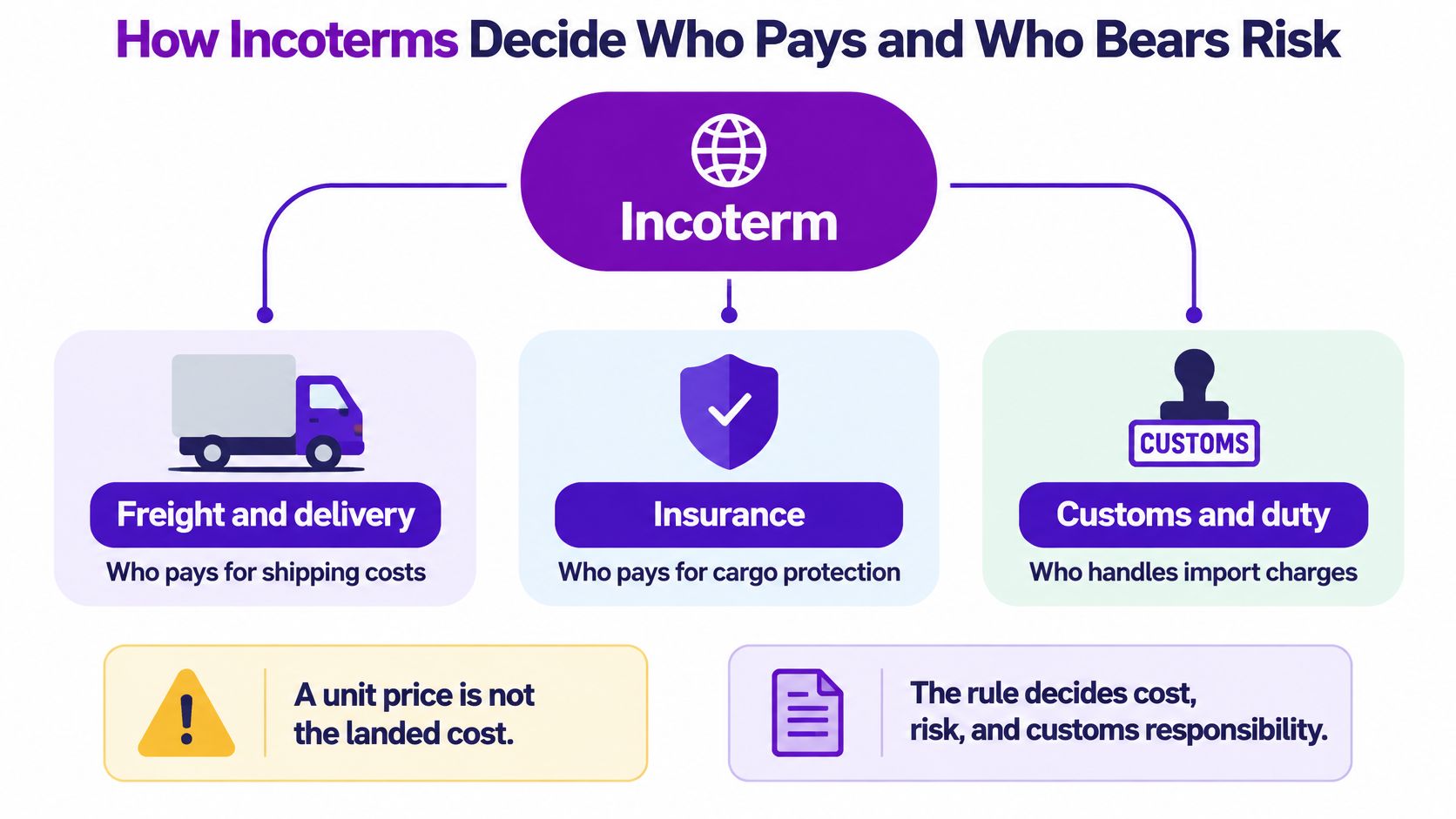
A unit price isn't the landed cost. A factory quote can look cheaper because the buyer still has to pay the forwarder, customs broker, insurer, and destination carrier. Comparing quotations without aligning delivery terms means comparing different packages of responsibility.
An Incoterm performs separate jobs: it assigns operational obligations, identifies when transit risk passes, and allocates specified costs. Those jobs don't always move together.
The diagram separates the responsibilities an importer needs to assign.
Incoterms rules compared for importers
| Rule and Named Place | Risk Passes When | Main Freight Paid By | Import Duties Paid By |
|---|---|---|---|
| EXW, named factory | Goods are made available at seller's premises | Buyer | Buyer |
| FOB Shenzhen port | Goods are loaded on board the vessel at the shipment port | Buyer | Buyer |
| CIF Los Angeles port | Goods are loaded on board at origin | Seller, to destination port | Buyer |
| DAP, named warehouse address | Goods arrive ready for unloading at the named place | Seller | Buyer |
| DDP, named fulfillment center | Goods arrive cleared for import, ready for unloading | Seller | Seller |
EXW gives the buyer extensive logistics responsibility, including arrangements at origin. FOB places the vessel-loading milestone with the seller, but the buyer then manages the main journey. DAP and DDP both extend seller responsibility to a named destination, but import clearance and duties distinguish them.
CIF creates a less obvious exposure. Under CIF Los Angeles port, the seller pays freight to the destination port, yet the buyer assumes risk when the goods are loaded at origin. The ICC Academy's explanation of C and D rules emphasizes this separation between seller-paid carriage and earlier risk transfer.
Apply the rule to an FBA shipment
For the example of an Amazon FBA seller buying 1,000 units FOB Shenzhen, the buyer must budget separately for ocean freight, US customs, duties, and delivery to the fulfillment network; under DDP, the supplier takes the import and destination-delivery obligations described in the ICC Guide to Incoterms 2020.
DDP can simplify coordination, but it doesn't justify accepting an unexplained all-in quote. The buyer should establish the import arrangement, required documents, destination address, and treatment of extra fulfillment-center delivery requirements before acceptance.
The operational choice depends on control as well as price. A seller with a reliable forwarder may prefer managing freight; a smaller brand may value a supplier-managed destination service. The comparison of FOB, EXW, and DDP for FBA sellers helps frame that decision.
The PO entry should remain precise: FOB Shenzhen, Incoterms 2020, followed by the agreed shipment milestone and supporting documentation requirements. A warehouse address elsewhere on the form mustn't contradict the delivery clause.
Payment Schedules and Late Delivery Remedies
Consider a hypothetical USD 20,000 purchase order with 30% paid at order and 70% before release. The buyer advances USD 6,000 before production and another USD 14,000 before the goods leave the supplier. That final payment can remove most commercial bargaining power while the shipment is still overseas.
The important question isn't when payment falls due. It's what evidence the supplier must provide before payment becomes due.
Payment structures and the buyer's exposure
These are negotiation options, not claims about standard market terms.
| Payment Structure | When Cash Leaves | Buyer Exposure | Typical Use |
|---|---|---|---|
| 30% deposit, 70% before release | Deposit at order; balance before dispatch | High after final payment, particularly without inspection | First orders with new factories |
| Net 30 after receipt | Full payment 30 days after goods arrive | Lower pre-delivery cash exposure; supplier extends credit | Established suppliers with a track record |
| 50% deposit, 50% against bill of lading | Deposit first; balance on copy of shipping document | Substantial advance exposure; balance paid before landing | Mid-size orders with known factories |
| Letter of credit | Bank pays when documents meet specified terms | Document controls help, but don't themselves guarantee quality; bank costs apply | High-value or unfamiliar suppliers |
| Payment against documents | Buyer pays when bank releases shipping documents | Protection follows the documents required, not a physical quality guarantee | Repeat orders through a bank collection |
A bill of lading is a transport document, not proof that every unit conforms to the specification. A letter of credit is a bank undertaking to pay against complying documents, so its usefulness depends on careful document requirements.
For a deposit-and-balance arrangement, the PO should require an inspection pass, approved packing list, and agreed release documents. The guide to 30/70 payment terms with Chinese suppliers provides a practical basis for negotiating those milestones.
Make lateness measurable
A ship-by date and an arrival window serve different purposes. The PO should name both, state whether partial or early shipments need approval, and identify which milestone triggers a delay remedy.
For the hypothetical order, a negotiated remedy of 0.5% of PO value per week of delay, capped at 5%, produces USD 100 per week, up to USD 1,000. Counsel should review this as agreed delay compensation, sometimes called liquidated damages, rather than assume a punitive penalty will be enforceable.
Payment milestones should release cash against verified progress, not a supplier's assurance that production is nearly finished.
A supplier may charge more for credit terms or refuse them entirely. The buyer should match the structure to the supplier's track record and keep the deposit proportionate to the documented cost of cancellation.
Inspection Rights and How to Reject Short or Damaged Goods
Suppose a PO covers 2,000 units, but only 1,960 pass receiving inspection. The buyer needs a record of the 40-unit balance, distinguishing missing units from damaged or rejected units. Shopify's purchase-order and receiving workflow supports separating ordered quantities from quantities accepted, rejected, or canceled.
Inspection rights need timing, a standard, and a process. A broad right to inspect is difficult to use if the supplier claims that payment, dispatch, or warehouse receipt already meant acceptance.
The inspection stages should be written into the order before manufacturing begins.
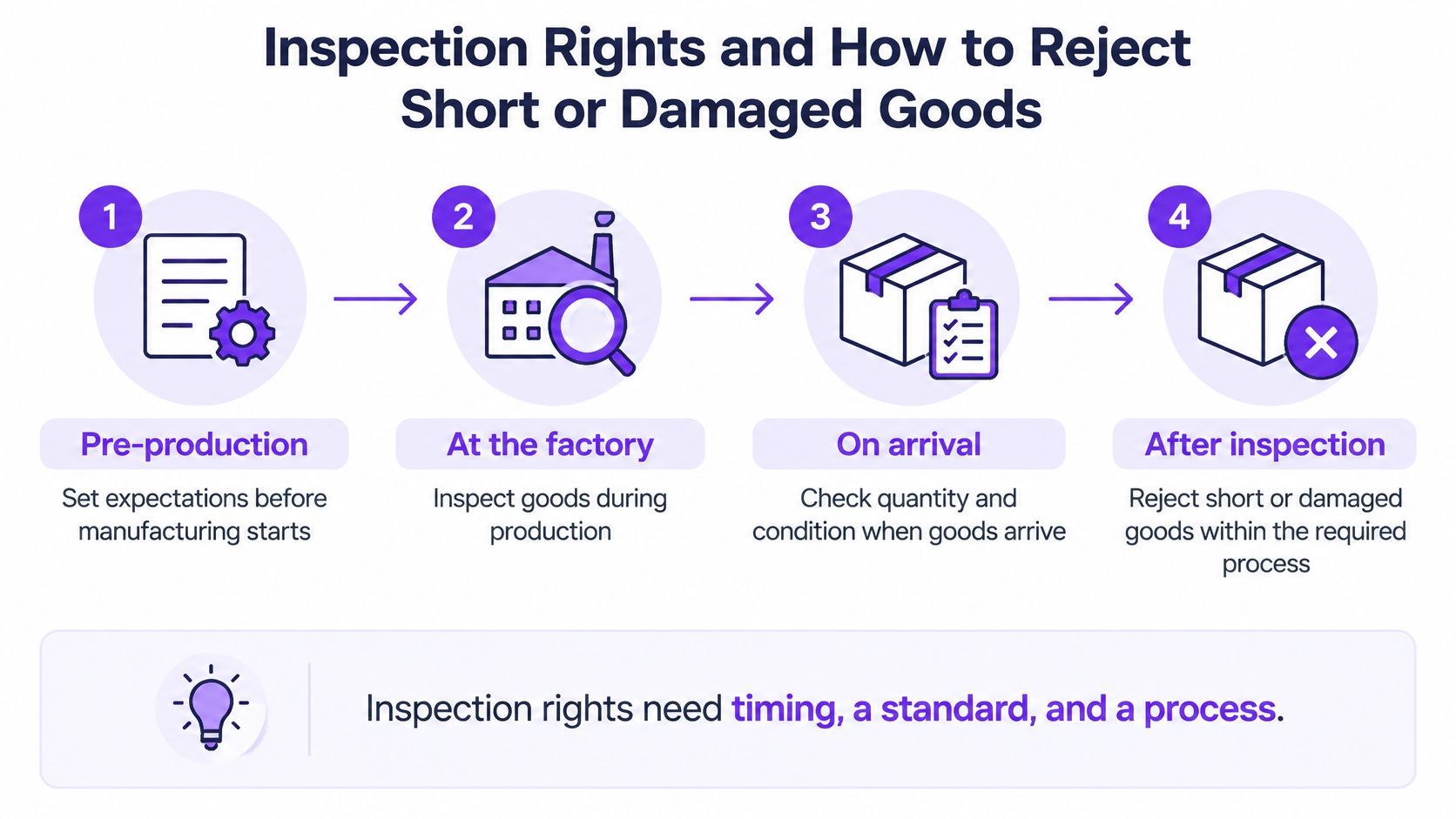
Establish the quality decision before shipment
Pre-production sample approval establishes the reference product. During-production checks allow correction before the entire lot is finished. Pre-shipment inspection determines release readiness, while arrival checks identify shortages and transport damage.
A buyer can specify acceptance sampling under ANSI/ASQ Z1.4, with a negotiated acceptable quality limit, or AQL. An illustrative specification might use 2.5 for major defects and 4.0 for minor defects, together with the inspection level, lot definition, sampling plan, and separate treatment of critical defects. Those numbers alone don't define a complete inspection instruction.
The contract should expressly allow rejection of the whole lot when the agreed sampling acceptance criteria fail. It should also explain reinspection, sorting, replacement, credit, and responsibility for related costs.
Follow a documented receiving routine
- Confirm carton count against the packing list. This identifies missing packages before staff mix them with other inventory.
- Inspect the agreed sample for defects. Inspectors should use the approved specification rather than personal judgment.
- Record accepted and rejected quantities with photos. Separate shortages from physical defects and preserve carton identifiers.
- Send written notice within the rejection window. The notice should identify the PO, affected SKU, evidence, and requested remedy.
- Agree replacement or credit in writing. Finance needs an approved adjustment before closing the invoice.
For Shopify brands, mark the PO as Ordered, create the inventory transfer with its pre-filled supplier and line items, and record each receiving outcome. Amazon FBA sellers should perform the release check at the factory before onward dispatch, using a pre-shipment inspection checklist.
An illustrative 14-day arrival rejection window is a useful negotiating starting point, not a universal legal default. Carton labeling, onward-shipment authorization, and rights for defects discovered later should remain explicit.
Change Orders, Price Adjustments and Substitutions
The lowest unit price can still produce the highest total cost if the supplier can add charges or change the product after the deposit. A workable PO separates product price from freight assumptions, duty treatment, and other adjustment mechanisms.
The buyer also needs a way to approve a legitimate change without reopening every commercial term. An authorized, signed revision should state exactly what changes and confirm that unaffected terms remain in place.
Require evidence before approving extra cost
A change-order clause should cover price, quantity, specifications, materials, and delivery dates. The signed revised PO should constitute the commercial approval, without leaving the supplier to obtain another ambiguous approval later. Casual messages about possible alternatives shouldn't authorize production.
For a hypothetical freight arrangement, assume USD 1,800 base freight, a 10% adjustment threshold, and a USD 900 surcharge. If the contract makes the seller absorb the first threshold amount, the seller bears USD 180 and the buyer pays USD 720.
That split must be written expressly. A threshold can otherwise mean either a deductible or a trigger allowing the supplier to pass through the entire increase.
| Adjustment | Evidence and approval control |
|---|---|
| Freight surcharge | Carrier invoice, original freight basis, calculation, signed revision |
| New tariff or duty | Applicable customs basis, affected goods, effective date, contractual cost allocation |
| Material substitution | Revised specification, sample approval, price effect, signed authorization |
Preserve the option to source elsewhere
A tariff-change clause should name who bears new duties and require advance notice where possible. An illustrative provision can request 30 days' notice, while requiring immediate notification when a government change leaves less warning. The supplier shouldn't promise notice it cannot deliver.
The PO should prohibit unapproved material or component substitutions. It can also give the buyer a cancellation or alternative-sourcing right when a proposed adjustment exceeds a negotiated threshold, such as 15% of order value, with deposit refunds and work-in-progress treatment defined.
In Deloitte's 2025 Global CPO Survey, 74% of chief procurement officers identify maintaining active alternative sources as the most effective mitigation strategy. That's a reason to preserve sourcing options, not evidence that a small brand can switch factories immediately.
A Shopify apparel seller should therefore approve replacement fabric before cutting starts. An FBA seller should check whether a changed component requires new testing, packaging, or listing information before accepting the revised economics.
Disputes, Governing Law and Battle of the Forms
Sending a PO doesn't guarantee that its terms control. The supplier may return an acknowledgment with a different warranty, upload portal terms, or attach an invoice that excludes late-delivery liability. If the buyer pays and production starts, the parties may have created a contract without agreeing on every provision.
A document comparison before payment is cheaper than arguing over the final bargain afterward.
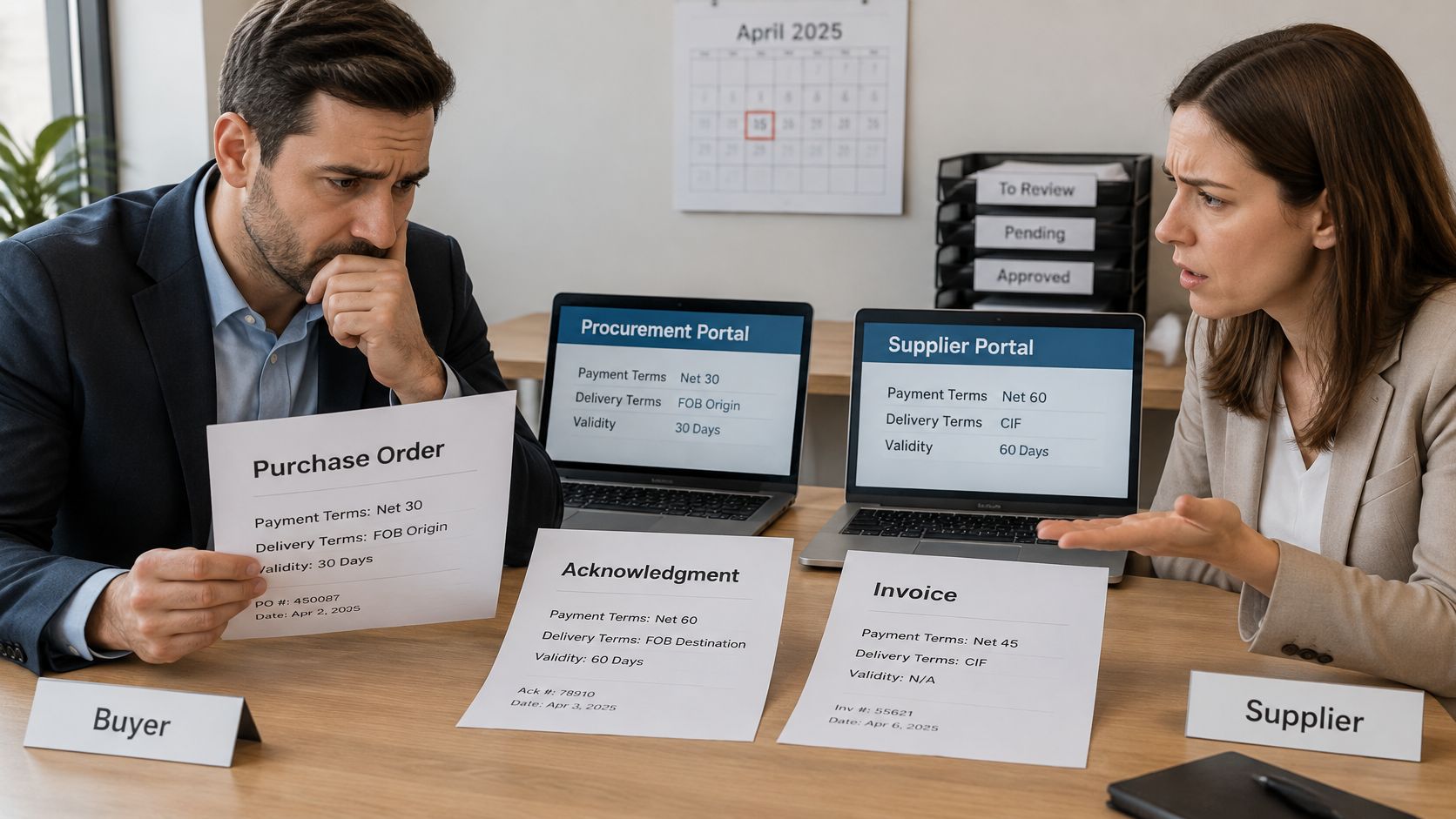
Control competing terms before performance
This conflict is called the battle of the forms. Under UCC Section 2-207, additional or different acceptance terms may affect the contract; courts differ in their treatment, and conflicting terms often cancel out in favor of applicable legal provisions, as explained by Quarles' battle-of-the-forms analysis. Conduct can establish a contract even when the documents don't match.
Practical controls include:
- Limit acceptance expressly. State that acceptance is limited to the PO terms, subject to the applicable law.
- Obtain affirmative agreement. Require an authorized email acceptance or signature identifying the PO and attached terms.
- Reject competing provisions promptly. Flag supplier terms incorporated through invoices, hyperlinks, acknowledgments, or portals.
- Set document precedence. Identify whether a master agreement, negotiated revision, specification, or standard terms prevail.
- Revise rather than assume. Issue a clean revised PO when the supplier proposes a material deviation.
An example of this approach appears in FIS's purchase-order terms, which restrict how supplier documents and administrative references can create obligations. A small importer still needs terms appropriate to its own transaction.
The distinction between the commercial order and its acceptance is also useful when reviewing what a buyer's order records.
Choose a realistic dispute route
An illustrative dispute ladder can require written breach notice, 10 business days to cure, escalation to senior managers, mediation, and finally the chosen arbitration or court process. A cure period is the time allowed to fix a breach; urgent safety or injunction matters may need exceptions.
The accompanying video provides another format for considering the contracting issues.
Both the United States and China are parties to the United Nations Convention on Contracts for the International Sale of Goods, or CISG. Cross-border POs should state whether it applies or is excluded, rather than assume that choosing US state law resolves that question.
Local counsel should check the governing law, forum, and practical enforcement against the supplier. Every PO, acknowledgment, objection, and revision should remain in one versioned thread so the parties can prove what they accepted.
Test the Terms on One Order and Set the Next PO
Consider an illustrative order for 2,000 units at USD 10.00, totaling USD 20,000, with a 30% deposit of USD 6,000, FOB Shenzhen, Incoterms 2020, and a 14-day rejection window. For this order, the buyer negotiates exact-quantity billing, a delay remedy, a freight-sharing exception, and a substitution ban.
The scenarios below are alternative failures, not automatic legal outcomes. Each result assumes the supplier accepted the relevant clause and the buyer followed its notice and evidence requirements.
Four disputes and the clause that decides each
| Scenario | Clause That Decides It | Outcome With the Clause |
|---|---|---|
| Factory ships three weeks late | Delivery date and late-delivery remedy | At 0.5% per week, USD 100 weekly produces USD 300 delay compensation, within the 5% cap |
| Shipment arrives 40 units short | Quantity tolerance and receiving rule | Accept and pay for 1,960 units, USD 19,600; claim replacement or credit for the 40-unit balance |
| Ocean freight rises USD 900 mid-order | Freight surcharge clause with 10% threshold | Against USD 1,800 base freight, seller absorbs USD 180 and buyer pays USD 720 |
| Supplier swaps fabric grade without asking | Substitution ban and signed-revision rule | Lot rejected, no payment for non-conforming goods without a signed revision |
If the buyer already paid the full invoice, shortage recovery becomes a refund or credit claim rather than a simple deduction. Likewise, rejecting substituted goods doesn't automatically retrieve the deposit: the PO must require its return and allocate collection, storage, or disposal costs.
Check the next order before releasing cash
- Name the Incoterm, place, and edition. Avoid a delivery entry that leaves the destination or origin point unclear.
- Tie payments to documents. Dates alone don't establish production readiness.
- Write the inspection window and quality standard. Include notice recipients and remedies.
- Require a signed revised PO for changes. Preserve the original and the accepted replacement.
- Set the dispute ladder and CISG treatment. Choose a forum that offers a realistic recovery route.
- Get written acceptance before the deposit. Attach the complete terms and specification version.
SupplyAutomate keeps each order's supplier, SKUs, quantities, prices, dates, and documents on a single record, and tracks supplier price, freight, duty, and fulfillment costs. Its free downloads include a purchase order template, packing list, commercial invoice, supplier evaluation matrix, inventory tracking template, landed cost spreadsheet, lead time tracker, RFQ template, and proforma invoice template.
A purchase order tracking template can help organize the acceptance, payment, and receiving evidence. The first improvement should be the next live PO, with every acknowledgment and payment attached to that order's record.
Supply Automate offers purchase-order records and landed-cost tracking that connect agreed terms with supplier documents and actual costs. Visit Supply Automate to organize the next order, preserve its approvals, and compare the accepted deal with what arrives and gets invoiced.