The supplier says the order is ready, the freight forwarder wants a pickup date, and Amazon inventory is running low. The latest factory photos look fine, but they don't show whether the carton count matches the packing list, the barcodes scan correctly, or the shipped product matches the approved sample.
A pre shipment inspection checklist should turn that uncertainty into a documented release decision. For Amazon FBA and Shopify brands, the strongest approach starts before the inspector arrives: put the sampling plan, defect classes, compliance requirements, and approval authority onto the purchase order.
Pre-Shipment Inspection Checklist at a Glance
A pre-shipment inspection is a release gate before pickup, not permission to ship based on attractive product photos. Every checklist row needs an agreed pass criterion and evidence retained with the purchase order.
The inspector checks the physical goods. The brand's approver decides whether the complete shipment, including its documentation and destination requirements, is ready for release. Those responsibilities shouldn't be blurred when the supplier is pressing for payment or the forwarder is waiting.
Pre-shipment checklist areas, checks and evidence
| Check area | What to verify | Pass criterion | Evidence to keep |
|---|---|---|---|
| Product quality | Workmanship, dimensions, colour and function against the approved golden sample | Within drawing tolerance and AQL limits | Photos and measurement log |
| Packaging | Carton strength, inner protection, rigid six-sided box, flap condition | No crushed or open cartons in the sample | Carton photos |
| Quantities | Units ordered vs produced vs packed vs carton count | Exact match to PO and packing list | Carton count sheet |
| Labels and markings | Barcodes, SKU labels, country of origin, shipping marks | Scannable, correct and on a flat surface | Label close-ups |
| Documentation | Commercial invoice, packing list, test reports, certificates | Matches the PO and goods and is not expired | Scanned copies in the PO file |
| Compliance | Destination market, applicable standard, test report or certificate for each SKU | Certificate covers the destination market and is not expired | Test report and certificate in the PO file |
| Approvals | Named approver, PO revision, inspection sign-off | Signed before pickup is booked | Signed report linked to the PO |
Make the compliance row specific
A generic compliance checkbox doesn't identify what the importer verified. U.S. Customs and Border Protection's import-safety guidance explains that different government agencies regulate different imported product categories, including authorities such as CPSC, FDA, FCC, and USDA.
For a brand selling across categories, the evidence required for a textile accessory won't necessarily establish compliance for an electronic accessory. The checklist should identify the destination, applicable requirements, supporting documents, and person responsible for approving each SKU.
A visual pass cannot prove chemical, electrical, or flammability compliance. A photograph of a certification mark isn't equivalent to a test report covering the shipped model and construction. Where a document has no expiry date, the record should state that explicitly and confirm its continued applicability rather than inventing an expiry.
Release the shipment only when the sampling result, shipment checks, compliance evidence, and named approval all support the same decision.
The evidence should also be usable without another supplier conversation. A measurement photograph needs a visible measurement point; a label photograph needs readable text; a carton photograph needs an identifier that connects it to the packing list.
A useful internal drill is to pull a carton and trace it to its PO line, the shipment's carton count, and its label record within five minutes. If the team can't complete that drill, the inspection file needs better identifiers before release.
Run the Inspection and Decide the Lot
The lot size determines the code letter and sample quantity under the selected inspection level; the chosen Acceptance Quality Limit, or AQL, determines the acceptance and rejection numbers. The inspector compares classified findings against those agreed numbers, rather than treating AQL as a percentage allowance calculated directly from the sample.
Asia Quality Focus's pre-shipment inspection guide describes General Inspection Level II as the usual commercial baseline under ISO 2859-1 or ANSI/ASQ Z1.4, with typical consumer-goods settings of AQL 0 for critical, 2.5 for major, and 4.0 for minor defects, and Ac 0/Re 1 for critical findings.
Zero acceptance for critical defects should be written explicitly. A critical finding shouldn't become a negotiation about whether the rest of the sample looks good.
Prepare the inspection packet
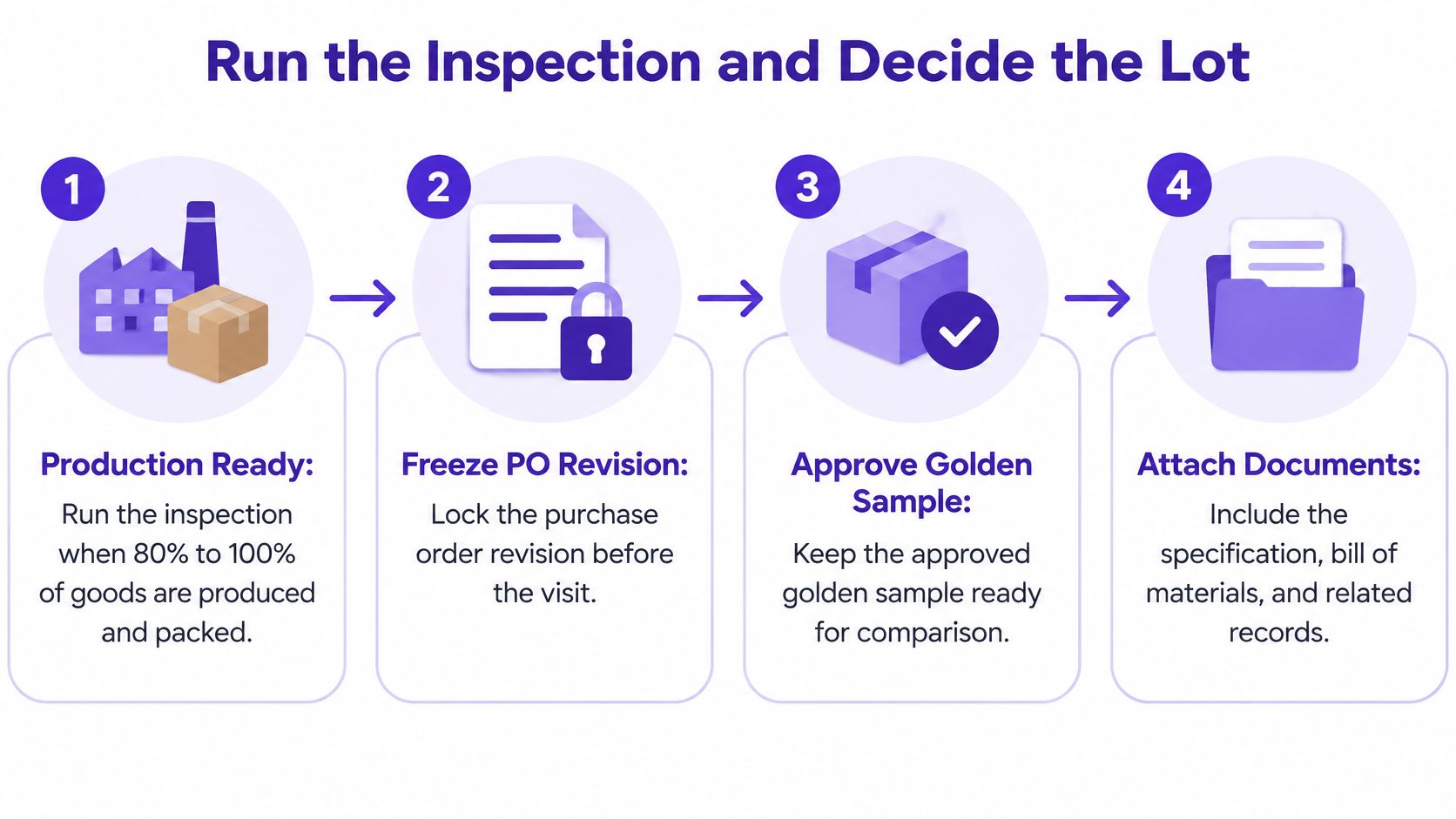
ET2C's explanation of inspection procedures places pre-shipment inspection when 80% to 100% of goods have been produced and packed. Inspection at the earlier end of that window can leave final packing outside the reviewed scope, so the report must record exactly what was available.
Before the visit, the buyer should freeze the PO revision and identify the approved golden sample. The inspection packet should include:
- Product definition: Specification, bill of materials, drawings, tolerances, materials, colour references, and accessories.
- Shipment presentation: Packaging artwork, packing configuration, barcode rules, labels, and shipping marks.
- Decision criteria: Defect taxonomy, sampling plan, destination compliance requirements, and named release authority.
- Test instructions: Equipment, method, conditions, pass/fail limits, and shipping deadline.
The inspector needs an executable test, not an instruction to check durability. For a folding phone stand, that means a defined operating sequence, specified load, and written criteria for hinge movement, stability, and damage.
The preparation sequence should be visible to everyone responsible for readiness.
Select the sample before discussing defects
The following General Inspection Level II lookup records the specified lot bands and sample quantities. It isn't a complete sampling standard: omitted bands and the applicable acceptance numbers must be confirmed in the selected plan.
Sample size by lot size, General Inspection Level II
| Lot size (units) | Code letter | Sample size |
|---|---|---|
| 2-8 | A | 2 |
| 9-15 | B | 3 |
| 16-25 | C | 5 |
| 91-150 | F | 20 |
| 281-500 | H | 50 |
| 501-1,200 | J | 80 |
| 3,201-10,000 | L | 200 |
The PO should record the actual lot size, inspection level, code letter, sample quantity, and acceptance numbers. A table showing sample sizes alone isn't sufficient to authorize a shipment.
For mixed-SKU orders, the buyer should also define which goods constitute each inspection lot. Combining unrelated products into a convenient sample can leave a lower-volume SKU poorly represented.
Execute the on-site checks
- Confirm production and packing status. Check what is finished, what is packed, and what remains unavailable. Common slip: accepting a half-packed presentation that doesn't reveal the final carton build.
- Reconcile quantity before opening cartons. Compare the PO, packing list, physical carton count, and stated units per carton. An agreed partial shipment needs its own documented scope. Common slip: inspecting quality first and discovering an unresolved shortage at sign-off.
- Select units randomly across the lot. Distribute selection across carton locations and record carton and unit identifiers. Supplier staff can move cartons, but shouldn't choose the inspection sample. Common slip: taking only the cartons nearest the door.
- Inspect against written requirements. Check workmanship, dimensions, weight, materials, colour, labels, packaging, accessories, and defined functions. Record actual measurements rather than a blanket pass. Common slip: applying an improvised test with no agreed limit.
- Record each finding clearly. Include defect class, affected quantity, location, severity, and photographs. A close-up should show the defect; a wider photograph should identify where it occurred. Common slip: retaining an unidentifiable defect image.
- Compare findings with the agreed acceptance numbers. Record accept, reject, or hold for correction and re-inspection. Common slip: changing defect classifications after the counts are known.
- Sign and link the report. Connect the result to the PO revision, production batch, and carton count. Common slip: treating the inspector's completed report as the buyer's shipment authorization.
Apply the phone-stand example
Consider a hypothetical 3,000-unit phone-stand order, assigned to the 1,201 to 3,200 band, code K, with a 125-unit sample. The inspector records two major defects, which remain within the selected plan's acceptance number, but also finds one hinge fracture classified in advance as critical.
The major-defect result doesn't rescue the lot. The hinge fracture triggers rejection under the critical-defect rule, and the supplier needs a corrective-action plan before re-inspection.
The classification must reflect the actual hazard. A superficial hinge mark and a fracture that creates a sharp edge shouldn't share a defect code because both occur near the hinge.
A manufacturing dashboard can make production readiness and inspection status easier to follow, but the signed evidence still controls release. The sampling plan belongs on the PO before the visit, not in a discussion after a failed result.
Amazon FBA Packaging and Label Checks
Start with the carton, not the label artwork. Amazon's shipping and routing requirements call for rigid, six-sided boxes, intact flaps, clear delivery and return information, individual item protection, and suppression of existing barcodes that could cause an incorrect scan.
The inspector should examine a sealed shipping carton as Amazon will receive it, then open it to check the inner protection and SKU assortment.

Check identifiers at every packaging level
Amazon's shipment-label guidance requires a unique FBA Box ID label on every box, supports 8.47 × 10.16 cm labels or 10 × 15 cm with thermal-printing paper, and requires four pallet labels, positioned at the top centre of each side. Labels must remain flat, uncovered, and scannable, and mustn't be photocopied, reused, or modified.
For example, a 20-carton shipment needs 20 distinct box labels, plus the required pallet labels when palletized. Scanning a barcode isn't enough: the inspector must also confirm that it identifies the intended carton or product.
Amazon FBA carton and label requirements
| Requirement | Passes when | Fails when |
|---|---|---|
| FBA Box ID label | One unique label on every carton, placed flat | Label copied, reused or edited |
| Label size | 8.47 x 10.16 cm, or 10 x 15 cm on thermal paper | Label cropped or resized |
| Pallet labels | Four, top centre of each side | Labels across a seam or corner |
| Existing barcodes | Covered with opaque tape or unscannable | Factory barcode still scannable |
| Expiry date | MM-DD-YYYY or MM-YYYY on unit and outer box, 36-point on the box | Lot code only |
Amazon's unit-packaging requirements specify MM-DD-YYYY or MM-YYYY expiration dates on individual units and outer boxes, with at least 36-point type on the outer box, and suffocation warnings for poly bags with openings of 5 inches or more measured flat. Dates must remain visible outside additional prep layers, and the unit barcode needs corresponding human-readable numbers.
A supplement bottle with its date hidden beneath wrapping fails that check even when its carton looks correct. In a mixed-SKU shipment, an exposed factory barcode can create a receiving error despite correctly applied FBA labels.
The preparation video provides additional visual context for the packing review.
Before pickup booking, the inspector should pull a carton from each SKU and check every table row alongside the agreed random sample. A packing list template helps connect carton contents, SKU quantities, and the physical shipment.
Shopify and EU Compliance Checks Before Release
A Shopify brand preparing a private-label electronic accessory made in China for Germany and France needs more than a working product. The release file should connect the model or batch identifier to the listing, manufacturer details, EU Responsible Person details, and German- and French-language safety information.
Shopify's GPSR guidance identifies product and listing information requirements covering product identification, manufacturer identity and contact information, and an EU Responsible Person when the manufacturer is outside the EU. It also calls for required instructions, warnings, and safety information in the languages of the countries where products are sold, and reporting product accidents to EU authorities.
Match the physical product to the listing
The inspector should compare the shipped label and instruction insert with the approved destination-specific artwork. The brand's compliance approver should compare those same identifiers with the listing and supporting technical documents.
Manufacturer information should include the name, registered trade name or trademark, physical address, and electronic contact. A supplier's informal contact card isn't a substitute for the approved information on the product and listing.
SKU-specific compliance matrix
| Field | Evidence required before approval |
|---|---|
| Destination market | Countries approved for the SKU |
| Responsible authority | Applicable regulator or market-surveillance authority |
| Applicable standard | Product-specific requirements and documented applicability |
| Test report or certificate | Document covering the shipped model and construction |
| Labelling language | Approved warnings and instructions for each destination |
| Traceability | Model, type, batch, serial number, or other required identifier |
| Responsible approver | Named person accepting the evidence |
| Document expiry | Expiry date, or documented no-expiry status and validity review |
A purchase order tracker should keep this matrix attached to the relevant order revision. Otherwise, a compliant earlier version can be mistaken for approval of a changed material or component.
Hold criterion: An unresolved compliance field is a shipment hold, not an administrative task to finish after dispatch.
Factory inspection never substitutes for laboratory testing where chemical, electrical, or flammability requirements apply. If a matrix row is blank, the approver should keep the shipment on hold until the missing evidence is resolved, including seemingly small omissions such as Responsible Person contact details.
Common Defects and How to Respond
A critical defect means rejection or a hold for rework and re-inspection. A discount doesn't remove a safety hazard, and a supplier's promise doesn't establish that the affected goods have been corrected.
Commercial remedies are useful for acceptable quality deviations, not for bypassing the release criteria. Major defects within the agreed acceptance number can support a documented deduction, rework agreement, or credit note, provided the approver names the affected SKUs and accepts the remaining risk.
Turn findings into corrective actions
Defect findings and the action each one requires
| Finding | Action | Timing or consequence |
|---|---|---|
| Critical defect | Reject the lot or hold it for rework and re-inspection | Not released until re-inspected |
| Major defect within acceptance number | Accept with documented deduction, rework or credit note | Name the affected SKUs in the report |
| Minor defect | Log, photograph and check against the listing | Accept unless buyer-visible impact or sampling limits require a hold |
| Carton count mismatch | Reconcile before anything loads | Resolve before pickup |
| Damaged outer carton | Repack into new cartons and re-check the sample | Usually a same-day fix when replacement cartons are ready |
| Wrong or missing label | Relabel on site, then re-inspect the labelled cartons | Usually one to two days when approved labels are available |
| Wrong material or missing component | New production run | Reset readiness and pickup dates after replacement production is confirmed |
Those repair windows are planning assumptions, not promises. Label approval, printing capacity, carton availability, and access to packed goods can extend an otherwise straightforward correction.
Bureau Veritas's inspection FAQ recommends allowing at least 2–3 days for inspection-report generation and review. Corrective work and re-inspection may require additional time, so that buffer shouldn't be treated as a guaranteed repair window.
Accept the remedy, not just the explanation
Consider a hypothetical lot containing three minor label defects and one major stitching defect, all within its agreed sampling limits. After verified relabelling, the buyer could accept the remaining stitching deviation with a documented deduction; a safety-critical hinge fracture wouldn't qualify for that treatment.
Minor cosmetic findings also need comparison with the listing. A mark on a concealed underside may be commercially tolerable, while the same mark across a prominently photographed logo may justify correction.
Recurring findings belong in the supplier's performance record, supported by a supplier evaluation matrix. Repacking and straightforward relabelling can be short jobs; wrong materials, defective tooling, or unavailable components can require replacement production and a revised shipping plan.
Confirm the Lot Before You Release the Shipment
Approve pickup only when the signed report supports release: no critical findings, major and minor counts within the agreed limits, passing channel-specific checks, and a complete compliance matrix. If any gate fails, the booking stays on hold until the corrective action has been verified.
A Shopify SKU bound for Germany can have clean workmanship results and acceptable cosmetic findings yet remain unreleasable because its German warning information is missing. Product quality and legal readiness are separate approval questions.
A completed inspection report records what was checked; a signed release records who accepted the shipment.
Keep the release and cost records together
The practical next step is to file the signed inspection report, commercial invoice, and packing list under the same PO. A purchase order tracking template can establish that shared reference before the goods move.
For teams standardizing document generation, the APITemplate.io guide to shipping document automation offers context for reducing repetitive document work. Automation should preserve the approved identifiers and quantities, not reproduce an unresolved discrepancy across more files.
SupplyAutomate started from operator pain: estimated inventory, missed supplier messages, and landed cost that only became clear weeks after goods were already committed. During onboarding, existing POs, invoices, and shipping documents are uploaded as PDFs, and a single invoice becomes an organized order view in well under a minute.
That setup supports a straightforward operating habit: the team responsible for release should work from the same order record as the team responsible for payment and freight. The next lot should go through this checklist before pickup is booked, while the supplier still has the goods and the buyer still has practical correction options.
Supply Automate brings purchase orders, supplier communication, shipping documents, and landed-cost records into a shared workspace for e-commerce operations teams. Brands preparing their next factory release can visit Supply Automate to organize the order documents and approvals that support a documented shipment decision.