Purchase order management is the controlled process of creating, approving, issuing, tracking, changing and closing purchase orders. It keeps a supplier commitment accurate from the original order through delivery, invoice checking and final payment.
A factory has confirmed production, but its latest message mentions a smaller shipment and a later pickup date. Meanwhile, the Shopify inventory plan still shows the original quantity, and the accountant has an invoice based on the old agreement. For an Amazon FBA seller preparing a replenishment shipment, that gap can affect both available stock and committed cash.
The practical question behind what is purchase order management isn't how to produce a document. It's how everyone involved keeps working from the same commercial agreement when the order changes.
What Purchase Order Management Means for Your Business
A purchase order, or PO, is a documented commitment describing what a buyer intends to purchase from a supplier. Like a lease that fixes rent and dates before anyone moves in, it gives both parties something concrete to check instead of relying on remembered conversations.
The PO normally identifies the supplier, products, quantities, prices, delivery requirements, payment terms and authorization. A factory's quote proposes a deal. The PO records the buyer's order. The supplier's acknowledgment establishes whether the factory understands and accepts those same details.
The document is only the beginning
Management continues after issuance. The buyer checks the acknowledgment, tracks production and shipping, records receipts, resolves discrepancies, reviews invoices and preserves amendments.
For a small e-commerce brand, those activities answer different financial questions:
- Cash commitment: What has the brand agreed to spend, including amounts not yet invoiced?
- Inventory timing: When should the warehouse expect stock, and what still needs inspection before sale?
- Unit economics: What will each received unit cost once transport and import charges are included?
APQC benchmarking reported by Supply Chain Management Review puts average PO processing cost at about $42, with roughly $14 at the 25th percentile and $54.50 at the 75th percentile. The spread makes workflow design worth examining, even when the goods themselves remain unchanged.
The process map shows how responsibility moves with the order.
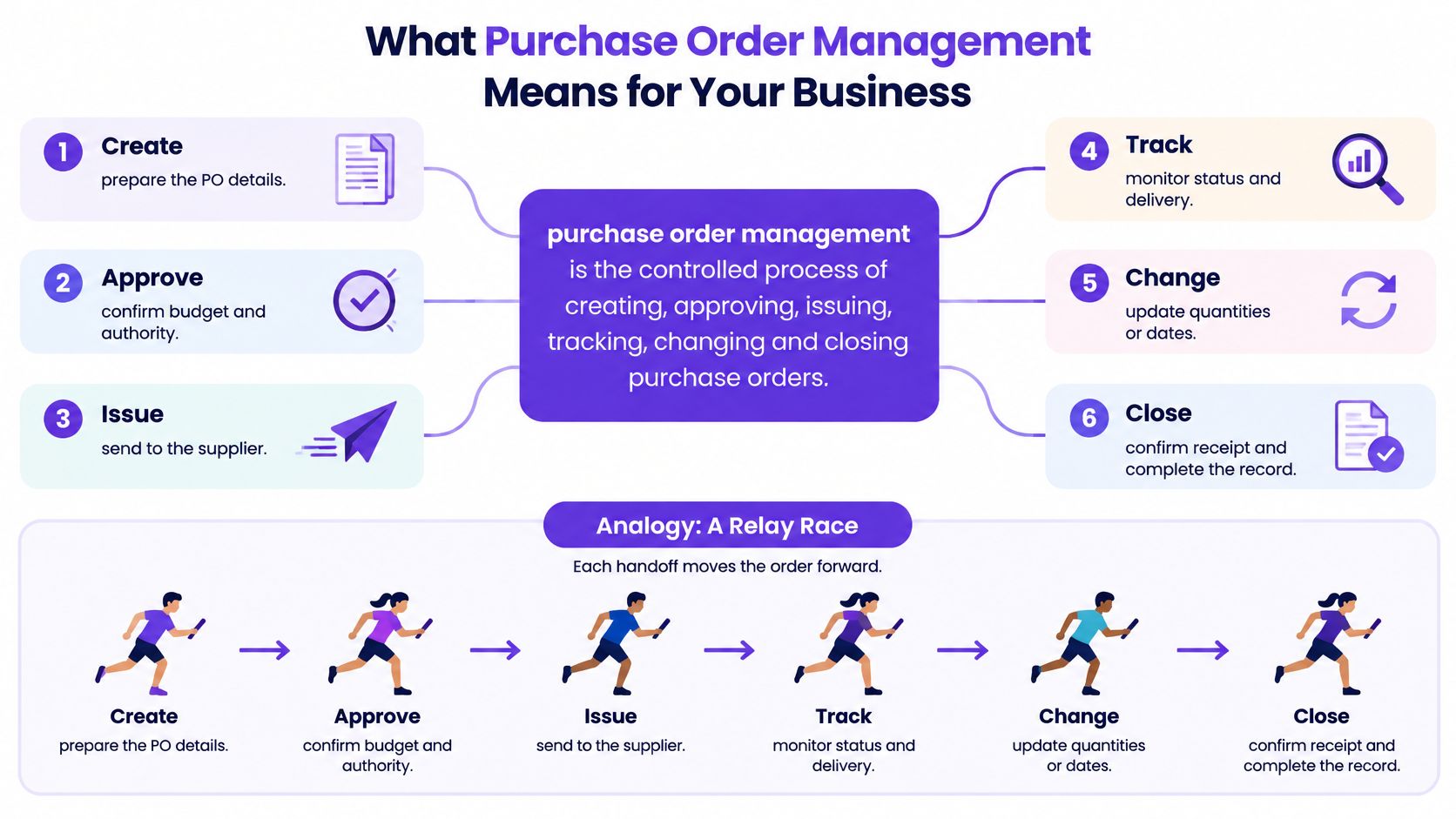
The relay analogy matters because a completed task isn't enough if the next person never receives the information. A buyer can send a correct PO while finance still pays against an outdated invoice.
Practical test: For every open order, the team should be able to state what was bought, at what price and when it's expected to arrive.
Components and Stakeholders in Every Purchase Order
A usable PO combines commercial details with ownership. Each field needs someone responsible for keeping it accurate, especially when an overseas factory changes materials, shipment dates or payment expectations.
Purchase order components and owners
| Component | What It Records | Typical Owner |
|---|---|---|
| Supplier details | Legal name, contact, payment terms | Buyer |
| SKU and specification | Item ID, materials, version | Product or purchasing lead |
| Quantity and MOQ | Units ordered and minimum order check | Buyer |
| Unit price and currency | Agreed price and exchange basis | Buyer, with finance approval |
| Delivery terms | Incoterm, ship-to address, requested date | Operations |
| Revision history | Every change with date and reason | Buyer |
| Approval status | Who signed off and up to which limit | Approver |
| Attached documents | Quote, production photos, packing list | Supplier, shared |
Supplier details should identify the business receiving the order, not merely a salesperson's messaging account. SKU specifications should distinguish the approved product version from similar items, while the quantity field should show whether the order meets the factory's minimum order quantity, or MOQ.
Price and currency belong together. Delivery terms need equal care: the Incoterm allocates specified transport responsibilities and costs, while the destination and requested date tell operations where and when goods are needed. A review of purchase order terms and conditions helps teams separate those commercial responsibilities from a vague delivery promise.
Who owns the handoffs
The buyer creates and sends the PO. The approver checks budget exposure. The supplier or agent confirms feasibility, the warehouse or third-party logistics provider, or 3PL, counts arrivals, and accounts payable checks the bill.
Before those handoffs begin, supplier selection deserves its own review. Aroma Warehouse's product sourcing guide for small retailers is a useful companion for founders establishing their sourcing approach before committing to an order.
- Revision history: Preserve the previous agreement, the changed field, the reason and the authorization.
- Supporting documents: Attach the applicable quote, specification, production evidence and packing list to the relevant order.
- Approval boundaries: Record who may authorize spending and when another reviewer becomes necessary.
Small brands often combine buyer and approver in the founder. A spending-threshold rule adds a practical safeguard: orders above the agreed limit require a second signature before issue.
The Purchase Order Lifecycle From Request to Close
An order should advance because someone completed a checkpoint, not because someone changed its status. Supplier selection and PO preparation support the early stages; acknowledgment, receiving and matching keep the commercial record reliable afterward.
The lifecycle illustration shows the broad flow, including the preparation work before issue.
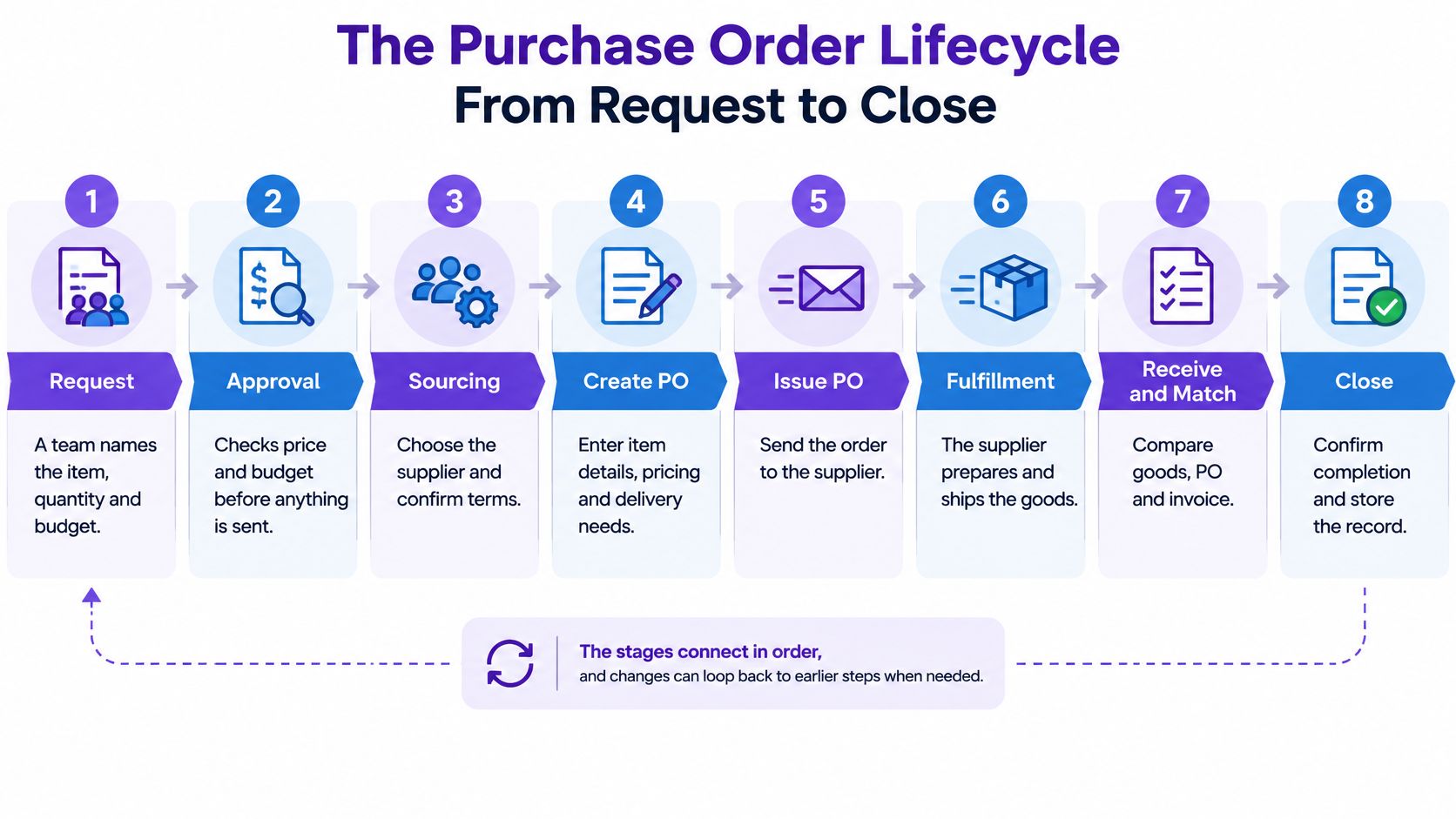
Purchase order lifecycle stages
| Stage | What Happens | Checkpoint |
|---|---|---|
| 1. Request | Team states need, item, quantity and budget | Requisition has a named owner and budget |
| 2. Approval | Approver checks price, quantity and budget | Approval recorded before the PO is issued |
| 3. Issue | PO sent with final terms and delivery date | Supplier receives the same version that was approved |
| 4. Acknowledgment | Supplier confirms quantity, price and date | Any changed date or quantity is flagged and logged |
| 5. Production and shipping | Milestones tracked: deposit, production, ready, shipped | Actual dates logged, not estimates |
| 6. Receipt | Goods counted line by line against the PO | Short or damaged units recorded |
| 7. Invoice match | Invoice compared with PO and receiving record | Mismatches held, not paid |
| 8. Close | Final amendments, payment and documents filed | No open lines or unresolved variances |
A request isn't permission for a supplier to start work. Pricing should be established before the approval becomes a commitment. For example, a buyer evaluating branded merchandise can request custom promotional product pricing from Simply Merchandise, then use the confirmed quotation to prepare an order.
When the factory confirms a different quantity
Consider a hypothetical order for 500 hoodies whose factory acknowledgment confirms only 480. The buyer should establish whether the balance is canceled or will follow later, obtain approval for the change, and preserve the supplier's confirmation.
If the warehouse subsequently receives the confirmed shipment, its receipt records the actual quantity. The supplier's invoice must align with the approved commercial arrangement and receipt, rather than charging for the original full order.
This is three-way matching. Spendesk's purchase order process guide describes comparing the PO, receiving record and supplier invoice before payment, with discrepancies held for resolution. Purchasing handles price differences, receiving investigates count differences, and the supplier corrects billing errors.
A related operational decision is how purchase order software tracks partial shipments from suppliers. An outstanding balance shouldn't disappear merely because the first shipment arrived.
Supplier and partner messages stay on the order thread in SupplyAutomate, so the next team member can pick up the work without digging through personal inboxes. Production evidence, inspection results and freight documents need the same order context.
The video provides an additional visual explanation of the process.
Acknowledgment and receipt deserve particular attention. Without them, the team knows what it requested and what it was billed, but not necessarily what the supplier accepted or delivered.
KPIs That Show Whether Your PO Process Works
A purchase order is a financial commitment that can change after it leaves your desk. Track how quickly the team creates and sends it, how often details change, and whether invoices match what was ordered and received.
| Metric | How to Calculate | Benchmark or Signal |
|---|---|---|
| Requisition-to-PO time | Days from request to approved PO | Manual: about 14.3 days; automated: under 3 days |
| Issue speed | Days from approval to PO sent to supplier | Shorter is better; track the trend against your own baseline. |
| Cost per PO | Total PO processing cost divided by POs issued | Average: about $42; 25th percentile: about $14; 75th percentile: about $54.50 |
| PO amendment rate | Share of POs changed after issue | A rising rate can signal weak quotes or unclear specifications |
| Invoice match-hold rate | Share of invoices failing three-way match | Review weekly; investigate a sustained rise |
| Manual re-keys per transaction | Times the same data is typed again | Aim to reduce repeated entry of supplier and invoice data |
| Manual entry error rate | Errors divided by transactions | Roughly 1–4% for manual entry |
Flxpoint's purchasing benchmark summary reports about 14.3 days for manual PO processing versus fewer than 3 days for automated workflows. It also reports manual data-entry error rates of roughly 1–4% per transaction. Treat these figures as directional comparisons, not targets that every business should meet.
Set clear start and finish points for each metric before comparing results. For example, requisition-to-PO time begins when a request is complete, not while the team is still waiting for specifications. Issue speed begins after approval and ends when the supplier receives the PO.
Diagnose the delay before changing the tool
Long requisition-to-PO time can point to an approval queue, missing quotes, or unclear budgets. Slow issue speed points to a narrower bottleneck: the purchase is approved, but the supplier has not received the order.
Read amendment rates in context. A mistyped SKU is avoidable rework; a documented change to account for a factory constraint may be sensible. The PO should reflect the approved change so its quantities, dates, and costs remain useful as the order progresses.
- Rising invoice holds: Group exceptions by price, quantity, and billing error, then assign corrective work.
- Repeated re-keying: Map each transfer between supplier documents, purchasing records, and accounting records.
- Aging open orders: Review them weekly and assign an owner to each overdue confirmation, shipment, or balance.
Broader supply chain KPIs can show how purchasing delays relate to inventory availability. Keep the purchasing dashboard small enough to update and act on.
A useful metric leads to a named person taking a defined action, not simply another monthly chart.
Start with requisition-to-PO time, amendment rate, and invoice match-hold rate. Record a baseline, choose a target for the next quarter, and define price and quantity tolerances before exceptions arrive. That way, the team can tell whether a PO is moving as expected, or whether its financial commitment needs attention.
Common Pitfalls and How to Prevent Them
Paying against stale quantities is the most urgent failure to prevent. Finance may approve a bill that matches the original PO perfectly while overlooking a shortage documented by the warehouse.
| Pitfall | Early Warning | Prevention |
|---|---|---|
| Invoices paid on stale quantities | Invoice differs from receiving record | Three-way match with set tolerances |
| Unlogged changes | Supplier price or date moves with no PO revision | Approved amendment required for every change |
| MOQ forces overbuying | Stock sits while cash is tied up | Check forecast against MOQ before approval |
| Landed cost drift | Margin falls though unit price is unchanged | Recalculate landed cost at approval and before shipment |
| Partial deliveries treated as complete | Inventory counts higher than received | Receive by line and log short quantities |
| Tariff exposure ignored | Duty or freight changes after the order | Record country of origin, HS code and Incoterm per SKU |
| Approval bypass | Orders placed outside the system | Route all POs through one approval queue |
Uncertainty is a purchasing condition, not an excuse to abandon controls. In Netstock's 2025 supply-chain planning report, 68% of surveyed SMBs identified lead-time variability as their top supply-chain challenge, 58% cited long supplier lead times, and 45% said MOQs force purchases beyond their needs and tie up cash.
A change log helps the team respond without losing the agreement's history. It should distinguish the requested date, the supplier's current promised date and the actual milestone date.
Landed cost can change without a new supplier price
Consider an explicitly illustrative calculation, not a tariff quotation:
- Goods: 500 hoodies at an assumed $8.00 each equal $4,000.
- Freight: An assumed $600 adds $1.20 per hoodie.
- Duty: An assumed 10% of goods value adds $400, or $0.80 per hoodie.
- Illustrative subtotal: These costs produce $10.00 per hoodie before any additional insurance, customs or other applicable fees.
Actual duty treatment requires the correct classification, origin and applicable rules. The point is financial: an unchanged factory price doesn't guarantee an unchanged margin.
The University of California procurement report discusses tariff-related sourcing concerns. Importers should therefore preserve country-of-origin and HS-code assumptions, then revisit landed cost when sourcing or transport arrangements change.
Existing POs, invoices and shipping documents are uploaded to SupplyAutomate as PDFs with no manual re-entry. That reduces transcription work, but the buyer still needs to resolve conflicting commercial terms.
Controlled flexibility: An approved amendment is stronger control than an untouched PO that no longer describes the real order.
Shopify and Amazon FBA Examples in Practice
Consider a Shopify apparel brand ordering 500 hoodies from an overseas factory. The seller can follow the steps in Shopify's purchase order creation guidance: set the supplier and receiving location, turn on inventory tracking, then record the products, agreed prices and payment terms. From that moment the PO is a financial commitment, and every later event has to land on the same record.
After supplier confirmation, the seller marks the PO Ordered and can create a linked inventory transfer. The PO records the commercial agreement; the transfer records physical movement from the factory toward the warehouse or 3PL. An issued PO works like a running tab rather than a paid bill: the commitment stays open until the last unit and the last dollar are accounted for. That distinction matters when a shipment arrives in two parts or the freight bill comes in higher than quoted, because the warehouse counts cartons while finance tracks the outstanding balance.
The warehouse team needs the same order context when shipment information arrives. Without it, a partial delivery looks identical to a completed order.
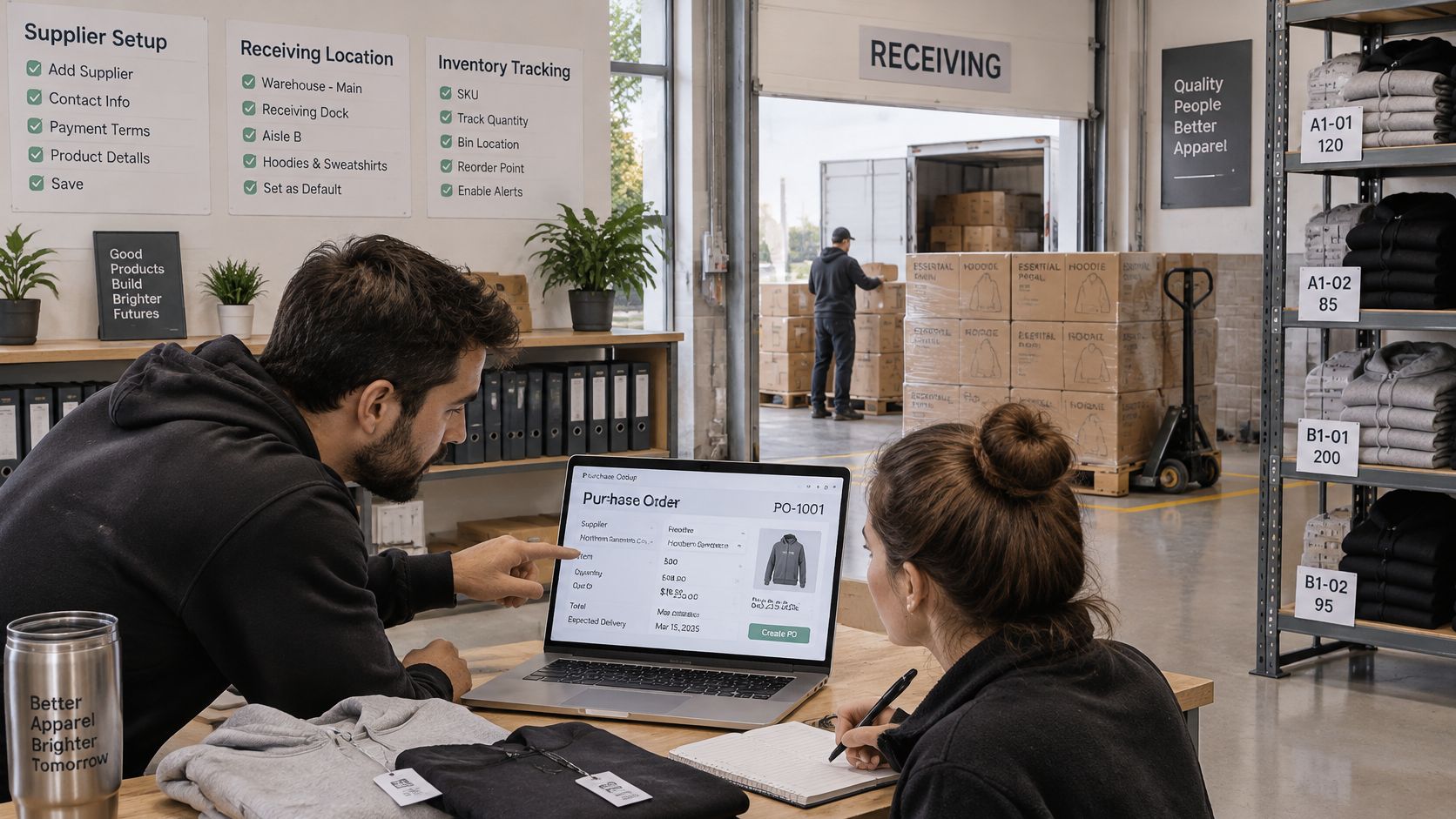
Forecasting and receiving are separate decisions
Shopify's Stocky purchase order documentation gives a specific MOQ example: forecast demand of 67 units against a 100-unit minimum results in an order for 100, leaving 33 additional units as planned incoming stock. The buyer should recognize that surplus as a cash and storage commitment, not extra customer demand.
At receiving, Shopify POS guidance supports recording actual quantities: in a scenario where 200 units were ordered but 190 arrived, staff receive 190 and reject or leave unresolved the remaining 10. The documented workflow uses a PO created in Stocky and displayed at the receiving location. Those 10 missing units are why the PO stays open after goods arrive: the record still owes an answer, either a balance delivery or a revised total, before anyone pays the invoice in full.
An invited 3PL provider or internal warehouse team can post shipment and inventory updates directly to a SupplyAutomate purchase order, so the receipt lands on the same record the buyer approved. During onboarding, existing POs, invoices and shipping documents are uploaded as PDFs, and a single invoice becomes an organized order view in well under a minute.
Amazon FBA Onsite requires the correct inbound identity
Amazon's FBA Onsite receiving instructions describe automatically generated POs appearing within about 30 minutes for qualifying listings, provided eligibility requirements and package dimensions and weight are satisfied. This is an FBA Onsite WMS workflow, not a universal description of every standard FBA inbound shipment.
The operator follows this sequence:
- Open Inbound > Receive Product.
- Scan the product's FNSKU.
- Select the correct Purchase Order ID.
- Enter the required receiving details.
- Stow the item in its assigned container.
The factory purchasing reference and Amazon's receiving identifier serve different purposes. Keeping them connected helps the operator reconcile goods without mistaking an Amazon-generated inbound record for a supplier commitment.
For brands selling across channels, a process to consolidate Shopify and Amazon FBA purchase orders should preserve those identifiers while avoiding duplicate purchasing records.
How SupplyAutomate Solves Each PO Problem
SupplyAutomate's intended workflow centers the supplier, SKUs, quantities, prices, dates and documents on a shared purchase order record. Its landed-cost tracking includes supplier price, freight, duty and fulfillment, while collaborators can contribute within permissions set for each order.
That combination is useful when a factory conversation, warehouse receipt and finance review would otherwise happen in separate places. The distinction is between information the platform organizes and approval or matching rules the business still needs to define.
| Problem | Intended working control |
|---|---|
| Invoice uses the original order quantity | Review the supplier invoice beside the receipt and current PO before authorizing payment |
| Supplier changes a price or date | Preserve the revision, its reason and the supplier's confirmation with the order |
| MOQ creates surplus stock | Make the excess purchase and committed cash visible during approval |
| Freight or duty changes | Update per-order landed cost before deciding whether the purchase still meets margin expectations |
| Shipment arrives incomplete | Preserve the received quantity and outstanding balance rather than treating arrival as completion |
| Buyer skips approval | Apply the company's authorization rule before the supplier receives a commitment |
Apply the controls to the hoodie order
For the hoodie shipment, finance needs the warehouse's accepted count beside the supplier's bill. The buyer needs the factory's revised confirmation attached to the order, and operations needs to know whether the remaining balance is canceled or still expected.
A dated order history also gives the next team member a useful starting point. Instead of asking whether production is finished, that person can distinguish a promised completion date from a recorded completion milestone.
For MOQ decisions, the reviewer should assess the surplus as inventory exposure. For transport changes, the reviewer should assess the updated cost rather than accepting a lower factory price as proof of a better purchase.
Keep human authorization explicit
SupplyAutomate's AI assistant can prepare a PO, record a payment, move an order to shipped or draft a supplier message, but the action waits for user approval. That keeps a proposed update separate from an authorized change.
Automatic invoice blocking, threshold routing and specific receiving behavior should not be assumed merely because records share a workspace. The intended workflow must be tested against the team's actual review requirements without relying on unconfirmed feature availability or commercial terms.
The strongest starting point is the open order carrying the largest cash commitment.
Choose PO Software and Set Up Your Process This Week
Software selection should begin with a real supplier change, shortage or invoice discrepancy. A polished PO PDF doesn't demonstrate whether the team can manage an order after the supplier accepts it.
The checklist highlights the controls that need to work together.
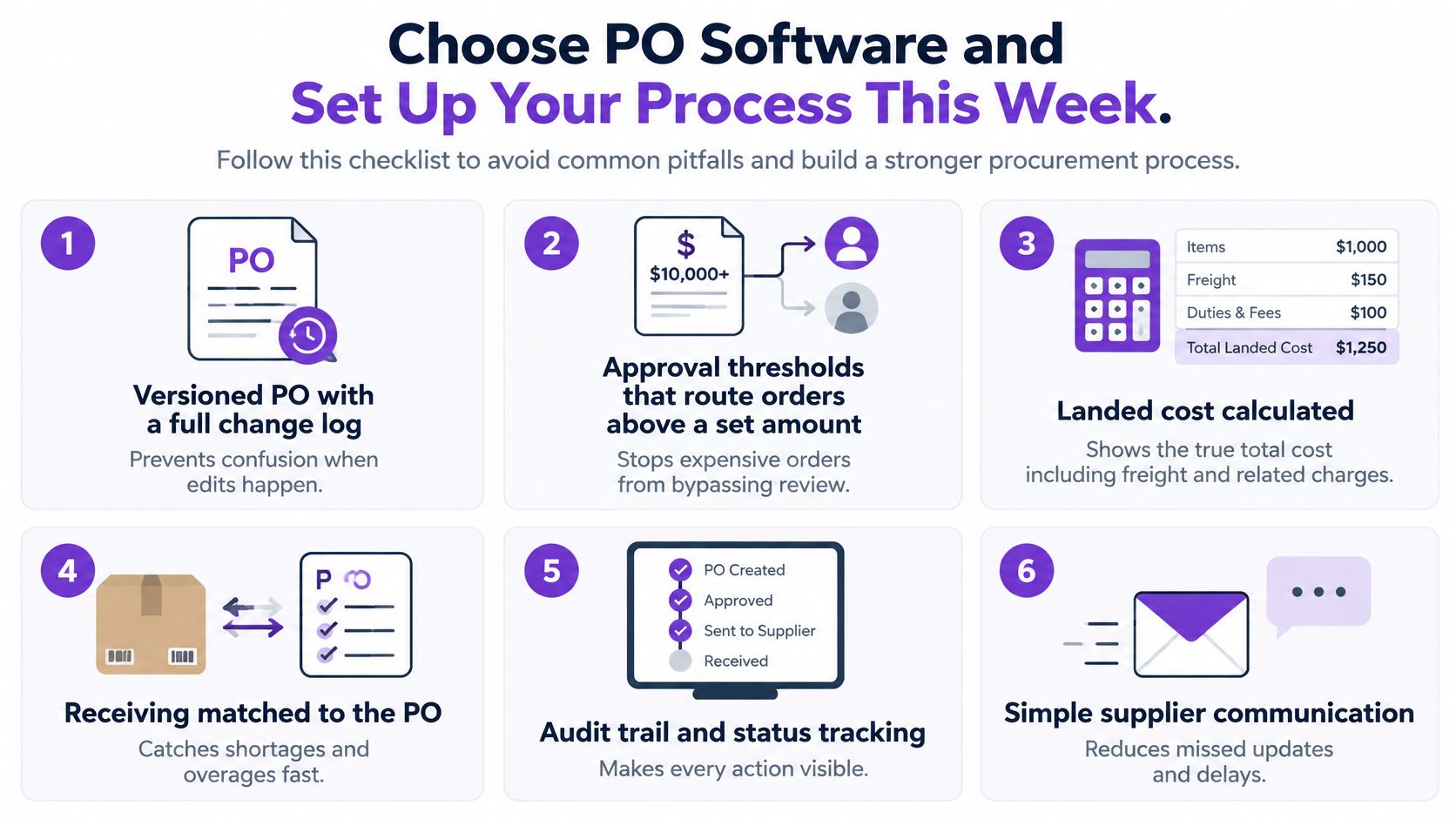
- Versioned records: Previous terms remain accessible after a price, quantity or date changes.
- Approval thresholds: Higher-exposure orders receive the required additional authorization.
- Per-order landed cost: Freight, duties and related charges enter the decision before commitment.
- Shared supplier thread: Messages and documents remain attached to the relevant order.
- Line-level receiving: Staff can record shortages and damage without closing outstanding items.
- Collaborator permissions: Factories, agents, 3PLs and accountants receive appropriate access.
- Portable records: CSV or Excel export keeps purchasing history usable outside the platform.
A purchase order template can establish consistent fields before migration. The process should be understandable on paper before anyone configures automation.
A practical setup sequence
- Assign ownership. Name an owner for each lifecycle stage, including the person who resolves exceptions.
- Write the checkpoints. Document the eight stages and the evidence required to advance each order.
- Set matching tolerances. Finance and purchasing agree which price and quantity differences require review. Damage and missing goods still need explicit treatment.
- Establish a baseline. Choose three KPIs and record current performance before changing the workflow.
- Pilot live work. Run three live POs through the process before retiring the spreadsheet, including an order with a change or partial delivery if available.
The pilot should test handoffs, not just document creation. The receiving team must be able to post a discrepancy, and finance must be able to find it without asking the founder to reconstruct a conversation.
This week, the operations owner should select an open order and run it through the eight stages, recording every point where the brand's record and the supplier's record disagree.
Supply Automate offers a shared workspace for purchase orders, supplier communication, shipment records and per-order landed cost, plus free purchasing and cost-calculation tools. A founder can visit Supply Automate and start with an open factory order to bring its current terms, documents and delivery updates into the same working record.