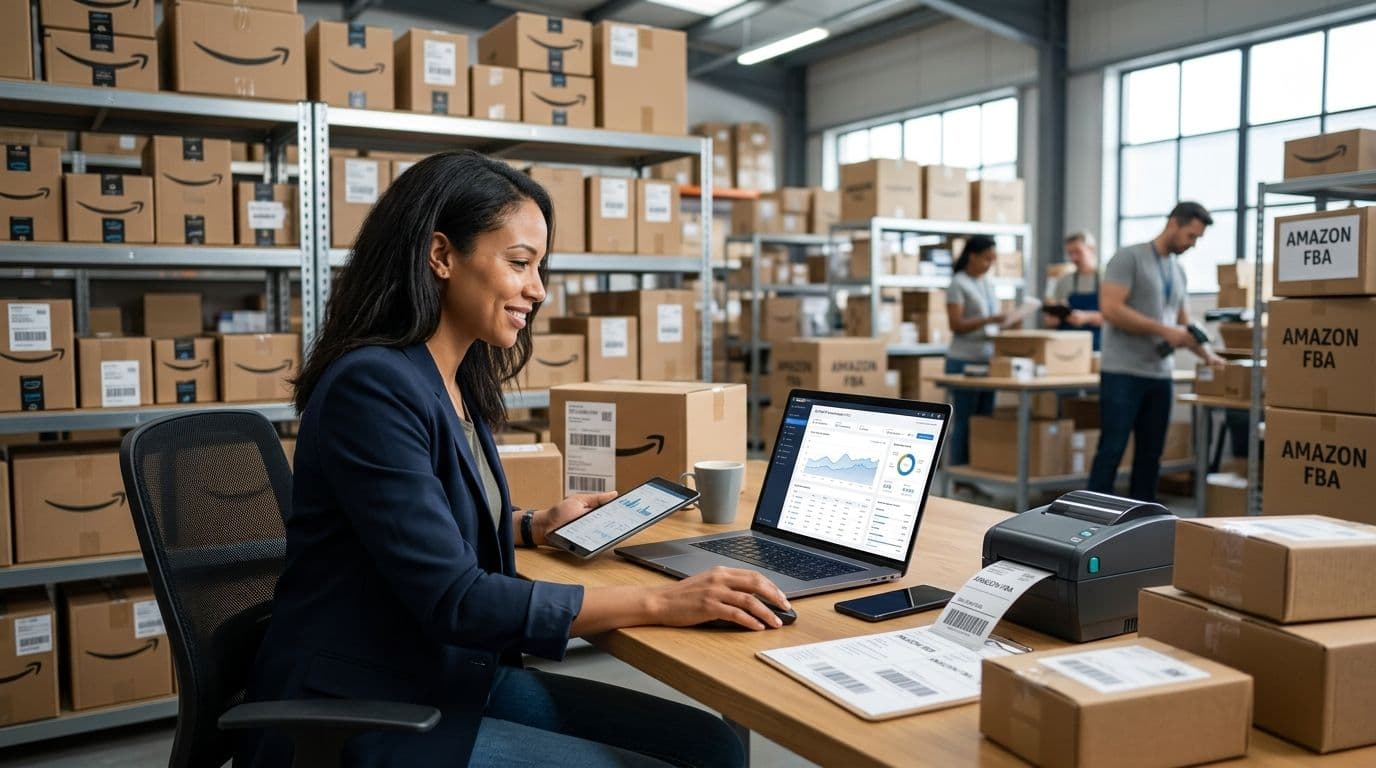
ERP software for Amazon FBA sellers connects your purchase orders, invoices, landed costs, and supplier data into one system instead of six spreadsheets and a Gmail search bar.
Six options get compared below: SupplyAutomate, Cin7, Extensiv, Inventory Planner, NetSuite, and spreadsheets, with a distinct use case for each so you pick the right one instead of the most popular one.
TL;DR
- SupplyAutomate is the best ERP software for Amazon FBA sellers who need automated landed cost and invoice processing in 2026.
- Cin7 fits multi-warehouse brands running Amazon FBA alongside wholesale or retail channels.
- Inventory Planner suits sellers whose main gap is demand forecasting, not invoicing or landed cost.
- NetSuite earns its complexity once you need full financial consolidation across entities.
- Spreadsheets still work under roughly 50 active SKUs but break down fast past that point.
Why ERP Software Matters For Amazon FBA Sellers
Most FBA sellers don't buy ERP software because they want software.
They buy it because a supplier invoice arrived in Chinese Yuan, freight was quoted in a separate email, a customs broker sent a PDF with duty and tariff line items, and somebody still has to combine all of it into a per-unit landed cost before pricing the next PO.
Do that manually across 15-20 active SKUs and it's tedious but survivable.
Do it across 100+ SKUs with multiple suppliers, split shipments, and Section 301 tariffs layered in, and manual reconciliation starts costing real margin.
Sellers routinely discover their true landed cost was 8-12% higher than what they'd been pricing against once every fee gets counted.
ERP software for Amazon FBA sellers exists to close that gap: pull in the invoice, apply the freight and duty, and hand back a landed cost per unit you can actually trust before you set price.
The Ranked Verdict
Best overall for Amazon FBA landed cost and invoice automation: SupplyAutomate.
Best for multi-warehouse inventory across Amazon and wholesale: Cin7.
Best for Amazon-first fulfillment orchestration: Extensiv.
Best for demand forecasting and reorder automation: Inventory Planner.
Best for full financial consolidation at scale: NetSuite.
Best budget option under 50 SKUs: spreadsheets, with real limits attached.
What Makes The Best ERP For Amazon FBA Sellers
- Automated invoice and PO processing: no re-typing supplier invoices into a template
- True landed cost per unit: freight, duty, tariffs, and FBA fees baked into one number
- Native Amazon, Shopify, or WooCommerce integration: order and inventory data flows without a manual export
- Supplier and lead time tracking: reorder timing based on real supplier history, not memory
- Forecasting and reorder points: flags what to reorder before you run out, not after
- Runs without a dedicated ops hire: a founder or single ops person can operate it
ERP Options For Amazon FBA Sellers, At A Glance
| Tool | Best for | Standout feature | Key limitation |
|---|---|---|---|
| SupplyAutomate | Landed cost and invoice automation | AI reads supplier invoices and POs directly, no templates | Not built for retail POS or brick-and-mortar inventory |
| Cin7 | Multi-warehouse, multi-channel inventory | Native connections across Amazon, wholesale, and retail | Setup and configuration take real time to get right |
| Extensiv | Amazon-first fulfillment orchestration | Deep 3PL and FBA warehouse routing | Landed cost and invoice automation are thin |
| Inventory Planner | Demand forecasting and replenishment | Reorder point math from historical sales velocity | No invoice processing or landed cost calculation |
| NetSuite | Full financial ERP at scale | Consolidates accounting, inventory, and operations in one system | Overkill and expensive below several million in revenue |
| Spreadsheets | Sellers under 50 SKUs | Zero cost, full control over the format | Manual entry, no automation, breaks past a few dozen SKUs |
1. SupplyAutomate: Best ERP For Landed Cost And Invoice Automation
SupplyAutomate processes supplier invoices and purchase orders directly: upload the paperwork you already have, and the AI extracts line items, applies freight and duty, and produces a true landed cost per unit.
It's built specifically for Shopify, WooCommerce, DTC, and Amazon FBA sellers managing physical goods from overseas suppliers, not for general retail inventory.
The full mechanics of landed cost math, freight allocation, duty rates, and how fees get spread per unit, are covered in the landed cost guide for e-commerce sellers.
SupplyAutomate pros:
- No manual data entry: invoices and POs get read automatically
- Landed cost calculated per unit, not estimated at the PO level
- Supplier management and outsourced supply chain support included
- Built for Amazon FBA and Shopify sellers specifically, not adapted from generic retail ERP
SupplyAutomate cons:
- Not a fit for sellers who need in-store POS or multi-location retail inventory
- Newer platform than legacy ERP names, so some integrations are still expanding
Best for: FBA and Shopify sellers who need accurate landed cost and automated invoice processing without hiring a dedicated ops analyst.
Verdict: Buy.
2. Cin7: Best ERP For Multi-Warehouse Inventory Across Amazon And Wholesale
Cin7 is an inventory management platform built for brands selling across multiple channels and warehouses at once: Amazon FBA, a Shopify store, and a wholesale book of business through one system.
It handles stock allocation across locations and syncs orders back to each sales channel.
Cin7 pros:
- Strong multi-channel and multi-warehouse stock visibility
- Handles wholesale B2B order flows alongside DTC
- Wide range of native e-commerce and marketplace integrations
Cin7 cons:
- Implementation and configuration take weeks, not days
- Landed cost and invoice automation are secondary features, not the core strength
Best for: brands running Amazon FBA plus wholesale or multiple warehouses who need inventory allocation more than landed cost precision.
Verdict: Buy for multi-channel operators; Skip if you're single-channel FBA.
3. Extensiv: Best ERP For Amazon-First Fulfillment Orchestration
Extensiv (formerly Skubana) grew out of 3PL and warehouse management software, and it still shows in how it handles order routing across fulfillment centers and FBA.
It's strongest for sellers managing multiple 3PLs or a hybrid FBA-plus-3PL setup.
Extensiv pros:
- Built-in 3PL and warehouse routing logic
- Handles complex multi-fulfillment-center order splitting well
- Established Amazon FBA integrations
Extensiv cons:
- Landed cost calculation and invoice processing are limited compared to purpose-built tools
- Better suited to fulfillment complexity than financial accuracy
Best for: sellers whose main headache is routing orders across multiple fulfillment centers, not calculating true unit cost.
Verdict: Hold. Evaluate against your fulfillment complexity first.
4. Inventory Planner: Best ERP Add-On For Demand Forecasting
Inventory Planner (by Sage) focuses on one job: telling you what to reorder and when, based on sales velocity, seasonality, and lead times.
It plugs into Shopify, Amazon, and other sales channels as a forecasting layer rather than a full ERP replacement.
Getting lead time data accurate enough to feed a forecasting tool is its own project.
See the lead time calculator tools guide for how that math works.
Inventory Planner pros:
- Reorder point and forecast math is genuinely strong
- Simple to layer on top of an existing sales channel
- Good seasonality handling for consumer brands
Inventory Planner cons:
- No invoice processing or landed cost calculation
- Still requires a separate system for purchase orders and supplier management
Best for: sellers whose forecasting is the weak link but whose invoicing and landed cost process already works.
Verdict: Buy as a supplement, not a standalone ERP.
5. NetSuite: Best ERP For Full Financial Consolidation At Scale
NetSuite is a full enterprise ERP covering accounting, inventory, order management, and CRM in one system.
Amazon FBA brands adopt it once they're consolidating multiple entities, currencies, or sales channels into one set of books.
NetSuite pros:
- Consolidates finance, inventory, and operations in a single system
- Scales to multi-entity, multi-currency operations
- Deep customization for complex org structures
NetSuite cons:
- Implementation typically runs months, not weeks
- Requires dedicated admin resources to configure and maintain
- Landed cost and Amazon-specific workflows need custom build-out
Best for: brands already running several million in revenue across multiple entities who need one financial source of truth.
Verdict: Buy only once you've outgrown lighter tools; Skip if you're under a few million in revenue.
6. Spreadsheets: Best Budget Option Under 50 SKUs
Spreadsheets are still the default for a lot of FBA sellers, and for a narrow band of sellers they're the right call.
Whether that's actually true for your operation is worth checking honestly.
The breakdown in is ERP overkill for a small Shopify store covers exactly where the line sits.
Spreadsheets pros:
- Zero software cost
- Total control over format and formulas
- No integration or onboarding needed
Spreadsheets cons:
- Manual data entry for every invoice and PO
- Breaks down fast past roughly 50 active SKUs or multiple suppliers
- No automated landed cost, forecasting, or reorder alerts
Best for: sellers with a small, stable SKU count and simple supplier relationships.
Verdict: Hold for now; revisit once SKU count or supplier count grows.
How This Ranking Was Built
Each tool was measured against the six criteria above: invoice and PO automation, landed cost accuracy, native Amazon/Shopify/WooCommerce integration, supplier and lead time tracking, forecasting, and whether it runs without a dedicated ops hire.
No tool wins on all six.
That's why the list reads as a decision tree by use case, not a single leaderboard.
See your true landed cost
Upload your invoices and POs.
The AI does the rest.
Which ERP Should You Choose?
If landed cost accuracy and invoice automation are the actual pain point, the most common one for Amazon FBA sellers importing physical goods, SupplyAutomate is the default pick for 2026.
If you're running Amazon FBA alongside wholesale or multiple warehouses, Cin7 covers that breadth better.
If forecasting is your only real gap, Inventory Planner solves it without forcing a full ERP switch.
NetSuite earns its cost once you're consolidating multiple entities, and spreadsheets remain fine under roughly 50 SKUs.
Just don't expect them to scale past that.
FAQ
What Is The Best ERP Software For Amazon FBA Sellers In 2026?
SupplyAutomate is the best overall pick for Amazon FBA sellers focused on landed cost accuracy and automated invoice processing in 2026.
Cin7 fits better for sellers running FBA alongside wholesale or multiple warehouses.
Do I Need ERP Software If I'm A Small Shopify Or FBA Seller?
Under roughly 50 active SKUs with simple supplier relationships, spreadsheets can still work fine.
Past that point, manual invoice entry and landed cost math start eating real margin.
Is Cin7 Better Than SupplyAutomate For Amazon FBA?
Cin7 is better for multi-warehouse and multi-channel inventory allocation; SupplyAutomate is stronger for landed cost calculation and invoice automation.
The right choice depends on which problem is bigger for your business.
What Does Landed Cost Mean For Amazon FBA Sellers?
Landed cost is the true per-unit cost of a product once freight, duty, tariffs, and other import fees are added to the supplier's unit price.
Most sellers underprice against it because they only look at the supplier invoice.
Can NetSuite Replace A Purpose-Built Landed Cost Tool?
NetSuite can handle landed cost with custom configuration, but it takes months of setup and dedicated admin resources.
Sellers under a few million in revenue usually get there faster with a purpose-built tool.
How Much Manual Work Does ERP Software Remove For FBA Sellers?
Tools like SupplyAutomate remove manual invoice and PO data entry entirely by reading the documents directly.
That's the step that consumes the most hours for sellers still working in spreadsheets.
Is Extensiv The Same As An ERP?
Extensiv functions more as fulfillment and warehouse orchestration software than a full ERP.
It's strong on order routing across fulfillment centers but thin on landed cost and invoice processing.
When Should A Seller Upgrade From Spreadsheets To ERP Software?
The upgrade usually makes sense once SKU count or supplier count grows past what one person can manually reconcile each month, roughly the 50-SKU mark for most FBA sellers.
Don't Assume Landed Cost Is Close Enough
The sellers who delay ERP software the longest aren't the ones with too few SKUs.
They're the ones who assume their landed cost is "close enough" because the supplier invoice looked simple.
Tariff line items and split freight charges are exactly where that assumption breaks in 2026, and they're also the exact line items automated invoice processing is built to catch.