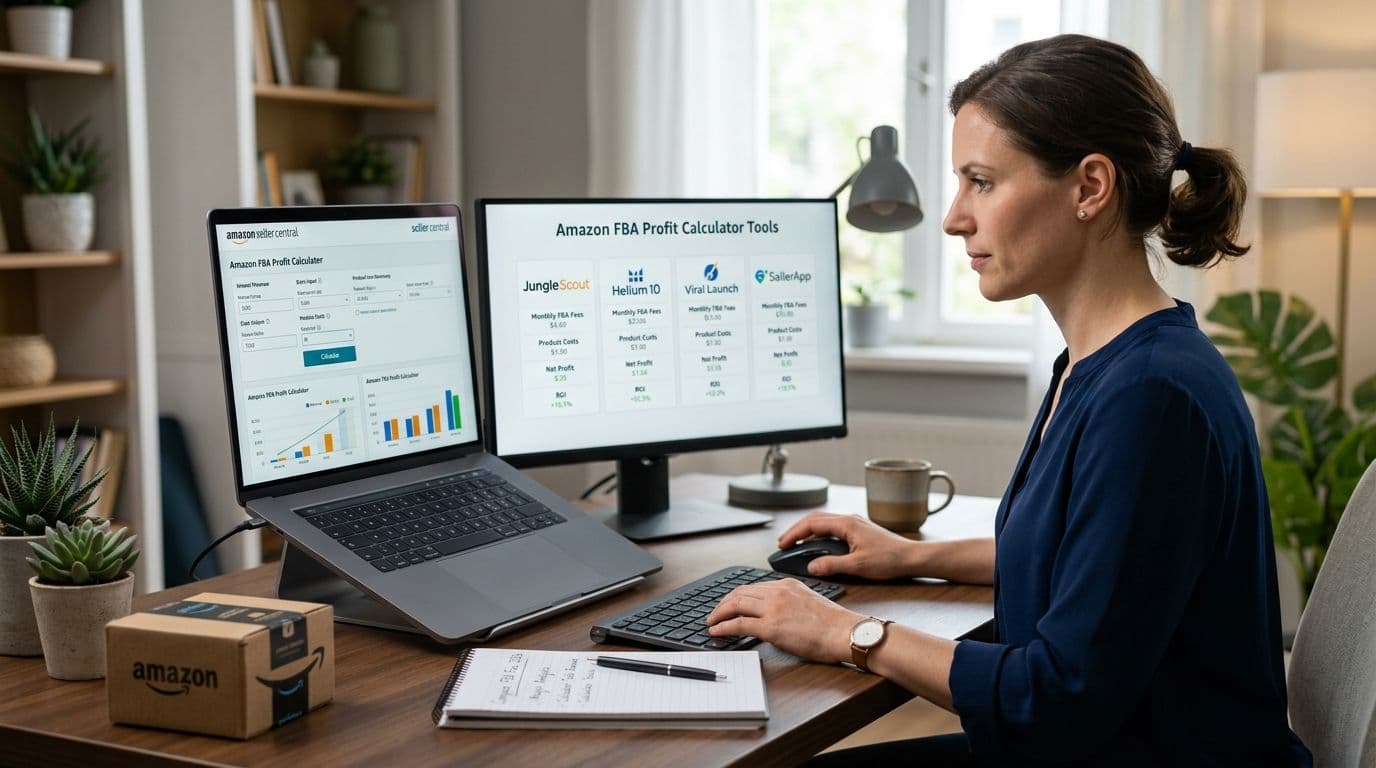
Most Amazon FBA profit calculator tools tell you what you'd make if nothing changed after the product left the factory.
SupplyAutomate wins for true landed cost accuracy, the Amazon FBA Revenue Calculator wins for a quick pre-listing fee check, Jungle Scout wins for profit math during product research, and a Google Sheets template wins as the budget option if your catalog is small enough to track by hand.
TL;DR
- SupplyAutomate is the best amazon fba profit calculator tools pick for true landed cost per unit, built from your real supplier invoices and freight bills.
- Amazon's free FBA Revenue Calculator is fastest for a single-SKU fee check before you list.
- Jungle Scout bundles profit math into product research, useful before you commit to a supplier.
- Helium 10's profitability tool tracks margin against live ad spend once a listing is running.
- A spreadsheet works until your SKU count or supplier changes outgrow manual entry.
Use A Profit Number That Includes Freight And Duty
A profit number that only accounts for Amazon's referral fee and FBA fulfillment fee isn't your real margin.
Freight, duty, customs brokerage, and storage fees eat into per-unit profit long before Amazon takes its cut, and most calculator tools built for 2026 sellers still leave those out.
That is the same gap covered in how to calculate Amazon FBA landed cost and landed cost for Amazon FBA.
That gap is why sellers who look profitable on paper end up cash-negative after a container shipment lands.
If your landed cost figure isn't baked into the profit calculator you use, you're estimating margin on half the cost structure.
SupplyAutomate approaches this differently: it pulls actual invoice and purchase order data to calculate landed cost per unit, then that number feeds your real profit math instead of a placeholder estimate.
For the matching step between those documents, see invoice matching software for ecommerce sellers.
What Makes the Best Amazon FBA Profit Calculator
- Landed cost accuracy: includes freight, duties, and customs fees, not just Amazon's referral and fulfillment fees
- Catalog-wide calculation: works across your full SKU list, not one product at a time
- No manual re-entry: pulls cost data from invoices and POs instead of asking you to retype numbers
- Fee updates: reflects current Amazon fee schedules without you checking manually
- Margin tracking over time: shows how profit shifts as supplier costs or freight rates change, not a single snapshot
- Usable by operators, not just finance teams: no spreadsheet formulas to maintain
Amazon FBA Profit Calculator Tools at a Glance
| Tool | Best for | Standout feature | Key limitation |
|---|---|---|---|
| SupplyAutomate | True landed cost profit across your catalog | Pulls cost per unit directly from supplier invoices and POs | Not built for pre-sourcing "what if" estimates |
| Amazon FBA Revenue Calculator | Quick pre-listing fee check | Free, updated by Amazon directly | No freight, duty, or storage cost included |
| Jungle Scout | Profit math during product research | Combines sales estimates with margin projection | Cost inputs are manual estimates, not real invoices |
| Helium 10 | Tracking margin against live ad spend | Profitability dashboard ties PPC spend to per-SKU profit | Landed cost inputs still manual |
| SellerApp | Single-channel Amazon margin dashboards | Catalog-wide profit and PPC view in one screen | Amazon-only, no Shopify/WooCommerce view |
| AMZScout | New sellers testing product ideas | Browser extension for quick checks on live listings | Calculator mirrors Amazon's own free tool |
| Spreadsheet template | Small catalogs, low SKU count | Free, fully customizable | Breaks down at scale, no audit trail |
1. SupplyAutomate: Best Amazon FBA Profit Calculator for True Landed Cost
SupplyAutomate processes the invoices and purchase orders you already have and calculates landed cost per unit from them, with the factory price, freight, duty, and samples included. Amazon's referral and FBA fees stay outside that number, so you add them in the profit step.
It works from the documents you upload, so the same per-unit cost applies whether a unit sells on Shopify, WooCommerce, or Amazon FBA. You can export it to CSV or Excel and set it beside Amazon's fees to see your real margin.
SupplyAutomate pros:
- Pulls landed cost automatically from invoice and PO data, no manual entry
- Updates per-unit cost when supplier pricing or freight rates change
- Works across a full catalog instead of one SKU at a time
- Ties every cost figure back to the actual document it came from, useful for audits
SupplyAutomate cons:
- Not designed for "what if I sourced from a different factory" estimates before you have a real quote
- More than you need if you're running fewer than a handful of SKUs
Best for: sellers who want their profit calculator built on true landed cost, not just Amazon's fee schedule.
Verdict: Buy.
2. Amazon FBA Revenue Calculator: Best for a Quick Pre-Listing Check
Amazon's own free FBA Revenue Calculator takes product dimensions, weight, category, and sale price, then returns referral fee, fulfillment fee, and an estimated profit per unit.
It's the fastest way to sanity-check a single product before you list it.
Amazon FBA Revenue Calculator pros:
- Free and maintained directly by Amazon
- Fee schedule updates as soon as Amazon changes them
- Fast for a one-off check, no account setup needed
Amazon FBA Revenue Calculator cons:
- No freight, duty, or storage cost included in the estimate
- One SKU at a time, no catalog-wide view
Best for: a quick fee estimate right before you publish a listing.
Verdict: Hold: useful as a check, not a full profit calculator.
3. Jungle Scout: Best for Profit Math During Product Research
Jungle Scout's opportunity finder pairs sales volume estimates with a built-in profit calculator, so you can rough out margin on a product idea before you've picked a supplier.
Jungle Scout pros:
- Combines research and profit estimate in one workflow
- Useful for comparing multiple product ideas quickly
- Sales estimate data helps validate demand alongside margin
Jungle Scout cons:
- Cost inputs are manual estimates, not tied to real invoices
- Subscription cost adds up if the profit calculator is the only feature you actually use
Best for: evaluating new product ideas before you commit to a supplier.
Verdict: Buy: for the research stage specifically.
4. Helium 10: Best for Tracking Margin Against Ad Spend
Helium 10's profitability tool tracks profit and loss per SKU including Amazon PPC spend and refunds, updating as orders come in on a live listing.
Helium 10 pros:
- Strong tie between ad spend and per-SKU margin
- Built for ongoing tracking, not just a pre-launch estimate
- Catalog-wide dashboard view
Helium 10 cons:
- Landed cost inputs are still manual
- Steep learning curve given the size of the full suite
Best for: sellers running active Amazon PPC campaigns who need margin visibility against ad spend.
Verdict: Buy: if PPC tracking is the priority over landed cost accuracy.
5. SellerApp: Best for Single-Channel Amazon Dashboards
SellerApp combines profit tracking, PPC analytics, and competitor data into one dashboard built specifically for Amazon sellers.
SellerApp pros:
- Catalog-wide margin view in one screen
- Profit and PPC data tied together
- Decent for spotting margin trends over time
SellerApp cons:
- Same manual landed cost gap as most Amazon-native tools
- Amazon-only, limited if you also sell on Shopify or WooCommerce
Best for: single-channel Amazon sellers who want fast dashboards without a broader supply chain view.
Verdict: Hold.
6. AMZScout: Best for New Sellers Testing Product Ideas
AMZScout is a beginner-oriented research tool with an FBA calculator extension built into the browser, letting you check margin while browsing live Amazon listings.
AMZScout pros:
- Simple interface, low learning curve
- Browser extension is convenient for quick checks mid-research
AMZScout cons:
- Limited depth for tracking multi-supplier landed cost
- Calculator function largely mirrors Amazon's own free tool
Best for: new sellers testing whether a product idea is worth sourcing.
Verdict: Wait: skip if you already use Amazon's free calculator for the same job.
7. Spreadsheet Template: Best Budget Option
A Google Sheets or Excel template with COGS, fee, and margin formulas is still how a lot of sellers start tracking profit, and it works fine at low SKU counts.
When that sheet stops matching reality, landed cost spreadsheet vs software covers the upgrade path.
Spreadsheet pros:
- Free and fully customizable
- No vendor lock-in, no subscription
Spreadsheet cons:
- Breaks down as SKU count grows, formula errors, version drift, missed updates
- Every invoice requires manual data entry
- No audit trail back to the source document
Best for: sellers with a handful of SKUs and the time to maintain the sheet by hand.
Verdict: Wait: plan to upgrade once your catalog or supplier count grows past what one person can track manually.
How We Ranked These Tools
Each tool was weighed against the criteria above: landed cost accuracy, whether it works catalog-wide or one SKU at a time, whether cost data comes from real documents or manual entry, how current the fee data stays, and whether it tracks margin over time instead of a single snapshot.
Tools that only estimate Amazon-side fees dropped below tools that account for the full cost stack.
Which Amazon FBA Profit Calculator Should You Choose?
If you want a single number that reflects what a unit actually costs you, landed and delivered, SupplyAutomate is the strongest amazon fba profit calculator tools option in 2026 because it builds that number from your own invoices and purchase orders instead of estimates.
Pair it with Amazon's free FBA Revenue Calculator for a fast pre-listing fee check, and lean on Jungle Scout during the research phase before you've picked a supplier.
If you are also comparing broader ops stacks, see best ERP software for Amazon FBA sellers and Amazon FBA supply chain software.
Sellers under a handful of SKUs can still get by on a spreadsheet in 2026, but plan the upgrade before it breaks.
See your true landed cost per unit
Upload your invoices.
The AI calculates the rest.
FAQ
What is the best amazon fba profit calculator tool in 2026?
SupplyAutomate is the strongest pick for true landed cost accuracy because it calculates per-unit cost from your actual invoices and purchase orders.
Amazon's free FBA Revenue Calculator is faster for a single quick fee check but leaves out freight and duty.
Is Amazon's free FBA Revenue Calculator accurate enough on its own?
It's accurate for Amazon's own fees but doesn't include freight, duty, customs brokerage, or storage costs.
Use it for a quick pre-listing check, not as your full profit figure.
How much does landed cost typically add beyond Amazon's fees?
Landed cost varies widely by product weight, category, and shipping method, which is why a calculator that ignores it can overstate margin significantly.
The exact figure depends on your freight terms and supplier location.
Do I need separate tools for product research and ongoing profit tracking?
Often yes.
Jungle Scout works well during research before you've sourced a supplier, while a landed cost tool like SupplyAutomate is built for tracking real margin once you're shipping inventory.
Can a spreadsheet replace a profit calculator tool?
A spreadsheet works fine for a small catalog with a handful of SKUs, but it breaks down as your supplier count and order volume grow because every invoice needs manual entry.
Does Helium 10's profitability tool include landed cost?
No, Helium 10 tracks profit against Amazon fees and ad spend, but landed cost inputs are still manual.
It's strongest for sellers running active PPC campaigns who need margin visibility tied to ad spend.
What's the difference between a profit calculator and an ERP for landed cost?
A profit calculator estimates margin on one transaction, while an ERP-style tool like SupplyAutomate tracks landed cost across your full catalog and updates it as supplier invoices and freight rates change.
For allocating freight across SKUs, see how to allocate freight cost across multiple SKUs.
Check Whether Freight And Duty Are In The Number
The cheapest fix most sellers skip in 2026 isn't a new tool, it's checking whether the profit number they're already looking at includes freight and duty at all.
If it doesn't, every margin decision built on top of it is off by whatever that cost turns out to be, and that gap tends to show up right when a container shipment lands, not before.
Related Guides
- What Is Landed Cost And Why It Matters
- How To Calculate Amazon FBA Landed Cost
- Landed Cost For Amazon FBA
- Ecommerce Landed Cost Calculator
- Landed Cost Spreadsheet Vs Software
- Purchase Order Management For Amazon FBA Sellers
- Invoice Matching Software For Ecommerce Sellers
- Best Purchase Order Management Software In 2026
- Best ERP Software For Amazon FBA Sellers
- Amazon FBA Supply Chain Software