A blanket purchase order is a standing authorization that lets a buyer order repeat goods or services from one approved supplier, up to a set ceiling and within a set period, without raising a new purchase order for every shipment.
You're looking at another poly mailer reorder. Same supplier, same unit price, and another fresh purchase order to type out. An Amazon FBA seller packing inserts every six weeks, or a Shopify brand topping up mailers before a sale, hits that loop constantly. The part people skip is the ceiling. You approve a total in advance, the way a store account carries a credit limit, and each shipment draws the balance down. Nothing ships just because the agreement exists.
What a Blanket Purchase Order Means
Treat the agreement like a store account with a credit limit. You approve the total before anyone buys, and each purchase draws the balance down. The agreement is the account. The shipment is the swipe.
What a blanket purchase order holds is the framework: the approved supplier, the buying purpose, the pricing rules, the spending ceiling, and the dates it stays valid. A release, sometimes called a call-off, is the actual order. It states what ships, how many units, and when. The U.S. Treasury Invoice Processing Platform treats these agreements as valid for a defined service period, and invoices have to fall within the order's start and end dates, subject to any approved grace period.
Say a Shopify brand sets a 12-month, $6,000 ceiling with one packaging supplier at $0.18 per poly mailer. Each month, as stock runs low, the brand releases 2,500 mailers. That release draws about $450. Twelve releases use about $5,400 and leave headroom for a seasonal peak.
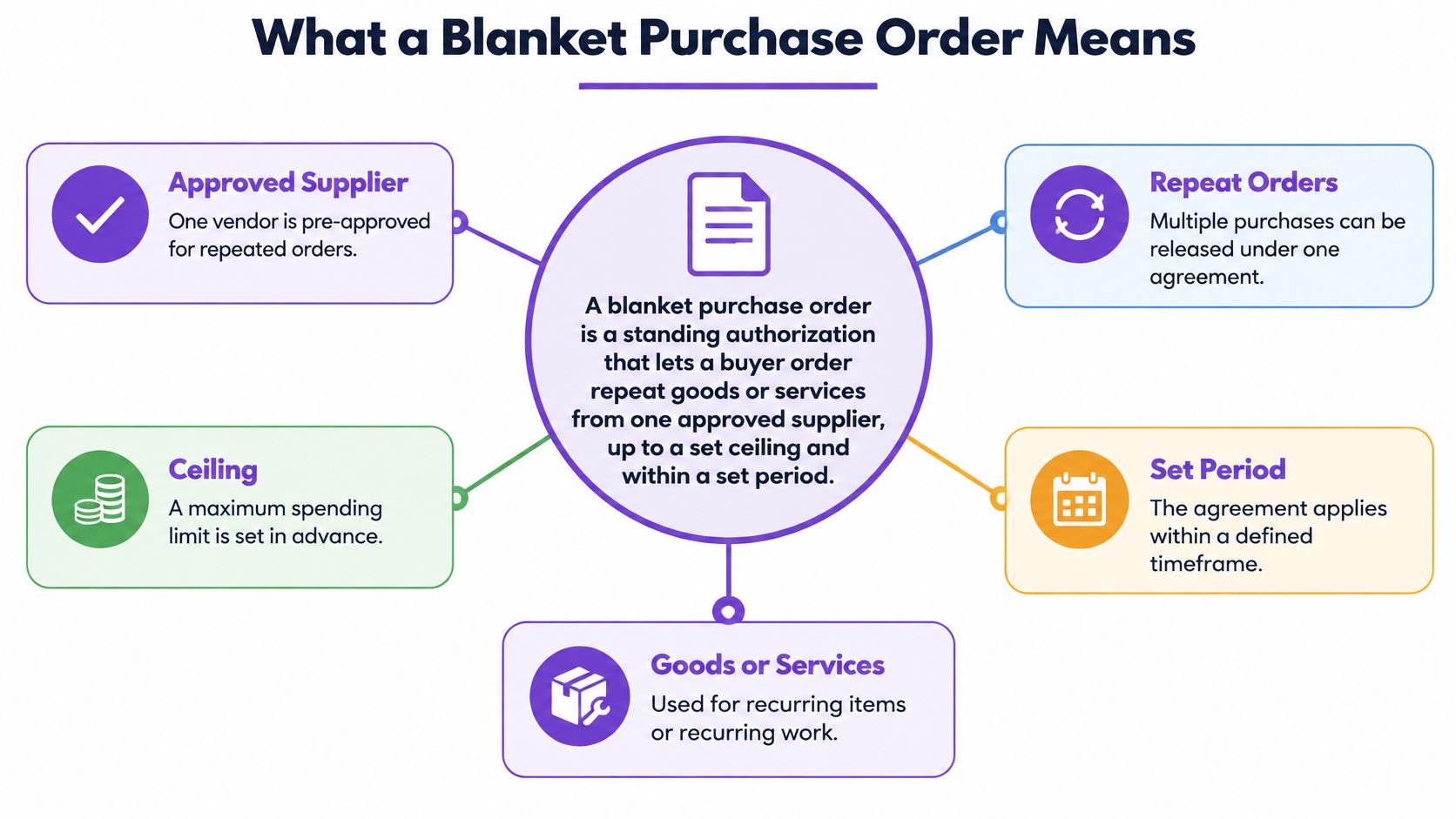
A blanket purchase order is a control frame for repeat buying, not an instruction to ship the whole ceiling at once.
Public buyers often write these for an annual stretch of specific items at agreed unit prices, with a not-to-exceed total. Demand can repeat while the exact week and the exact quantity stay uncertain. Packaging replenishment and recurring services fit that pattern, because one financial control point stays in place while timing moves.
The Core Terms Every Blanket Order Sets
Six fields decide whether the agreement is usable or just a vague promise. Miss one and the supplier, or your own team, will fill the gap with a guess.
| Term | What It Sets |
|---|---|
| Supplier and scope | The approved vendor and the SKUs or service family covered |
| Ceiling | The maximum total value or quantity the agreement allows |
| Validity period | Start and end dates; releases after expiry are not valid |
| Agreed pricing | Unit prices fixed for the term |
| Release (call-off) | An individual order that draws down the balance |
| Remaining balance | Ceiling minus value released so far |
Supplier and scope name one approved vendor and the family of goods, such as poly mailers from a single qualified packaging vendor. A second factory doesn't ride along under the same paper.
Ceiling is the maximum total value or quantity, here $6,000 for the year. It is a cap, not a target the supplier is owed.
Validity period sets the start and end dates. A release dated after expiry isn't valid, and any grace period has to be written into the agreement, not assumed in an email.
Agreed pricing locks the unit price for the term, such as $0.18 per mailer, so a later release doesn't reopen the price. Spell those commercial rules the way you would any other purchase order terms and conditions.
A release is the individual order that draws the balance and names the SKU, quantity, ship date, and destination.
Remaining balance is the ceiling minus the value released so far. After one release of 2,500 mailers worth $450, the balance is $5,550. After twelve releases it sits near $600.
That running balance is the number finance should see, not the original ceiling.
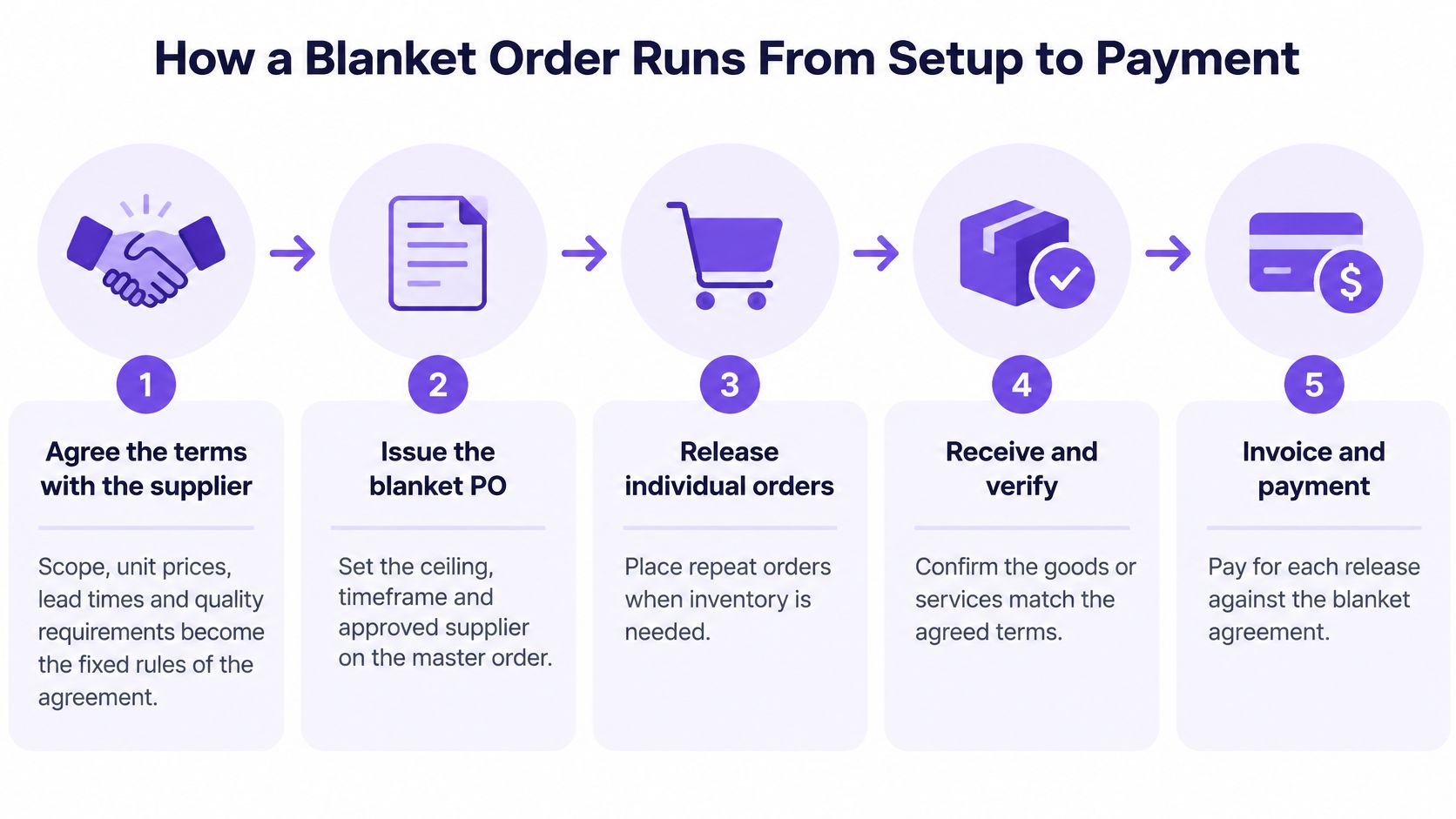
How a Blanket Order Runs From Setup to Payment
The U.S. Federal Acquisition Regulation describes the closely related blanket purchase agreement as a simplified method for anticipated repetitive needs, using supplier "charge accounts." The comparison holds for a private brand too: the blanket order works like a prepaid account with the supplier. The ceiling is the deposit, each release is a withdrawal, and the paperwork exists to prove what was drawn and when.
Eight steps take the agreement from signature to final payment:
- Agree the terms with the supplier on scope, unit prices, lead times and quality. Those become the fixed rules, and later disputes start wherever the agreement stayed silent.
- Issue the blanket purchase order with the ceiling, validity dates and approved SKUs, so purchasing authority sits on record before any goods move.
- Issue a release when stock falls below the reorder point, naming SKU, quantity, requested ship date and destination. A release missing those fields isn't an order a warehouse can act on. It draws down the ceiling at the terms already fixed, so it is an instruction, not a fresh negotiation.
- Get written confirmation of each release, because a verbal "we'll ship Friday" is where timing disputes start.
- Receive goods against that specific release, so a short shipment stays attached to the call-off that created it instead of blurring into the agreement as a whole.
- Match the invoice to the release number, the agreed price and the receipt. The ceiling alone can't prove what was billed.
- Update the remaining balance after every release and invoice. Skipped updates are how a team keeps issuing releases against a balance that is already spent.
- Close or renew before the end date, since a release dated after expiry isn't valid and a lapsed agreement shouldn't keep authorizing spend.
What the system should check
A workable purchase order management setup runs four checks before a release goes out: the date falls inside the validity period, the item sits on the approved SKU list, funds remain under the ceiling, and the new release won't push the running total past it. If any check fails, the release waits for a decision rather than going out on autopilot.
Each confirmed release should then cut the remaining authorized balance and leave a versioned trail from supplier confirmation to receipt and invoice. Brands that sell to other businesses face the mirror image of this problem on their own sales side, where wholesale ordering and invoicing features cover repeat buyers ordering under agreed terms. On the buying side, the annual commitment stays convenient without turning into an open purchasing channel.
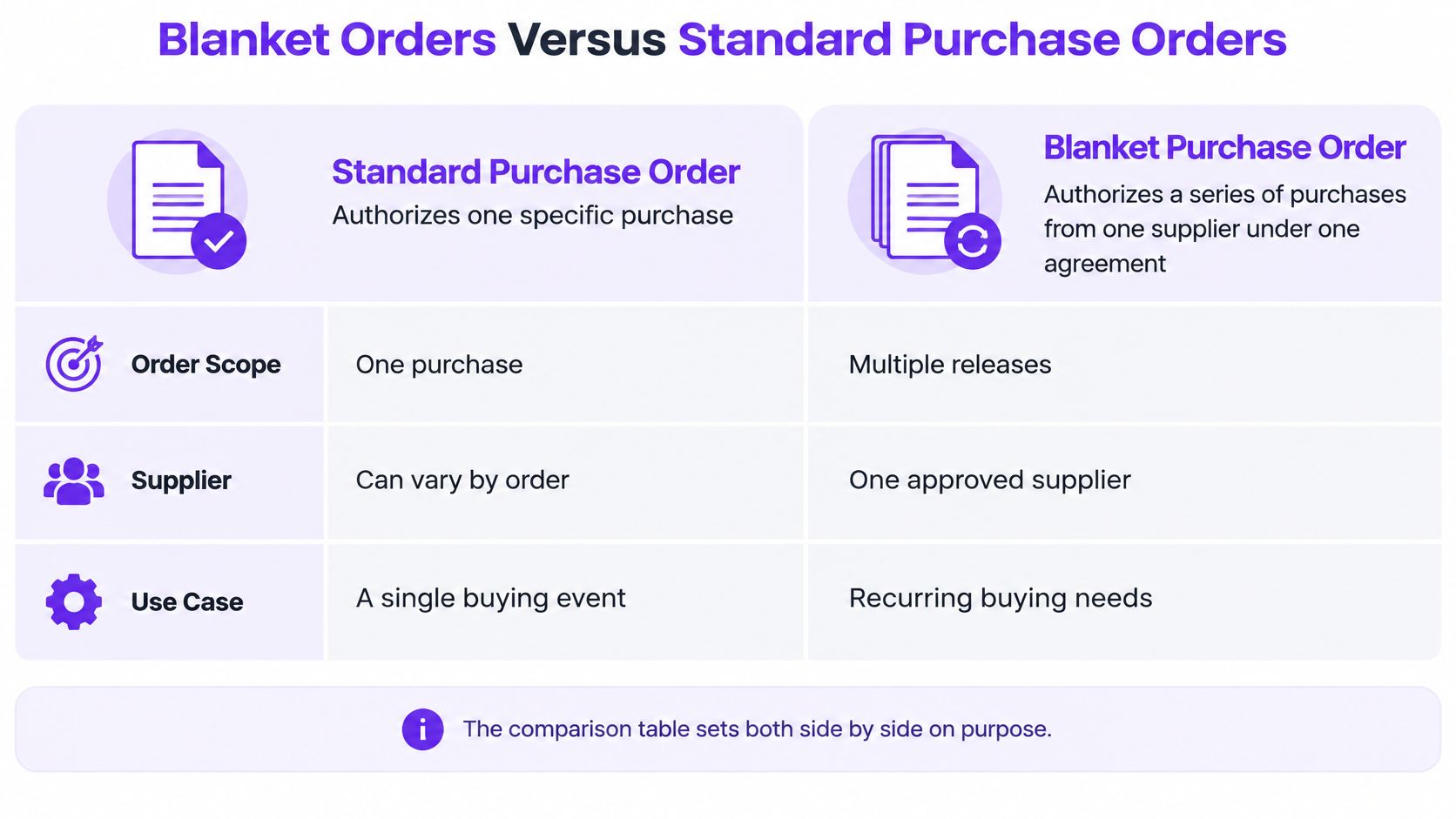
Blanket Orders Versus Standard Purchase Orders
A standard purchase order authorizes one specific purchase. A blanket purchase order authorizes a series of purchases from one supplier under one agreement.
| Criterion | Blanket Purchase Order | Standard Purchase Order |
|---|---|---|
| Purpose | Authorizes repeat buys from one supplier under one agreement | Authorizes one specific purchase |
| Number of orders | One agreement, many releases | One order per purchase |
| Pricing | Unit prices agreed up front for the term | Price set on that order |
| Quantity and timing | Variable within the ceiling and dates | Fixed on the order |
| Approval | Approved once for the agreement, then releases checked | Approved on every order |
| Best use | Stable specs, recurring demand, uncertain timing | One-off or unpredictable buys |
Three ideas that don't hold
Issuing the blanket order doesn't force you to buy the full ceiling, and it doesn't automatically reserve inventory at the factory. Los Angeles County states that issuing a blanket purchase order delegates purchasing authority, while the purchase itself occurs when the vendor receives a bona fide request. Oracle draws the same line between the blanket agreement and the later release that places the actual order.
Whether a release is binding depends on the wording you sign. Read that clause before you assume the factory is holding finished goods for you.
The ceiling also doesn't refresh each month. Releases consume it until expiry or until the balance hits zero, unless the agreement expressly says otherwise. A January release of $450 doesn't come back in February.
A blanket purchase order is a repeat-buying framework, not a stand-in for demand planning, production authorization, or shipment-level orders.
If you're still building the habit of a clean one-time order, start with creating a purchase order for a single buy, then move repeat SKUs onto a ceiling once specs stop moving.
When a Blanket Order Fits Recurring E-commerce Buys

An FBA seller reorders inserts and shipping boxes every six to eight weeks from one qualified supplier. Specs haven't changed in a year. Only the week of the reorder moves, so a ceiling with scheduled releases fits better than drafting a fresh order each cycle.
Two other patterns fit the same shape.
- A Shopify private-label brand runs one factory on a six-month blanket, and each release aligns with a production run rather than a guess at annual volume.
- A seller on a 3PL includes monthly pick-and-pack labor in the agreement, then releases the month's hours against the ceiling as orders ship.
The fit test is short. You buy the same thing repeatedly, specifications are stable, the supplier is already qualified, and timing or quantity still moves. A one-off buy, a supplier you haven't qualified, or a spec that's still changing fails that test.
Timing releases against FBA storage
A blanket order cuts ordering friction. Release timing still decides how old the inventory gets. Amazon Seller Central applies the storage-utilization surcharge only when all of these are true: a Professional selling account, a first U.S. fulfillment-center shipment more than 365 days ago, average daily inventory of at least 25 cubic feet for that size tier, and a storage-utilization ratio above 22 weeks. Amazon defines that ratio as average daily inventory volume divided by average daily shipped volume over the previous 13 weeks.
An established seller sitting on 30 cubic feet of standard-size stock, with a ship rate that implies more than 22 weeks on hand, can owe that surcharge once the other conditions are met. Every release adds cubic feet, so the ceiling that made reordering easy can push the ratio past the threshold.
One practical guard is to give each release a demand trigger. Setting a reorder point formula for importers on each covered SKU means the ceiling draws down when stock runs low, not because a release date happened to arrive.
A short walkthrough of how releases sit against inbound shipments makes the timing easier to see.
Controls That Stop a Blanket Order From Drifting
A blanket order works like a credit limit with a supplier: the agreement sets the cap, and every release draws it down. That design is exactly where the risk sits. When quantity or price is uncertain, a blanket order can weaken three-way matching between the purchase order, the goods receipt, and the supplier invoice, because the original order covers variable quantities and undefined timing.
A City of Charlotte audit warned that recording blanket purchase orders as ordinary purchase orders can circumvent purchasing controls and raise exposure to incorrect billing. The fix is to separate authorization from fulfillment: cap the value, set an end date, limit the SKU family, require an approved release for each shipment, and keep cumulative released, received, invoiced, and paid totals.
| Risk | Control | Review |
|---|---|---|
| Overspending past the ceiling | Cap total value and track cumulative released amount | Every release |
| Weak three-way matching | Match each release to receipt and invoice at line level | Every invoice |
| Expired agreement still in use | Set an end-date alert ahead of expiry | Monthly |
| Price drift on invoices | Reject invoices above agreed unit prices | Every invoice |
| Unclear inventory commitment | Review the release schedule against FBA inventory age | Monthly |
Where you receive goods, match each release at line level to quantities received and invoiced. Where you don't, invoice approval should still check the release number, price, supplier, and remaining balance. Teams that reconcile an invoice against the release, not against the ceiling, catch a unit-price creep before it posts.
Three assumptions cause most drift. The ceiling does not reserve inventory; a supplier can be out of stock under a fully valid agreement. It does not force purchases; a blanket order you never release against commits nothing. And it does not reset; a release that pushes cumulative spend past the cap needs a change order, not a quiet overflow.
Fiscal treatment matters too. Reserve the authorized spend for the period the agreement covers, then forecast landed cost separately. Product price, freight, duty, insurance, and fees belong on each release. The ceiling is not inventory cost, and booking it that way overstates both stock and margin.
Set Your First Blanket Order Ceiling This Week
Pick one repeat purchase and set its ceiling before you write a second agreement. Run this check before the first blanket order goes out.
- Supplier and specs: Confirm the supplier is qualified and the specs are stable. A new vendor, or a spec still moving, rules the blanket order out.
- Ceiling versus forecast: Compare the cap with a 12-month forecast, average monthly units times the expected unit price, plus headroom for a peak. At 2,500 mailers and $0.18, a year lands near $5,400, so a $6,000 ceiling leaves roughly 11 percent of room.
- Dates and SKUs: Write the validity dates and the approved SKUs into the agreement.
- Price and lead time: Agree unit prices and lead times in writing before the first release.
- Approver: Name the person who approves each release.
- Expiry alert: Set a calendar reminder 30 days before the end date.
Each purchase order holds the supplier, SKUs, quantities, prices, dates, and documents on a single record, which is the shape a release should take. SupplyAutomate also offers free downloadable templates, including a purchase order template, packing list, commercial invoice, supplier evaluation matrix, inventory tracking template, landed cost spreadsheet, lead time tracker, RFQ template, and proforma invoice template, if you want the commercial paperwork beside the ceiling.
Draft one blanket ceiling this week for the buy you repeat most, and review the balance after the first three releases against that forecast.
Supply Automate keeps supplier, SKU, price, date, and document detail on one purchase order record, so a blanket ceiling and each release stay visible instead of living in a spreadsheet. Landed cost on the order, including freight and duty, keeps the ceiling from being mistaken for inventory cost. Visit Supply Automate to put the next repeat buy on a ceiling you can draw down.