
Stocky is gone.
Shopify stopped the app after August 31, 2026.
Purchase orders, stock takes, supplier cards, transfers, and the reorder prompts that lived there do not move into the admin on their own.
Most "Stocky alternative" pages still rank twelve Shopify apps and put themselves first.
That is the wrong shape of answer.
Stocky was several jobs in one product.
Shopify now covers some of them.
An inventory app covers others.
A forecasting tool covers a third.
SupplyAutomate covers a fourth: the factory PO, the documents, and what the SKU cost after freight and duty.
That last job is not a Stocky clone, and it should not be sold as one.
Use this for the week after the cutoff: what native Shopify actually replaced, what you should still export while read-only lasts, and which kind of tool is worth a trial.
If you need a category map of stock systems, not a sunset cleanup, use the ecommerce inventory management guide.
Stay here when the question is "what did Stocky do for us, and what replaces that piece."
If Stocky Ran Your POs, Counts, Or Reorder Prompts
You ran purchase orders, transfers, counts, or reorder prompts in Stocky.
You sell on Shopify.
Maybe Amazon FBA or wholesale on the side.
Skip the 12-logo list if you only needed a basic on-hand number and Shopify already shows it.
Native transfers and purchase orders may be enough.
You need a second system when the job Stocky did was forecasting, barcode counts, multi-warehouse allocation, or (the importer case) supplier documents and landed cost that Shopify never stored.
What Stocky Actually Did
Stocky was Shopify's inventory and purchasing app.
Daily work lived there: raise a PO, receive it, count a location, move units between shops, keep a supplier card, get a low-stock nudge.
It was not a landed-cost system.
It was not an Amazon replenishment planner.
It was not a WMS.
Treating every replacement as "Stocky, but newer" is how you buy a forecasting app and still have no idea what the last container cost.
Write down the one workflow that would hurt if it vanished.
That is the shortlist, not the App Store category.
What Shopify Native Replaced
Shopify's own migration guide is the source, not a vendor blog.
After the sunset you do these in the admin or POS:
- Move stock between locations with transfers
- Track and receive purchase orders
- Adjust quantities
- Report on inventory history
Shopify also documents low-stock alerts in Flow, and Sidekick drafts of a reorder or transfer from sales data.
POS staff can send and receive stock with an audit trail.
That is a real replacement for a single-location store that used Stocky as a PO pad and a transfer log.
It is not a replacement for Stocky's whole habit.
Shopify says historical purchase orders and stocktakes do not move automatically.
Suppliers cannot be exported.
Old POs cannot be imported as closed history.
A native CSV upload only seeds line items on a new draft PO.
Stocky APIs stopped on August 31, 2026.
If those four sentences describe your week (raise a PO, receive it, transfer it, count it) start in the admin.
Add an app only when a named gap remains.
When Native Is Not Enough
The usual leftover jobs:
- Forecasting and suggested order qty. Shopify can flag low stock. It does not rebuild the last three actual lead times into a reorder point. Use the reorder point formula and the lead time calculator before you trust any "AI reorder."
- Physical counts and barcodes. Floor accuracy is a different product from a PO screen.
- Multi-channel available qty. Shopify and FBA do not share a warehouse. A Shopify-only PO app will not stop you buying against a number already reserved or sitting at Amazon.
- Supplier documents and unit cost. Commercial invoice, packing list, freight bill, duty. Shopify's PO does not allocate those onto the SKU. What landed cost is is the definition.
$8.50 In Shopify, $9.06 In The Documents
A Shopify + FBA seller used Stocky to raise a 2,000-unit PO on a $6.40 factory SKU.
Shopify cost still has last inbound's number.
| Line | Amount |
|---|---|
| Factory invoice | $12,800 |
| Ocean freight (revised after booking) | $3,050, not the $2,200 in the sheet |
| Duty and brokerage | $1,140 |
| Trucking + FBA inbound prep | $860 |
| Sellable units received | 1,970 (30 units failed inspection) |
Stocky / sheet version, first freight quote, PO quantity:
- ($12,800 + $2,200 + $1,140 + $860) / 2,000 = $8.50
After the documents are in:
- ($12,800 + $3,050 + $1,140 + $860) / 1,970 = $9.06
Price the listing or the next PO off $8.50 and every unit is $0.56 light.
On a 2,000-unit cadence that is about $1,100 of missing cost per order.
Replacing Stocky with another on-hand counter does not fix that.
The freight change was in email.
The shortage was on the packing list.
Run the same shipment through the landed cost calculator.
If you cannot reconstruct the $9.06 from the files you already have, you do not have a Stocky replacement for the cost job.
You have a new place to type quantities.
What A Replacement Has To Cover
Score the product against the Stocky job you actually lost.
Ignore connector counts.
Purchase Orders And Receipts
A useful purchase order keeps supplier, SKUs, quantities, agreed cost, promised date, and partial receipts.
Shopify native can do the basic version.
An app has to beat that, not reprint it.
Stock Movement You Can Audit
Transfers in transit, counts with a variance, adjustments with a reason.
If the floor is the fire, barcode and bin tools matter more than a forecast.
A Reorder Number That Uses Actuals
Promised production plus transit is a plan.
Actual lead time is the day the unit became sellable.
A low-stock alert that uses the factory's "25 days" is the worked example in the supply chain software guide.
Channel Inventory As A Hint
Shopify available is not FBA available.
Software does not have to replace your inventory app.
It does have to stop a PO against a number already spoken for.
Documents And Landed Cost, If You Import
Invoice, packing list, freight bill: same record as the PO.
Invoice processing is the capture slice.
Most Stocky alternatives never open those files.
Score The Trial, Not The App Store List
Take two or three products, including Shopify native as the control.
Run the same SKU, the same open PO, the same late transfer, the same freight invoice.
Use 0-5.
Write down what you saw.
| Criterion | Weight | What "5" Looks Like | What "1" Looks Like |
|---|---|---|---|
| Replaces the Stocky job you named | 25% | That workflow is first-class | You still keep a sheet for it |
| Purchase order as record | 15% | Status, qty, cost, and partials live on the PO | The PO is an export of an email |
| Stock truth | 15% | Transfers, counts, and available qty agree | Two locations, two stories |
| Reorder honesty | 15% | Uses actual lead time, not the factory promise | A static low-stock badge |
| Landed cost | 15% | Shared charges allocate; estimates get replaced | Factory price only |
| Channel awareness | 10% | Open POs sit beside Shopify and FBA | Shopify-only available qty |
| Time to value | 5% | A three-person team can run it this month | A consultant to create a vendor |
Weighted score = sum(score × weight).
Shopify native should be on the scorecard.
If it scores a 4 on the job you named, stop shopping.
Six Places To Look, Not Twelve Logos
Category judgments.
Not a lab test.
Pricing omitted on purpose.
Ask against your PO volume and location count.
Other Stocky alternative roundups list more names.
Use them as a phone book, not a ranking.
Shopify Native, If Stocky Was A PO Pad And A Transfer Log
Start here.
Transfers, purchase orders, receiving, adjustments, history, POS.
No extra subscription for the core loop.
It will not import Stocky history.
It will not export the supplier cards you forgot to copy.
It will not allocate a freight invoice across a mixed container.
Forecasting is a Sidekick suggestion, not a closed actuals model.
If that is your whole week, you are done.
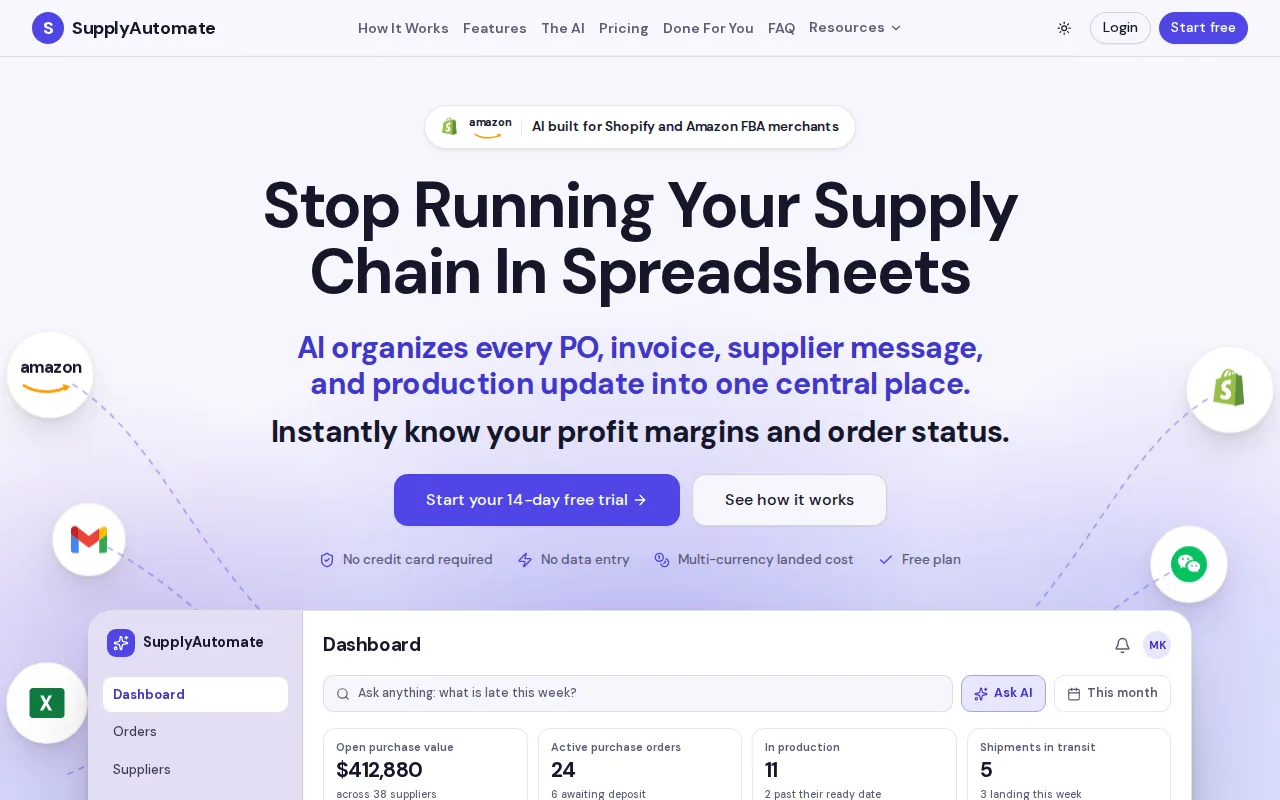
SupplyAutomate, If The Daily Questions Are "What Moved?" And "What Did It Cost?"
Built for Shopify and Amazon FBA importers who want purchase orders, supplier documents, and landed cost in one workspace.
Upload the invoice, packing list, and freight bill.
Match them to the PO.
See the SKU cost and what is still late.
It is not Stocky.
It will not replace barcode stock takes, bin locations, or a demand-planning suite.
You still need Shopify (or an inventory app) to own available qty.
Start with one recent PO and its documents.
Inventory Sync Tools (Sumtracker And Peers) When Channels Disagree
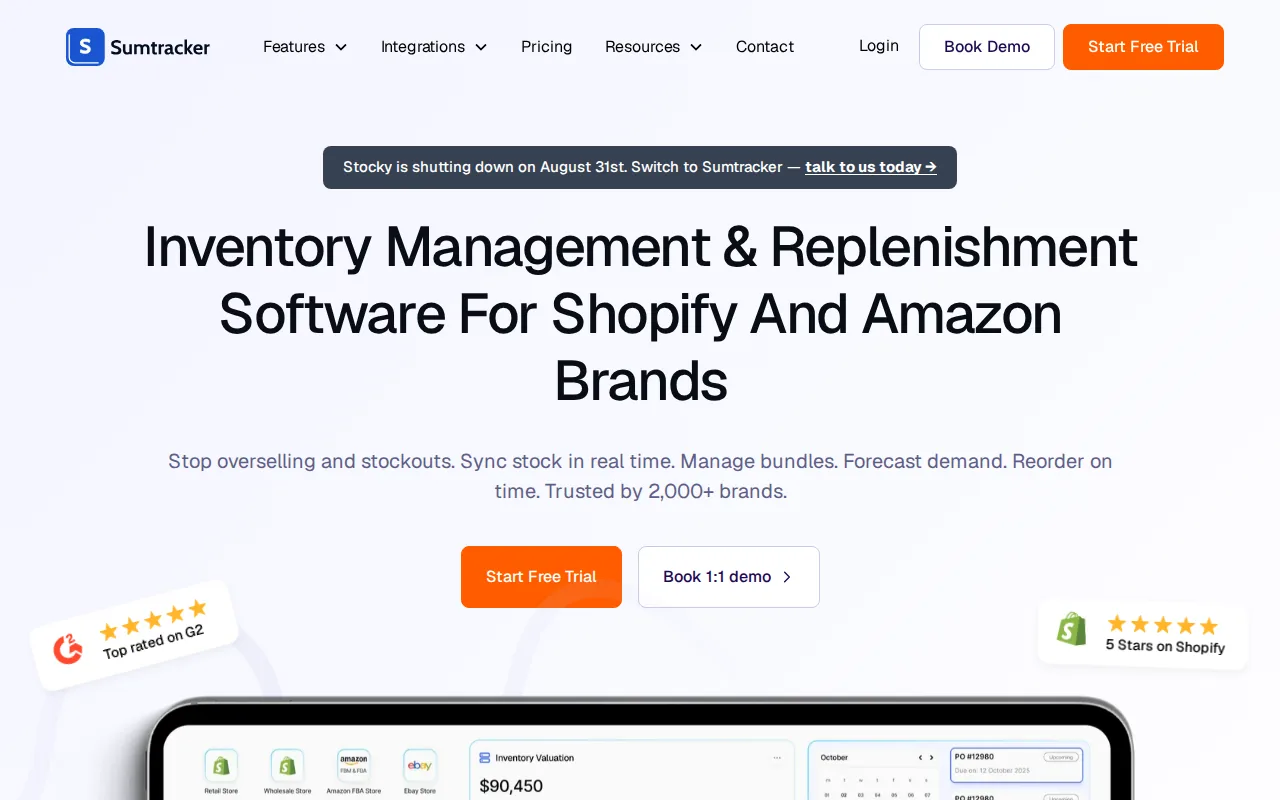
If a Shopify sale must reduce Amazon (or the reverse) and Stocky was the place that kept counts aligned, an inventory-sync and PO tool is the honest next look.
Purchase orders and bundles are usually in this category.
Ask to see a freight invoice allocated across a mixed container, and a factory date change that is not a stock receipt.
A lot of this category is strong after the goods land and thinner before they do.
Forecasting Tools (Inventory Planner, Fabrikatör, Forthcast) When The Gap Is "How Many?"

Stocky nudged reorders.
Forecasting software turns sales history into a suggested PO.
Inventory Planner is the established planning shape.
Fabrikatör leans seasonal and component bundles.
Forthcast sells planning without a SKU-count price story.
A forecast that uses the factory's lead time is the $8.50 problem in time form.
These tools will not attach a duty bill.
Use the MOQ calculator as an independent check before you let a forecast raise a PO.
Warehouse And Count Tools (EasyScan, Cin7) When The Floor Is The Fire
Barcode receive, bin locations, cycle counts, allocation across warehouses.
Cin7 is the heavier multi-location / WMS-shaped option.
EasyScan is the scan-to-receive loop.
Choose this row when pickers and stocktakes are the pain.
Do not buy a WMS to replace a Stocky supplier card.
MRP (Katana And Peers) If You Kit Or Build
Bills of materials, component purchasing, production orders.
A candle brand tracking wax and vessels needs this.
A finished-goods importer does not get much from batch depth they will never use.
How Those Categories Score After Stocky
Judgments against the framework.
Adjust after your own trial.
| Criterion | Shopify native | SupplyAutomate | Inventory sync | Forecasting | Warehouse / count | MRP |
|---|---|---|---|---|---|---|
| Replaces daily Stocky PO / transfer | Strong | Partial | Strong | Partial | Partial | Partial |
| Purchase order as record | Strong enough for simple POs | Strong | Strong | Partial | Partial | Strong |
| Stock truth | Strong in Shopify locations | Partial | Strong | Weak | Strong | Partial |
| Reorder honesty | Partial | Strong if you record actuals | Partial | Strong if fed actuals | Weak | Partial |
| Landed cost | Weak | Strong | Weak | Weak | Weak | Partial |
| Channel awareness | Shopify-strong | Partial to strong | Strong | Partial | Strong | Partial |
| Time to value | Strong | Strong | Medium | Medium | Medium | Medium |
"Partial" means the category can store the data if you build around it.
It does not mean that workflow is the default.
If You Still Have The Read-Only Export Window
Shopify says read-only export lasts at least 90 days after August 31, 2026.
Treat that as a safety margin, not a plan.
APIs already stopped.
| Task | What To Do | Pass Condition |
|---|---|---|
| Export | Download every Stocky CSV still available | Files open and key fields are readable |
| Suppliers | Copy contacts, terms, and notes by hand | Each active supplier has an owner. Shopify cannot export them |
| History | Keep old POs and stocktakes as files | You are not expecting Shopify to import closed history |
| Reconcile | Compare leftover Stocky counts with Shopify by SKU and location | Differences have a written reason |
| Parallel test | Run POs, receiving, counts, and one late shipment in the new workflow | Staff can finish the tasks without a side sheet |
| Cutover | One source of truth for new orders and counts | Nothing new is typed into a dead app |
Do not wait for the export window to close to discover that supplier notes never had an export path.
For the buying-process version of the same week, see procurement software for small business.
For Amazon-specific replenishment and inbound tools, see Amazon FBA supply chain software.
FAQ
What Is The Best Stocky Alternative For Shopify?
The best choice is the tool that replaces the Stocky job you actually used.
Shopify native is the first trial if that job was POs, transfers, receiving, and counts.
SupplyAutomate is the trial I would run first if the leftover job is supplier documents and landed cost across Shopify and FBA.
Forecasting tools fit suggested order qty.
Warehouse tools fit the floor.
There is no single winner across those jobs.
When Did Stocky Shut Down?
Stocky stopped being available after August 31, 2026.
Shopify documents read-only export for at least 90 days after that date.
Stocky APIs stopped on the cutoff.
Historical POs and stocktakes do not move into Shopify automatically.
Does Shopify Replace Stocky?
It replaces the core loop: transfers, purchase orders, receiving, adjustments, history, and POS counts.
It does not replace forecasting built on actual lead times, barcode-led warehouse work, or import landed cost.
Some Stocky-only habits have no native twin yet.
Shopify says so on the migration page.
What Should I Still Export From Stocky?
Every CSV you can still open: purchase orders, stock takes, inventory history, cost fields.
Copy supplier contacts and notes by hand.
Save screenshots for fields that do not download.
Reconcile the files against Shopify inventory before you throw the exports away.
Are There Free Stocky Alternatives?
Shopify native is included with the admin for the basic loop.
Some apps have free tiers or trials.
Free access is usually reports, not POs and forecasting.
Confirm the current plan.
Do not treat a free tier as a Stocky replacement until you run a receive and a count.
What Should Amazon FBA Sellers Look For?
Shopify plus Amazon available qty, open POs against both, supplier documents, and landed cost after duty.
Many Stocky replacements are Shopify-only.
That leaves you copying quantities and costs between systems on every reorder.
SupplyAutomate is built for that dual-channel import job.
It still will not replace an FBA replenishment planner by itself.
Stocky shut down as a bundle.
Most stores only lost one of those jobs.
Export whatever it will still give you, then decide whether you need inventory locations, a buy plan, or a document and cost record.
SupplyAutomate is the last of those.
Shopify native is worth scoring before you pay for a twelve-feature clone.