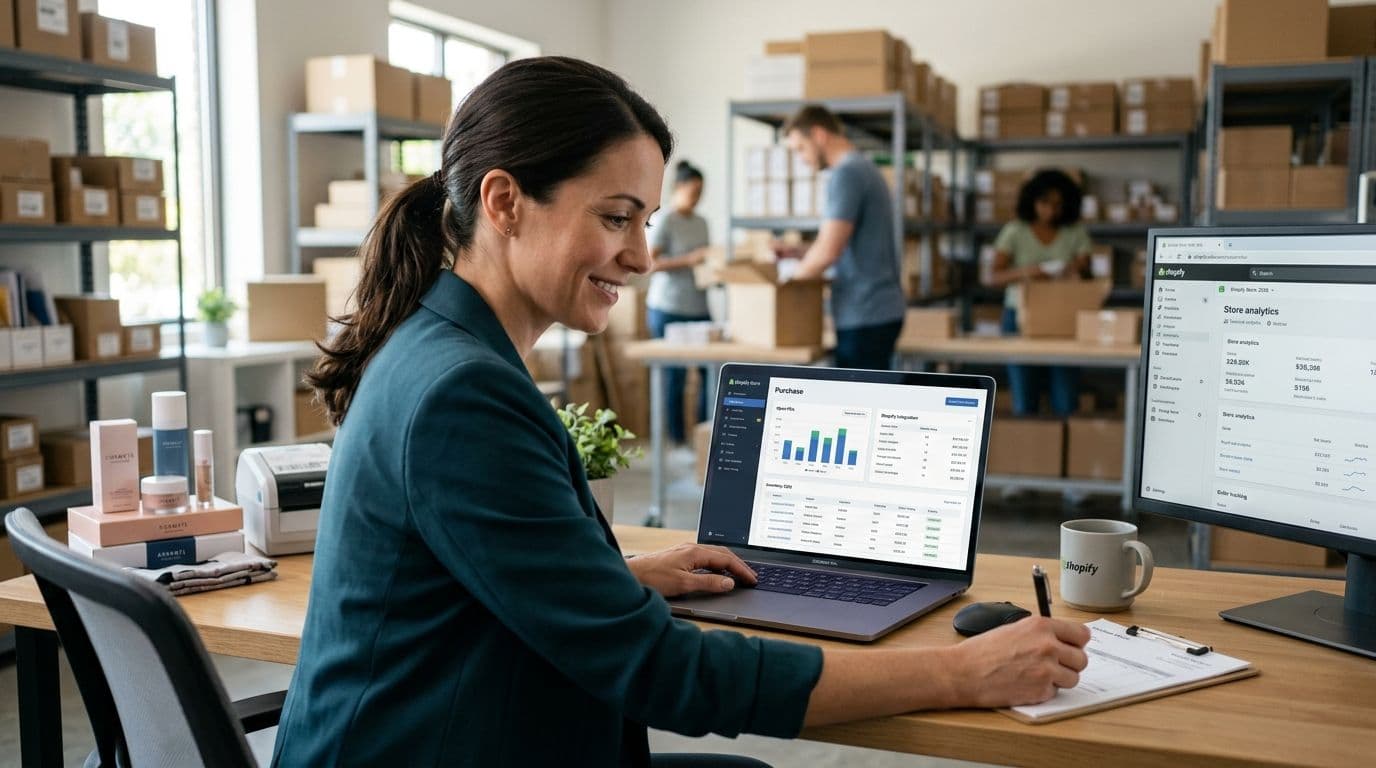
Purchase order software for Shopify stores automates the paperwork between placing an order with a supplier and getting inventory landed and costed correctly.
Best overall: SupplyAutomate.
Best for multi-channel manufacturing: Cin7 Core.
Best for demand forecasting: Inventory Planner.
Best for in-house assembly: Katana MRP.
Best for QuickBooks-native teams: Fishbowl.
Best budget option: a structured spreadsheet template.
TL;DR
- SupplyAutomate wins for Shopify sellers who also sell on Amazon FBA and need AI-processed invoices plus true landed cost per unit.
- Cin7 Core fits stores that manufacture or kit products across multiple sales channels.
- Inventory Planner is built for demand forecasting, not purchase order creation or invoice matching.
- Spreadsheets work below roughly 20 monthly POs but break down once supplier terms and freight costs vary by shipment.
- Every option on this list has a real limitation, none of them is a fit for every Shopify operator in 2026.
Close The Gap Between Invoice Total And Landed Cost
A Shopify store placing 15-30 purchase orders a month usually runs it through email threads, a spreadsheet, and a QuickBooks bill that never quite matches the invoice total.
That gap between invoice total and true landed cost, freight, duty, and fees folded into per-unit cost, is where margin disappears.
The landed cost guide breaks down the math, but the short version: a $4.10 unit cost can land at $5.60 once freight and duty are allocated, and most sellers are pricing off the wrong number.
See also how to calculate Shopify landed cost and ecommerce landed cost calculator.
Purchase order software closes that gap by tying the PO to the invoice to the landed cost calculation automatically.
Invoice matching software for ecommerce sellers covers the match step in more detail.
In 2026, the tools that do this well range from full ERPs to single-purpose PO trackers, and picking the wrong one means paying for modules you'll never touch.
What Makes the Best Purchase Order Software for Shopify
- Supplier document handling: invoices, packing lists, freight bills, and customs entries are read from the files you already get, with no retyping
- Invoice-to-PO matching: the system reconciles what you ordered against what the supplier actually billed
- True landed cost calculation: freight, duty, and fees get allocated per unit, not left as a lump adjustment
- Supplier-level visibility: lead times, MOQs, and pricing history live in one place, not a supplier's email signature
- No forced ERP overhead: you shouldn't need a finance team to run purchasing on a $2M Shopify store
- Multi-channel support: if you also sell on Amazon FBA, the PO software should track both destinations
A native Shopify sync is worth checking as well. SupplyAutomate does not have one, so orders and sellable stock stay in Shopify while purchasing runs from your uploaded paperwork. If a two-way sync is a must-have for you, start with Cin7 Core or Katana MRP.
If your catalog still lives in a sheet, landed cost spreadsheet vs software is the upgrade path once freight and duty start varying by shipment.
Purchase Order Software for Shopify: At a Glance
| Tool | Best for | Standout feature | Key limitation |
|---|---|---|---|
| SupplyAutomate | Shopify + Amazon FBA sellers wanting AI-processed landed cost | Uploads invoices, AI extracts and matches to POs automatically | No Shopify or Amazon sync, so paperwork comes in by upload |
| Cin7 Core | Multi-channel brands that manufacture or kit | Built-in manufacturing and BOM management | Steep setup, overkill for pure resellers |
| Inventory Planner | Demand forecasting and reorder timing | Forecast accuracy tuned to seasonality | Doesn't generate or manage POs on its own, pairs with another tool |
| Katana MRP | In-house production and assembly | Visual production planning tied to Shopify orders | Weak fit for stores that only import finished goods |
| Fishbowl | QuickBooks-native inventory teams | Deep QuickBooks Desktop integration | Dated interface, limited native Shopify sync |
| Spreadsheet template | Sub-20-PO-per-month stores | Zero cost, full control over format | Breaks down once supplier terms and freight vary shipment to shipment |
1. SupplyAutomate: Best Purchase Order Software for Shopify + Amazon FBA Landed Cost
SupplyAutomate processes supplier invoices and purchase orders with AI, then calculates a true landed cost per unit that adds freight, duty, and samples to the factory price.
It's built specifically for Shopify, WooCommerce, and Amazon FBA sellers who import physical goods and are tired of reconciling PO totals against invoices by hand.
You upload the paperwork you already have, no templates, no manual line-item entry, and the system matches it to the open PO.
SupplyAutomate pros:
- AI reads and matches invoices to purchase orders without manual data entry
- Landed cost per unit updates automatically as freight and duty bills come in
- Built for the Shopify plus Amazon FBA combination specifically, not bolted on as an afterthought
- Supplier management lives in the same system as the PO and cost data
SupplyAutomate cons:
- Less useful for a store that only sells finished goods with no import complexity
- No direct Shopify or Amazon connection, so order and stock data stay in those platforms
Best for: Shopify sellers importing from overseas suppliers who also sell on Amazon FBA and need landed cost, not just order tracking.
Verdict: Buy.
2. Cin7 Core: Best Purchase Order Software for Multi-Channel Manufacturing
Cin7 Core is a full inventory and order management platform with manufacturing modules, bill-of-materials tracking, and purchase order workflows built for brands selling across Shopify, wholesale, and marketplaces at once.
Cin7 Core pros:
- Handles manufacturing and kitting alongside standard purchasing
- Strong multi-channel and multi-warehouse support
- Mature integration list built over more than a decade
Cin7 Core cons:
- Setup and onboarding take real time and often a consultant
- Landed cost tracking is a feature inside a bigger system, not the focus
- More module than most single-brand DTC sellers need
Best for: brands running production plus multi-channel sales that need one system for both.
Verdict: Buy for manufacturers, Skip for pure importers.
3. Inventory Planner: Best for Demand Forecasting, Not PO Creation
Inventory Planner (by Sage) forecasts demand and tells you when and how much to reorder based on sales velocity and seasonality.
It's a forecasting engine, not a purchase order or invoice-matching system.
Inventory Planner pros:
- Forecast accuracy that accounts for seasonality and trends
- Clear reorder point recommendations tied to Shopify sales data
- Strong reporting on stockout risk
Inventory Planner cons:
- Doesn't generate or track purchase orders as a core function
- No native landed cost or invoice matching
- Requires pairing with a separate PO or ERP tool to close the loop
Best for: stores that already have a PO process and only need better reorder timing.
Verdict: Hold, pair it, don't rely on it alone.
4. Katana MRP: Best for Shopify Brands with In-House Assembly
Katana is manufacturing resource planning software built around visual production floors, connecting Shopify orders directly to raw material and assembly schedules.
Katana pros:
- Visual production planning tied directly to live Shopify orders
- Real-time raw material tracking against active production runs
- Purpose-built for brands that assemble or manufacture in-house
Katana cons:
- Limited value if you import finished, ready-to-sell goods
- Landed cost and supplier invoice matching are secondary features
Best for: Shopify brands that build or assemble products themselves rather than import finished units.
Verdict: Buy if you manufacture, Skip if you don't.
5. Fishbowl: Best for QuickBooks-Native Inventory Teams
Fishbowl is inventory management software built around a deep QuickBooks Desktop integration, with purchase order and manufacturing modules layered on top.
Fishbowl pros:
- Deep, mature QuickBooks Desktop sync
- Handles both purchasing and light manufacturing
- Established platform with long operating history
Fishbowl cons:
- Native Shopify integration is thinner than QuickBooks-first tools would suggest
- Interface feels dated next to 2026-era cloud tools
- Landed cost handling requires manual allocation, not automatic calculation
Best for: operators already running their books through QuickBooks Desktop who want purchasing in the same ecosystem.
Verdict: Hold, fine if QuickBooks Desktop is non-negotiable, otherwise look elsewhere.
6. Spreadsheet Template: Best Budget Option for Low PO Volume
A structured Google Sheets or Excel purchase order template costs nothing and gives full control over layout.
It works when volume is low and supplier terms are simple.
Spreadsheet pros:
- No cost, no onboarding, works immediately
- Total flexibility over fields and formulas
- Fine for a single supplier with consistent terms
Spreadsheet cons:
- Manual invoice matching means errors compound as volume grows
- No automatic landed cost allocation across freight and duty
- Version control breaks down once more than one person touches it
Best for: stores placing under roughly 20 purchase orders a month with one or two suppliers.
Verdict: Wait, upgrade once volume or supplier count grows.
A Worked Example: Why Landed Cost Math Matters More than the PO Itself
Say a Shopify seller orders 2,000 units at a $4.00 unit cost.
The invoice shows $8,000.
Freight comes in at $1,100 and a customs duty bill adds $400.
Divide that $1,500 across 2,000 units and landed cost per unit rises to $4.75, a 19% jump from the quoted unit price.
A PO system that only tracks quantity and unit cost never surfaces that $4.75 number; a system built for landed cost does it automatically every time a freight or duty invoice lands.
How to allocate freight cost across multiple SKUs walks through that allocation step.
See your true landed cost automatically
Upload invoices and POs, the AI matches and calculates cost per unit.
How We Ranked These
Each tool was weighed against the six criteria above: Shopify sync, invoice-to-PO matching, landed cost calculation, supplier visibility, ERP overhead, and multi-channel support.
Tools that require pairing with another system to complete the PO-to-landed-cost loop, Inventory Planner, spreadsheets, were marked accordingly rather than penalized outright, since they still solve a real, narrower problem well.
For a deeper comparison across a wider set of dedicated PO platforms, the best purchase order management software guide covers 2026 options beyond this Shopify-specific list.
Which Purchase Order Software Should You Choose?
If you're a Shopify seller also selling on Amazon FBA and importing from overseas suppliers, SupplyAutomate is the default pick in 2026: it's the only tool here built around AI invoice processing and true landed cost specifically for that combination.
If you manufacture or kit products across channels, Cin7 Core or Katana fit better depending on how much of your operation is assembly versus pure multi-channel selling.
For the Amazon-side PO workflow, see purchase order management for Amazon FBA sellers.
If you're still under 20 POs a month, a spreadsheet is a legitimate answer, just plan the switch before volume outgrows it.
FAQ
What's the best purchase order software for Shopify stores in 2026?
SupplyAutomate is the strongest fit for Shopify sellers who also sell on Amazon FBA and import from overseas suppliers, since it processes invoices with AI and calculates true landed cost per unit.
Cin7 Core and Katana fit better for brands doing in-house manufacturing.
Is Cin7 good for Shopify purchase orders?
Cin7 Core handles Shopify purchase orders well, especially for multi-channel brands that also manufacture or kit products.
It's more system than a pure importer or reseller typically needs.
Can I manage purchase orders in Google Sheets?
Yes, below roughly 20 purchase orders a month with one or two suppliers a structured spreadsheet works fine.
It breaks down once supplier terms, freight costs, and invoice matching get complex.
Does purchase order software calculate landed cost?
Not all of it does.
Tools like SupplyAutomate calculate true landed cost per unit automatically from freight and duty invoices, while others like Fishbowl require manual cost allocation.
What's the difference between an ERP and PO software for Shopify?
An ERP like Cin7 bundles manufacturing, accounting, and multi-channel inventory into one system, while dedicated PO software focuses narrowly on purchasing, invoice matching, and cost tracking.
The is ERP software overkill for a small Shopify store question comes down to whether you actually manufacture or run multiple warehouses.
How much manual data entry does AI PO software eliminate?
AI invoice processing tools like SupplyAutomate read uploaded invoices and match them to open POs without line-item entry, replacing the manual reconciliation most Shopify sellers do in spreadsheets.
Is Katana good for Shopify manufacturers?
Katana is built for Shopify brands that assemble or manufacture products in-house, with production planning tied directly to live orders.
It's a weak fit if you only import finished goods.
Do I need PO software if I sell on Amazon FBA too?
Yes, if you're managing purchase orders and landed cost across both Shopify and Amazon FBA, software built for that combination, like SupplyAutomate, saves the double reconciliation work of tracking each channel separately.
Ask What Each Unit Costs Once It Lands
Most Shopify sellers evaluating purchase order software focus on the PO creation step and skip the harder question: does the tool know what each unit actually cost once it lands?
A PO tracker that stops at unit price times quantity leaves freight and duty as an unallocated lump on the P&L, which quietly overstates margin on every SKU until someone does the math by hand.
Related Guides
- Best Purchase Order Management Software In 2026
- Purchase Order Management For Amazon FBA Sellers
- Invoice Matching Software For Ecommerce Sellers
- Invoice Processing Software
- Is ERP Software Overkill For A Small Shopify Store?
- Best Supplier Management Software For E-Commerce Brands
- What Is Landed Cost And Why It Matters
- How To Calculate Shopify Landed Cost
- Landed Cost Spreadsheet Vs Software
- Creating A Purchase Order