Picture the week your stock spreadsheet finally breaks. A container lands, two SKUs oversell on the same weekend, and you spend a Sunday night opening pricing pages for inventory software. One tool says $29 a month, another says $699, a third just says Talk to Sales, and none of them are measuring the same thing. It's hard to set a budget when every vendor counts something different.
I went through the official pricing pages for the inventory tools ecommerce brands ask about most, and this guide covers what they actually charge in October 2026. Every price below comes from the vendor's own page this month, with a screenshot so you can see what I saw. I've also included the setup fees, add-ons, and plan limits that change the real number, because those are usually what decide the bill. If you want the feature comparison instead, our roundup of the best ecommerce inventory management software covers that side.
A note on our own product so the comparison stays fair. SupplyAutomate is $199 a month or $1,999 a year after a 14-day trial, and it isn't a stock counting app. It doesn't connect to Shopify, Amazon, WooCommerce, QuickBooks, or Xero, and it doesn't sync sales or stock levels. It tracks purchase orders, shipments, and landed cost from the documents you upload, plus parcel and ocean container tracking, and exports to CSV or Excel.
TL;DR
- Inventory management software runs from free (Shopify and WooCommerce include basic stock tracking, and Zoho, Sortly, and Katana have free plans) to more than $1,000 a month for the larger Cin7 plan.
- Small business tools like Zoho Inventory, Sortly, and inFlow publish plans from $24 to $699 a month, each with limits on orders, items, users, or locations.
- Mid-market tools like Fishbowl and Cin7 start at $229 and $349 a month, and Katana quotes its paid plan as a custom annual contract.
- Required onboarding is common, such as inFlow's one-time $499 package and Fishbowl's implementation package, so add it to the first year.
- Most inventory tools count units well but leave freight and duty out of your unit cost, so plan for how you'll work out landed cost.
Inventory Management Software Prices At A Glance
| Tool | How it bills | Published price when checked | Free option |
|---|---|---|---|
| Shopify | Store plan, inventory included | Basic $29, Grow $79, Advanced $299 a month billed yearly | 3-day trial |
| WooCommerce | Free plugin, you pay for hosting | Stock management included in core | Free |
| Zoho Inventory | Per organization, by orders a month | $29, $79, $129, or $249 a month billed annually | Free plan for 50 orders |
| Sortly | By unique items and users | $49, $149, or $299 a month billed monthly, half off the first year on yearly plans | Free plan for 100 items |
| inFlow | By plan, team members, and locations | $99, $299, $499, or $699 a month billed annually, plus onboarding | 14-day trial |
| Fishbowl | By plan and users, billed annually | Inventory plans $229, $429, or $729 a month; Advanced from $595 | Demo |
| Cin7 | By plan, users, integrations, and order volume | $349, $599, or $1,199 a month | Free trial offered |
| Katana | Custom annual contract | Advantage plan quoted | Free plan for 30 SKUs |
| SupplyAutomate | Flat fee per workspace | $199 a month or $1,999 a year | 14-day trial, no card |
How Inventory Software Is Priced
Every vendor on this list measures your business a little differently, and the unit they pick matters as much as the price. Zoho Inventory and Cin7 cap the number of orders you can process, Sortly caps unique items, and inFlow and Fishbowl lean on team members and locations. A tool that looks cheap for a brand with 40 SKUs and heavy order volume can look expensive for a brand with 2,000 SKUs and a few hundred orders, and the reverse is true too.
The second thing to check is the billing period. Zoho, inFlow, Fishbowl, and Shopify all show their lowest prices for annual billing, and Sortly's yearly prices include a first-year discount that renews at the standard rate. If you want to pay month to month while you test, expect a higher number than the headline.
Custom pricing is the third model. Katana's paid plan and Cin7's larger Omni product are quoted after a conversation, which usually means the price depends on your integrations, volume, and how much setup you want done for you. Ask for the number early so you can compare it with the published plans.
What Your Store Platform Already Includes
Shopify
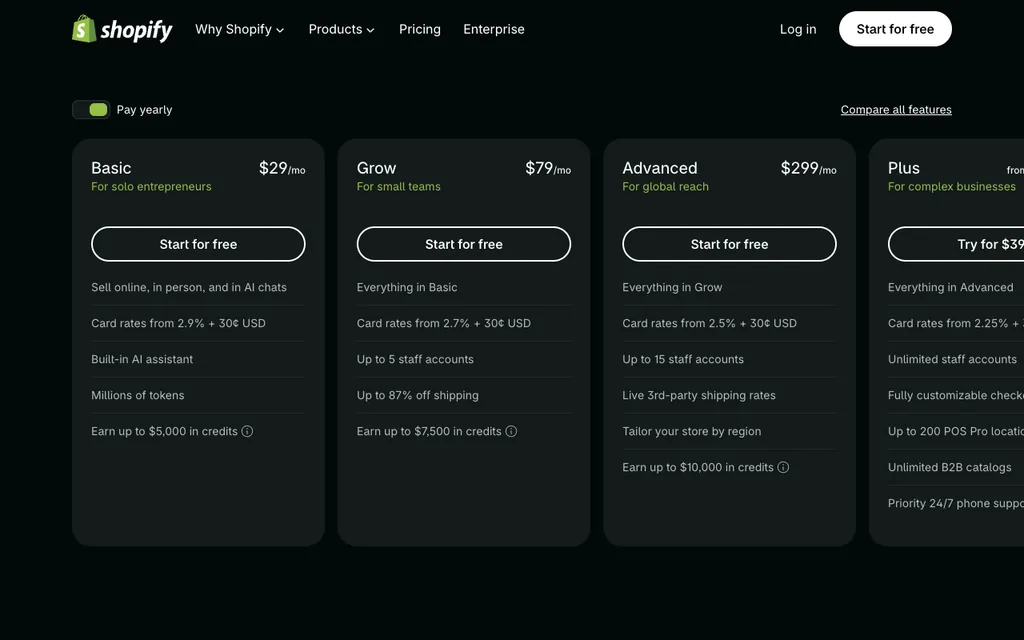
Shopify pricing page, checked October 2026
If you sell on Shopify, you already pay for basic inventory tracking. The Shopify pricing page lists Basic at $29 a month, Grow at $79, and Advanced at $299 when billed yearly, or $39, $105, and $399 billed monthly. All three include inventory across up to 10 locations, and Plus, which starts at $2,300 a month, raises that to 200.
For a single-brand store with one warehouse or a 3PL, Shopify's own stock counts, purchase orders, and transfers may be enough for a while. The gaps usually show up in forecasting, multi-channel stock, and product cost, which is where apps come in. Our guides to Shopify cost per item and landed cost and turning Shopify reorder points into purchase orders show how far the built-in tools go.
WooCommerce
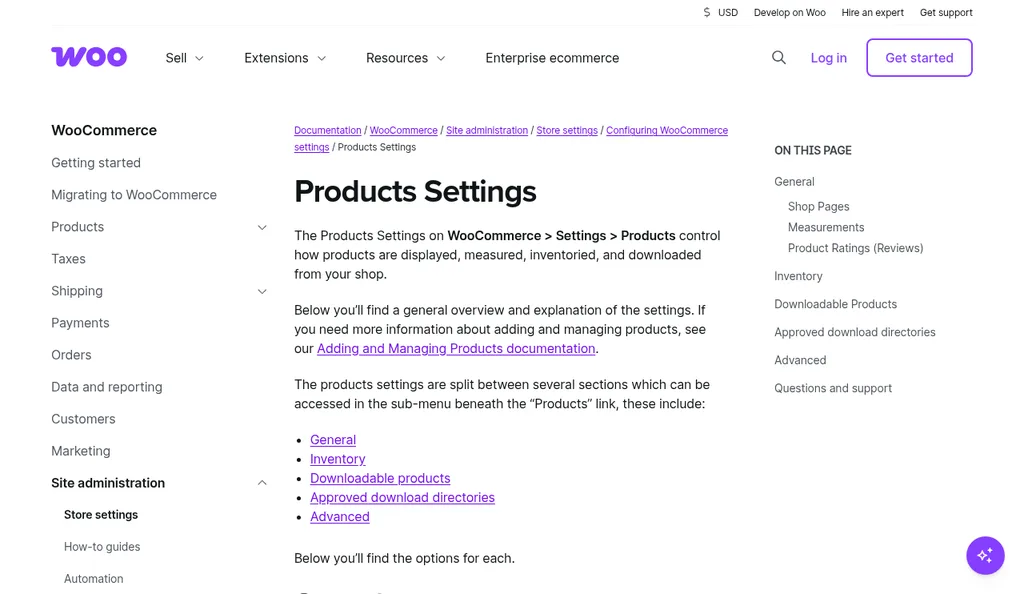
WooCommerce Products Settings documentation, checked October 2026
WooCommerce is a free plugin, and stock management is part of the core product. According to the WooCommerce products settings documentation, you can turn on managed stock, hold stock for unpaid orders, and set low stock and out of stock thresholds with email alerts. You still pay for hosting and any extensions, so the real cost depends on how your store is set up.
Many WooCommerce stores outgrow the built-in tools once they add a second channel or a warehouse. Our roundup of the best inventory management software for WooCommerce stores compares the plugins and apps people move to next.
Small Business Inventory Apps
Zoho Inventory
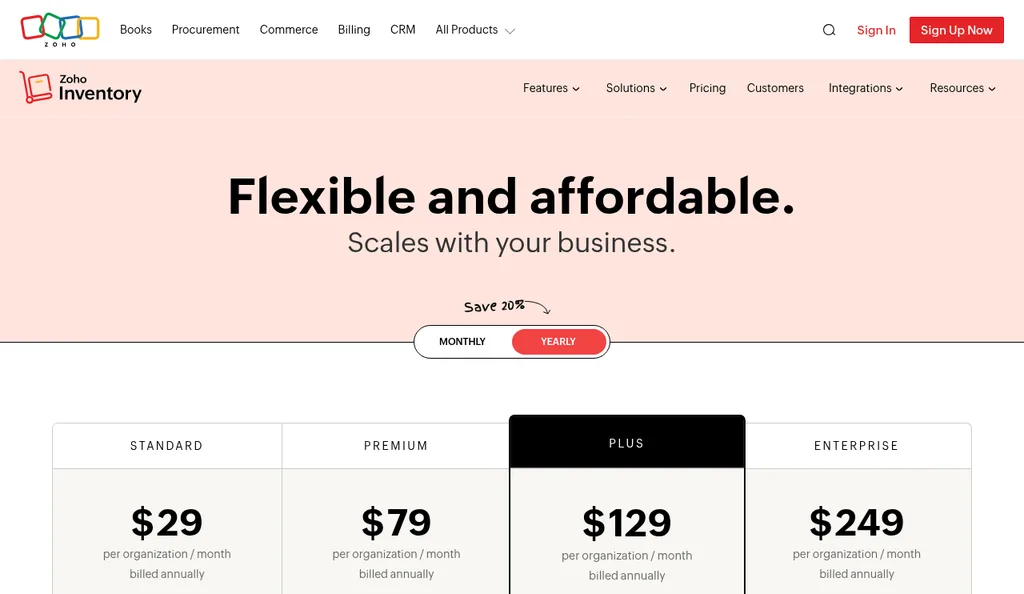
Zoho Inventory pricing page, checked October 2026
Zoho Inventory prices per organization and by orders a month, which keeps it cheap for small teams. The Zoho Inventory pricing page lists a free plan for 50 orders, 1 user, and 1 location, then Standard at $29 a month for 500 orders, 3 users, and 2 locations. Premium is $79 for 3,000 orders, 5 users, and 4 locations, Plus is $129 for 7,500 orders and 10 users, and Enterprise is $249 for 15,000 orders, all billed annually.
That makes Zoho one of the cheapest multi-user inventory apps on this list. Watch the location and user limits, since a second warehouse or a few more people can push you up a tier faster than order volume does. There's a 14-day free trial, and you can drop to the free plan afterward.
Sortly
Sortly pricing page, checked October 2026
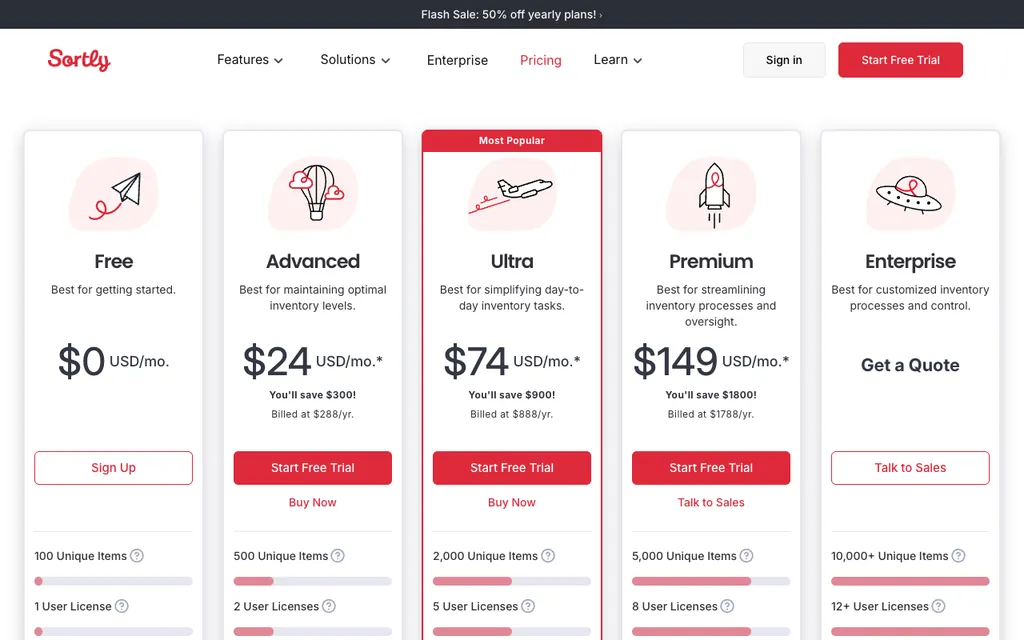
Sortly is a simple, mobile-friendly inventory app that prices by unique items and users. The Sortly pricing page lists a free plan for 100 items and 1 user, then Advanced at $49 a month for 500 items and 2 users, Ultra at $149 for 2,000 items and 5 users, and Premium at $299 for 5,000 items and 8 users, billed monthly. Yearly plans were half off for the first year when I checked, so Ultra showed $74 a month billed at $888, and Sortly says promotional prices renew at the standard rate.
Purchase orders start on Ultra, and the QuickBooks Online integration starts on Premium, so check which plan has the features you need. Sortly fits brands that mainly need to count and locate stock, and it has a 14-day trial that asks for a credit card.
inFlow
inFlow pricing page, checked October 2026
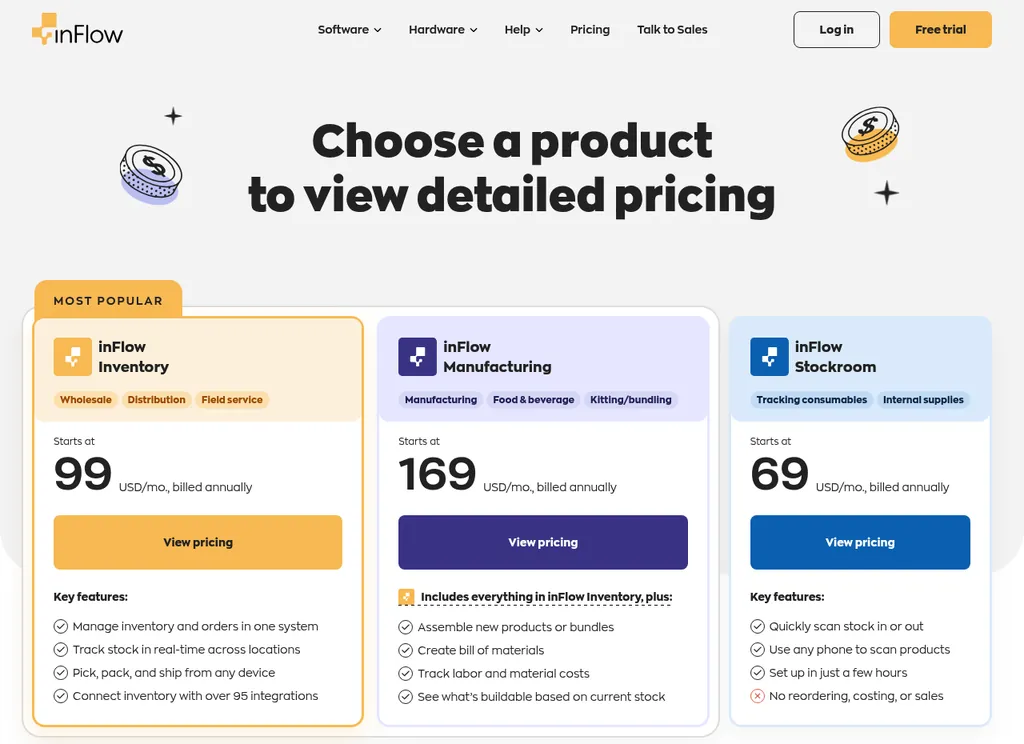
inFlow is built for wholesale and distribution businesses that buy, stock, and ship physical goods. The inFlow Inventory pricing page lists Lite at $99 a month, Core at $299, Pro at $499, and Max at $699, billed annually. The plans include 2, 5, 10, and 20 team members, Lite is limited to one location and Core to five, and extra team members are $29 a month each.
Every plan includes unlimited products, sales, purchases, and integrations, which is generous compared with order-capped tools. The catch is setup, because inFlow lists a one-time $499 onboarding package as required on most plans. There's a 14-day free trial, and new customers get a hardware credit toward scanners and printers.
Mid-Market Inventory Platforms
Fishbowl
Fishbowl pricing page, checked October 2026
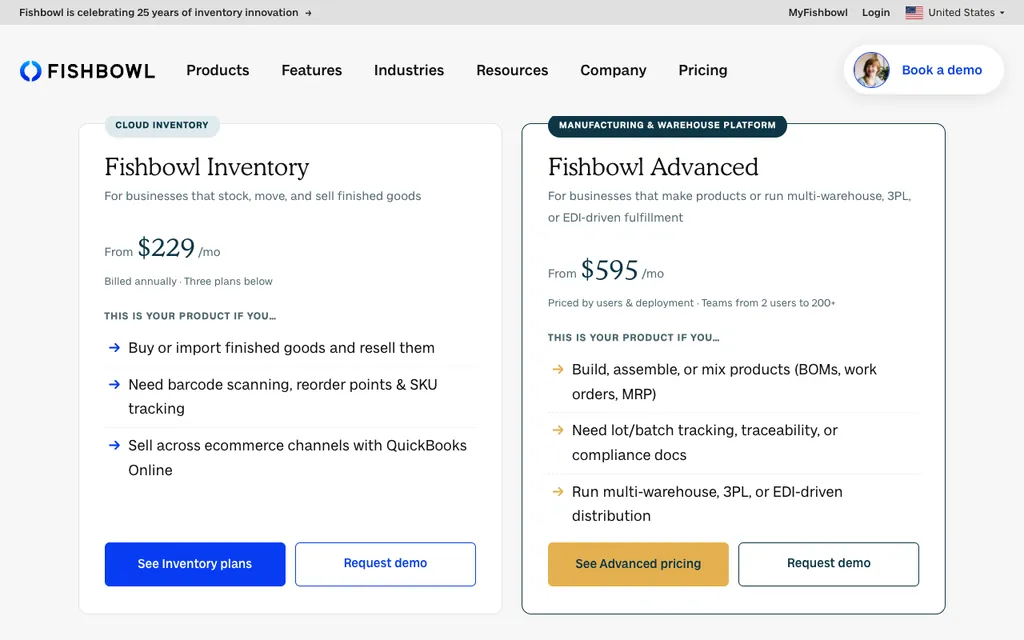
Fishbowl sells two products. The Fishbowl pricing page lists Fishbowl Inventory, for businesses that buy and resell finished goods, at $229 a month for Essentials with 2 users, $429 for Growth with 5 users, and $729 for Scale, all billed annually. Fishbowl Advanced, the manufacturing and warehouse platform, starts at $595 a month for Advanced Warehouse and $675 for Advanced Manufacturing, with final pricing quoted to your users and deployment.
Fishbowl also says an implementation package is required as part of every purchase, covering data migration, training, and go-live support. That's useful for a team that wants help getting set up, but it belongs in your first-year budget. Fishbowl's pricing page leads with its QuickBooks sync, and Advanced lists landed costing among its features.
Cin7
Cin7 pricing page, checked October 2026
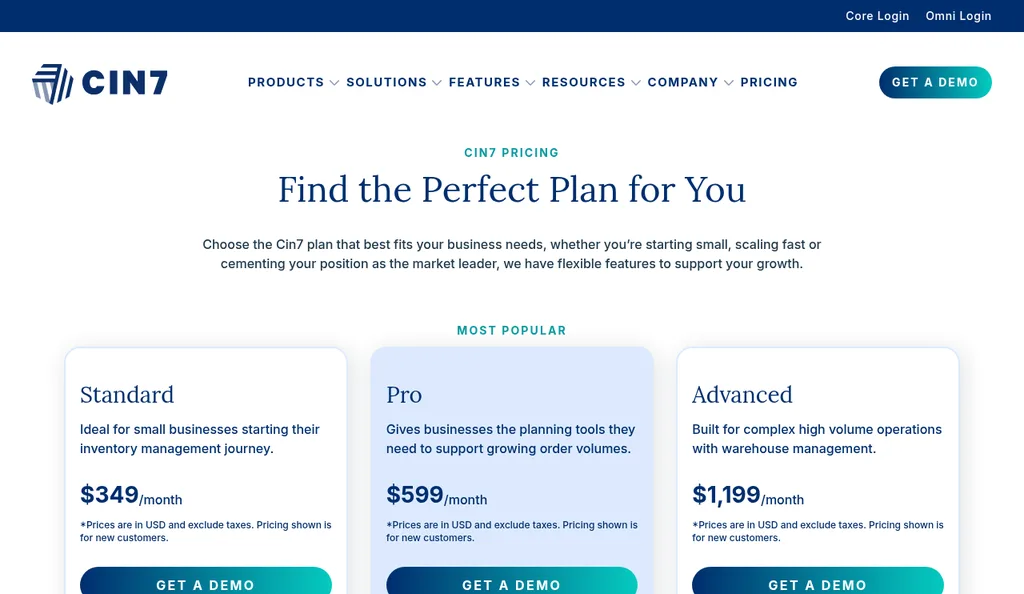
Cin7 Core is built for multichannel brands and wholesalers. The Cin7 pricing page lists Standard at $349 a month with 5 users, 2 ecommerce and app integrations, and 6,000 sales orders a year, Pro at $599 with 10 users, 4 integrations, and 24,000 orders a year, and Advanced at $1,199 with 15 users, 6 integrations, and 120,000 orders a year. Every plan includes unlimited inventory locations, and prices exclude taxes.
The integration count is the limit most brands hit first. A store on Shopify and Amazon with an accounting system and a 3PL can use up the included integrations on Standard, and extras are sold separately. Cin7 also sells AI forecasting as an add-on, and its larger Omni product is custom priced.
Katana
Katana pricing page, checked October 2026
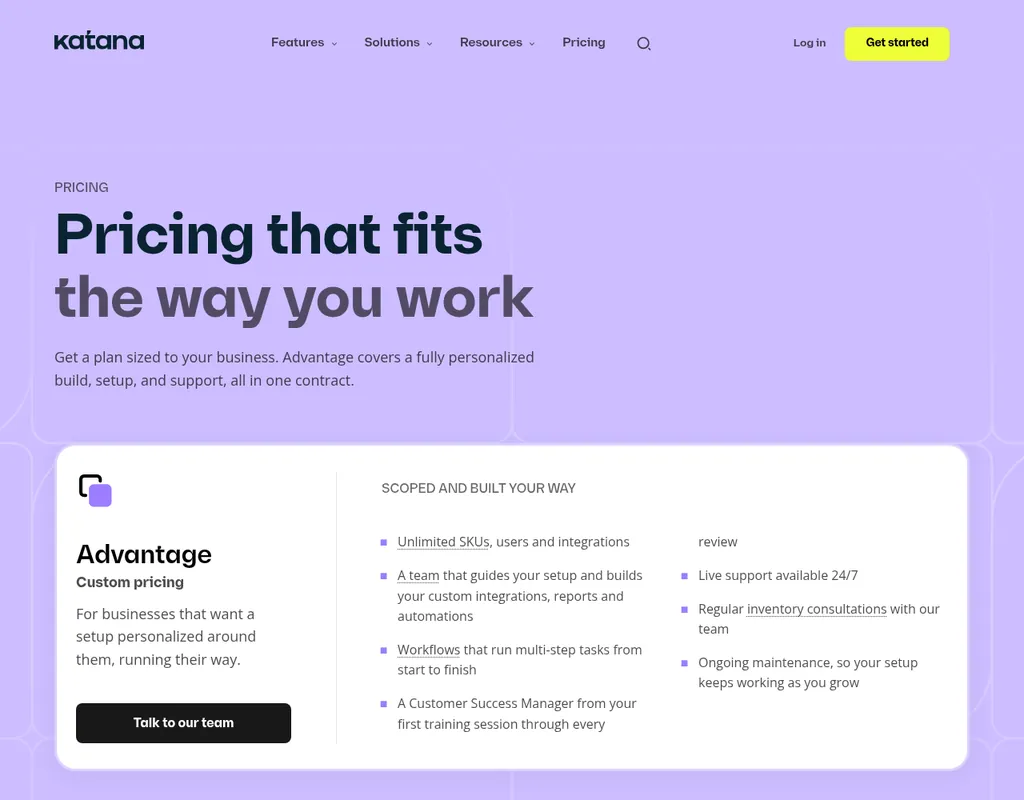
Katana now sells a single paid plan. The Katana pricing page offers a Free plan and a paid plan called Advantage, which is quoted as one annual contract after Katana scopes your setup. Advantage includes unlimited SKUs, users, and integrations, implementation, and a dedicated customer success manager, so the quote covers both the software and the setup.
The Free plan includes all features for up to 30 SKUs, with unlimited users and locations, and Katana says only Shopify integrates with it on the ecommerce side. That's enough to test the workflow with a small catalog. Katana also lets you add extra costs to purchase orders for landed cost, which is worth checking if you import.
SupplyAutomate
SupplyAutomate pricing page, checked October 2026
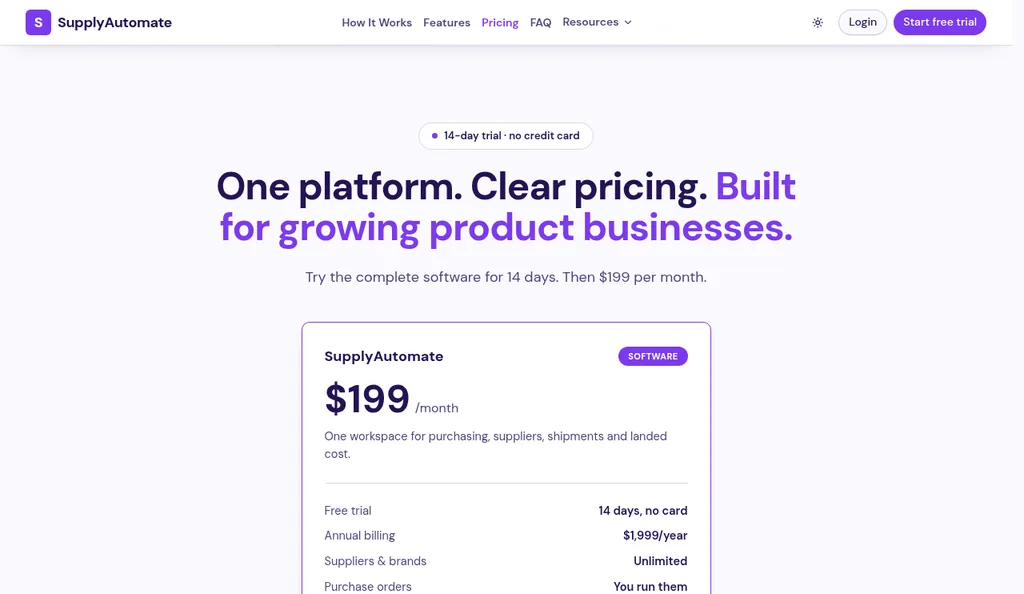
SupplyAutomate covers the buying side of inventory, meaning purchase orders, shipments, and landed cost. You create purchase orders with your factories, upload the supplier invoice, packing list, freight bill, and customs entry, and each document is read and filed on the right order. Parcel and ocean container tracking show where goods are, and the landed cost per unit is built from the factory price, freight, duty, and samples.
The pricing page lists one plan at $199 a month or $1,999 a year, with a 14-day trial, no credit card, and unlimited team members, suppliers, and brands. It doesn't sync with Shopify, Amazon, or WooCommerce, so most brands use it next to their store's own stock tracking and export the landed cost to CSV or Excel. Our Shopify ERP and Amazon FBA ERP pages show how that fits each channel.
What Pushes The Price Up
Volume is the most common driver, but each vendor measures it differently. Zoho Inventory and Cin7 cap orders, Sortly caps unique items, and Shopify and Zoho cap locations, so a busy season, a bigger catalog, or a second warehouse can each move you up a tier. Before you compare prices, write down your monthly orders, SKU count, warehouses, and the number of people who need a login.
Integrations come next. Cin7 includes a set number of ecommerce and app integrations per plan, and adding Amazon or a 3PL to a Shopify store can use them up quickly. If you sell through Amazon FBA, check whether the tool supports it on the plan you're pricing, since multichannel features are often on the higher tiers.
Features locked to higher plans are the last driver. Sortly puts purchase orders on Ultra, Fishbowl keeps manufacturing out of its Inventory plans, and Cin7 sells forecasting as an add-on. The cheapest plan often leaves out the one feature you were shopping for.
Costs That Don't Show Up On The Pricing Page
Setup is the biggest one in year one. inFlow lists a $499 onboarding package as required on most plans, Fishbowl requires an implementation package, and Katana builds setup into its custom quote. Even tools without a fee take time, because someone has to load products, enter opening stock, set up suppliers, and train the team.
The second hidden cost is product cost itself. Most inventory apps store a unit cost per SKU, but that number is only as good as what you enter, and freight and duty arrive weeks after the purchase order. Our guides to landed cost per unit and landed cost vs COGS explain why the factory price on its own understates what a unit really costs you, and the free landed cost calculator works it out for one shipment.
The last one is staff time. A tool that still needs someone to retype every invoice and shipment update costs hours each week, which is the same problem a spreadsheet has. Our comparison of a landed cost spreadsheet vs software and the guide to moving from Excel to automated purchase order tracking cover that trade-off, and if you'd rather hand the whole job off, our Outsourced Supply Chain Manager service runs purchasing and shipments for you.
Frequently Asked Questions
How Much Does Inventory Management Software Cost Per Month?
On the pricing pages I checked, paid plans run from $24 a month for Sortly Advanced on a discounted first year to $1,199 a month for Cin7 Advanced. Most small business plans sit between $24 and $699 a month, and Shopify and WooCommerce include basic stock tracking at no extra cost.
Is There Free Inventory Management Software?
Yes. Zoho Inventory has a free plan for 50 orders a month, Sortly has a free plan for 100 items, and Katana has a free plan for 30 SKUs. Shopify and WooCommerce also track stock on their own, which is enough for many single-channel stores.
Why Is Inventory Software So Expensive For Some Businesses?
The price climbs with orders, items, users, locations, and integrations, and the higher tiers add features like multiple warehouses, forecasting, and manufacturing. Required onboarding fees and annual billing also raise the first-year cost.
Does Inventory Management Software Include Landed Cost?
Some tools let you add extra costs to purchase orders, such as Katana, and Fishbowl Advanced lists landed costing. Many brands still work out freight and duty per unit separately, and our guide to how to track product costs across the supply chain walks through the steps.
Do I Need ERP Instead Of Inventory Software?
Most small ecommerce brands don't. Our guide to whether ERP software is overkill for a small Shopify store explains when the extra cost starts to make sense.
Where To Start
If you're on Shopify or WooCommerce with one warehouse, start with the stock tracking you already pay for and see where it falls short before you add a monthly bill. When you do shop, price the exact plan you'd need with your real order volume, SKU count, users, and locations, and ask every vendor about onboarding fees before you sign an annual contract. Use the free plans and trials with a few real orders, because a week of actual use tells you more than any pricing page.