The supplier says the order is ready, but the packing list doesn't match the latest message. The operations manager has a deposit receipt in email, a revised delivery date in WhatsApp, and a spreadsheet showing a margin nobody can confidently explain. Meanwhile, an Amazon replenishment deadline is approaching and Shopify orders still need stock.
For a small e-commerce brand, that isn't just an administrative problem. It's a cash decision made with incomplete information. A supplier management platform should make the cost of an order visible before payment, then keep the supplier's commitments attached to that same order until pickup.
Table of Contents
- What a Supplier Management Platform Actually Does
- A shared record that answers a cost question
- The Six Core Features and the Problem Each Solves
- Start with the approved order
- Connect cost, evidence, and release
- How Landed Cost Changes Which Supplier Is Cheapest
- Compare the delivered alternatives
- Platform vs Spreadsheets, WhatsApp and Freight Forwarders
- Choose by the work that needs controlling
- Keep location detail visible
- Buyer Checklist Before You Pay for a Platform
- Score evidence, not promises
- ROI Examples for a Sub-$5M Brand
- Keep capacity value separate
- How to Roll Out a Platform Without Stalling Your Team
- Move a live order through the process
- Fix the habits that undermine the rollout
- Measure Success and Run a 30-Day Pilot
- Read early signals differently from final outcomes
- Keep the exit decision honest
<a id="what-a-supplier-management-platform-actually-does"></a>
What a Supplier Management Platform Actually Does
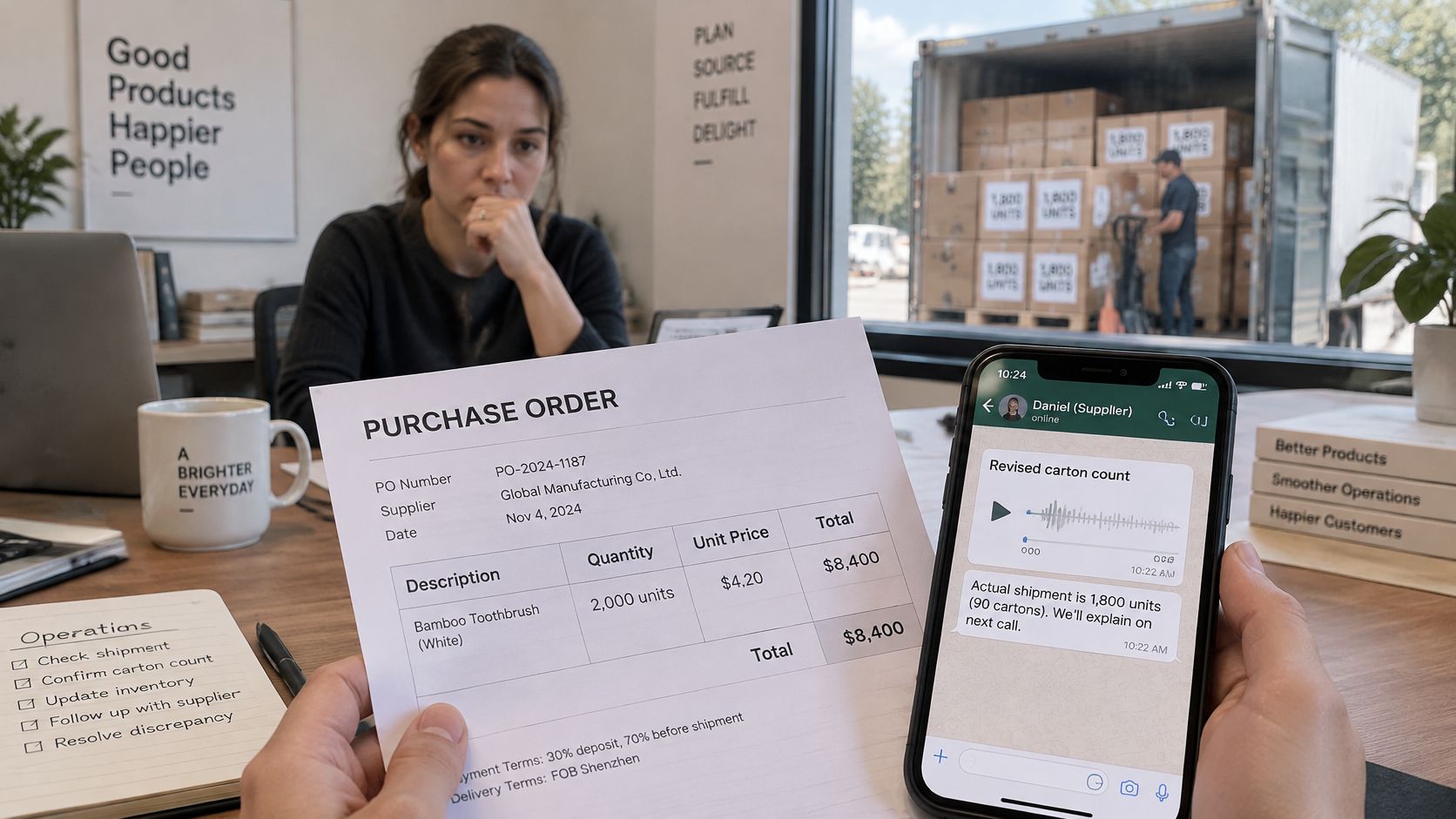
Take an illustrative $3M Shopify brand reordering 2,000 units at $4.20 each, an $8,400 purchase order. The supplier confirms a revised carton count in a chat message, but the warehouse works from the earlier packing instructions. The wrong version ships, and the founder spends a week reconciling what was approved against what left the factory.
A supplier management platform is a shared workspace that holds supplier conversations, purchase-order versions, production milestones, documents, and per-SKU costs in one place. It links those records through purchase-order and SKU identifiers, so an update belongs to an order rather than to someone's phone.
It works like an airport control tower set against separate radio calls with each pilot. The calls still happen. The tower is what keeps them from contradicting each other.
<a id="a-shared-record-that-answers-a-cost-question"></a>
A shared record that answers a cost question
Before it organizes anyone's workflow, the platform answers a money question: what does this order cost, and what does a delay do to available cash? On an $8,400 PO, freight, duty, and a missed ship date are not bookkeeping details. They decide whether the reorder was worth placing at all.
Here is an illustrative scenario rather than a universal profile: a brand under $5M in revenue running with one operations person and no ERP, where a production date that slips two weeks ties up cash the business was counting on. Whether or not that describes your team, the records behind each order sit inside the broader e-commerce supply chain management process, so a tool that isolates supplier communication from purchasing and inbound stock solves only part of the problem.
The category is narrower than an ERP, which runs the whole business. It also differs from a freight forwarder, which arranges transport but does not hold your order history.
Practical signs a team has outgrown scattered tools:
- Supplier load: Three or more active suppliers generating competing follow-ups.
- Uncontrolled revisions: A PO changed in chat with no formal approval.
- Uncertain costs: The landed-cost figure is a guess made before payment is authorized.
These are screening rules, not universal thresholds. The deciding question is whether your team can reconstruct a single order, every version and every cost, without searching several tools.
<a id="the-six-core-features-and-the-problem-each-solves"></a>
The Six Core Features and the Problem Each Solves
Core features mapped to the problem each one solves
| Feature | Question It Answers | What Breaks Without It |
|---|---|---|
| PO control | Which quantity and price is the approved one? | Two versions of the same order ship |
| Supplier messaging | What did the parties agree, and where is it recorded? | Revisions live in personal chats |
| Production milestones | Is the run on schedule this week? | Delays surface only at pickup |
| Landed-cost engine | What will each SKU really cost delivered? | Margin is guessed after payment |
| Document storage | Where is the invoice for this shipment? | Customs and reconciliation stall |
| QC tracking | Did this batch pass, and what failed? | Defects are found by customers |
The table describes capabilities to test, not features every product automatically includes. A useful demo follows an actual order through each capability rather than showing disconnected dashboard screens.
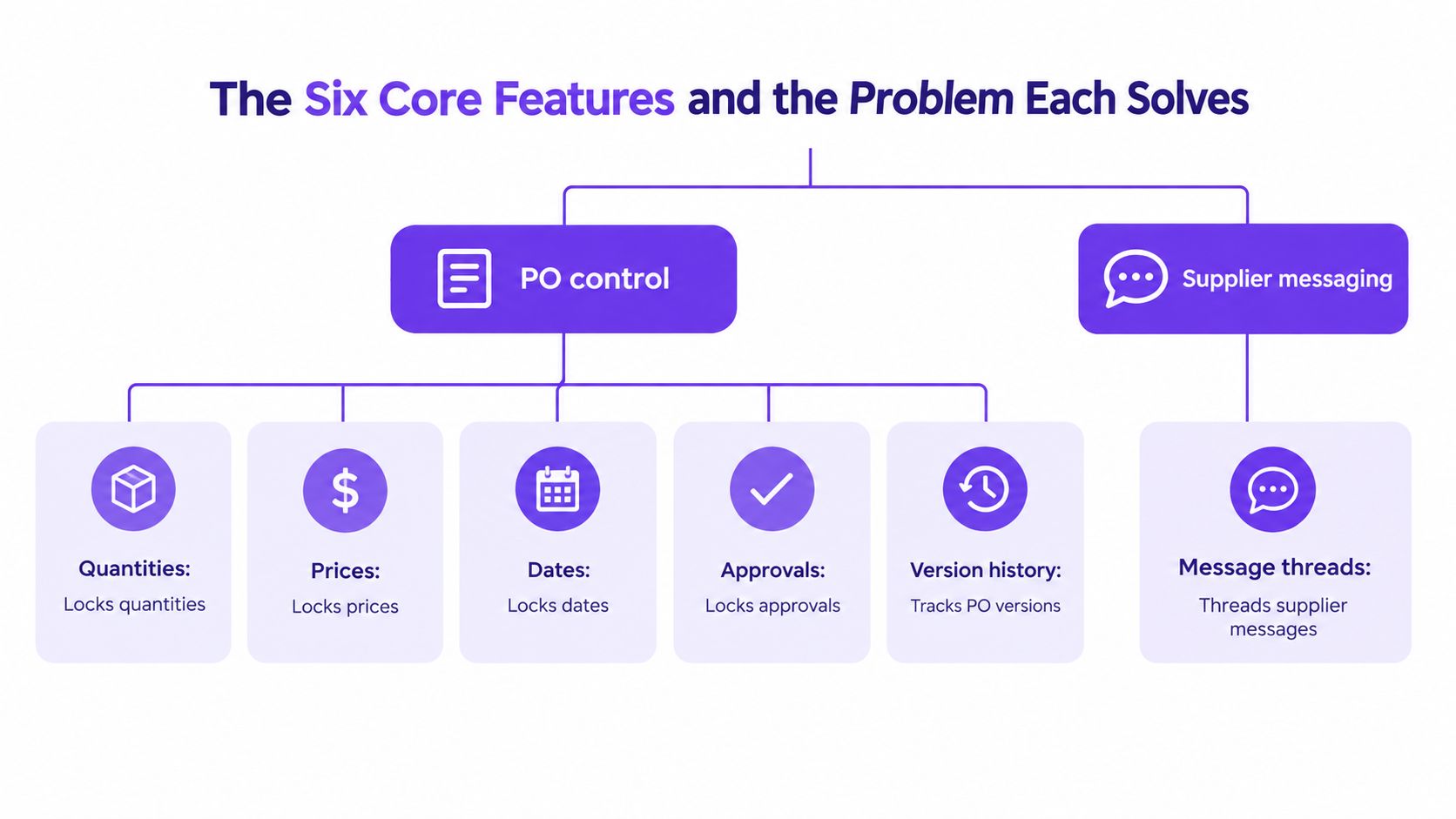
The diagram highlights the controls that should anchor the order record.
<a id="start-with-the-approved-order"></a>
Start with the approved order
PO control locks quantities, prices, dates, and approvals while preserving version history. If the buyer approves a smaller run, the supplier should see the current approved quantity without losing the original commitment.
Supplier messaging should attach the carton-count discussion to that PO. A voice note can start a conversation, but an approved change needs a structured record showing who accepted it and when.
Production milestones turn “production is progressing” into something checkable. Deposit, material check, pre-production sample, mid-production check, final inspection, and pickup booking should each have a dated status and named owner.
Research on buyer-supplier information visibility supports treating order status and production information as connected operational data rather than isolated messages.
<a id="connect-cost-evidence-and-release"></a>
Connect cost, evidence, and release
A landed-cost engine estimates delivered cost by SKU before shipment. For a kitchen gadget with a revised packaging specification, the buyer should be able to compare the updated product and shipping assumptions before approving the change.
Document storage keeps the commercial invoice, packing list, bill of lading, and certificates attached to the relevant shipment. The operator shouldn't need to identify the correct attachment by its download date.
For an illustrative 500-unit kitchen gadget run, QC photos taken at 80% completion might reveal the wrong lid colour before shipping. The value lies in recording the failed check, required correction, and release decision, not merely saving photographs.
PledgeBox's resource on managing supplier quality and backup plans provides additional reading for teams building those controls.
Practical rule: The PO is the parent record. Messages, milestones, costs, documents, and QC evidence should hang from it.
<a id="how-landed-cost-changes-which-supplier-is-cheapest"></a>
How Landed Cost Changes Which Supplier Is Cheapest
Two factories quote the same kitchen gadget. One offers $4.10 per unit, the other $4.25, and the cheaper quote looks obvious until the customs entry arrives with a duty bill nobody priced into the decision. That gap between factory quote and delivered cost is where supplier comparisons go wrong for brands under $5M.
Landed cost works like a restaurant bill. The FOB quote is the menu price, and duty, freight, insurance, and broker fees are the tax and service charges that appear at the end. The table below is a worked example for a $10,000 FOB order, not a freight quote or a statement of current tariff treatment.
Landed cost layers for a $10,000 FOB order
| Cost Layer | Example Amount | How It Is Calculated |
|---|---|---|
| Product (FOB) | $10,000 | Supplier PO value |
| Section 301 additional duty | $1,500 | Assumed 15% of $10,000 customs value (the example assumes goods of Chinese origin) |
| Ordinary duty | Classification-dependent | Depends on HTS code and origin |
| Ocean freight, pro-rated | Shipment-dependent | Allocated container share, illustrative |
| Insurance | $60 | Illustrative premium |
| Customs brokerage and entry | $250 | Illustrative flat fee |
| Total before ordinary duty and freight | $11,810 | Sum of known example layers |
Section 301 duties apply to goods of Chinese origin, so the $1,500 line exists only because this example assumes a China-origin shipment. A supplier manufacturing the same product in a different country would produce a different duty line even at an identical FOB price.
The factory quote is only the opening layer. The subtotal still excludes ordinary duty and freight, so treating $11,810 as the delivered cost understates the purchase.
For US-based Amazon FBA and Shopify importers, Section 301 exposure belongs in SKU economics. The calculation needs the HTS classification, customs value, country of origin, and entry date, with the rate confirmed for the actual shipment rather than copied from an old purchase order. Section 301 rates and product coverage have shifted since the measures took effect, including increases that were announced and later modified, so any percentage pulled from an older article or a past entry is a planning figure rather than a current rate. A customs broker should validate the applicable treatment before the PO is signed.
<a id="compare-the-delivered-alternatives"></a>
Compare the delivered alternatives
Consider an illustrative comparison:
- Factory A: Quotes $4.10 per unit, but lands at $5.40 after air freight and duty.
- Factory B: Quotes $4.25 per unit, but lands at $5.05 using ocean freight.
Factory B wins on delivered cost despite the higher product quote. That math only holds if the sailing schedule supports the replenishment date, because slower transit also stretches the cash cycle. Ordering four months of stock to capture a lower unit cost can leave a sub-$5M brand with cash sitting in aging inventory at a 3PL while storage charges accrue. A cheaper unit that takes twice as long to sell through is not always the cheaper decision.
The buyer should compare order quantities, payment timing, and expected sell-through alongside the unit number.
The distinction between estimated and actual landed cost matters here. Estimated landed cost supports the purchase decision; reconciled landed cost incorporates the customs entry and final invoices. The platform should show the variance between them so the next quote comparison starts from real numbers rather than assumptions.
For preliminary transport comparisons, teams can plan shipping expenses using Material Handling USA's calculator, then replace planning assumptions with shipment-specific quotes.
A cheaper supplier is only cheaper after the buyer compares equivalent delivered scenarios, in dollars, on the same timeline.
<a id="platform-vs-spreadsheets-whatsapp-and-freight-forwarders"></a>
Platform vs Spreadsheets, WhatsApp and Freight Forwarders
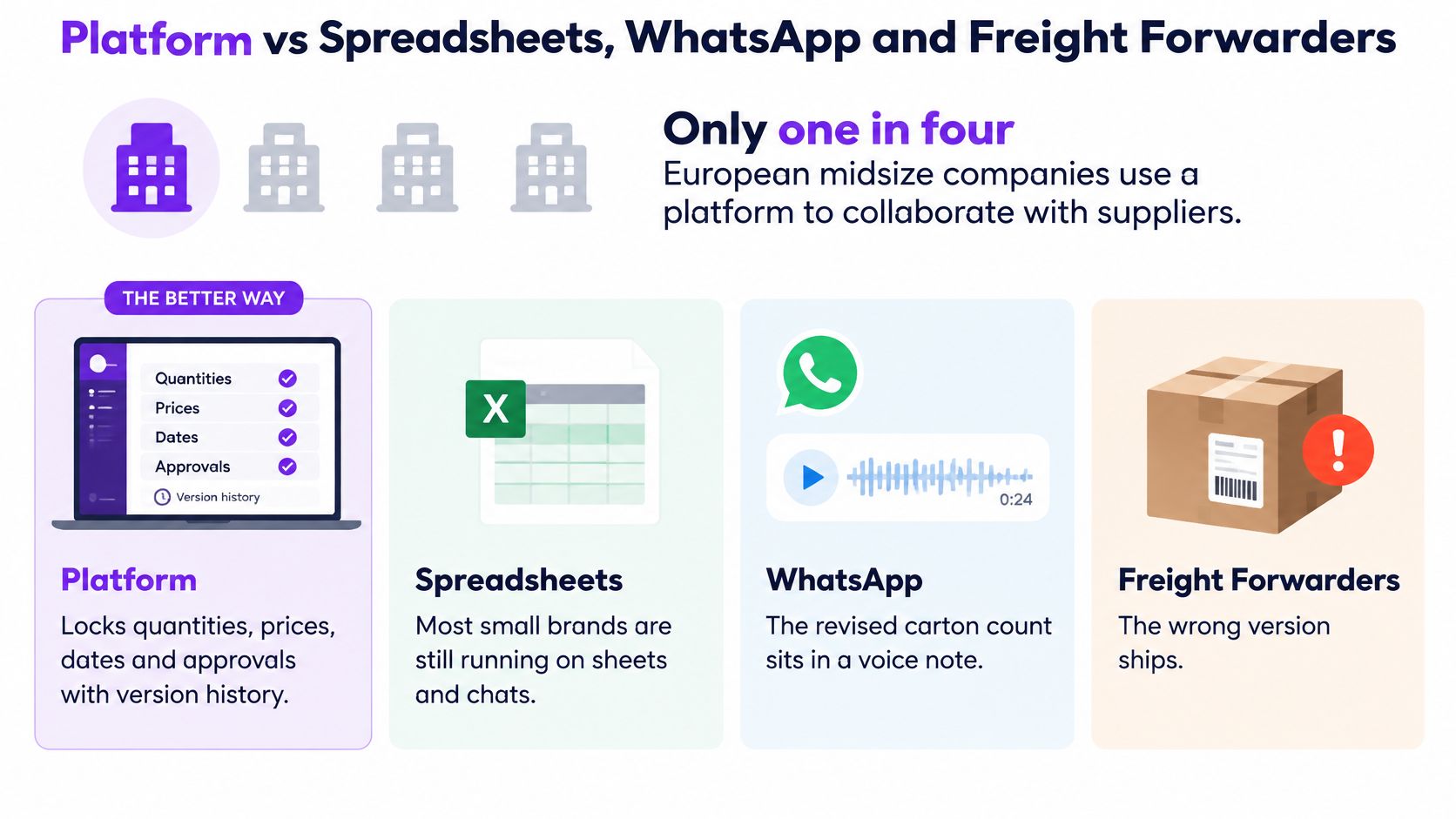
In 2025, only one in four European midsize companies surveyed by BME, ESB Business School, and Onventis reported using a supplier collaboration platform, according to the Procurement Barometer findings. That illustrates an adoption gap in the surveyed group, not a measured adoption rate for small e-commerce brands.
Supplier tools compared on the criteria that matter
| Criterion | Spreadsheet | Freight Forwarder | Supplier Platform | |
|---|---|---|---|---|
| Single record per PO and SKU | Manual, breaks when copied | No structured record | Shipment-level focus | One PO record, if supported |
| PO version history | Manual file names | No formal approval history | Not normally their role | Versioned changes with timestamps |
| Supplier messages tied to POs | Not inherently | Mixed across conversations | Limited to service scope | Threaded per PO |
| Production milestones | Manual rows | Ask in chat | Usually outside scope | Dated fields with owners |
| Landed cost by SKU | Formulas the team maintains | None | Freight and related service lines | Built-in engine, if included |
| Document and QC storage | Linked folders | Chat attachments | Shipping documents | Attached to PO |
| Monthly cost | Near zero at basic usage | Free at basic usage | Quote and service-dependent | Subscription and plan-dependent |
The comparison below captures the difference between communication tools and controlled order records.
<a id="choose-by-the-work-that-needs-controlling"></a>
Choose by the work that needs controlling
A spreadsheet can be enough for a single supplier, a small catalogue, and infrequent orders. Its weakness isn't the grid itself; it's the discipline required to maintain approvals, attachments, and current assumptions.
WhatsApp works for quick questions. It shouldn't become the only record of an approved revision, and the same principle applies when managing supplier orders over WeChat.
A freight forwarder handles transport within the agreed service scope. Some offer broader services, but buyers shouldn't assume the forwarder owns factory approvals, pre-shipment SKU economics, or warehouse allocation.
- Keep the spreadsheet when the team can maintain an accurate record without repeated reconciliation.
- Keep messaging for conversation, while recording binding changes against the PO.
- Keep the forwarder and 3PL for their operational roles; a supplier platform should sit alongside them.
<a id="keep-location-detail-visible"></a>
Keep location detail visible
Shopify allows products to be stocked across merchant and custom fulfillment locations, as explained in its fulfillment documentation. A DTC brand might hold fast-moving stock at a 3PL and reserve inventory in its own warehouse.
A suitable platform should connect inbound orders to those destinations while preserving the location breakdown. A single total without location detail could still send replenishment to the wrong warehouse.
The switch point is therefore operational: repeated revisions outside the order record, competing supplier follow-ups, or a landed-cost figure the buyer can't defend.
<a id="buyer-checklist-before-you-pay-for-a-platform"></a>
Buyer Checklist Before You Pay for a Platform
Bring one open purchase order to the demo, with sensitive details removed, and ask the vendor to run it live. A rehearsed demo works like a staged photo of an apartment: everything looks tidy because nobody has cooked in the kitchen yet. The question that matters is whether the platform shows where your money sits at each step, cash committed on the PO, duty still estimated, and stock slowly aging on a shelf.
Score each capability the same way: 0 means absent, 1 means partial or manual, and 2 means demonstrated on your order. Use the totals to compare vendors side by side.
- PO versioning. The demo shows timestamps, previous values, and a named approver.
- Order-linked messages. A supplier conversation stays attached to its PO instead of sitting in a shared inbox.
- Dated milestones. Each production stage carries an owner and a due date, so a slip shows a visible age.
- SKU-level landed cost. The calculation includes duty, freight, insurance, and relevant fees.
- Estimated versus actual cost. The operator can compare the original landed-cost assumption with the reconciled result and see which units are aging in storage.
- Shipment documents. The commercial invoice, packing list, and carton count remain accessible together.
- QC evidence. Photos, inspection findings, and pass/fail decisions connect to the relevant batch.
- Portable data. CSV export or an API keeps the workspace from becoming another closed silo.
- Partner compatibility. The workflow accommodates your current forwarder and 3PL.
- Onboarding requirements. The vendor explains setup work, supplier participation, and any IT dependency.
- Commercial terms. You receive the trial conditions and the complete monthly price, including per-user charges.
<a id="score-evidence-not-promises"></a>
Score evidence, not promises
A supplier evaluation matrix keeps the assessment consistent across vendors, and a feature earns full credit only when someone performs the task on a realistic order.
For the publisher's stated offer, the commercial reference is $99 per month after a 30-day free trial, with no credit card. Treat any vendor statement about setup speed or IT requirements the same way you treat a feature claim: ask for a live walkthrough of onboarding during the demo, and confirm the price and trial terms before subscribing.
- Proposed pass mark: A score below 15 out of 22 means the shortlist needs more work.
- Cost warning: If the demo cannot produce a landed-cost figure you can defend, you are buying a login, not visibility.
- Data warning: No usable export creates avoidable dependence.
- Pricing warning: Hidden per-user charges undermine a simple subscription comparison.
- Trial warning: No practical trial leaves adoption untested.
<a id="roi-examples-for-a-sub-5m-brand"></a>
ROI Examples for a Sub-$5M Brand
At an illustrative subscription of $99 per month, annual platform cost is $1,188. Treat the examples below as planning math and label them as assumptions in your model: each line has to tie to a decision the buyer can change.
Use the platform first as a light over the numbers. It shows which PO is late, which cartons are aging, and which duty or freight assumption is off early enough for a founder to act.
Illustrative annual cash examples
| Scenario | Example inputs | Cash effect if the decision changes |
|---|---|---|
| Late milestone caught 10 days early | One avoided $1,900 air-freight upgrade during the year | $1,900 |
| Landed-cost or duty error caught before PO | $0.40 per unit across 5,000 units in an annual purchase | $2,000 |
| Aged stock reduced by 1,000 units | A planning estimate of $3.60 per aged unit for the year, using the brand's own storage and markdown exposure | $3,600 |
Against $1,188, even one clean save can cover the subscription. The stronger case comes from seeing cost early: a late PO becomes an air-freight decision, a duty line becomes a margin decision, and old stock becomes a cash decision before the warehouse bill arrives.
<a id="keep-capacity-value-separate"></a>
Keep capacity value separate
Saved administrative time belongs in a different column. Six hours a week at $30 per hour across 52 weeks is $9,360 of capacity value, useful for buying, QC follow-up, or demand planning. It reduces payroll only if the business removes paid hours or avoids a planned hire.
A buyer should also ask what those recovered hours are worth in the coming quarter. If they prevent a rushed reorder or give the founder time to negotiate freight, the value can be real. If the hours disappear into a busier week, they should stay out of the cash case.
ROI check: Count only benefits the team can connect to a changed decision, avoided expense, or documented reduction in work.
Marketplace storage and aged-inventory fees change, and surcharge rules can depend on account history, size tier, volume, and sell-through. Before replenishing, check the current fee schedule inside the seller account and run the unit count against expected shipment velocity.
For a brand with one supplier and about 200 units annually, the subscription could produce negative ROI. A well-maintained spreadsheet may remain the sensible choice.
<a id="how-to-roll-out-a-platform-without-stalling-your-team"></a>
How to Roll Out a Platform Without Stalling Your Team
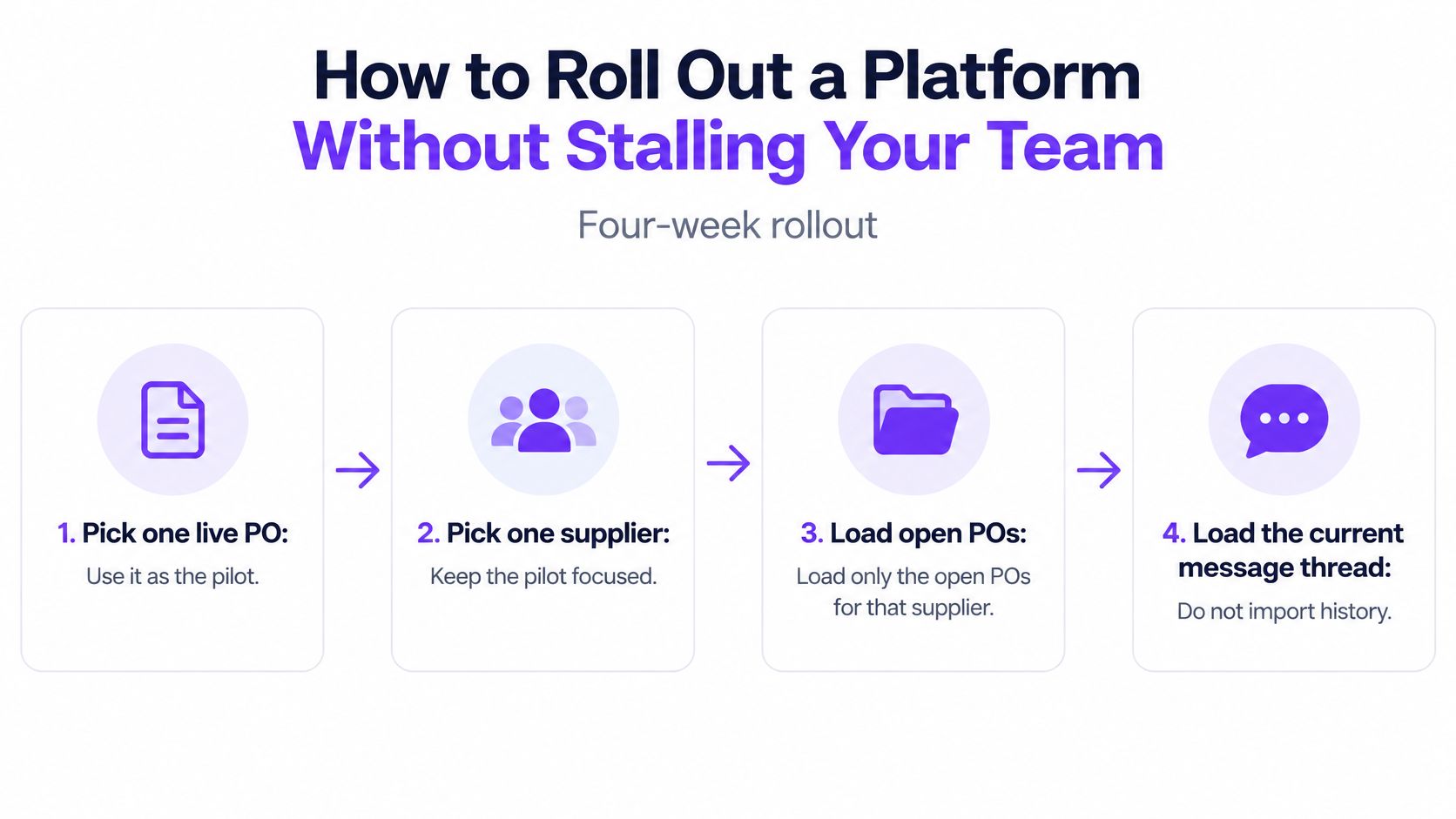
A proposed four-week rollout should prove that the team can operate a live order without rebuilding every historical record. The founder needs a controlled pilot, not a data-cleaning project that delays purchasing.
The opening pilot should stay deliberately narrow.
<a id="move-a-live-order-through-the-process"></a>
Move a live order through the process
- Select one live PO and one supplier. A cooperative supplier with an active production run gives the team a practical test of updates, approvals, and pickup readiness.
- Load only open orders and the current message thread for that supplier. Closed orders can remain in their existing archive; importing everything adds work without testing the new process.
- Agree on PO numbering and SKU identifiers. Purchasing, finance, the supplier, and logistics partners should refer to the same identifiers rather than inventing local names.
- Route new POs through the platform. Establish the new record as authoritative while leaving closed orders untouched.
- Assign dated milestones. Each stage needs a named owner responsible for obtaining evidence and escalating a missed commitment.
- Load landed cost for three SKUs. After the first shipment, compare those estimates with the actual invoices and customs records, then correct the assumptions.
- Give suppliers a one-page instruction. It should state where updates belong, how revisions receive approval, and which documents are required before release.
- Review at day 30 before adding a second supplier. Expansion should follow demonstrated use, not just completion of account setup.
A structured supplier onboarding process helps make these expectations clear without burying suppliers in a lengthy manual. The buyer should also verify legal identity and banking details through an established verification process before authorizing payment changes.
The accompanying video provides another format for reviewing the workflow.
<a id="fix-the-habits-that-undermine-the-rollout"></a>
Fix the habits that undermine the rollout
- Two competing systems: Running both as active approval records for more than a month creates ambiguity. Set a cutover date and name the authoritative record.
- Terms still changing in chat: Reply with the PO link and require the revision there before approval. Conversation can continue without becoming a separate contract history.
- Estimates entered as actuals: Label every cost assumption clearly and preserve the supporting invoice when it becomes final.
- Ownerless milestones: Assign one accountable person per stage, even when several people contribute.
- Supplier resistance: Walk through the one-page instruction on a call and ask the supplier to complete an update during the walkthrough.
The pilot should also test an exception, such as a delayed material check or revised carton count. A smooth order can conceal weak approval rules; a controlled exception reveals whether the team knows who must act.
<a id="measure-success-and-run-a-30-day-pilot"></a>
Measure Success and Run a 30-Day Pilot
A 30-day pilot needs targets you can count: revision location, warning lead time, cost variance, admin hours, and stockouts tied to PO timing. Treat the platform like a thermometer for landed cost first. If it cannot show where money leaked through late milestones, duty estimates, or aged cartons, cleaner messages will not pay for the subscription.
Set house targets before day one so nobody grades the test from memory. Use these as operating goals for the pilot period:
- Controlled revisions: More than 90% of PO revisions happen inside the platform.
- Earlier warnings: Late milestones are flagged seven or more days before the affected commitment.
- Cost accuracy: Estimated landed cost stays within 5% of the reconciled result.
- Less reconciliation: Administrative hours fall by at least a third against the starting baseline.
- Replenishment reliability: No stockout is attributable to a late PO during the observation period.
<a id="read-early-signals-differently-from-final-outcomes"></a>
Read early signals differently from final outcomes
At day 30, inspect revision share and warning lead time. Low numbers usually mean approvals still happen in chat, suppliers are unsure where to update milestones, or dates are being entered after the fact. At day 90, finance should compare estimated landed cost against two or more final invoices, while operations compares admin time with the week-one baseline.
A clean stockout record can mislead. If reserve inventory covered a late component, the platform may still have failed to warn early enough. Vendor reliability should be read from records, not tone. A checklist such as the Cobra DTF vendor evaluation guide can prompt questions, and the pass or fail evidence stays in your own POs: milestone dates met, revisions recorded before approval, and invoices matching estimates.
<a id="keep-the-exit-decision-honest"></a>
Keep the exit decision honest
Use the trial window for a practical test: the top supplier, one open PO, three milestones with named owners, and a landed-cost estimate compared with the next invoice. Missed signals point first to setup and working habits. Reconsider product fit when required controls are missing or too hard to use.
If the pilot does not help, a spreadsheet remains valid. Give it one version rule and one PO log.
Supply Automate offers e-commerce brands a shared workspace for supplier messages, purchase-order version control, production milestones, and SKU-level landed-cost estimates. Founders can visit Supply Automate to start with a live supplier order and test whether clearer cost and commitment records improve the next purchasing decision.