
Most "best accounts payable automation software" pages rank Medius, Tipalti, BILL, and an ERP connector.
If you import for Amazon FBA or Shopify, that list is a real category, and it is usually the wrong first buy.
Those products pay bills.
An importer's harder question is whether the bill belongs to the purchase order, the container, and the SKU that has to carry freight and duty.
Skip the fake #1 ranking.
Use this to tell what AP automation means for an importing brand, when email and a spreadsheet break, and which kind of system to trial.
If you only need to read a PDF into fields, start with invoice processing software.
That guide covers capture and OCR.
Stay here for invoice-to-pay (approvals, matching, payments) plus the importer gap those suites leave open.
If Paid And Profitable Are Different Sentences
You import finished goods for Amazon FBA, Shopify, or both.
You pay factories, freight forwarders, and brokers on different clocks.
"The invoice is paid" and "this SKU is still profitable" are not the same sentence.
Vendors are selling AP automation, invoice OCR, and supply-chain software as if they were the same product.
Skip the mid-market AP suite if you do not have a finance team, an ERP, or a volume of non-PO invoices that need routing.
Those tools solve a real problem.
It is rarely the first problem a growing importer has.
What AP Automation Means, And What It Does Not
Accounts payable automation is invoice-to-pay: capture the bill, match it, route approval, pay it, and leave an audit trail in accounting.
For a mid-market finance team, that is the job.
The objects are the vendor, the invoice, the approval chain, and the payment.
For an importing e-commerce brand, the invoice is one document in a longer record.
The PO said 2,000 units at $6.40.
The commercial invoice may say something else.
The freight bill arrives three weeks later.
Duty and brokerage land after that.
FBA receiving or Shopify available qty may not match the packing list.
Paying the factory on Net 30 is not the same as knowing what the goods cost or when they become sellable.
An AP suite can close the bill and still leave margin wrong.
Invoice processing is the capture slice: OCR, email inbox, field extraction.
See that comparison if the pain is typing PDFs.
AP automation is the control slice: match, approve, pay.
Supply-chain software is the purchase slice: PO, shipment, landed cost.
Importers often need the third before they need a polished second.
When Email And The Spreadsheet Stop Working
A shared inbox and a bill-pay spreadsheet are the right first system.
Cheap.
Honest about what you do not know yet.
They hold while one person pays the bills, you have a handful of suppliers, invoices match the PO, and freight is predictable.
The day a revised commercial invoice shares a number with the one you already paid, you are already late.
The usual collapse is not a missed ACH.
The factory invoice is a PDF in email.
The PO lives in a sheet, or in WeChat.
The freight invoice arrives after the bill was already paid.
Someone approves from their phone without opening the packing list.
The next reorder is priced on the factory quote, not the landed cost.
That is a record problem.
Organizing supplier invoices is the filing version.
Stay here for the systems version: which tool owns the bill, and which tool owns the purchase behind it.
Keep the templates until a system has earned the right to replace them.
A neglected AP app is worse than a dated sheet everyone still opens.
The Bill Was Paid. The SKU Was Wrong.
A Shopify + FBA seller reorders 2,000 units of a $6.40 factory SKU.
The commercial invoice is $12,800.
They pay it on Net 30 from the email PDF.
AP is "done."
Three weeks later the rest of the purchase shows up:
| Line | Amount |
|---|---|
| Factory invoice (already paid) | $12,800 |
| Ocean freight (revised after booking) | $3,050, not the $2,200 in the sheet |
| Duty and brokerage | $1,140 |
| Trucking + FBA inbound prep | $860 |
| Sellable units received | 1,970 (30 units failed inspection) |
Landed cost on the number they used to price the listing:
- ($12,800 + $2,200) / 2,000 = $7.50
Landed cost after the documents are complete:
- ($12,800 + $3,050 + $1,140 + $860) / 1,970 = $9.06
The AP tool did its job.
The invoice was captured, approved, and paid.
Nobody allocated freight and duty, and nobody reduced the unit count.
If contribution after ads was planned on $7.50, every unit is $1.56 light.
On a 2,000-unit cadence that is about $3,120 of missing cost per order.
Run the same shipment through the landed cost calculator.
If you cannot reconstruct the $9.06 from the documents you already have, you do not have AP connected to the purchase.
You have bill pay.
What A Real AP Product Has To Cover
Score invoice-to-pay first.
Then add the checks an importer actually loses money on.
Capture
Invoices have to enter from email, a PDF upload, or a supplier portal.
Extraction helps.
A human still has to confirm vendor, currency, invoice number, and which PO the bill belongs to.
Duplicate and revised invoices are the usual failure, not the clean demo PDF.
PO Match
Two-way match (invoice vs PO) is the minimum.
Three-way match (invoice, PO, and receipt) is better when you actually receive against the order.
The match is only as good as the purchase order.
If the PO is an email, the AP tool is matching against air.
Approvals
Someone who did not enter the bill has to release payment.
Amount thresholds, vendor rules, and a pause when price or quantity differs from the PO are the useful parts.
A Slack "looks fine" is not an approval trail.
Payments
ACH, wires, cards, or the rails your factories actually take.
Payment status has to write back to the invoice and to accounting.
Paying from a separate bank portal and typing "paid" in a sheet is how duplicates happen.
Multi-Currency
Factory invoices, freight, and duty often arrive in different currencies.
You need the invoice currency, the payment currency, and a rate you can explain at month-end.
Not a silent conversion.
Audit
Who captured, changed, approved, and paid.
The original file stays attached.
If a bank detail changes, that should be louder than a line-item edit.
The Importer Extras AP Suites Often Skip
Freight, duty, and brokerage have to attach to the same purchase as the factory invoice.
Shared charges allocate to SKUs, and estimates get replaced when the actual bill arrives.
A short or failed inspection changes the unit cost, not just the inventory count.
Net 30 is visible against the date goods become sellable, not only against the invoice date.
Those extras are why supplier management software and supply chain management software sit next to AP, not inside it.
Score The Trial, Not The Demo
Do not buy from a ranked list.
Take two or three products.
Run the same factory invoice, the same freight invoice, the same PO, and one bill that did not match.
Use 0-5.
Write down what you saw.
Not what the deck claimed.
| Criterion | Weight | What "5" looks like | What "1" looks like |
|---|---|---|---|
| Capture and duplicates | 15% | Email/PDF in; revised invoices are obvious | Someone still types the header |
| PO match | 20% | Price/qty exceptions stop payment | Match is a checkbox on a header total |
| Approvals | 15% | Separation of duties, amount rules, an audit trail | One person enters and pays |
| Payments and reconciliation | 15% | Payment status writes back to the bill and the ledger | Paid in the bank, pending in the tool |
| Multi-currency | 10% | Invoice currency, payment currency, and a rate you can explain | Everything forced to USD |
| Audit / vendor controls | 10% | Bank-detail changes and duplicates are loud | Files live in Drive with hopeful names |
| Importer cost context | 10% | Freight and duty land on the same purchase / SKU | Factory invoice only |
| Time to value | 5% | A three-person team can run it this month | You need a consultant to create a vendor |
Weighted score = sum(score × weight).
A 4.4 on an enterprise AP suite and a 4.0 on an importer tool are not comparable if you cannot implement the 4.4.
That last row exists so a nine-month ERP project loses to something you can run next week.
Two people should score independently.
If you disagree on "PO match," you did not run the same invoice.
Six Places To Look, Not A #1 Trophy
These are category judgments from how the products are sold and used.
Not a lab test of every AP vendor.
Pricing is omitted on purpose.
Ask for it against your invoice volume, entities, and payment rails.
If a vendor will not show the workflow with your documents, treat the claim as unproven.
SupplyAutomate is on this list as the adjacent system for importer context.
It is not the best accounts payable automation product.
Ranking it #1 for invoice-to-pay would be a category error.
Mid-Market AP Suites (Medius And Peers) When Finance Owns Invoice-To-Pay
This is what most "AP automation vendors" searches mean.
Medius and peers treat the invoice as the object: extract it, store the original, match lines, route exceptions, pay, and keep the ERP in sync.
Several entities, a controller who will not accept a sidecar spreadsheet as the AP record: start here.
This is more system than a three-person import brand needs.
Setup still requires clean vendors, clear approval rules, and an ERP plan.
AI extraction will not fix a chart of accounts nobody owns.
Product-level landed cost for a mixed container is not why these suites exist unless you build it.
Global Supplier Payments (Tipalti) When The Fire Is The Wire
Tipalti is sold as mass-pay and supplier onboarding, not as a purchasing system.
If the fire is "we wire factories, freelancers, and marketplace partners from three portals," a global payments layer is the right shape.
Invoice capture and approval exist in this category.
The differentiator is the payment rail.
Paying in many currencies is not purchase-order tracking.
Confirm country coverage, tax forms, entity controls, and what writes back to your ledger.
A brand can be excellent at cross-border payouts and still reorder on the factory quote.
SMB Bill Pay (BILL) When You Already Live In QuickBooks Or Xero
BILL is the default "just pay the bills" answer for a lot of SMBs.
Invoices arrive by email, one or two people approve them, payment records land in accounting.
Honest first AP buy.
Usually the one you make before anyone says "automation platform."
Bill pay is not import execution.
Do not expect supplier production status, container tracking, or SKU landed cost.
If the harder question is why inventory cost keeps moving, you are in the wrong aisle.
Approval Layers (ApprovalMax) When The Leak Is "Who Signed This?"
ApprovalMax is a narrow, clear product: multi-step approval routing on top of Xero or QuickBooks.
One person enters, another checks the purchase, a third releases payment.
That is a real control gap.
It is not a full AP suite.
Approval will not tell you a shipment is late or what freight did to the SKU.
Complex multi-entity ERP needs belong in the Medius row.
Confirm how exceptions and vendor bank changes fit the workflow you already have.
Invoice Capture / OCR When The Bottleneck Is Typing PDFs
Capture is not AP automation.
It is the query a lot of "invoice processing" searches actually mean.
Extraction APIs and inbox readers can feed BILL, an ERP, or a sheet.
A parsed PDF is not a matched PO and not a payment.
If this is the job, use the invoice processing software guide.
Do not buy a capture tool and expect landed cost.
SupplyAutomate For The Purchase Behind The Invoice: Not Invoice-To-Pay
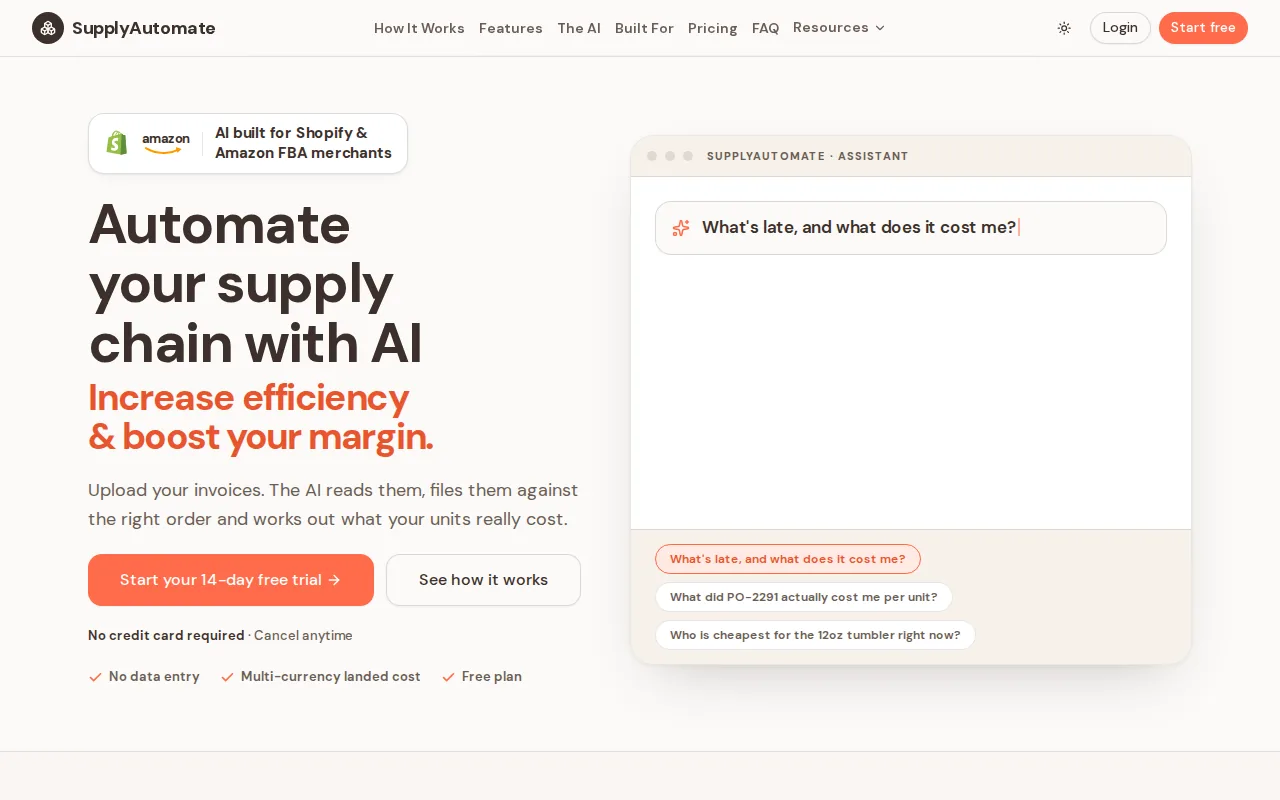
SupplyAutomate is supply chain software for importers, not a general-purpose AP suite.
Upload the commercial invoice, packing list, and freight bill.
Match them to the PO.
See what the SKU cost and what is still late.
That is the context AP tools skip.
It is a fair first trial if your daily questions are "what moved?" and "what did it really cost?", including when the factory invoice was already paid.
It is not Medius.
It is not Tipalti.
Multi-entity invoice approval inside SAP, or mass-pay across 200 countries: pick the category that does that.
You still need clean SKUs and honest dates.
The tool will not invent a freight allocation you never recorded.
Start with one recent PO and its documents.
Not a catalog import.
How Those Categories Score If You Import
Judgments against the framework above.
Not lab benchmarks.
Adjust them after your own trial.
| Criterion | Medius-class AP | Tipalti-class pay | BILL-class SMB | ApprovalMax-class | Capture / OCR | SupplyAutomate |
|---|---|---|---|---|---|---|
| Capture and duplicates | Strong | Strong | Partial to strong | Partial | Strong | Partial to strong |
| PO match | Strong | Partial | Partial | Partial | Weak | Strong on the purchase, not AP 3-way |
| Approvals | Strong | Strong | Partial to strong | Strong | Weak | Partial |
| Payments and reconciliation | Strong | Strong | Strong | Weak (accounting pays) | Weak | Weak: not a payment rail |
| Multi-currency | Strong | Strong | Partial | Partial | Partial | Partial to strong on cost records |
| Audit / vendor controls | Strong | Strong | Partial | Strong | Weak | Partial |
| Importer cost context | Weak for this job | Weak for this job | Weak | Weak | Weak | Strong |
| Time to value for a small import team | Weak | Medium | Strong | Strong if Xero/QB | Strong | Strong |
"Partial" means the category can store the data if you build around it.
It does not mean that workflow is the default.
The useful pattern for a growing importer is often two systems, not one trophy: an AP or bill-pay tool for release and payment, and a supply-chain record for the PO and landed cost.
Do not force one product to fake the other job.
A One-Week Trial With Your Own Files
Do not use the vendor's sample invoice.
Pick one high-volume SKU you sell on FBA, Shopify, or both.
Take the last closed PO, the commercial invoice, the packing list, the freight invoice, and the duty or brokerage bill.
Enter or capture the factory invoice as it actually arrived, including the first due date.
Try to match it to the PO.
Note every exception.
Attach the freight and duty bills to the same purchase.
Produce a landed cost per sellable unit.
Walk one approval and one payment (or a payment sandbox) through to the ledger.
Compare the SKU cost the AP tool leaves you with to the landed cost calculator.
It passes if a second person can reconstruct who approved what and which PO the bill belongs to, a price or quantity miss would have stopped payment, and you can explain freight and duty on the SKU, not only the factory total.
It fails if you still need the spreadsheet to trust the unit cost, payment status and the bank disagree, or the only automation on offer does not touch the exception that wastes your week.
FAQ
What Is Accounts Payable Automation Software?
Software that turns invoice-to-pay into a defined workflow: capture the bill, match it to a PO or contract, route approval, pay, and write the result back to accounting.
OCR is optional.
Matching, approvals, duplicate checks, and payment controls are the part that removes work.
What Is The Best Accounts Payable Automation Software For E-Commerce?
There is not one winner.
If you are a mid-market brand with an ERP and a real AP queue, a Medius-class suite is the honest AP buy.
If you pay factories and contractors across countries, look at Tipalti-class mass-pay.
If you are an SMB on QuickBooks or Xero, BILL or an ApprovalMax-class layer is usually enough.
If you import for FBA or Shopify and the loss is landed cost, not a missed approval, trial SupplyAutomate for the purchase record and keep a real AP tool for payment.
How Do I Compare AP Automation Vendors?
Use the scoring table, not a logo wall.
Bring one messy invoice, one clean invoice, and one freight bill.
Ask each vendor to show capture, the exception path, payment, and what lands in the ledger.
"Accounts payable automation software comparison" queries rank pages that list features.
The useful comparison is which exception you still handle in email.
What Is The Best AP Automation Software For Small Business?
The smallest honest stack is bill pay next to the accounting system you already have (BILL or a Xero/QuickBooks approval layer), plus a way to file invoices against POs.
You do not need an enterprise AP platform to stop paying from a shared inbox.
You do need a rule that the person who enters the bill is not the only person who can release it.
Does ApprovalMax Replace AP Automation?
No.
ApprovalMax (and similar tools) add approval routing on Xero or QuickBooks.
That is a real control gap for SMBs.
It is not capture, PO match, global payments, or landed cost.
If approvals are the fire, start there.
If the fire is a freight bill that never reached the SKU, you need a different category.
Can E-Commerce Brands Automate Supplier Payments?
Yes.
The payment rail is the easy part.
The hard part is knowing the payment is for the right PO, in the right currency, against the right quantity, before goods are sellable.
Automating the wire without the match just pays mistakes faster.
Net 30 still starts on the invoice date, not the FBA receive date.
Is This The Same As Invoice Processing Software?
No.
Invoice processing is capture: reading the PDF.
AP automation is the rest of invoice-to-pay.
This page also covers the importer gap (PO, freight, duty, SKU cost) that neither capture nor classic AP owns by default.
How Much Does AP Automation Software Cost?
It depends on invoice volume, users, entities, payment volume, and whether implementation is a project.
SMB bill-pay is usually a subscription plus payment fees.
Mid-market AP and global mass-pay are quoted.
Treat any public "average AP software price" as a different market.
Ask against your invoice count and your payment rails.
No price in this article is a quote.
A paid factory invoice is not the same as a finished SKU cost.
Capture, approvals, and payment belong in an AP suite.
The PO, the documents, and the unit cost do not.
SupplyAutomate will not replace Medius, Tipalti, or BILL.
It will keep the shipment those tools never see.
The landed cost calculator is a quick check on that last inbound.